









Learning how to reduce medical claim denials is important for healthcare practices that want to improve billing accuracy, minimize administrative work, and maintain a more predictable revenue cycle. When insurance companies deny claims, practices may experience delayed payments, additional paperwork, and increased pressure on billing staff.
Understanding how to reduce medical claim denials begins with identifying common causes, including incorrect patient information, insurance eligibility issues, coding errors, missing documentation, and authorization problems. By improving these processes, healthcare providers can address many preventable billing issues before they become recurring problems.
This guide explains 10 powerful strategies for how to reduce medical claim denials, improve claim management, and strengthen revenue cycle workflows.
What Are Medical Claim Denials?
A medical claim denial occurs when an insurance payer refuses to pay all or part of a submitted healthcare claim. Reasons may include coverage limitations, coding errors, missing documentation, authorization requirements, or other billing issues.
A rejected claim is generally returned before full processing because of a submission or data problem. A denied claim has typically been processed by the payer and determined not payable in whole or in part. Terminology can vary between payers.
Understanding this distinction helps billing teams determine whether to correct claim information, submit additional documentation, or appeal a payer’s decision.
Why Do Medical Claim Denials Happen?
Before learning how to reduce medical claim denials, practices should identify the reasons claims are not being paid as expected.
Common causes include:
- Incorrect patient demographics or insurance details
- Inactive insurance coverage
- Missing prior authorizations or referrals
- Incorrect diagnosis or procedure codes
- Incomplete clinical documentation
- Duplicate claim submissions
- Missed filing deadlines
- Provider identification errors
- Services excluded from the patient’s insurance plan
- Failure to follow payer-specific billing requirements
The most frequent denial reasons vary by practice and payer. Reviewing your own claim data is the best starting point for identifying preventable issues.
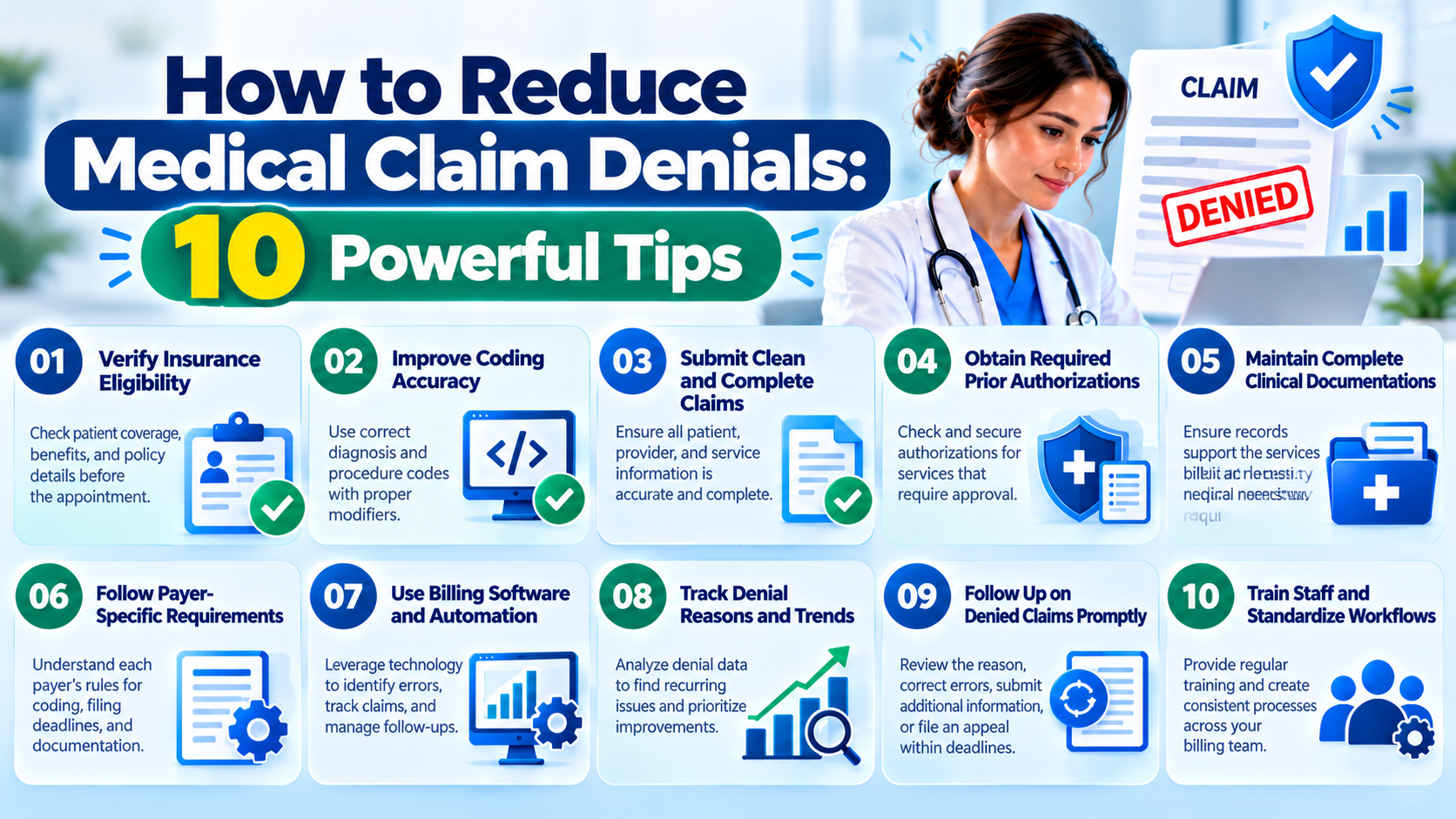
10 Powerful Tips on How to Reduce Medical Claim Denials
1. Verify Insurance Eligibility Before Appointments
Insurance eligibility verification helps staff identify potential coverage issues before services are provided. Because coverage and benefits can change, practices should verify insurance information as close to the appointment as practical.
Confirm these details:
- Active insurance coverage
- Member ID and policy information
- Benefits and coverage limitations
- Copayments, coinsurance, and deductibles
- Referral and authorization requirements
- Payer-specific requirements for the planned service
Eligibility verification does not guarantee payment. Reimbursement may still depend on the service provided, medical necessity, documentation, and plan terms.
A consistent verification process is an important first step in how to reduce medical claim denials and avoid preventable billing problems.
2. Improve Medical Coding Accuracy
Coding errors can cause claim denials, payment delays, and additional administrative work. Billing teams should use current coding guidance and ensure that submitted codes accurately reflect the services documented.
To improve coding accuracy:
- Verify diagnosis and procedure codes.
- Review applicable coding guidelines.
- Check relevant modifiers and code requirements.
- Ensure clinical documentation supports the codes billed.
- Train staff when coding requirements change.
- Refer complex cases to qualified coding professionals.
Codes must accurately reflect the services provided and the supporting documentation. They should never be selected simply because they are more likely to receive payment.
For official Medicare billing guidance, consult the CMS Medicare Claims Processing resources.
3. Submit Clean and Complete Claims
Incomplete or inaccurate claim information can delay processing and create unnecessary follow-up work. A standardized review process helps staff identify errors before submission.
Review the following details:
- Patient demographics and insurance information
- Provider identification details
- Dates of service
- Diagnosis and procedure codes
- Required modifiers
- Place of service
- Supporting documentation
Use available billing software validation tools to identify missing fields or inconsistencies. Staff should review flagged issues and correct genuine errors before submitting the claim.
Accurate claim preparation is a practical way to reduce medical claim denials caused by preventable administrative mistakes.
4. Obtain Required Prior Authorizations
Some services require prior authorization or a referral under the patient’s insurance plan. Missing or incorrect authorization details can lead to denied claims.
Establish a clear process to check authorization requirements before the appointment or procedure.
Your process should identify:
- Services that may require authorization
- Staff responsible for obtaining approval
- Approved service details and dates
- Limitations attached to the approval
- Where authorization information is recorded
- How changes to the planned service are handled
Requirements vary by payer and plan, so verify current rules rather than relying on assumptions or previous approvals.
5. Maintain Complete Clinical Documentation
Clinical documentation should accurately support the services billed. Missing, unclear, or inconsistent records may create problems during claim review and medical necessity assessments.
Practices can improve documentation by using suitable templates, completing records promptly, and establishing consistent review procedures.
Ensure that records accurately reflect the services provided and support the relevant diagnosis and billing information. When a payer requests additional records, submit the appropriate information through an approved, secure process.
Good documentation supports accurate billing, continuity of care, and effective denial management.
6. Follow Payer-Specific Billing Requirements
Different insurance companies may have different requirements for coding, authorization, documentation, filing deadlines, and claim submission. Applying identical assumptions to every payer can cause avoidable errors.
Maintain an accessible reference guide for your major payers and update it when requirements change.
Track details such as:
- Claim filing deadlines
- Authorization and referral rules
- Documentation requirements
- Coding and modifier guidance
- Electronic claim submission procedures
- Appeal instructions and deadlines
Assign responsibility for reviewing payer updates and communicating relevant changes to billing staff. Understanding payer-specific rules is essential to reducing avoidable claim problems.

7. Use Medical Billing Software and Automation
Medical billing software can help organize claims, identify missing information, track submission status, and manage follow-up tasks. Some platforms also use artificial intelligence to flag potential errors or identify recurring denial patterns.
When evaluating software, consider whether it integrates with your electronic health record, supports your existing workflows, and provides useful reporting.
Automation can support efforts to reduce medical claim denials, but it cannot prevent every billing issue. Staff should verify automated alerts and ensure that corrections are appropriate.
Explore our medical billing and practice management services to learn more about support for healthcare billing operations.
You can also read our related guide to AI in medical billing to explore technology-assisted billing workflows.
8. Track Denial Reasons and Identify Trends
Correcting individual claims is important, but practices should also investigate why denials occur repeatedly.
Organize denial information by reason, payer, provider, service type, or workflow stage. This helps managers identify patterns and prioritize improvements.
Useful metrics include:
- Overall claim denial rate
- Most frequent denial reasons
- Denial rate by payer
- Appeal success rate
- Average time to resolve denials
- Total value of denied claims
- Amount recovered through corrections and appeals
Use consistent definitions when calculating these metrics. For example, determine whether your denial rate is based on claim counts, claim lines, or dollar amounts.
Regular reporting helps practices understand where process improvements may have the greatest impact.
9. Follow Up on Denied Claims Promptly
When a claim is denied, review the payer’s explanation of benefits, remittance advice, or other notification to understand the reason and required response.
Depending on the circumstances, the appropriate action may be to correct the claim, submit additional documentation, resubmit it, or file an appeal.
A structured denial follow-up process should include:
- Record the denial reason and date.
- Review the payer’s explanation.
- Determine the appropriate corrective action.
- Gather the required information.
- Follow the applicable submission or appeal deadline.
- Record the outcome and lessons for future claims.
Appeal rights and deadlines vary by payer and plan. Follow the applicable instructions and retain supporting records.
Timely follow-up helps practices avoid overlooking claims that may still be corrected or appealed.
10. Train Staff and Standardize Billing Workflows
Consistent workflows help staff identify errors and complete billing tasks more reliably. Training should cover registration, eligibility checks, coding, documentation, claim submission, and denial follow-up.
Create written procedures for recurring tasks and update them when payer requirements or internal processes change.
Encourage front-desk staff, clinicians, coders, and billing teams to communicate about recurring problems. An issue identified during registration, for example, may be easier to correct before it reaches the claim submission stage.
Staff training, clear responsibilities, and regular process reviews help practices maintain progress toward fewer preventable denials.
How to Reduce Medical Claim Denials With Regular Audits
Regular claim audits help practices identify recurring problems that may not be obvious when reviewing individual claims. Examine a sample of submitted claims and compare them with supporting documentation and applicable payer requirements.
Review coding errors, missing information, authorization issues, and filing delays. Document the findings and use them to improve staff training and billing procedures.
Learning how to reduce medical claim denials requires ongoing review, not just correcting individual claims after a problem occurs.
How to Measure Claim Denial Performance
Establish a baseline before introducing new processes, then compare results over consistent reporting periods.
Monitor these indicators:
- Overall denial rate
- Total value of denied claims
- Days in accounts receivable
- Average time to resolve denials
- Percentage of denials overturned on appeal
- Staff time spent correcting claims
A lower denial rate may indicate progress, but practices should also monitor claim accuracy, documentation quality, and administrative workload. Set realistic targets based on historical performance rather than assuming every practice will achieve the same results.
Common Mistakes to Avoid
When implementing a strategy for how to reduce medical claim denials, avoid these common mistakes:
- Assuming eligibility verification guarantees payment
- Using outdated coding references
- Ignoring payer-specific requirements
- Submitting claims without required authorization checks
- Allowing denied claims to remain unresolved
- Tracking denials without investigating their causes
- Relying entirely on automated alerts
- Missing correction or appeal deadlines
- Failing to train staff on updated procedures
A repeatable process helps practices address individual claim problems while reducing the likelihood of similar errors in the future.
Frequently Asked Questions
What is the best way to reduce medical claim denials?
Start with eligibility verification, accurate coding, complete documentation, authorization checks, and claim reviews. Track denial reasons to identify recurring problems and improve the underlying workflow.
What are the most common reasons for medical claim denials?
Common reasons include eligibility problems, inaccurate claim information, coding errors, missing documentation, authorization issues, and payer-specific requirements. The most frequent causes vary by practice and payer.
Can medical billing software prevent all claim denials?
No. Billing software can flag certain errors and support claim tracking, but it cannot prevent every denial. Coverage decisions, medical necessity requirements, payer policies, and other factors may still affect reimbursement.
What should a practice do after a claim is denied?
Review the payer’s explanation, identify the reason, and determine whether the claim needs correction, resubmission, additional documentation, or an appeal. Follow the applicable payer instructions and deadlines.
How often should practices review denial reports?
Many practices benefit from regular operational reviews and monthly trend analysis. The ideal frequency depends on claim volume, staffing, and the complexity of the billing process.
Final Thoughts
Understanding how to reduce medical claim denials requires consistent attention to eligibility verification, coding accuracy, documentation, payer rules, and timely follow-up.
Healthcare practices can strengthen their revenue cycle by combining standardized billing procedures with staff training, useful reporting, and carefully selected technology. Reviewing denial trends and addressing their underlying causes can help reduce preventable rework and improve operational visibility.
If your practice needs support with billing workflows, explore Pro Health Care Advisors’ medical billing and practice management services.




