








New patient cpt codes are for the first office visit with a patient who has not received a professional service from that physician in the past three years.
The same rule applies to another physician of the same specialty in the same group.
Get this one decision wrong, and the level, the payment, and the audit risk all go wrong too.
This guide to new patient cpt codes is for primary care, family practice and small specialty practices that see new patients every week.
Good E/M coding is the backbone of medical billing and practice management.
If your team cannot audit these visits every month, CPC-certified ICD-10 coding support can review each encounter and check MDM and time before it reaches a payer.
New Patient CPT Codes: Quick Reference Table
All new patient cpt codes for office visits sit in one short range: 99202 to 99205.
There is no 99201 anymore. It was deleted in 2021.
Each level below is chosen by MDM or by total time on the date of the encounter.
Pick one method for that visit, and document it clearly.
| Code | MDM Level | Total Time |
| 99202 | Straightforward | 15-29 minutes |
| 99203 | Low | 30-44 minutes |
| 99204 | Moderate | 45-59 minutes |
| 99205 | High | 60-74 minutes |
| +99417 (with 99205 only) | Prolonged service | Each extra 15 minutes beyond 74 minutes |
The 3-Year Rule in New Patient CPT Codes: Who Counts as New?
In new patient cpt codes, a new patient has not received a professional service from the physician in the past three years.
The same applies to another physician of the same specialty and subspecialty in the same group practice.
A professional service means a face-to-face service reported with a CPT code.
It does not mean just a phone call, a lab order, or a chart being opened.
Example 1: A patient seen by Dr. A in your group two years ago, now seen by Dr. B, same specialty, same group.
That patient is established, not new.
Example 2: The same patient, but Dr. B is a different specialty in the same group.
That patient is new. A child moving from a pediatrician to a family physician in the same group is the classic example.
Example 3: A patient last seen four years ago.
That patient is new, because more than three years have passed.
Example 4: A patient seen in a different group entirely.
That patient is new for your group, even if they were established elsewhere.
Your front desk and your EHR must check the same three things every time.
Same physician? Same specialty? Same group? And within three years?
MDM vs Time in New Patient CPT Codes: How to Choose the Level
Since 2021, new patient cpt codes are chosen in only two ways.
Way one is medical decision making. Way two is total time on the date of the encounter.
You choose one way for each visit. History and examination are still documented as medically appropriate.
But they do NOT set the level anymore.
Any guide that still asks you to count history and exam elements to pick 99202-99205 is using pre-2021 rules.
Do not follow it.
The AAPC E/M 2021 guide explains this change clearly: office E/M level now focuses on time or MDM, not on history and exam counts.
MDM has three elements. The level is met when two of the three meet or exceed that level.
The three elements are problems addressed, data reviewed and analysed, and risk of patient management.
Straightforward means one self-limited or minor problem, minimal data and minimal risk.
Low means two or more self-limited problems, or one stable chronic illness, or one acute uncomplicated illness.
Low also means limited data and low risk.
Moderate means a chronic illness with exacerbation, or two or more stable chronic illnesses.
Moderate can also mean an undiagnosed new problem with uncertain prognosis, or an acute illness with systemic symptoms.
Moderate data and moderate risk apply here. Prescription drug management is a common moderate-risk example.
High means a chronic illness with severe exacerbation, or an illness posing a threat to life or bodily function.
High also means extensive data and high risk, such as a decision about hospitalisation.
Total time, when you use it, means total time spent by the reporting physician on the date of the encounter.
That includes time before, during and after the face-to-face visit on that same date.
It includes reviewing records, examining the patient, counselling, ordering, and documenting.
It does NOT include time on a different date, time by other staff alone, or time on a separately reported procedure.
If you bill by time, document the total time and what it was spent on.
“45 minutes” alone is not enough under audit.
99202 in New Patient CPT Codes: Straightforward, 15-29 Minutes
In new patient cpt codes, 99202 is the lowest active level.
It needs straightforward MDM, or 15-29 minutes of total time.
A typical example is a healthy new patient with a single minor, self-limited problem.
Data review is minimal, and risk is minimal.
If the visit is truly that simple, 99202 is correct.
Do not stretch it to 99203 just because the patient is new.
99203 in New Patient CPT Codes: Low, 30-44 Minutes
In new patient cpt codes, 99203 needs low MDM, or 30-44 minutes of total time.
Low MDM often looks like one stable chronic illness, or an acute uncomplicated illness or injury.
Data is limited, and risk is low.
If documentation only supports low MDM and time was under 30 minutes, 99203 is the ceiling for that visit.
99204 in New Patient CPT Codes: Moderate, 45-59 Minutes
In new patient cpt codes, 99204 needs moderate MDM, or 45-59 minutes of total time.
Moderate MDM often looks like a chronic illness with exacerbation, or two or more stable chronic illnesses.
It can also look like an undiagnosed new problem with uncertain prognosis.
This is the most common downcoding trap.
A visit that truly supports 99204 is often submitted as 99203 because MDM was not documented clearly.
The payment difference depends on your payer contract. Do not copy a dollar figure from another blog.
Instead, check your own contracted rate for 99203 versus 99204.
Multiply the difference by how many such visits you see each week. That is your own leakage number.
99205 in New Patient CPT Codes: High, 60-74 Minutes
In new patient cpt codes, 99205 needs high MDM, or 60-74 minutes of total time.
High MDM means a severe exacerbation of a chronic illness, or an illness posing a threat to life or bodily function.
Data is extensive, and risk is high.
If total time goes beyond 74 minutes, prolonged service add-on +99417 may apply, but only with 99205.
One unit applies for 75-89 minutes, two units for 90-104 minutes, and so on in 15-minute blocks.
Do not add +99417 to 99202, 99203 or 99204.
Do not use 99205 for a long visit with low complexity alone.
Time and MDM are alternatives, but the one you choose must be fully documented.
New Patient CPT Codes vs Established Patient Codes: 99211-99215
New patient cpt codes (99202-99205) should always be compared with established patient codes (99211-99215).
The new-versus-established decision changes both the code family and the time thresholds.
Established codes use the same MDM levels, but different time ranges.
99211 has no time requirement and may not require physician presence.
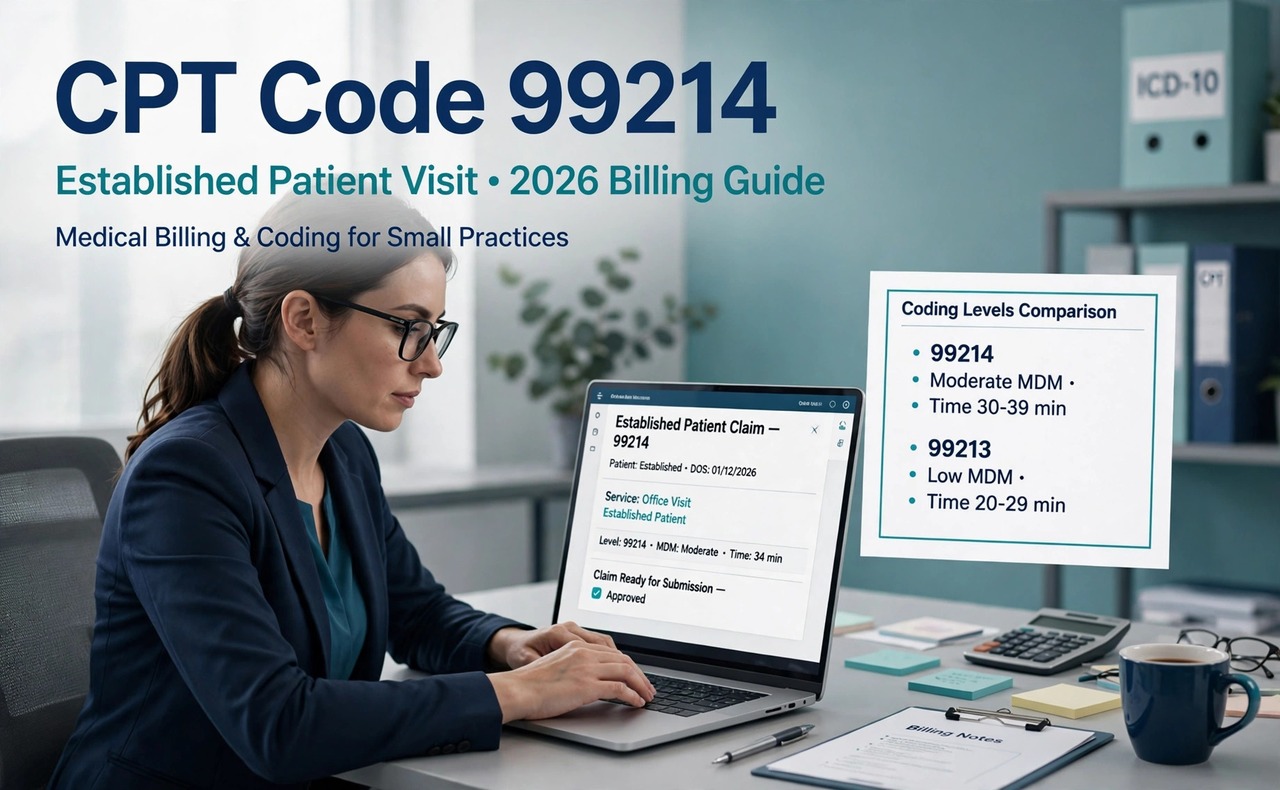
99212 is straightforward or 10-19 minutes. 99213 is low or 20-29 minutes.
99214 is moderate or 30-39 minutes. 99215 is high or 40-54 minutes.
A patient who is established cannot be billed as new just because the visit was long.
A new patient cannot be billed as established just because the documentation was thin.
99203 vs 99204 in New Patient CPT Codes: Where Downcoding Happens
The 99203 versus 99204 question is where new patient cpt codes most often leak revenue.
The difference is not the length of the note. It is MDM.
Ask: how many problems were addressed, and how complex were they?
How much data was reviewed? What was the risk of the management decision?
If two of those three elements reach moderate, and the documentation proves it, 99204 is supported.
If only low is proven, 99203 is correct, even if the visit felt busy.
Common downcoding causes are vague MDM lines, data review not listed, and time not totalled on the date of the encounter.
Fix the documentation template first, and the level usually fixes itself.
Documentation Checklist for New Patient CPT Codes
Before you submit any visit in new patient cpt codes, check these items in the note.
- New or established? Three-year check, same specialty, same group — documented, not assumed.
- Method chosen: MDM or total time? State which one. Do not mix the two to reach a higher level.
- MDM elements: problems, data, risk — at least two elements at the claimed level.
- Time, if used: total minutes on the date of the encounter, and what the time was spent on.
- Medically appropriate history and examination: present, even though they do not set the level.
- Diagnoses: coded to the highest specificity supported, with the reason for the visit clear.
- Prolonged time, if claimed: +99417 only with 99205, in correct 15-minute blocks.
The AAPC E/M 2021 checklist is a useful second reference for this checklist. Use it to check MDM and time before submission.
The same discipline applies to HIPAA-compliant coding documentation.
Complete, accurate notes protect the practice in every payer review, not just at claim submission.
EHR Template and Audit Checklist for New Patient CPT Codes
Most errors in new patient cpt codes are template errors, not coder errors.
Check your EHR today. Remove 99201 from every pick-list, form and template.
99201 was deleted in 2021 and should not be selectable.
Remove any history and exam point system for office E/M level selection.
Add a required field for “new or established, and why” with the three-year, specialty and group checks.
Add separate prompts for MDM problems, data and risk, and a separate field for total time.
Then audit a sample every month. Pull 20 new patient visits and re-code them by MDM and by time.
Track how many were downcoded, how many were upcoded, and why.
Correct new patient cpt codes protect revenue across the whole cycle.
Coding belongs inside revenue cycle management, not at the end of it.
What to Do After a New Patient CPT Codes Denial
After a new patient cpt codes denial, do not simply resubmit the same code.
Read the denial reason first.
If it is a new-versus-established denial, pull the three-year history and the specialty and group record.
If it is a level denial, re-check MDM or time — whichever method you used — against the note.
If the note supports a different level, correct and resubmit inside the payer deadline.
If it does not, query the provider and appeal with the documentation attached, not with a new code alone.
Our step-by-step approach to how to reduce claim denials uses the same fix: categorise by reason code and fix the root cause.
Track patterns by payer. A pattern by payer is easier to fix than a single denial.
If an audit is the risk, defend the coding behind the claim with the full note and MDM evidence.
If a denied claim has already aged into old AR, work that balance instead of letting it sit unpaid.
Frequently Asked Questions About New Patient CPT Codes
What is CPT code 99202 in new patient cpt codes?
99202 is the lowest active new patient office visit code.
It needs straightforward MDM, or 15-29 minutes of total time, with a medically appropriate history and/or examination.
What is procedure code 99203 in new patient cpt codes?
99203 is a new patient office visit code for low MDM, or 30-44 minutes of total time.
Low MDM often means one stable chronic illness, or an acute uncomplicated illness or injury.
When is a patient considered a new patient in new patient cpt codes?
When the patient has not received a professional service from that physician in the past three years.
The same applies to another physician of the same specialty in the same group.
What is the 99205 time requirement in new patient cpt codes?
99205 needs 60-74 minutes of total time if you bill by time, or high MDM if you bill by MDM.
Beyond 74 minutes, +99417 may apply in 15-minute blocks, with 99205 only.
Is 99201 still valid in new patient cpt codes?
No. 99201 was deleted effective 1 January 2021.
The active new patient range is 99202-99205 only. Remove 99201 from your templates.
Get a Free New Patient CPT Codes Audit
If new patient visits, downcoding, or new-versus-established denials are showing up in your accounts receivable, get a sample review.
Pro Health Care Advisors can review recent 99202-99205 claims, re-check them by MDM and by time, and show where revenue is leaking.
Contact Pro Health Care Advisors for a free coding audit and a clear, practice-specific fix list.