









What Is Revenue Cycle Management? A Complete 2026 Guide for Healthcare Practices
Let’s start with something that might surprise you: most healthcare practices in the United States are leaving money on the table every single month — not because they are providing bad care, but because of broken billing processes happening quietly behind the scenes.
According to the American Medical Association (AMA), practices lose billions each year to claim denials, billing errors, and unresolved accounts receivable. In 2026, the national average claim denial rate has climbed to 12%. That means for every $100,000 your practice bills, up to $12,000 can slip away if you do not have a tight billing system in place.
This is exactly where Revenue Cycle Management (RCM) comes in.
Whether you run a small family practice or a multi-specialty clinic, understanding RCM is not optional anymore. It is the financial heartbeat of your entire operation. And the good news? Once you understand how it works, fixing it is very achievable.
At Pro Health Care Advisors, we have helped practices across the United States recover revenue they did not even know they were losing. In this guide, we will walk you through everything — in plain, clear language — so you walk away knowing exactly what RCM is, why it matters, and what steps you can take right now.
What Exactly Is Revenue Cycle Management?
Think of Revenue Cycle Management as the full financial journey of a patient visit — from the moment someone books an appointment to the moment your practice receives its final payment.
It covers every single step in between: verifying insurance, getting pre-approvals, submitting claims correctly, following up when insurers don’t pay, resolving denials, and collecting patient balances.
If even one step in that journey breaks down, it costs money.
Here’s a simple way to picture it:
Imagine a water pipe running from your practice to a payment reservoir. RCM is the pipe. Every denial, coding error, missed authorization, or slow follow-up is a hole in that pipe. The water — your revenue — leaks out before it reaches you.
Good RCM seals those holes. Great RCM prevents them from forming in the first place.
The Healthcare Financial Management Association (HFMA) defines RCM as the process that healthcare organizations use to track patient care episodes from registration and appointment scheduling all the way to final balance payment. But in 2026, it has grown into something even bigger — it now includes automation, analytics, compliance oversight, and real-time financial reporting.
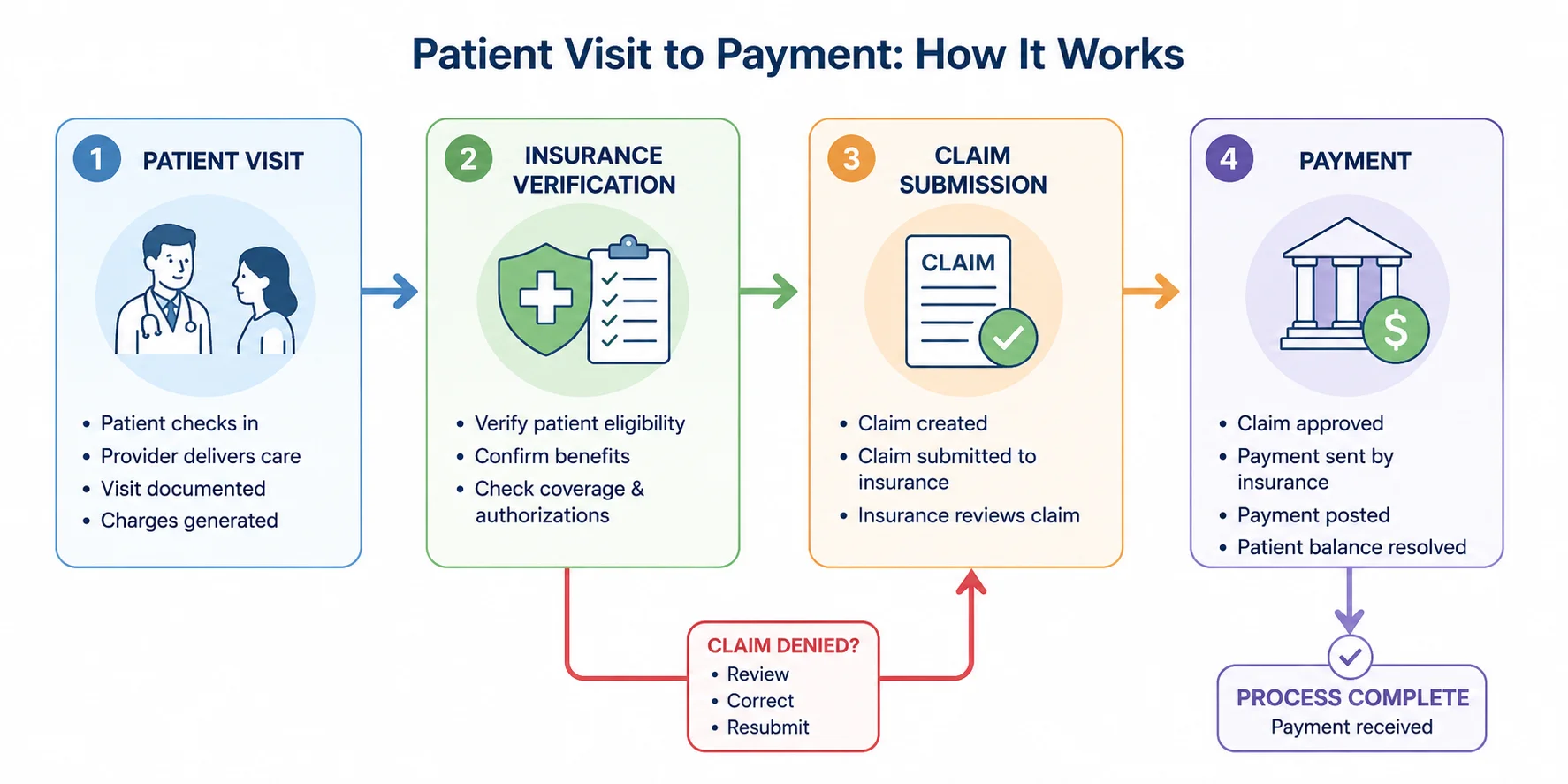
The 8 Stages of the Revenue Cycle — Explained Simply
Most people think billing is just about sending a claim and waiting for a check. In reality, there are eight interconnected stages, and each one directly affects how much you get paid.
Stage 1 — Patient Scheduling & Registration
The cycle begins before the patient even walks through your door. Accurate collection of name, date of birth, insurance ID, and contact details at this stage prevents errors down the line. A single typo in an insurance number here can become a denied claim weeks later.

Stage 2 — Insurance Eligibility Verification
Before the appointment, your team must confirm the patient’s insurance is active, understand their deductible and copay status, and verify whether your practice is in-network. Our medical billing and practice management team runs eligibility checks for every patient before every visit — catching coverage issues before they turn into denied claims.
According to CMS, a significant share of front-end denials trace directly back to eligibility errors that could have been caught before the appointment.
Stage 3 — Prior Authorization
Certain procedures, specialty referrals, and medications require payer approval before you provide the service. Skip this step, and you may deliver the care but never get paid for it. The 2026 CMS Prior Authorization API Rule now requires electronic processing — making it faster but also stricter for practices that are not set up correctly.
We handle prior authorizations completely on your behalf: submitting requests, tracking approvals, following up with payers, and documenting every authorization so nothing falls through the cracks.
Stage 4 — Medical Coding (ICD-10, CPT, HCPCS)
Every diagnosis and every procedure must be translated into the correct medical code. One wrong code — or a missing modifier — and the claim gets rejected or underpaid. Our CodeMAXX certified coding services ensure that every service your providers deliver is captured accurately and compliantly.
The American Academy of Professional Coders (AAPC) estimates that coding inaccuracies contribute to billions in lost revenue and unnecessary compliance risk across US healthcare every year.
Stage 5 — Claim Submission
Once coded, claims are submitted to the payer — electronically through a clearinghouse that scrubs them for errors before they ever reach the insurer. This dramatically improves first-pass acceptance rates. Our team maintains a 98.5% clean claim rate, meaning nearly every claim we submit goes through without a correction request.
Stage 6 — Payment Posting
When the payer responds — with a payment, a partial payment, or a denial — that information gets posted against the original claim. Accurate, timely payment posting keeps your accounts receivable current and reveals underpayments you might otherwise miss entirely.
Stage 7 — Denial Management & Appeals
Denials happen. But here is a number that should concern every practice owner: 60% of denied claims are never resubmitted. That is not a payer problem — that is a workflow problem. Our creative collection solutions team identifies denial patterns, corrects the root causes, and systematically appeals every recoverable claim.

Stage 8 — Patient Collections
With high-deductible health plans now the norm, patients are responsible for a bigger share of the bill than ever before. Clear, transparent billing statements — delivered promptly — dramatically improve collection rates. Patient payment is no longer just the end of the cycle. It is a major revenue pillar in its own right.
Why Is RCM More Important Than Ever in 2026?
The short answer: the rules keep changing, the stakes keep rising, and the complexity keeps growing.
Here is what is driving the urgency right now:
- Claim denial rates hit 12% nationally. For a practice billing $500,000 a year, that is potentially $60,000 in at-risk revenue every single year.
- New CPT codes took effect January 1, 2026. Practices that have not updated their fee schedules may be under-billing Medicare claims right now without even realizing it.
- The CMS Prior Authorization API Rule now mandates electronic processing, creating both faster approvals and greater compliance risk for practices that are not properly set up.
- NCQA and CMS credentialing standards changed in 2025–2026. Providers who have not updated their physician credentialing records may face billing disruptions and revenue gaps.
- Patient financial responsibility is growing. Patients now behave like healthcare consumers — they expect clear bills, flexible payment options, and transparency. Practices that cannot deliver lose collections they have already earned.
The practices thriving financially in 2026 are not necessarily the ones with the most patients. They are the ones with the tightest, most efficient revenue cycles.
What Does ‘Good’ RCM Actually Look Like?
A healthy revenue cycle is not just about avoiding denials. It is about building a financial system that works quietly and reliably in the background — every single day — without your clinical team having to think about it.
Strong RCM benchmarks to aim for:
- Clean claim rate above 95% (we target 98.5%)
- Denial rate below 5% (our average is under 2%)
- Days in AR under 35 for most specialties
- First-pass resolution rate above 90%
- Net collection rate above 95% of all collectible charges
If your practice is not hitting these numbers, revenue is leaking somewhere in the cycle — and it can be found and fixed.
RCM and HIPAA: Why Compliance Is Non-Negotiable
Every piece of patient data that flows through the revenue cycle — from insurance cards to claim details — is Protected Health Information (PHI) under HIPAA. Any billing partner you work with must sign a Business Associate Agreement (BAA) with your practice before they handle a single patient record.
At Pro Health Care Advisors, HIPAA compliance is foundational to everything we do. Our HIPAA compliance services include AES-256 encrypted data handling, restricted PHI access controls, regular compliance audits, and BAA management for every client. We also maintain alignment with the No Surprises Act to protect your patients from unexpected billing situations.
The U.S. Department of Health & Human Services (HHS) provides the official HIPAA framework that governs how all patient billing data must be stored, transmitted, and protected.
Should You Outsource Your Revenue Cycle Management?
This is the question most practice owners eventually face. The honest answer is: it depends on your bandwidth, your specialty, and what your current numbers look like.
Outsourcing RCM tends to make strong financial sense when:
- Your denial rate is above 5% and you don’t have a dedicated team actively working it down
- Your AR is aging past 60–90 days with no structured follow-up process in place
- You are spending more time on billing administration than on growing your practice
- You have recently added providers or new specialties with different coding and payer rules
- You have gone through a credentialing gap that disrupted your billing continuity
Outsourcing to a qualified partner does not mean losing control of your practice finances. It means gaining a team of specialists whose entire job is maximizing your reimbursements and protecting your compliance — while you focus on the reason you started your practice in the first place: patient care.
Pro Health Care Advisors works as an extension of your practice, not a replacement for it. Our AAPC-certified billers specialize by specialty — so whether you run a mental health practice, a cardiology clinic, or a wound care center, you get billers who know your specific CPT codes, payer rules, and documentation requirements cold.
Learn more about our medical billing and practice management services, or explore specialty-specific billing and credentialing for practices like yours.
The Role of Technology in Modern RCM
Artificial intelligence, automation, and real-time analytics have fundamentally changed what great RCM looks like. Tasks that once took hours of manual work — eligibility checks, claim scrubbing, denial pattern detection — now happen in seconds.
According to Guidehouse research, AI-powered billing automation ranked as the top RCM investment priority for medical groups in 2026. Practices using AI-assisted claim scrubbing are catching documentation mismatches and eligibility gaps before submission — instead of reacting to denials six weeks after the fact.
Our EMR/EHR integration services ensure your clinical and billing platforms communicate seamlessly — eliminating the data silos that cause preventable claim failures. We also provide Electronic Fund Transfer (EFT) services with direct payer connections, speeding up the time from claim approval to cash in your account.
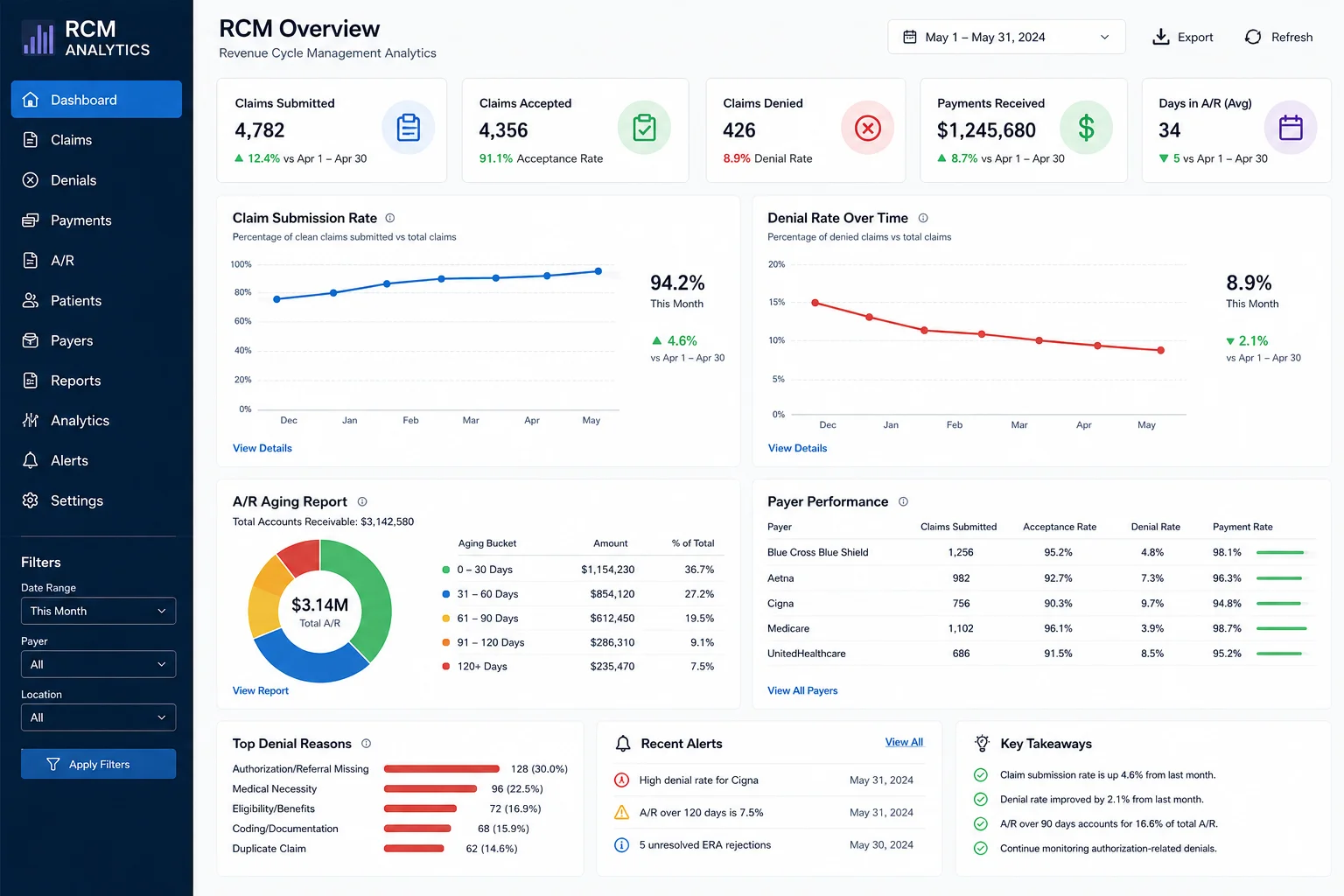
RAC Audits: The Hidden Risk Most Practices Overlook
Recovery Audit Contractors (RACs) are government-authorized auditors who review Medicare and Medicaid claims looking for overpayments. If they find one — even if it was an honest coding error from years ago — they can demand repayment, sometimes with interest.
Most practices only think about audits after they receive an audit letter. By then, the scramble begins — pulling records, building responses, managing appeals under a deadline.
Our MD Audit Shield RAC protection service keeps your practice audit-ready at all times, not just when a letter arrives. Proactive compliance is always less expensive than reactive damage control.
Common Questions About Revenue Cycle Management
How is RCM different from regular medical billing?
Medical billing is one component of the revenue cycle — primarily the claim submission and payment collection piece. RCM is the complete financial picture: every process from patient registration through final payment, including credentialing, coding, compliance, analytics, and strategic oversight. Think of medical billing as a chapter, and RCM as the whole book.
How long does it take to see improvement after outsourcing RCM?
Most practices see measurable improvement in clean claim rates within the first 30–60 days. AR recovery and denial rate reductions typically become visible within 90 days, depending on where your billing stands at the start.
What specialties benefit most from outsourced RCM?
Every specialty benefits, but practices in complex or high-volume specialties — mental health, cardiology, oncology, wound care, and urology — tend to see the most significant improvements because their coding and payer rules are more nuanced and penalty-heavy.
What does outsourcing medical billing typically cost?
Most full-service billing companies charge between 4% and 10% of monthly collections depending on practice size, specialty, and service scope. The better question is not what it costs but what it recovers. A practice losing 12% to denials that spends 6% to fix it is still materially ahead.
The Bottom Line: Your Revenue Cycle Is Either Working For You or Against You
There is no neutral in revenue cycle management. Every day that claims sit unchecked, denials go unworked, or eligibility gets skipped is a day revenue walks out the door — quietly, without anyone noticing until the numbers are reviewed.
The encouraging truth is that most of the money being lost is fully recoverable — with the right systems, the right people, and the right focus on the right stages of the cycle.
At Pro Health Care Advisors, we offer a free revenue audit that shows your practice exactly where the gaps are — in real numbers, not vague generalizations. You will see where money is leaking and what it would take to stop it. No obligation. No pressure. Just clarity.
Schedule your free consultation today and find out how much revenue your practice could be recovering starting this month.