






By Sandy Kaur, Founder, Pro Health Care Advisors
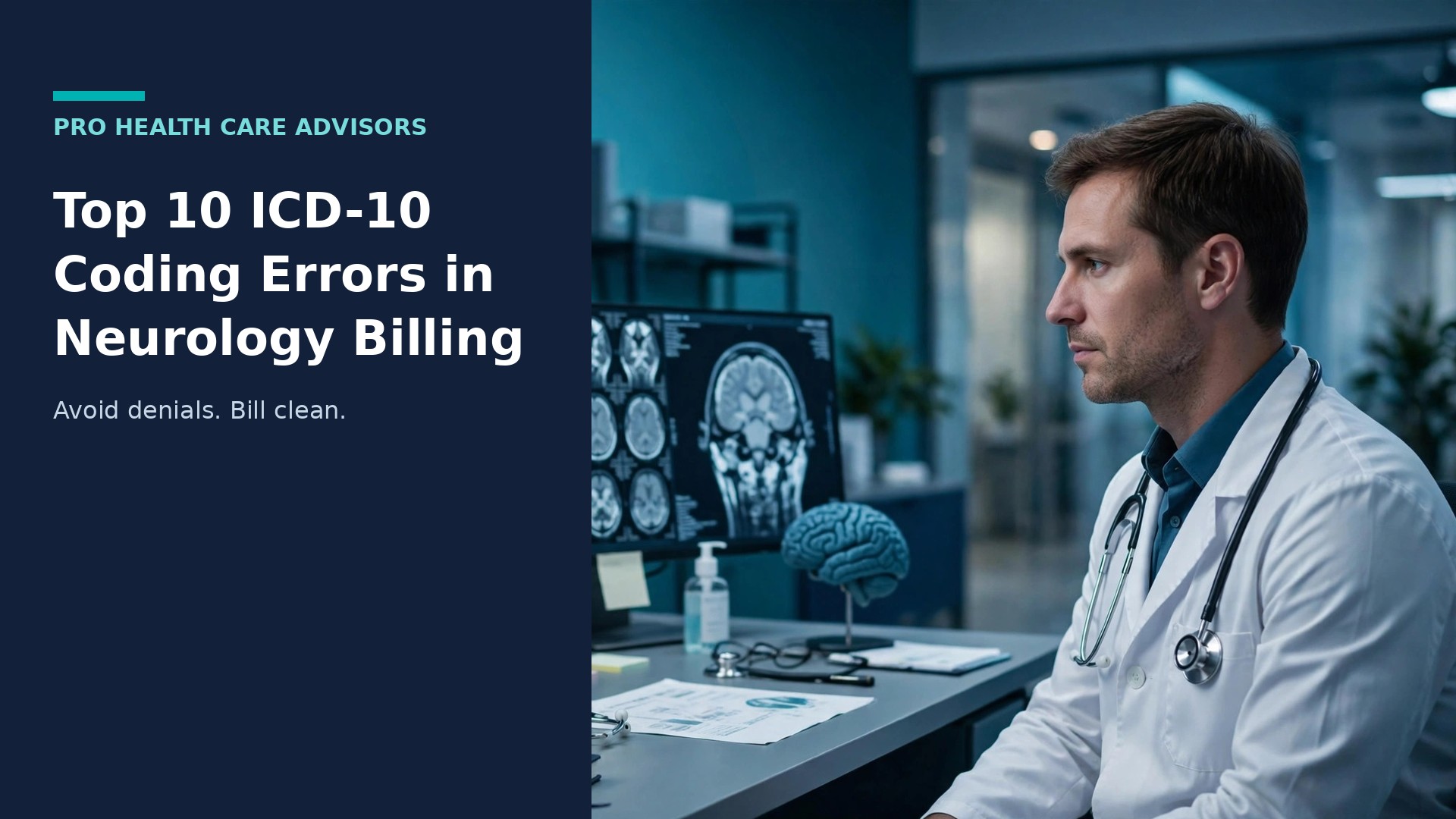
ICD-10 coding errors in neurology are one of the most expensive problems in the specialty, because a neurology claim lives or dies on the diagnosis code. The neurologist examines the patient, orders the test and documents the findings — but the payer reads the claim. When the ICD-10 code does not name the right condition, misses the specificity the code family demands, or describes a symptom instead of a diagnosis, the claim is denied before anyone looks at the clinical notes.
Quick Answer
The most common ICD-10 coding errors in neurology are vague or unspecified diagnosis codes, missing migraine and epilepsy specificity, and confusing an acute stroke with its late effects. Together they cause most neurology denials. The fix: code from the neurologist’s final assessment and the documented test results.
Why ICD-10 Coding Errors in Neurology Cost Practices So Much
Neurology is a high-complexity, high-denial specialty. A single EEG, EMG or nerve conduction study, a botulinum toxin injection or an infusion pays well, but a single denial costs the practice the entire professional fee. Once the patient has left the office, the only thing left to correct is the code. That is why ICD-10 coding errors in neurology are so expensive: they turn completed work into unpaid work.
The risk is growing. Payers now run automated medical-necessity edits that compare the ICD-10 code against the CPT code before a human ever sees the claim. A vague code such as G43.9, migraine, unspecified, will not support a botulinum toxin injection for chronic migraine. Our neurology billing and credentialing services check every claim for diagnosis-to-procedure match, code specificity and medical necessity before it is submitted, so denials are prevented instead of appealed.
The Top 10 ICD-10 Coding Errors in Neurology Billing
The ten errors below are the most common ICD-10 coding errors in neurology we see in practice. The pattern is not unique to neurology — the top 10 ICD-10 coding errors in radiology billing follow the same logic. The lesson is the same.
1. Migraine Coded Without Aura, Status or Intractable Specificity
The error: Migraine lives in the G43.- family, and the fourth character matters: G43.0 is migraine without aura, G43.1 is migraine with aura, and G43.7 is chronic migraine. The error is stopping at G43.9, migraine, unspecified, or never recording whether the migraine was intractable or involved status migrainosus.
Why claims deny: Payers treat G43.9 as a weak diagnosis. It does not support botulinum toxin injections or CGRP therapy. Unspecified migraine claims deny or downcode far more often than specific ones.
The fix: Code migraine from the neurologist’s documented assessment. Record aura, chronicity, intractable status and status migrainosus exactly as documented — and never let G43.9 go out when the note names the type.
2. Epilepsy Coded as Unspecified Instead of by Seizure Type
The error: Epilepsy lives in the G40.- family, coded by seizure type: G40.0–G40.2 for localization-related epilepsy and G40.3–G40.4 for generalized epilepsy. The error is defaulting to G40.9, epilepsy, unspecified, even when the note names the seizure type — and never capturing intractable epilepsy or status epilepticus.
Why claims deny: An unspecified epilepsy code cannot support long-term antiepileptic drug management, EEG monitoring or epilepsy surgery evaluation. Payers and auditors expect the seizure type, because treatment and coverage turn on it.
The fix: Code the seizure type the neurologist documented, and add the intractable and status epilepticus characters when they apply.
3. Parkinson Disease (G20) Confused With Secondary Parkinsonism (G21.-)
The error: G20 is Parkinson disease — the idiopathic, degenerative condition. Secondary parkinsonism belongs in G21.-: drug-induced parkinsonism (G21.1), vascular parkinsonism (G21.4) and other secondary forms. The error is coding every parkinsonian patient G20, including patients whose parkinsonism was caused by a drug or a stroke.
Why claims deny: The two diagnoses carry different treatment, prognosis and coverage. A G20 code on a drug-induced case misstates the disease and hides the real cause.
The fix: Check the cause before coding. If the note links parkinsonism to a drug, a vascular event or another condition, use the G21.- code that names it — and code the underlying cause as well. Reserve G20 for idiopathic Parkinson disease.
4. Acute Stroke (I63.-) Confused With Its Late Effects (I69.-)
The error: An acute cerebral infarction is coded from I63.-, by mechanism and vessel — I63.0–I63.2 for precerebral artery occlusion and I63.3–I63.5 for cerebral artery occlusion — while the late effects of a stroke belong in I69.-, such as I69.35 for hemiplegia following cerebral infarction. The error is coding a months-old stroke as an acute I63.- event, or coding a fresh stroke with I63.9, cerebral infarction, unspecified.
Why claims deny: An acute code on an old stroke tells the payer a new event happened, which can deny rehabilitation or follow-up care as a duplicate.
The fix: Ask one question: is this the acute event or a late effect? Code the acute infarction from I63.- with the documented mechanism and vessel, and use I69.- with the specific deficit for sequelae. See our ICD-10 stroke coding guide for the full breakdown.
5. TIA (G45.-) Coded as a Stroke — or a Stroke Coded as a TIA
The error: A transient ischemic attack is coded from G45.- — G45.0 for vertebro-basilar artery syndrome, G45.1 for carotid artery syndrome, and G45.9 for transient cerebral ischemic attack, unspecified. The error is coding a TIA as a stroke, or coding a completed stroke as a TIA because the symptoms resolved quickly.
Why claims deny: A TIA and a stroke are different events with different coverage, different follow-up and very different risk. Getting them backwards misstates the event and the risk.
The fix: Code what the neurologist diagnosed, not how long the symptoms lasted. If imaging confirms an infarction, it is a stroke — code I63.-. If the deficit resolved with no infarction, code the G45.- TIA that matches the documented territory.
6. Dementia Coded Without the Behavioral-Disturbance Digit
The error: Dementia codes carry a final character for behavioral disturbance: F01.50 is vascular dementia without behavioral disturbance and F01.51 is the same dementia with behavioral disturbance; F03.90 and F03.91 do the same for unspecified dementia, and Alzheimer disease (G30.-) pairs with F02.80 or F02.81. The error is leaving the digit off — or coding the disturbance and never coding the dementia.
Why claims deny: The behavioral-disturbance digit changes the severity picture and the care the patient needs. Claims without it understate the case.
The fix: Check the note for agitation, aggression, wandering or other behavioral symptoms on every dementia visit, and code the matching with- or without-disturbance code. When Alzheimer disease is documented, code G30.- first and the F02.- dementia code with it.
7. Coding “Possible” or “Probable” MS as Confirmed (G35)
The error: Multiple sclerosis is coded G35 — but only when the diagnosis is established. The error is coding “possible MS”, “probable MS” or “MS suspected” as G35 on an outpatient claim. Outpatient coding rules are clear: uncertain diagnoses are not coded as if confirmed; code the signs and symptoms until the diagnosis is established.
Why claims deny: A G35 code on an unconfirmed case creates a false chronic-disease record and invites recoupment when the workup later rules MS out.
The fix: In the outpatient setting, code what is known: the documented symptoms and findings. Reserve G35 for a confirmed diagnosis, and document the workup — MRI, lumbar puncture, evoked potentials — that supports it.
8. Neuropathy Coded as Unspecified (G62.9) Instead of by Cause
The error: Peripheral neuropathy has specific homes: diabetic polyneuropathy is E11.42 for type 2 diabetes, drug-induced polyneuropathy is G62.0, and single-nerve problems live in G57.- — G57.5 for tarsal tunnel syndrome, for example. The error is coding every neuropathy G62.9, polyneuropathy, unspecified, even when the note names diabetes or a single trapped nerve.
Why claims deny: G62.9 says nothing about cause, and cause is what payers check. A diabetic neuropathy coded as unspecified loses the diabetes link that supports foot care, testing and treatment.
The fix: Find the cause in the note before coding. If diabetes caused it, code the diabetes-with-neuropathy combination (E11.42). If one nerve is trapped or injured, use the G57.- mononeuropathy code that names it.
9. Sleep Apnea Coded as Unspecified (G47.30) Instead of by Type
The error: Sleep apnea is not one code. Obstructive sleep apnea is G47.33, central sleep apnea is G47.31, and G47.30 is sleep apnea, unspecified. The error is coding every sleep study G47.30, even when the sleep study report names obstructive apnea — or coding obstructive apnea when the study showed central events.
Why claims deny: Obstructive and central apnea are treated differently: CPAP and oral appliances for obstructive apnea. An unspecified code cannot support the device the patient actually needs, so the claim denies.
The fix: Code sleep apnea from the sleep study report, not from the referral. Match the code to the apnea type the study proved, and record the severity and the device ordered so the claim supports the equipment.
10. Coding Symptoms Instead of the Confirmed Diagnosis
The error: ICD-10-CM guidelines are clear: when a definitive diagnosis is documented, code the diagnosis — not the symptoms that led to it. Yet neurology claims still carry R-codes as the primary diagnosis: R51 for headache when the note confirms migraine, R25.1 for tremor when the note confirms Parkinson disease, or R56.9 for convulsions when the note confirms epilepsy.
Why claims deny: A symptom code tells the payer too little to support medical necessity for testing or treatment.
The fix: Code from the neurologist’s final assessment, not from the referral. When the assessment confirms a diagnosis, report it first and list symptoms only as secondary codes.
Pre-Bill Checklist: Catch ICD-10 Coding Errors in Neurology Before You Submit
Run every neurology claim through this list before it is submitted — it takes two minutes and catches the ICD-10 coding errors in neurology that cause most denials.
- Migraine is coded to the G43.- type, with aura, chronicity, intractable status and status migrainosus documented.
- Epilepsy is coded by seizure type from G40.-, with intractable epilepsy and status epilepticus captured when they apply.
- Parkinson disease (G20) is separated from secondary parkinsonism (G21.-), and the cause is coded.
- Acute stroke (I63.-) is separated from late effects (I69.-), and I63.9 is never used when the mechanism is known.
- TIA (G45.-) is coded by territory — never as a stroke, and never for a completed infarction.
- Dementia codes carry the behavioral-disturbance digit, and Alzheimer disease (G30.-) is paired with its F02.- code.
- Neuropathy names its cause: diabetic (E11.42), drug-induced (G62.0) or a specific mononeuropathy (G57.-).
- Sleep apnea matches the sleep study: obstructive (G47.33) or central (G47.31), never unspecified G47.30 by default.
How Pro Health Care Advisors Helps Neurology Practices
Neurology billing is unforgiving: ICD-10 coding errors in neurology — one wrong code, one missing digit, one acute code on a late effect — can cost a practice more in a month than a full audit would. Pro Health Care Advisors reviews every neurology claim for code specificity, diagnosis-to-procedure match and medical necessity before it is submitted.
The same discipline that protects radiology revenue protects neurology revenue too. If ICD-10 coding errors in neurology are eating your revenue, request a free billing audit — or call us directly at (888) 341-4599.
Frequently Asked Questions
What are the most common ICD-10 coding errors in neurology?
Vague or unspecified diagnosis codes, missing migraine and epilepsy specificity, and confusing acute stroke with its late effects. These are the ICD-10 coding errors in neurology we see most often.
What is the difference between G20 and G21.- in Parkinson’s coding?
G20 is Parkinson disease, the idiopathic degenerative condition. G21.- is secondary parkinsonism — drug-induced (G21.1), vascular (G21.4) or another secondary cause. Code the cause, not just the symptoms.
When should I use I63.- and when should I use I69.- for stroke?
Use I63.- for the acute cerebral infarction, coded by mechanism and vessel. Use I69.- for the late effects of a stroke, such as hemiplegia (I69.35) or dysphasia (I69.32), once the acute phase has passed.
How do I code migraine correctly in ICD-10?
Use the G43.- family: G43.0 for migraine without aura, G43.1 for migraine with aura and G43.7 for chronic migraine, with the final character capturing intractable migraine and status migrainosus. Avoid G43.9, migraine, unspecified, when the type is documented.
Can I code multiple sclerosis (G35) when the diagnosis is only suspected?
No — not on an outpatient claim. Uncertain diagnoses are not coded as if confirmed. Code the documented signs and symptoms until the diagnosis is established, then code G35.
What should I do if a claim is denied for an ICD-10 error?
First, read the denial reason and the remittance code — it usually names the exact problem. Correct the diagnosis or the specificity, and resubmit or appeal within the payer’s deadline. Then fix the root cause: most ICD-10 coding errors in neurology repeat until the workflow changes, so add the failed check to your pre-bill list.
Sources: CMS ICD-10, CDC ICD-10-CM, and American Academy of Neurology.