







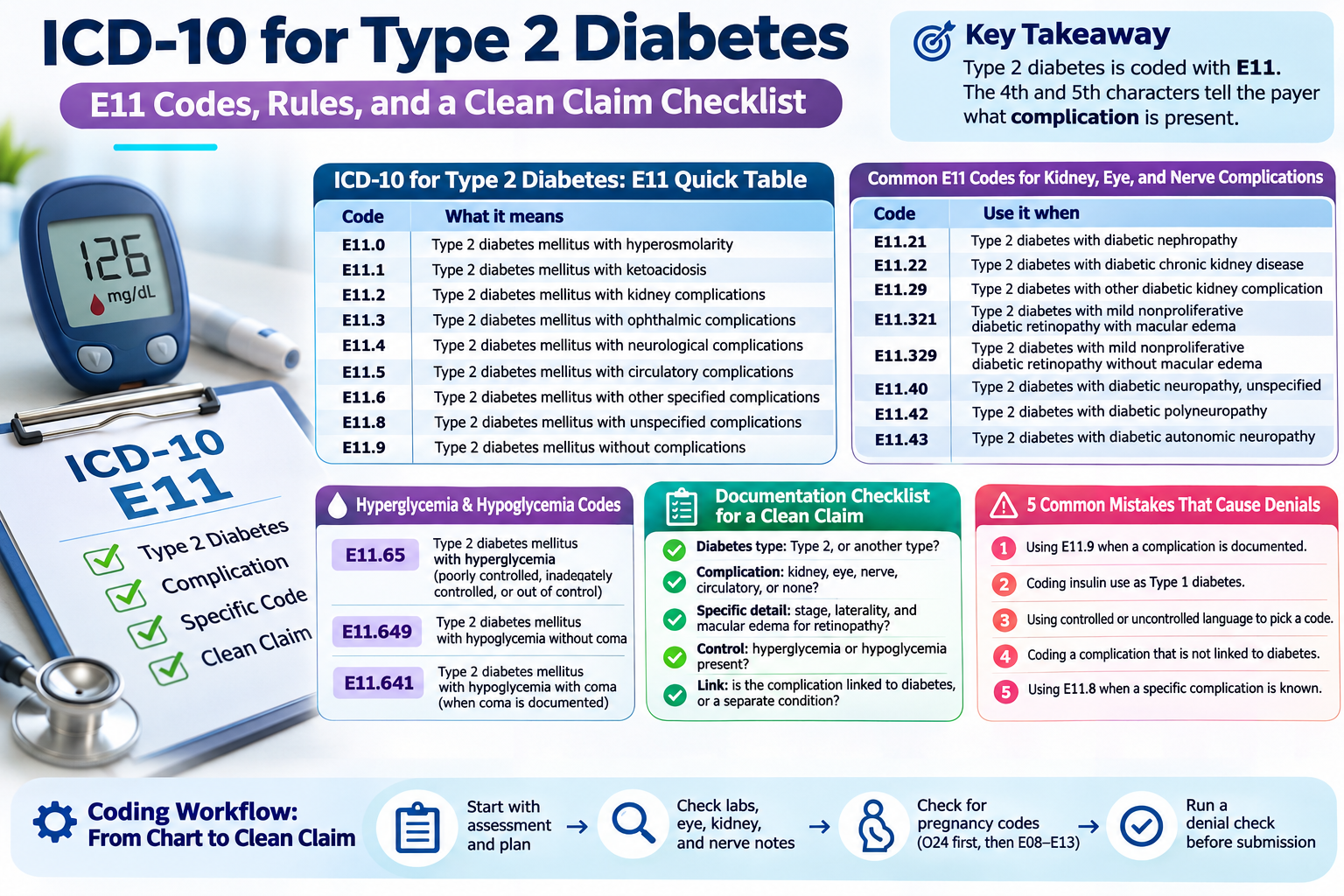
icd 10 for type 2 diabetes starts with one code family: E11. Type 2 diabetes mellitus is coded with E11, not E10, E08, or E09.
The fourth and fifth characters then tell the payer what complication is present. That detail is what turns a generic claim into a clean claim.
This guide gives you the icd 10 for type 2 diabetes table first, then the rules that stop denials. Use it as a checklist before you submit a claim.
icd 10 for type 2 diabetes Quick Table: E11 Codes
| Code | What it means |
| E11.0 | Type 2 diabetes mellitus with hyperosmolarity |
| E11.1 | Type 2 diabetes mellitus with ketoacidosis |
| E11.2 | Type 2 diabetes mellitus with kidney complications |
| E11.3 | Type 2 diabetes mellitus with ophthalmic complications |
| E11.4 | Type 2 diabetes mellitus with neurological complications |
| E11.5 | Type 2 diabetes mellitus with circulatory complications |
| E11.6 | Type 2 diabetes mellitus with other specified complications |
| E11.8 | Type 2 diabetes mellitus with unspecified complications |
| E11.9 | Type 2 diabetes mellitus without complications |
icd 10 for type 2 diabetes codes live in Chapter 4, in the E08 to E13 block. E11 is only for Type 2 diabetes, so check the type first.
Always check the date of service first. Use the FY 2027 code set for encounters from October 1, 2026, through September 30, 2027.
icd 10 for type 2 diabetes Without Complications: E11.9
Use E11.9 when Type 2 diabetes is present but no complication is documented. This is the most common code for a routine diabetes visit.
Do not add a complication code just because the patient has another condition. The complication must be linked to diabetes in the record.
icd 10 for type 2 diabetes With Kidney, Eye, and Nerve Complications
| Code | Use it when |
| E11.21 | Type 2 diabetes mellitus with diabetic nephropathy |
| E11.22 | Type 2 diabetes mellitus with diabetic chronic kidney disease |
| E11.29 | Type 2 diabetes mellitus with other diabetic kidney complication |
| E11.321 | Type 2 diabetes mellitus with mild nonproliferative diabetic retinopathy with macular edema |
| E11.329 | Type 2 diabetes mellitus with mild nonproliferative diabetic retinopathy without macular edema |
| E11.40 | Type 2 diabetes mellitus with diabetic neuropathy, unspecified |
| E11.42 | Type 2 diabetes mellitus with diabetic polyneuropathy |
| E11.43 | Type 2 diabetes mellitus with diabetic autonomic neuropathy |
icd 10 for type 2 diabetes coding needs the exact complication, not just the organ. Retinopathy, for example, needs its stage and whether macular edema is present.
For kidney complications, check whether the record says nephropathy or chronic kidney disease. Those two terms point to different E11.2 codes.
For nerve complications, check whether the record says polyneuropathy, autonomic neuropathy, or just neuropathy. Each term has its own E11.4 code.
icd 10 for type 2 diabetes With Hyperglycemia and Hypoglycemia
Use E11.65 for Type 2 diabetes mellitus with hyperglycemia. This code applies when diabetes is poorly controlled, inadequately controlled, or out of control.
ICD-10 does not use controlled or uncontrolled as a code choice. Poor control is coded by adding hyperglycemia, not by changing the diabetes type.
Use E11.649 for Type 2 diabetes mellitus with hypoglycemia without coma. Add the coma code, E11.641, only when coma is documented.
For icd 10 for type 2 diabetes claims, never code hyperglycemia alone when diabetes is the cause. The combination E11 code already includes it.
icd 10 for type 2 diabetes: Type 2 Is the Default Type
When the record does not state the diabetes type, use Type 2. E11 is the default code family when the type is not documented.
Insulin use does not make a patient Type 1. Many Type 2 patients use insulin, so check the documented type, not the medication list.
Use E10 only when the record clearly states Type 1 diabetes. Use E08 or E09 only when diabetes is due to an underlying condition, drug, or chemical.
For icd 10 for type 2 diabetes, sequence the underlying condition first only for E08 and E09. For E11, the diabetes code itself comes first in most cases.
icd 10 for type 2 diabetes Documentation Checklist for Clean Claims
Before you submit, check these five items in the record. Missing details are the main reason diabetes claims get denied.
- Diabetes type: Type 2, or another type? 2. Complication: kidney, eye, nerve, circulatory, or none?
- Specific detail: stage, laterality, and macular edema for retinopathy? 4. Control: hyperglycemia or hypoglycemia present?
- Link: does the record link the complication to diabetes, or is it a separate condition?
If any item is missing, query the provider before coding. A short query now is cheaper than a denial and appeal later.
5 icd 10 for type 2 diabetes Mistakes That Cause Denials
Mistake 1: Using E11.9 when a complication is documented. Fix it by coding the specific E11 complication code.
Mistake 2: Coding insulin use as Type 1 diabetes. Fix it by using E11 when the record states Type 2 diabetes.
Mistake 3: Using controlled or uncontrolled language to pick a code. Fix it by coding hyperglycemia with E11.65 when poor control is documented.
Mistake 4: Coding a complication that is not linked to diabetes. Fix it by coding it separately, not as an E11 complication.
Mistake 5: Using E11.8 when a specific complication is known. Fix it by coding the exact E11.2, E11.3, or E11.4 code.
For help with specialty coding accuracy, see CodeMAXX medical coding services.
For a step-by-step denial fix, see how to reduce claim denials.
For the official FY 2027 code files, see the CMS ICD-10 page.
For how to separate diabetes codes by type, see the AAPC diabetes coding guide.
icd 10 for type 2 diabetes FAQ
What is the icd 10 for type 2 diabetes code without complications?
Use E11.9 for Type 2 diabetes mellitus without complications. Add a complication code only when one is documented and linked to diabetes.
What is the icd 10 for type 2 diabetes code with hyperglycemia?
Use E11.65 for Type 2 diabetes mellitus with hyperglycemia. This covers poorly controlled, inadequately controlled, and out-of-control diabetes.
What is the icd 10 for type 2 diabetes code with kidney disease?
Use E11.21 for diabetic nephropathy and E11.22 for diabetic chronic kidney disease. Check which kidney term the record uses.
Is insulin use coded as Type 1 diabetes?
No. Insulin use does not change Type 2 diabetes to Type 1. Code the type stated in the record, not the medication.
What if the diabetes type is not documented?
Use Type 2 diabetes codes, E11, as the default. Query the provider when the type could change the code or the payment.
Diabetes Coding Workflow: From Chart to Clean Claim
Start with the assessment and plan, not the problem list. The assessment usually states the diabetes type and complications most clearly.
Next, check labs and eye, kidney, and nerve notes. Those notes give the specific complication detail that E11 codes require.
Then, check for pregnancy codes when relevant. For a pregnant patient, code O24 first, then the diabetes code from E08 to E13.
Finally, run a denial check before submission. Confirm the type, the complication, and that no history code was used as an active code.
Two Quick Coding Examples
Example 1: A patient has Type 2 diabetes with diabetic polyneuropathy. Code E11.42, because the nerve complication is specific and linked to diabetes.
Example 2: A patient has Type 2 diabetes, no complications documented. Code E11.9, and do not add a complication code from another visit.
Example 3: A patient has Type 2 diabetes with hyperglycemia. Code E11.65, not a separate hyperglycemia code alone.
Get Help With icd 10 for type 2 diabetes Billing
If diabetes claims keep getting denied, get a free revenue audit. Pro Health Care Advisors can review your coding, denials, and revenue cycle.
Get a free consultation today.