








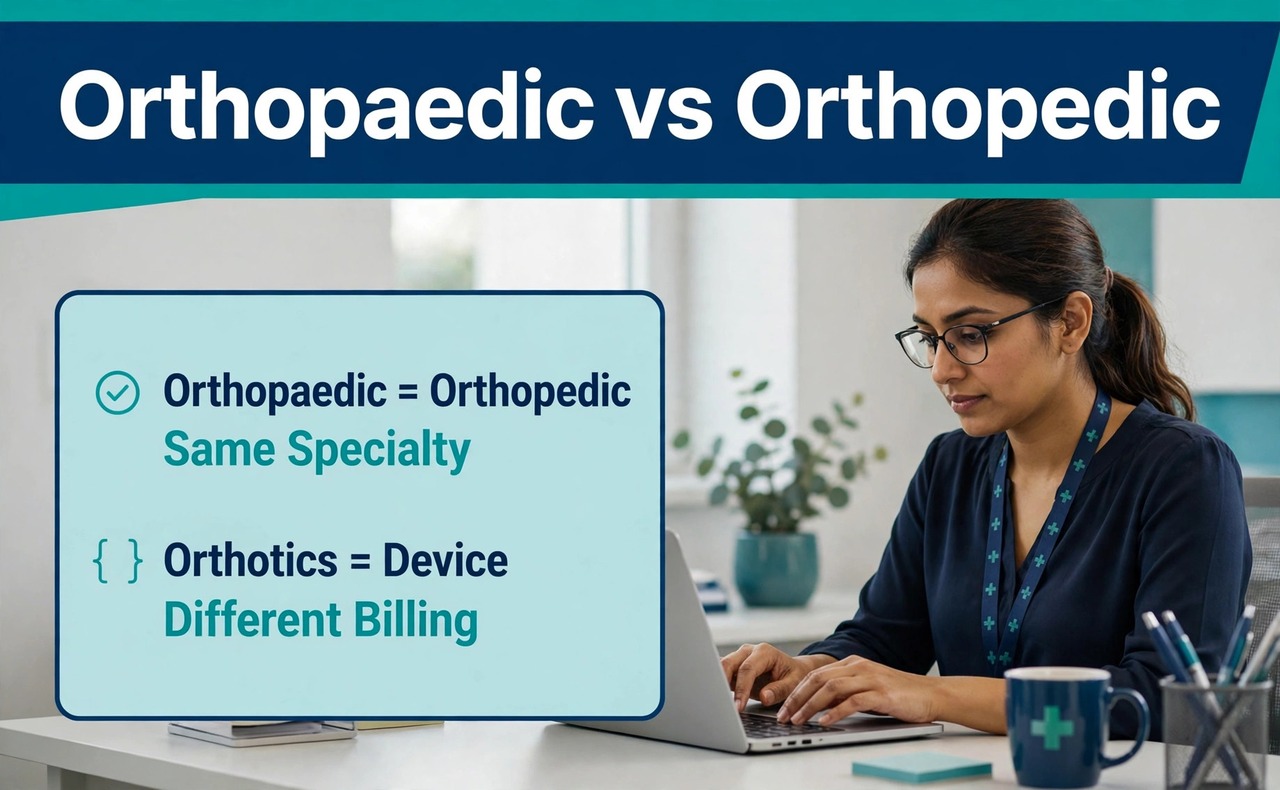
Orthopaedic vs orthopedic is a spelling question, not a medical question.
Both words mean the same specialty: the care of bones, joints, ligaments, tendons, muscles, and nerves.
The specialty treats fractures, arthritis, sports injuries, spine problems, and congenital musculoskeletal conditions.
A patient searching for either spelling is looking for the same kind of doctor.
A practice website should therefore answer the spelling question clearly, then move to the real billing question.
That real question is different: orthotics is not the same as orthopedics, and it is billed differently.
This guide explains the spelling, the people, and the billing, in plain language.
If coding and billing for these services take too much staff time, CPC-certified ICD-10 coding support can review the diagnosis, procedure, and device lines before submission.
Orthopaedic vs Orthopedic: The Short Answer
Many orthopaedic vs orthopedic searches come from patients and billers who see both spellings on different sites.
Orthopaedic vs orthopedic: there is no difference in meaning.
Orthopaedic is the traditional British English spelling, with “ae”.
Orthopedic is the simplified American English spelling, without “ae”.
In the United States, orthopedic is the standard spelling in most hospitals and clinic websites.
In the United Kingdom and many Commonwealth countries, orthopaedic is the standard spelling.
Pronunciation, training in that country, and the conditions treated do not change with the spelling.
Only the letters change.
Orthopaedic vs Orthopedic: Where the Word Comes From
The word comes from Greek roots meaning straight and child.
It was first used for correcting deformities in children.
Over time, the field grew to cover musculoskeletal problems in patients of all ages.
That history explains the “ae” in the older spelling.
British English often keeps classical spellings in medicine.
American English often simplifies “ae” to “e”, as in anemia and anesthesia.
Orthopaedics vs Orthopedics: The Plural Form
For orthopaedic vs orthopedic searches, the plural form does not change the answer.
Orthopaedics vs orthopedics follows the same rule as the singular form.
Orthopaedics, with “ae”, is the British plural. Orthopedics, without “ae”, is the American plural.
Both refer to the same specialty as a field of medicine.
Use the form that matches your audience and your site style, and stay consistent on one page.
Mixing both spellings on the same page can confuse readers and search engines.
Pick one main spelling for your site, and mention the other spelling once for clarity.
Orthopedic vs Orthopaedic Surgery: Is the Surgery Different?
Orthopaedic vs orthopedic surgery searches also return the same specialty, not two different operations.
Orthopedic vs orthopaedic surgery is also the same surgery, spelled two ways.
The operation does not change because the word is spelled differently.
What can differ is the training system and the health system in each country.
A surgeon trained in the UK and a surgeon trained in the US follow different national training paths.
That is a country difference, not a spelling difference.
On a US billing site, use orthopedic surgery as the main term.
Mention orthopaedic surgery once, so UK readers and searchers find the same page.
Why the American Academy Uses the Older Spelling
One exception confuses many readers. The American Academy of Orthopaedic Surgeons uses the “ae” spelling in its name.
That is a historical name, kept from the time when the “ae” spelling was more common in the United States.
It does not mean American doctors must use “ae” in everyday writing today.
Most US hospitals, journals, and clinic sites now use orthopedic.
The Academy’s own history shows the “ae” name, even though it is a US organisation.
See the American Academy of Orthopaedic Surgeons background for that naming history.
For your site, the rule is simple: match your audience, not one organisation’s historical name.
Orthotist vs Orthopedist: Different People, Different Jobs
Orthopaedic vs orthopedic is different from orthotist vs orthopedist, because the first pair is spelling and the second pair is people.
Orthotist vs orthopedist is a real difference, unlike the spelling question above.
An orthopedist, or orthopaedic surgeon, diagnoses and treats musculoskeletal conditions.
That work can include surgery, injections, casting, and non-surgical treatment plans.
An orthotist fits, adjusts, and maintains orthotic devices, such as braces and supports.
Orthotists are trained in prosthetics and orthotics, and they work from a clinician’s order.
The two roles often work together, but they are not interchangeable.
A claim for a device fitting is not the same as a claim for a surgical visit.
One common error in competitor content should be avoided here.
It is true that every orthopedic surgeon is an orthopedic specialist.
It is not true that every orthopedic specialist is a surgeon.
Non-surgical sports medicine, physiatry, and other musculoskeletal specialists are also specialists, without being surgeons.
Orthotics vs Orthopedics: Device vs Specialty
Orthopaedic vs orthopedic should not be confused with orthotics vs orthopedics, because the second pair is a real billing difference.
Orthotics vs orthopedics is also a real difference, and it changes billing completely.
Orthopedics is a medical specialty. Orthotics is a device that supports, aligns, or stabilises a body part.
Examples include knee braces, ankle-foot orthoses, spinal braces, and foot inserts.
A brace does not diagnose a condition. It supports treatment of a condition.
That is why the billing path is different, as the next section shows.
Billing Comparison: Orthopedics vs Orthotics
| Topic | Orthopedic Service | Orthotic Device |
| What is billed | Physician service: visit, procedure, or surgery | Device: HCPCS L-code, as durable medical equipment |
| Main code set | ICD-10 diagnosis + CPT procedure | HCPCS Level II L-codes for orthotics |
| Key documentation | Laterality, site, encounter type | Order, medical necessity, fitting, proof of delivery |
| Common extra step | Prior auth for some procedures | Prior auth for many custom or high-cost devices |
In orthopaedic vs orthopedic billing guides, the spelling does not change the code, but the service type does.
For orthopedic billing, laterality means right, left, or bilateral.
Site specificity means the exact body region, for example the lumbar spine, not just “back”.
Encounter type means initial, subsequent, or sequela, shown by the 7th character in many injury codes.
Missing any of these three can deny an otherwise valid claim.
For orthotics billing, the workflow starts with a valid order.
Then comes eligibility and verification, device and diagnosis entry, and authorisation where required.
After fitting, the claim needs proof of delivery and fitting documentation.
Custom-made devices need more documentation than off-the-shelf devices.
Off-the-shelf devices are prefabricated and need less fitting work, but they still need an order and medical necessity.
Do not bill a custom device code for an off-the-shelf device, or the reverse.
Orthotics Billing: L-Codes and Payer Rules
Orthotic devices are billed with HCPCS Level II L-codes, not with CPT procedure codes alone.
L-code ranges cover spinal, upper limb, and lower limb orthoses, plus repairs and fittings.
Each L-code describes a specific device type, not just “a brace”.
Pick the L-code that matches the device actually delivered and fitted.
Modifiers matter here too, for example left and right, and for distinct devices.
Payer rules vary, so check the payer policy before you submit a high-cost device.
One payer policy example lists off-the-shelf orthotics codes separately, which shows why a single universal list cannot be assumed.
See this payer DME policy listing off-the-shelf orthotics codes as an example of payer-specific rules.
Medicare, Medicaid, and commercial plans do not all cover the same devices on the same terms.
Some devices need prior authorisation. Some need a detailed written order.
Some need proof that a cheaper device would not meet the patient’s need.
Top Denial Reasons in Orthopedic and Orthotics Billing
Orthopaedic vs orthopedic claims deny for the same reasons as orthopedic claims, because the code set is the same.
- Orthopedic denial: laterality missing. Fix: document right, left, or bilateral for every applicable diagnosis.
- Orthopedic denial: site not specific. Fix: name the exact joint, bone, or spinal region.
- Orthopedic denial: encounter type missing. Fix: use the correct 7th character for initial, subsequent, or sequela.
- Orthotics denial: no valid order. Fix: get the order before delivery, with diagnosis and device described.
- Orthotics denial: authorisation missing. Fix: check authorisation for custom and high-cost devices before fitting.
- Orthotics denial: fitting or delivery not proven. Fix: keep fitting notes and proof of delivery on file.
Our step-by-step approach to how to reduce claim denials uses the same fix: categorise by reason code and fix the root cause.
Duplicate claims and charges above the fee schedule can also deny, but they are not the only causes.
Most orthopedic denials in practice come from documentation gaps, not from duplicate submission alone.
Frequently Asked Questions
These orthopaedic vs orthopedic questions come from the keyword file, answered in plain language.
What is the difference between orthopedic and orthopaedic?
There is no difference in meaning. Orthopedic is the American spelling and orthopaedic is the British spelling.
Both mean the same specialty: care of bones, joints, ligaments, tendons, muscles, and nerves.
Difference between orthopedic and orthopaedic: which spelling should a US site use?
A US site should use orthopedic as its main spelling, for US readers and US search.
Mention orthopaedic once on the page, so readers who search the British spelling still find the answer.
Orthotist vs orthopedist: who should I see?
See an orthopedist for diagnosis and treatment of a musculoskeletal condition.
See an orthotist for fitting and adjustment of a brace or support device, on a clinician’s order.
Is orthotics considered DME?
Yes, orthotics is generally billed as durable medical equipment, using HCPCS L-codes.
That is different from an orthopedic physician service, which is billed with ICD-10 and CPT codes.
Get Help With Orthopedic and Orthotics Billing
If orthopaedic vs orthopedic billing still confuses your team, a sample audit can help.
If orthopedic claims are denying for laterality, site, or encounter type, or orthotics claims are denying for order or authorisation, get a sample review.
Pro Health Care Advisors can review recent claims, check diagnosis, procedure, and device lines, and show where revenue is leaking.
Contact Pro Health Care Advisors for a free billing audit and a clear, practice-specific fix list.