







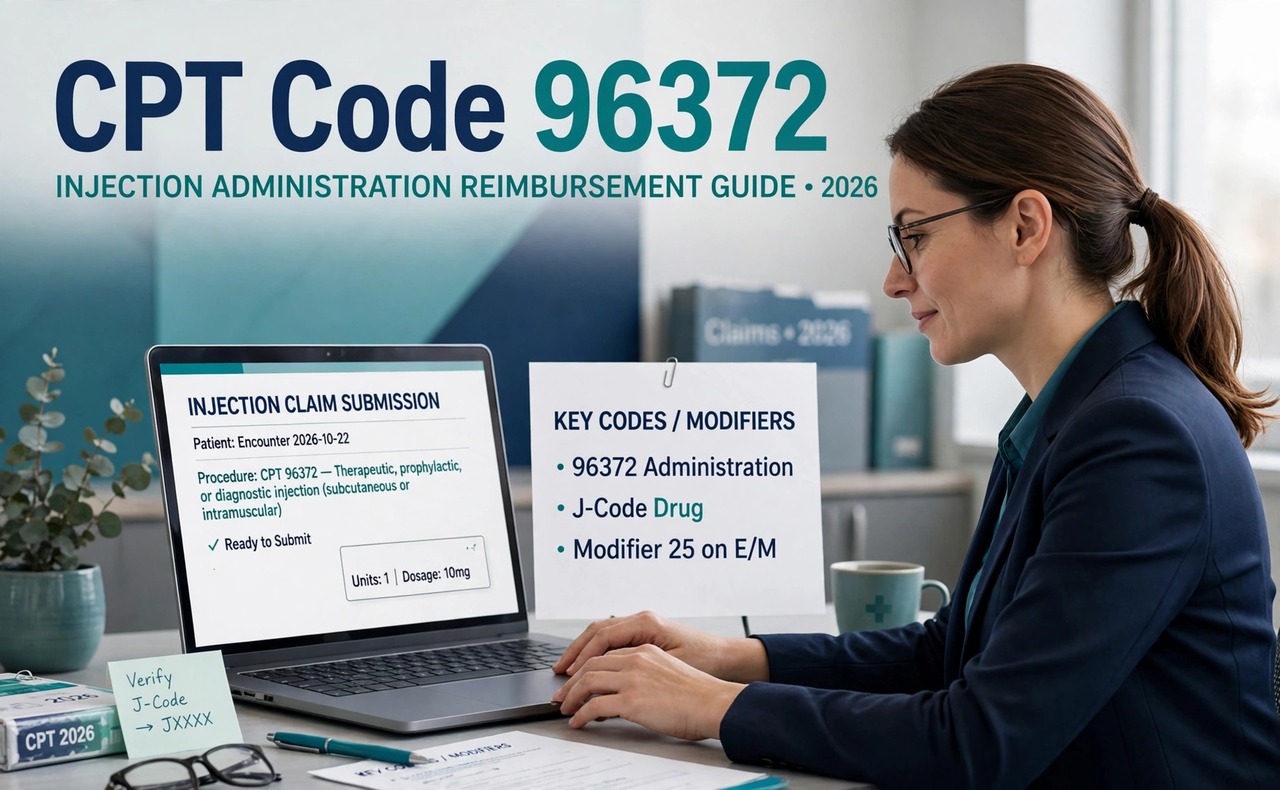
CPT Code 96372 is for the administration of a therapeutic, prophylactic, or diagnostic injection.
It covers the work of giving the injection, not the drug itself.
The route must be subcutaneous or intramuscular.
Intra-arterial administration is also in the descriptor, but it is rare in office practice.
If the route is intravenous push, this code is wrong.
That is a different code family, and it is a common audit trap.
This guide to cpt code 96372 is for primary care, family practice, allergy, pain and small specialty practices that give injections every day.
If your team cannot check these claims before submission, CPC-certified ICD-10 coding support can review the administration, drug and modifier lines together.
CPT Code 96372: Quick Comparison Table
Use this table before you pick a code. Route decides the code, not the drug name.
Do not pick a code because it pays more. Pick it because the note proves the route.
| Code | Service | Route |
| 96372 | Therapeutic, prophylactic, or diagnostic injection | Subcutaneous or intramuscular |
| 96374 | Intravenous push, initial substance | Intravenous, by syringe |
| 90471 | Immunization administration, single vaccine | Intramuscular or subcutaneous, vaccine only |
| 96401 | Chemotherapy administration | Subcutaneous or intramuscular, anti-neoplastic drug only |
What CPT Code 96372 Pays For, and What It Does Not Pay For
CPT Code 96372 pays for the administration service only.
That means preparing the injection, giving it, and the usual pre- and post-injection work.
It does not pay for the drug itself.
The drug is billed on a separate line with its HCPCS J-code.
Example: a Toradol injection needs 96372 for administration and a J-code for ketorolac.
If you bill only 96372, the drug cost is lost.
If you bill only the J-code, the administration work is lost.
Both lines need the diagnosis that proves medical necessity.
The diagnosis must support both the drug and the route.
A vague diagnosis, or a diagnosis that does not match the drug, will deny.
How to Build a Clean CPT Code 96372 Claim
A clean cpt code 96372 claim has three parts on separate lines.
Line one is 96372, the administration.
Line two is the J-code, the drug, with the correct units.
Line three is the ICD-10 diagnosis, showing why this drug and this route were needed.
Check the J-code units carefully. Many J-codes are per milligram, not per vial.
Billing one unit when the drug needs 100 units will underpay the claim.
Billing 100 units when the drug needs one unit will overpay and invite an audit.
For patient-supplied medication, put the drug name and dosage on the claim.
On a paper CMS-1500, that is Box 19. On an electronic 837P, it is the equivalent loop and segment.
Do not skip this step. Payers deny patient-supplied drug claims as incomplete without it.
Modifier 25 and CPT Code 96372: The Rule Most Practices Get Wrong
Modifier 25 goes on the E/M code, never on cpt code 96372.
That is the single most important modifier rule in this article.
Use Modifier 25 only when the E/M service is significant and separately identifiable.
It must be more than the usual work of giving the injection.
Routine work includes checking the drug, getting consent, and watching the patient after the shot.
That routine work is already included in 96372. It does not support a separate E/M.
A separate E/M means the provider evaluated a different problem, or the same problem in much more depth.
Example: a patient comes for shoulder pain, is fully evaluated, and then gets a Toradol injection.
That visit can support 99213-25 plus 96372 plus the J-code, if the note proves the separate evaluation.
Example: a patient comes only for a scheduled B12 injection, with a quick check before the shot.
That visit does not support a separate E/M. Bill 96372 and the J-code only.
Never bill 99211 with 96372.
99211 is a low-level visit that does not meet the “significant” test for Modifier 25.
Payers will deny one or both lines, and the combination looks like a documentation conflict.
Facility Setting Rules for CPT Code 96372
In a facility setting, a physician is generally not separately paid for cpt code 96372.
Facility place of service codes include 19, 21, 22, 23, 24, 26, 51, 52, and 61.
In those settings, the facility bills the administration work.
The physician bills only the professional E/M or procedure service.
Adding Modifier 25 in a facility setting does not unlock separate payment for 96372.
The rule is about place of service, not about the modifier.
In a non-facility setting, such as a physician office, POS 11, the rule is different.
There, 96372 can be separately reported with a qualifying E/M, if Modifier 25 rules are met.
Check POS before you submit. This one field prevents a whole category of denials.
If the same patient gets an injection in the office and later the same day is admitted to hospital, check the payer rule.
Different place of service on the same date can change how each service is paid, so do not assume both lines pay automatically.
Multiple Injections on the Same Day in CPT Code 96372
Two different drugs, given by injection on the same day, need two separate administration lines.
Each line needs its own drug, dose, route, and anatomical site in the note.
Use Modifier 59, or a payer-preferred X-modifier such as XS, on the second administration line.
That modifier tells the payer the second injection was a distinct service, not a duplicate.
Example: methylprednisolone in the left deltoid and cyanocobalamin in the right deltoid.
Bill 96372 with the first J-code, then 96372-59 with the second J-code.
For multiple injections of the same drug, CMS guidance has been to report the number of administrations as units, but always verify with your local Medicare contractor first.
A published CMS clarification on multiple injections shows why this area needs a payer check, not a guess.
If the same injection is repeated later the same day by the same provider, Modifier 76 may apply.
If it is repeated by a different provider, Modifier 77 may apply.
Do not use 59, 76, and 77 together for the same line. Pick the one that matches the facts.
Also check the Medically Unlikely Edit, or MUE, for 96372 before you submit many units.
MUE values change quarterly, so check the current CMS NCCI tables, not an old blog post.
Modifiers JW and JZ in CPT Code 96372 Claims
Modifiers JW and JZ go on the drug J-code line, never on cpt code 96372 itself.
JW reports drug amount discarded from a single-dose vial or single-use package.
JZ attests that no drug amount was wasted from that single-dose vial.
These modifiers are for single-dose vials only. They are not for multi-dose vials.
Document the wasted amount in the record, and bill the J-code for the full vial amount.
Do not apply JW or JZ to every drug claim. Apply them only where the payer and vial type require them.
Medicare rules on JW and JZ have changed over time, so verify the current rule before you submit.
A missing JW or JZ where required can be flagged in a RAC audit as overcoding of the drug line.
Payer Differences for CPT Code 96372: Do Not Use One Rule for All Payers
Payer rules for cpt code 96372 are not the same for every payer.
Medicare follows CMS and NCCI guidance, but local Medicare contractors can add their own policies.
Medicaid rules vary by state. Some state programs need prior authorization for the drug, even if 96372 itself does not.
Some state programs also need the NDC number on the claim, even though the NDC is tied to the J-code.
Commercial payers often follow CMS guidance, then add their own bundling edits.
Some commercial plans need Modifier 59 where another payer would accept Modifier 25, or the reverse.
Never copy a single payer policy and present it as a universal rule.
Before you submit, check the payer policy, the local coverage determination, and the drug authorization status.
The CMS NCCI Policy Manual is the authoritative starting point for bundling and integral-service rules, not a payer blog.
Keep a payer matrix for 96372 in your billing software.
It should prompt for POS, E/M status, vial type, and any concurrent procedure, before submission.
Top CPT Code 96372 Denials and How to Fix Them
- Denial: bundled with E/M. Fix: check if a separate E/M was truly documented, then add Modifier 25 to the E/M code only.
- Denial: missing J-code or NDC. Fix: add the drug J-code line, correct units, and NDC where the payer requires it.
- Denial: facility place of service. Fix: do not bill physician 96372 separately in a facility POS; bill the professional service only.
- Denial: duplicate line. Fix: add Modifier 59 or XS for a distinct second injection, with site and drug documented.
- Denial: wrong code for vaccine. Fix: use vaccine administration codes such as 90471, not 96372, for immunizations.
- Denial: medical necessity not proven. Fix: link the diagnosis to the drug, dose, and route in the note.
Documentation Checklist for CPT Code 96372
- Drug name, dose, route, and anatomical site, for every injection.
- Medical necessity: diagnosis that supports this drug and this route.
- E/M note, if billed: what was evaluated beyond routine injection work.
- J-code units: calculated from the J-code descriptor, not from the vial size alone.
- NDC number, where the payer requires it, plus lot and expiration if your payer asks for them.
- Wastage, if any: amount discarded from a single-dose vial, with JW or JZ as required.
- Patient-supplied drug: drug name and dosage on Box 19 or the 837P equivalent.
If any item above is missing, fix the note before you submit, not after the denial.
A complete note is cheaper than an appeal, every time.
CPT Code 96372 vs CPT Code 96374: Which Code Should You Bill?
CPT Code 96372 is for a small-volume injection given subcutaneously or intramuscularly.
No IV access is needed, and no prolonged monitoring is required for the route itself.
CPT Code 96374 is for an intravenous push, where the drug goes directly into a vein by syringe.
The provider must be present during the IV push, and rapid systemic absorption is the reason for the route.
If the note says “given in the deltoid” or “injected subcutaneously in the abdomen,” that is 96372.
If the note says IV access, syringe push through a catheter, or intravenous delivery, that is 96374.
Never bill both codes for the same drug administration event.
Billing both for one drug, by one route, is a bundling violation and an audit risk.
Billing 96374 when the route was IM, just because it pays more, is upcoding.
Route in the note decides the code. Payment rate never decides the code.
Frequently Asked Questions About CPT Code 96372
What does CPT Code 96372 cover?
CPT Code 96372 covers therapeutic, prophylactic, or diagnostic injections given subcutaneously or intramuscularly.
It covers only the administration service, not the medication itself.
Can CPT Code 96372 be billed with an E/M service?
Yes, but only when the E/M service is separately identifiable and medically necessary.
In that case, Modifier 25 goes on the E/M code, not on 96372.
Why are CPT Code 96372 claims often denied?
Common reasons are wrong modifier use, facility place of service, missing J-code or NDC, and weak medical necessity documentation.
Fix the root cause first, then resubmit or appeal inside the payer deadline.
Is CPT Code 96372 reimbursed in a facility setting?
Generally, a physician is not separately reimbursed for 96372 in many facility settings.
In those settings, the injection is bundled into the facility service, and the physician bills the professional service only.
Can patient-supplied medication be billed with CPT Code 96372?
Yes, if the injection is medically necessary and properly documented.
Put the drug name and dosage on the claim, on Box 19 or the 837P equivalent.
Get a Free CPT Code 96372 Audit
If injection claims, Modifier 25 denials, or facility POS denials are showing up in your accounts receivable, get a sample review.
Pro Health Care Advisors can review recent 96372 claims, check administration, J-code, and modifier lines, and show where revenue is leaking.
Good injection coding belongs inside revenue cycle management, not at the end of it.
Our step-by-step approach to how to reduce claim denials uses the same fix: categorise by reason code and fix the root cause.
Contact Pro Health Care Advisors for a free coding audit and a clear, practice-specific fix list.