







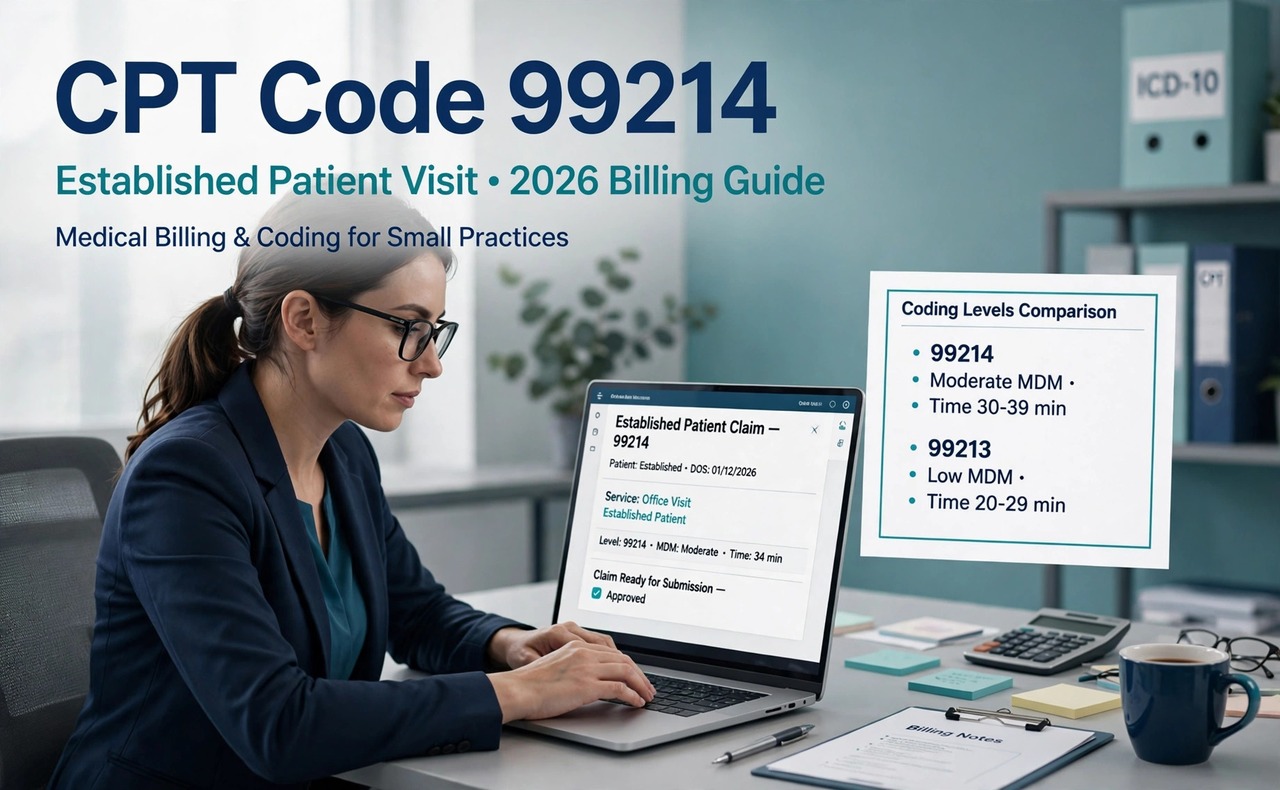
CPT Code 99214 is for an established patient office visit at a moderate level.
It needs moderate medical decision making, or 30-39 minutes of total time on the date of the encounter.
Pick one method for that visit: MDM or time. Do not mix the two to reach a higher level.
History and examination are documented as medically appropriate, but they do not set the level.
CPT Code 99214 is one of the most commonly billed E/M codes, and also one of the most audited.
That is why documentation must prove the level, not just claim it.
This guide to cpt code 99214 is for primary care, internal medicine, family practice, and small specialty practices.
If your team cannot audit these visits every month, CPC-certified ICD-10 coding support can re-check MDM and time before a claim reaches a payer.
CPT Code 99214: Quick Reference Table
Use this table to place cpt code 99214 in the established patient family.
Established means the patient was seen within the past three years by the same physician.
The same rule applies to another physician of the same specialty in the same group.
A patient seen by a different specialty in the same group can still be new, not established.
| Code | MDM Level | Total Time |
| 99212 | Straightforward | 10-19 minutes |
| 99213 | Low | 20-29 minutes |
| 99214 | Moderate | 30-39 minutes |
| 99215 | High | 40-54 minutes |
If total time is 40 minutes or more, the visit is not 99214 by time.
By time, 40-54 minutes points to 99215, if MDM or time rules are fully met.
Do not stretch 99214 to cover a 99215 visit, and do not shrink a 99215 visit to 99214.
Moderate MDM in CPT Code 99214: 2 of 3 Elements
Moderate MDM in cpt code 99214 means two of three elements meet the moderate level.
The three elements are problems addressed, data reviewed and analysed, and risk of patient management.
You do not need all three elements at moderate. Two are enough.
But the two you claim must be clearly documented, not just implied.
Problems at moderate level often look like one chronic illness with exacerbation or progression.
They can also look like two or more stable chronic illnesses.
They can also look like one undiagnosed new problem with uncertain prognosis.
Data at moderate level means a combination of data categories, as defined in the current MDM table.
Examples include review of prior external notes, review of test results, and ordering tests.
Other examples include assessment needing an independent historian and discussion with an external physician.
Do not use an old points system for data. The 2021 MDM table uses categories, not points.
Risk at moderate level often looks like prescription drug management.
It can also look like a decision about minor surgery.
It can also look like a diagnosis or treatment limited by social determinants of health.
If only one element reaches moderate, and the others are low, the visit is not 99214 by MDM.
It may be 99213, even if the visit felt busy.
The AAPC E/M 2021 guide explains this change clearly: office E/M level now focuses on time or MDM, not on history and exam counts.
CPT Code 99214 Example That Qualifies, and One That Does Not
Example that qualifies for cpt code 99214: type 2 diabetes with poor control, A1C rising over time.
The provider reviews A1C results and prior notes, discusses the case with another clinician, and adjusts insulin.
Problems, data, and risk all reach moderate here, so MDM supports 99214.
Example that does not qualify: a routine follow-up for stable hypertension, with no medication change.
Problems are one stable chronic illness, data are limited, and risk is low.
That visit supports 99213, low MDM or 20-29 minutes, not 99214.
The difference is not the length of the note. It is the complexity proven in the note.
Time Rules for CPT Code 99214: 30-39 Minutes
The 99214 time requirement is 30-39 minutes of total provider time on the date of the encounter, and the time for 99214 by this method is still 30-39 minutes in 2026.
When you bill cpt code 99214 by time, count total time on the date of the encounter only.
Total time includes preparing to see the patient, reviewing records, labs, and imaging.
It includes history, examination, counselling, ordering, referrals, and documentation.
It includes care coordination and communication with other providers on that same date.
Total time does NOT include time by clinical staff alone.
It does NOT include time on a different date.
It does NOT include time on a separately reported service on the same date.
It does NOT include time spent teaching a resident or student.
Document a clear time statement, for example: “Total time spent: 35 minutes.”
Better still, break it down: face-to-face time plus record review and coordination time.
“35 minutes” alone, with no breakdown, is weaker under audit than a total with its parts.
99213 vs 99214 in CPT Code 99214 Billing: Where Upcoding Happens
The difference between 99213 and 99214 is complexity and time, proven in the note, not the length of the visit alone.
The 99213 versus 99214 question is where cpt code 99214 most often goes wrong.
99213 needs low MDM or 20-29 minutes. 99214 needs moderate MDM or 30-39 minutes.
Do not bill 99214 for every established patient just because the patient is known to the practice.
Do not bill 99214 because the visit took a long time in the waiting room.
Waiting time, staff time, and time on another date do not count toward total time.
If MDM is low and time is under 30 minutes, 99213 is correct, even if the patient has many problems on the list.
Problems only count if they were addressed in that visit, with data and risk to match.
Audit the 99213 to 99214 ratio every month. A sudden jump to mostly 99214 is a red flag.
Modifier 25 and CPT Code 99214: When It Belongs on the Visit
Modifier 25 goes on cpt code 99214, not on the procedure code, when the rule applies.
Use it only when the E/M service is significant and separately identifiable from a same-day procedure.
It must go beyond the usual pre- and post-procedure work for that procedure.
Example that is wrong: a visit only for a joint injection, billed as 99214-25 plus the injection code.
In that case, the visit was the injection visit itself, not a separate evaluation.
Example that is correct: the same visit also evaluates an unrelated problem, with its own history, exam, and decision.
In that case, 99214-25 plus the procedure code can be supported, if the note proves the separate work.
Frequent 99214-25 billing with procedures is an audit red flag, even when some cases are correct.
Track it by provider and by procedure, and review the notes, not just the code pair.
99214 RVU and Reimbursement: What to Check, Not Copy
The 99214 RVU question is about work value, not about a single dollar rate.
Work RVU measures physician work: time, skill, effort, and stress for the service.
For 99214, the work RVU in the 2026 CMS fee schedule sources checked for this article is 1.92, higher than 99213 at 1.30.
Total payment is not work RVU alone. It also uses practice expense and malpractice RVUs, geographic adjustment, and the conversion factor.
That is why 99214 reimbursement and 99214 Medicare reimbursement vary by locality and by year, so check the current CMS Physician Fee Schedule for your locality.
Place of Service and Telehealth for CPT Code 99214
CPT Code 99214 can be billed in an office, in a facility outpatient setting, and by telehealth, with the correct place of service.
Office is POS 11. Hospital outpatient is POS 22. Telehealth uses POS 02 or 10, depending on where the patient is.
Payment differs by place of service and by locality. Facility rates are generally lower than non-facility rates.
Do not copy a dollar rate from another blog as your rate.
Check the current CMS Physician Fee Schedule for your locality and year, and your payer contracts.
Telehealth rules also change by payer and by year, so verify the current telehealth policy before you submit.
The documentation standard for 99214 does not drop for telehealth.
MDM or time must still be proven in the note, in the same way as an in-person visit.
Prolonged Time and CPT Code 99214: What Not to Add
Prolonged service add-on +99417 does NOT go with cpt code 99214.
It goes only with the highest codes in each family: 99205 for new patients and 99215 for established patients.
If an established visit runs long by time, check whether it reaches 99215 first.
99215 by time is 40-54 minutes. Beyond 54 minutes, +99417 may apply with 99215, in 15-minute blocks.
Do not add +99417 to 99214 to cover extra time. That combination will deny.
Do not use time alone to justify 99214 if the time was not on the date of the encounter.
Documentation Checklist for CPT Code 99214
- Established status: seen within three years, same specialty and group check documented.
- Method chosen: MDM or total time, stated clearly for that visit.
- MDM elements: problems, data, risk — at least two elements at moderate level.
- Time, if used: total minutes on the date, with a breakdown of what the time was spent on.
- Medically appropriate history and examination: present, even though they do not set the level.
- Diagnoses: coded to the highest specificity supported, with medical necessity clear.
- Modifier 25, if used: separate, significant work beyond the procedure, documented in the note.
The AAPC E/M 2021 checklist is a useful second reference for this checklist. Use it to check MDM and time before submission.
If any item above is missing, fix the note before you submit, not after the denial.
Audit Red Flags for CPT Code 99214
Auditors look for patterns in cpt code 99214 billing, not just single claims.
Red flag one: 99214 makes up more than 60 percent of all E/M codes for a provider.
That pattern is possible in some specialties, but it needs strong documentation to defend.
Red flag two: 99214 billed for routine follow-ups of stable conditions, with no change in management.
Red flag three: frequent 99214-25 billing with procedures, without separate evaluation notes.
Red flag four: time statements that do not match the complexity in the note.
Red flag five: templates that copy the same MDM language into every visit.
A template can prompt for MDM elements, but it must not create MDM that did not happen.
Document in real time, or immediately after the visit, while the details are fresh.
Retrospective documentation invites audit scrutiny, even when the code was correct.
What to Do After a CPT Code 99214 Denial
After a 99214 denial, do not simply resubmit the same code.
Read the denial reason first. If it is a level denial, re-check MDM or time, whichever method you used.
If the note supports a different level, correct and resubmit inside the payer deadline.
If the note does not support a different level, query the provider and appeal with the documentation attached.
If the denial is for Modifier 25, check whether a separate evaluation was truly documented.
If it was not, remove the modifier and correct the claim, rather than appealing the same pair.
Our step-by-step approach to how to reduce claim denials uses the same fix: categorise by reason code and fix the root cause.
Track patterns by payer. A pattern by payer is easier to fix than a single denial.
Frequently Asked Questions About 99214
What is the difference between CPT Code 99213 and 99214?
99213 needs low MDM or 20-29 minutes. 99214 needs moderate MDM or 30-39 minutes.
The difference is complexity and time, proven in the note, not the length of the visit alone.
Can 99214 be billed for a telehealth visit?
Yes, 99214 can be billed for telehealth, with the same MDM or time documentation as an in-person visit.
Use the correct place of service code for telehealth, and verify the current payer telehealth policy first.
How do I count the 30-39 minutes for 99214?
Count all provider time on the date of the encounter, including record review before the visit and documentation after it.
Do not include clinical staff time, time on another date, or time on a separately reported service.
Do I need to document all three MDM elements for 99214?
No, you need two of the three MDM elements at moderate level: problems, data, or risk.
Meeting all three is fine, but two are enough if both are clearly documented.
When should I use Modifier 25 with 99214?
Use Modifier 25 only when 99214 is a separate, significant E/M service on the same day as a procedure.
It must go beyond the usual pre- and post-procedure work for that procedure.
Can you bill a 99214 and 99401 together?
Can you bill a 99214 and 99401 together? Not as a routine pair for the same work.
99401 is preventive counselling. If counselling is part of the same visit work, it is usually included in the visit level, so check the current CPT guidance and your payer policy before billing both on the same date.
Is 99214 an ICD code or a HCPCS code?
No. 99214 is a CPT code, which is HCPCS Level I, for a physician service.
It is not an ICD-10 diagnosis code. Diagnosis codes are separate, and they must support medical necessity for the visit.
Get a Free 99214 Audit
If established visits, 99213 to 99214 upcoding, or Modifier 25 denials are showing up in your accounts receivable, get a sample review.
Pro Health Care Advisors can review recent 99214 claims, re-check them by MDM and by time, and show where revenue is leaking.
Contact Pro Health Care Advisors for a free coding audit and a clear, practice-specific fix list.