








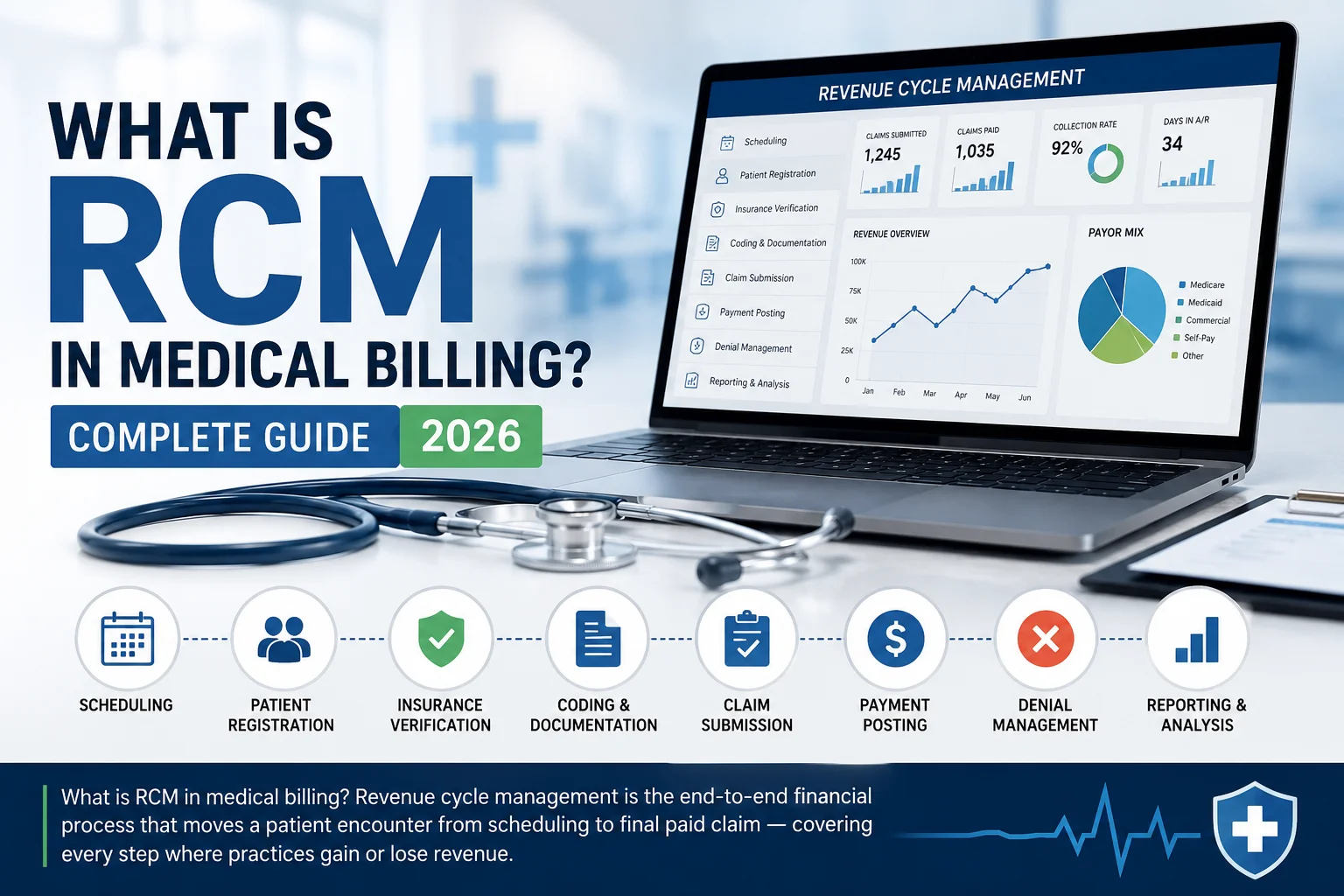
What Is RCM in Medical Billing? Complete 2026 Guide for Healthcare Practices
If you have ever asked yourself why your practice seems to be busy all the time but the bank account does not reflect it — RCM is usually the answer.
RCM stands for Revenue Cycle Management. In medical billing, it refers to the complete end-to-end financial process that healthcare organizations use to track, manage, and collect payment for every service they deliver — from the moment a patient books an appointment to the day the final payment clears.
It is not just billing. It is not just coding. It is the entire system that connects patient registration, insurance verification, clinical documentation, charge capture, claim submission, denial management, payment posting, and patient collections into one continuous revenue-generating process.
According to BillFlash’s RCM guide, RCM covers the entire patient financial journey — and any errors or inefficiencies early in the cycle can create problems that impact your bottom line at the very end. A single mistake at step two can trigger a denial at step eight. That is why understanding RCM as a system — not a collection of isolated tasks — is what separates practices that collect what they earn from practices that silently write off thousands of dollars every month.
This guide explains what RCM is, how each step works, why it matters more in 2026 than ever before, the key performance metrics you should be tracking, and what the right RCM partner looks like for your practice.
What Does RCM Stand For in Medical Billing?
RCM = Revenue Cycle Management
The “revenue cycle” is the complete financial lifecycle of a patient encounter — every administrative and clinical step that must happen between a patient walking into your office and your practice receiving final payment for the care delivered.
According to GeBBS Healthcare Solutions, in healthcare, RCM refers to the entire process of managing financial transactions from patient registration and insurance verification to final payment posting. It ensures that every clinical encounter is accurately captured, coded, billed, and reimbursed — so providers can protect margins, reduce administrative friction, and focus on patient care.
RCM vs. Medical Billing — What Is the Difference?
This is one of the most commonly confused distinctions in healthcare administration.
Medical billing is a component of RCM — it focuses specifically on claim creation, submission, and reimbursement from payers. It is important, but it is only one part of the larger process.
Revenue cycle management (RCM) is the complete financial framework — it encompasses everything from patient scheduling and eligibility verification on the front end, through medical coding, claim submission, and payment posting in the middle, all the way to denial management, AR follow-up, and patient collections on the back end.
A practice that only manages medical billing — without managing the full RCM cycle — is leaving money on the table at multiple points before and after the claim is submitted.
Why RCM Matters More in 2026 Than Ever Before
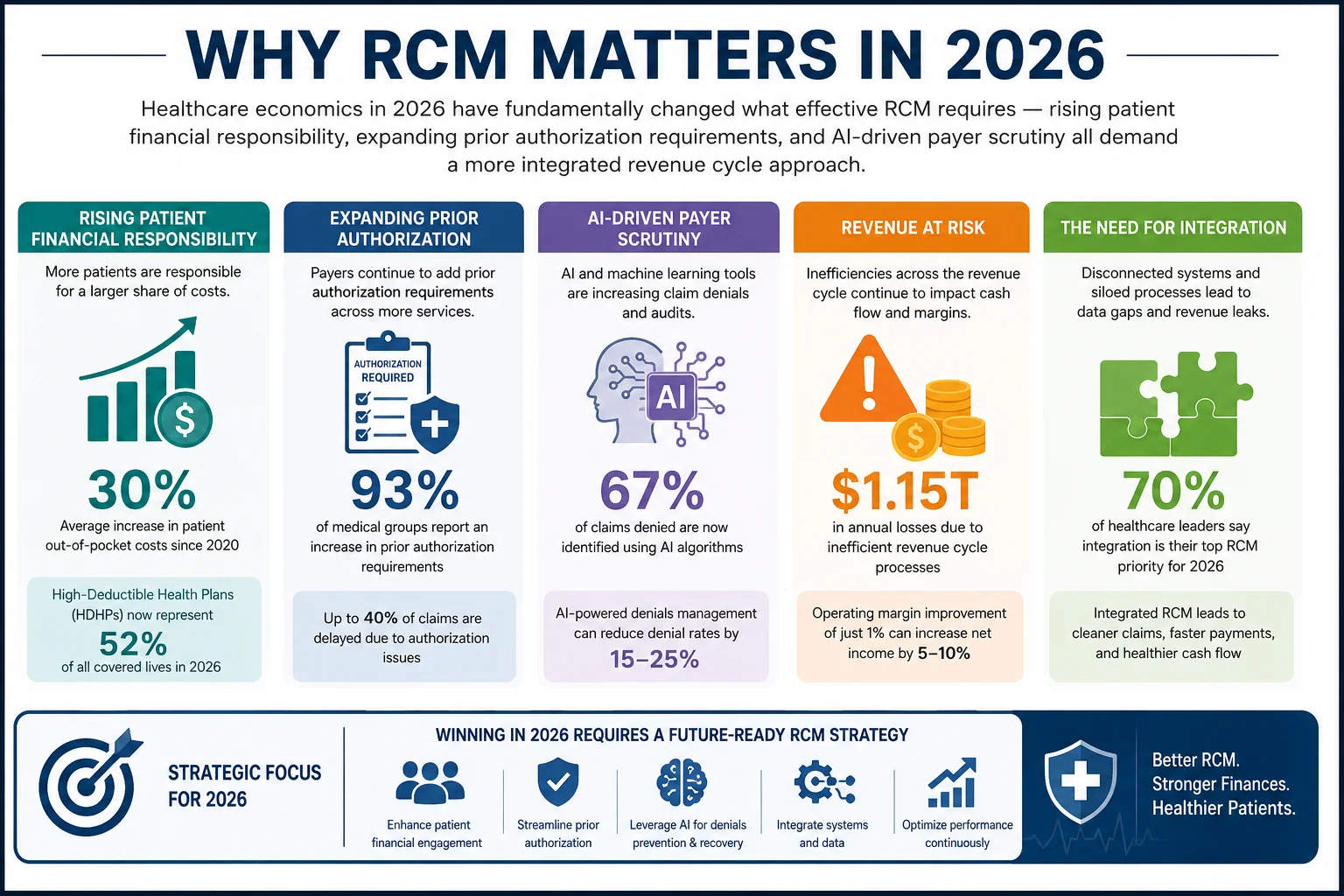
According to ADSC’s 2026 RCM guide, healthcare economics in 2026 look very different from a decade ago. Several forces have made effective RCM mission-critical for practices of every size:
Rising patient financial responsibility. With high-deductible health plans now covering more than 57 percent of employer-sponsored workers, patients now account for nearly 30 to 35 percent of total provider revenue. That means practices are no longer just billing insurance — they are collecting high-dollar amounts directly from patients, which requires a completely different skill set.
Expanding prior authorization requirements. Payers continue to tighten their prior authorization requirements across more service types and specialties. Practices without systematic prior authorization workflows generate CO-15 denials continuously — costing revenue that a proper process would prevent.
National claim denial rates keep climbing. The national initial claim denial rate hit 11.8 percent in 2024 and continued rising into 2026. Healthcare providers across the USA lose an estimated $125 billion annually to billing errors, claim denials, and inefficient RCM processes according to MDeRCM’s 2026 billing guide. The practices that close this gap are the ones managing a full revenue cycle — not just submitting claims.
AI-driven payer scrutiny. Payers now use automated tools to review and deny claims at high volume and high speed. Errors that previously slipped through are now caught and denied automatically — meaning RCM processes must be more accurate at the front end than they have ever been before.
Labor shortages and turnover. Administrative staff turnover in billing roles runs between 33 and 40 percent annually. Every departure creates a gap in the revenue cycle that compounds quickly when claims go unsubmitted, denials go unworked, and AR ages past recovery.
The 8 Steps of RCM in Medical Billing — Explained
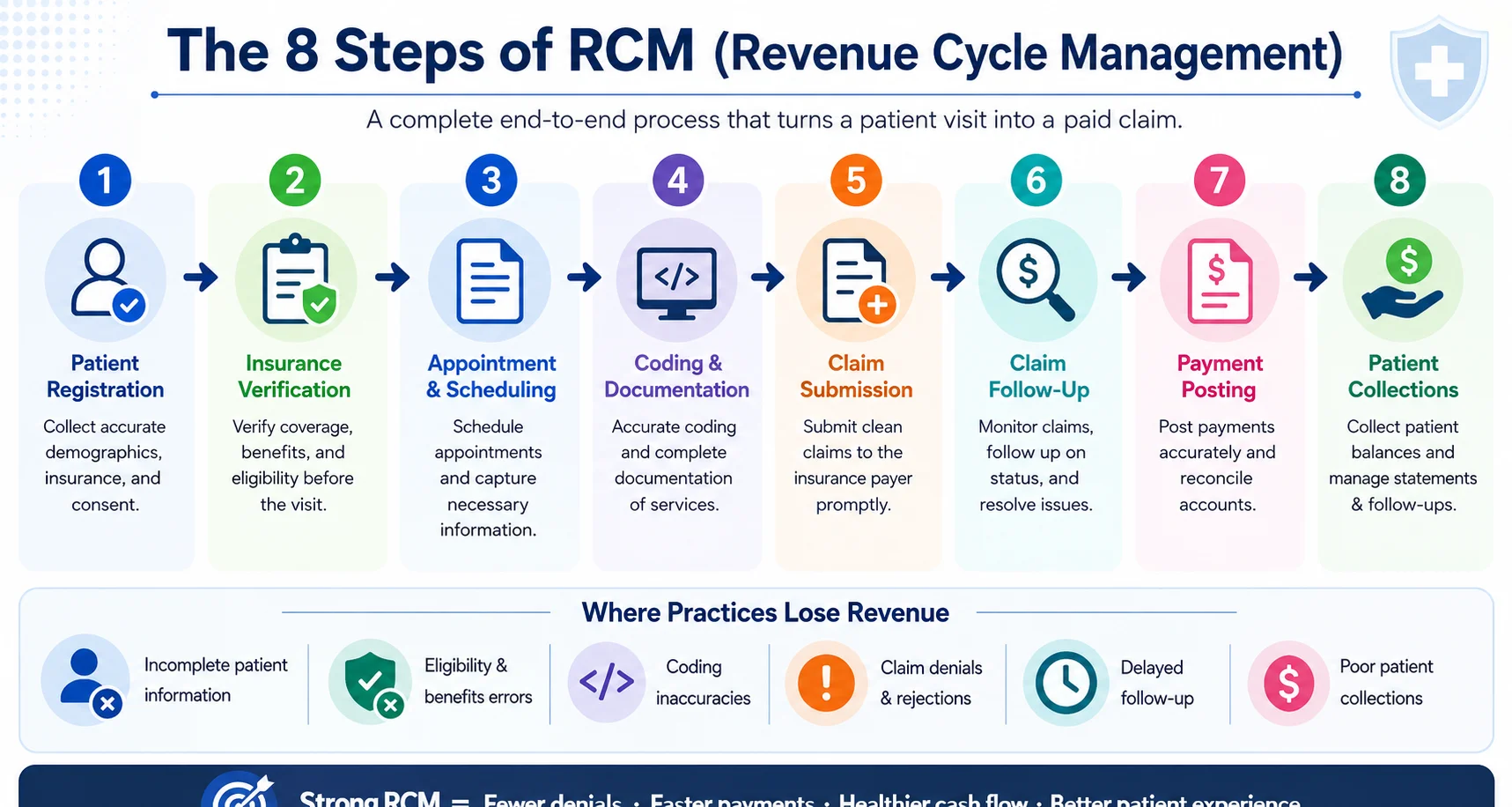
Step 1 — Patient Registration and Scheduling
The revenue cycle begins before the patient arrives. Patient registration captures the demographic, insurance, and financial information that travels through every subsequent step. Errors here — a transposed digit in a date of birth, an incorrect insurance ID, an outdated group number — generate CO-16 denials weeks later when the claim reaches the payer.
Good registration in 2026 means: collecting and scanning insurance cards and photo ID at every visit, verifying all demographic fields at each encounter, and updating insurance information even for established patients who may have changed plans.
Step 2 — Insurance Eligibility and Benefits Verification
Before every appointment, insurance coverage must be verified in real time — not from stored information from the patient’s last visit. Insurance changes constantly. A patient whose plan was correct in March may have a different group number, payer, or benefit structure in June.
Eligibility verification in 2026 goes beyond confirming that coverage exists. It confirms the specific plan type, effective date, deductible status, copay, coinsurance, out-of-pocket maximum, and whether mental health or other specialty benefits are managed by a separate entity (a carve-out). Missing any of these generates a denial downstream.
Step 3 — Prior Authorization
For services that require pre-approval from the payer, prior authorization must be obtained before the service is delivered. Once the service is rendered without authorization, the CO-15 denial is almost always unwinnable.
Prior authorization management in 2026 requires systematic tracking — knowing which services require authorization from which payers, confirming authorization status before every procedure, and monitoring for authorizations that expire before multi-visit treatment courses are complete.
Step 4 — Charge Capture and Medical Coding
After the patient encounter, the clinical services delivered must be translated into billable charges and ICD-10 and CPT codes. This step is where undercoding most commonly occurs — a provider documents a level 3 office visit when the clinical work and documentation support a level 4, or a procedure is delivered at higher complexity than the code selected reflects.
Undercoding is invisible: the claim gets paid, just for less than it should. Research consistently identifies undercoding as costing practices 6 to 9 percent of net collections annually — money that never appears as a visible denial or write-off because the claim was technically accepted.
According to Human Medical Billing’s RCM guide, clinical documentation is translated into billing codes through medical coders — and correct coding in accordance with payer rules is critical to claim acceptance and correct reimbursement.
Our CodeMAXX services specifically address this undercoding pattern before claims are submitted.
Step 5 — Claim Submission
Clean, correctly coded, complete claims are submitted electronically to the appropriate payer. This is what most people think of when they hear “medical billing” — but it is step five of eight, not the whole process.
A clean claim is one that passes all pre-submission edits — demographic, clinical, and technical — and reaches the payer without errors that prevent adjudication. The percentage of claims achieving clean submission on the first pass is your clean claim rate — the single most important performance metric in the entire revenue cycle.
Our medical billing and practice management services maintain a 98.5 percent clean claim rate — well above the 85 to 92 percent average for in-house billing operations.
Step 6 — Payment Posting and Remittance Processing
When payers process claims and issue payments, the Explanation of Benefits (EOB) or Electronic Remittance Advice (ERA) must be reviewed and posted accurately. This step involves verifying that payment amounts match contracted fee schedules, identifying denial codes on rejected claims, preparing secondary billing where applicable, and flagging underpayments for follow-up.
Poor remittance processing allows underpayments to go undetected — a payer reimbursing below contracted rates is a permanent revenue loss unless the discrepancy is caught and disputed within the contract’s appeal window.
For a complete breakdown of denial codes that appear on EOBs, see our medical billing denial codes guide.
Step 7 — Denial Management and AR Follow-Up
Denied claims must be categorized, prioritized, appealed, and resolved before their appeal windows close. This is the step where most practices’ revenue cycles break down.
Approximately 60 percent of denied claims are never resubmitted or appealed — they are simply written off. For a practice generating $200,000 per month in claims with a 12 percent denial rate, that is $14,400 per month in recoverable revenue being abandoned without a fight.
Effective denial management is not reactive — it is systematic. Every denial is categorized by CARC code within 24 hours. High-value denials with tight appeal windows are worked first. Denial patterns are analyzed monthly and fed back upstream to prevent the same errors from recurring. Our creative collection solutions are built around exactly this kind of structured denial recovery process.
Step 8 — Patient Collections
The final step of the revenue cycle is collecting balances owed directly by patients — after insurance adjudication is complete. With high-deductible health plans covering more than 57 percent of employer-sponsored workers, patient collections now represent 30 to 35 percent of total practice revenue.
Patient collections in 2026 requires: communicating estimated patient responsibility before the visit, collecting copays and estimated deductibles at time of service, offering flexible payment options and online payment portals, and maintaining structured follow-up for outstanding balances.
According to ADSC, practices offering mobile payment options collect balances up to 40 percent faster than those relying on paper statements alone.
Key RCM Performance Metrics Every Practice Should Track
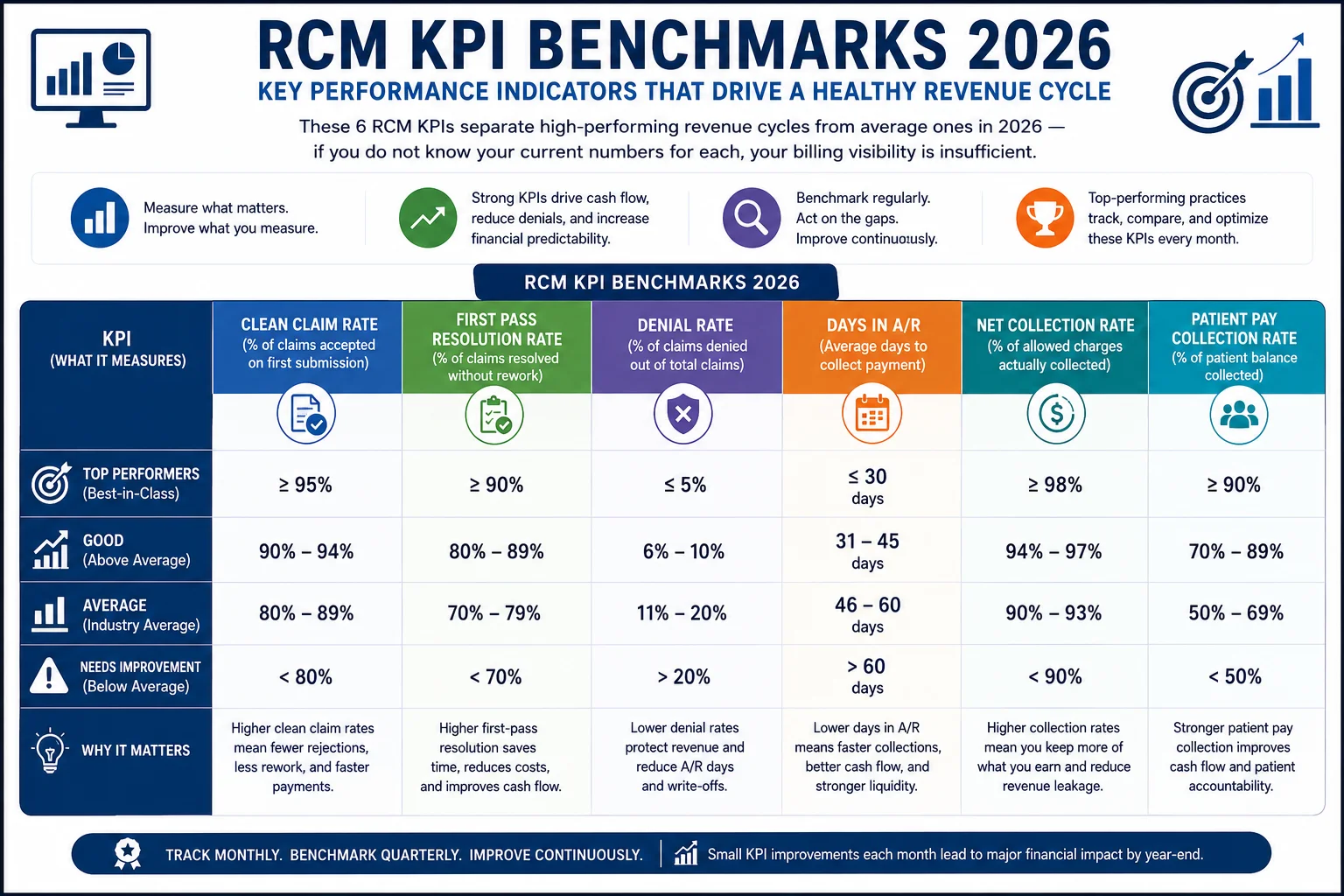
According to PMC’s revenue cycle management research, RCM key performance indicators maintain revenue integrity and identify practices with high compliance risks, bottlenecks impeding payment speed, and factors affecting patient experience.
| KPI | Industry Average | High Performer |
|---|---|---|
| Clean Claim Rate | 85–92% | 98%+ |
| Denial Rate | 11–13% | Under 3% |
| Net Collection Rate | 85–90% | 93–97% |
| Days in AR | 40–55 days | Under 30 days |
| AR Over 90 Days | 20–25% of total AR | Under 15% |
| Patient Collection Rate | 55–65% | 80%+ |
If you do not know where your practice currently sits on these six metrics — that is itself an RCM problem. You cannot improve what you cannot measure. And most practices are operating without visibility into at least three or four of these numbers.
The benchmark for AR aging: less than 15 percent of total AR should be more than 90 days old. An increase in days in AR — without a corresponding increase in patient volume — reveals gaps in the revenue cycle that need to be addressed immediately.
The Most Common RCM Failures — Where Practices Lose the Most Money
Understanding where the revenue cycle breaks down is the fastest path to fixing it. Here are the most common RCM failures in 2026 and what causes each one:
Front-end failures (Steps 1–3): Incomplete patient registration generates CO-16 denials. Eligibility not verified in real time generates OA-23 and CO-22 denials. Missing prior authorization generates CO-15 denials. All three are upstream failures that produce downstream revenue losses — and all three are preventable with the right front-end workflows.
Coding failures (Step 4): Non-specific ICD-10 codes trigger CO-11 and CO-50 medical necessity denials. CPT-diagnosis mismatches generate automatic rejections. Deleted CPT codes — 84 were removed in the 2026 update — generate automatic rejections on every claim containing them. Undercoding silently reduces net collections without ever appearing as a denial. For more on coding changes, see our CPT code changes 2026 guide.
Submission failures (Step 5): No pre-submission scrubbing means errors reach the payer instead of being caught before the claim is sent. Manual submission workflows produce more errors than electronic clearinghouse submission. Submitting to the wrong payer — particularly in managed care markets where behavioral health benefits are carved out to a separate entity — generates routing denials.
Back-end failures (Steps 6–8): Underpayments missed in remittance posting become permanent losses. Denials not worked within appeal windows become uncollectable. Patient balances not collected at time of service are significantly harder to collect later — and most become partial or complete write-offs.
In-House RCM vs. Outsourced RCM — Which Is Right for Your Practice?
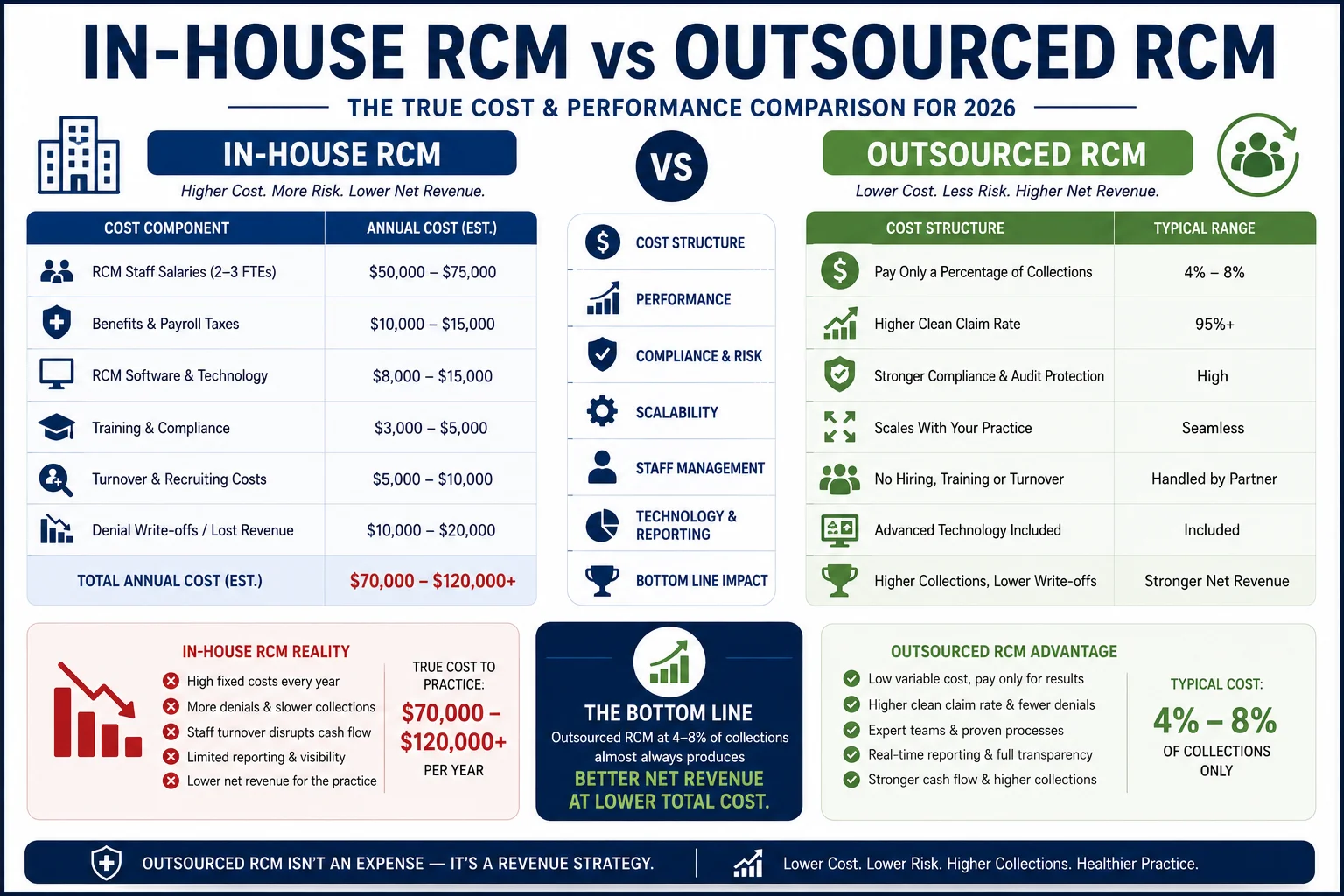
This is the question most practice owners eventually face — and most of them underestimate the true cost of in-house RCM when making the decision.
The true all-in annual cost of in-house RCM for a small practice — including salary, benefits, software, training, turnover, denied claim write-offs, and undercoding losses — typically runs $70,000 to $120,000 per year. Most practices estimate $45,000 to $60,000 because they only count salary and software. The rest of the cost is invisible until someone does the full accounting.
Outsourced RCM is typically priced at 4 to 8 percent of net collections. At that rate, for a practice collecting $150,000 per month, outsourcing costs $6,000 to $12,000 per month — while delivering:
- A higher clean claim rate (98%+ vs. 85–92% average in-house)
- A lower denial rate (under 2% vs. 11–13% national average)
- Structured denial management that recovers claims in-house teams abandon
- No staffing risk — no turnover, no training gaps, no vacation coverage problems
- Real-time performance reporting and AR visibility
For most practices collecting under $1.5 million annually, outsourced RCM produces better net revenue at lower total cost than in-house billing — when all true costs are counted.
For the complete side-by-side cost comparison with real numbers by practice size, see our medical billing vs in-house billing cost comparison guide.
What to Look for in an RCM Partner in 2026
Not all RCM companies deliver the same results. Here is what to specifically ask before choosing one:
Clean claim rate above 97 percent. The national benchmark is 95 percent. The best RCM companies operate at 98 percent or above. Ask for a specific number — not a vague claim of “industry-leading performance.”
Denial rate under 5 percent. The national average is 11 to 13 percent. Any denial rate above 5 percent signals a billing process with structural problems.
AAPC-certified coding staff. Coding accuracy is the foundation of clean claim submission. Confirm that the company employs AAPC-certified coders — not generalist billing staff who also do coding.
Payer-specific experience for your state and specialty. A billing company that treats California Medi-Cal the same as Texas Medicaid will generate avoidable denials. Confirm specialty-specific and state-specific experience relevant to your practice.
Physician credentialing included or available. Credentialing gaps create billing voids. Managing billing and credentialing through one company eliminates the coordination failures that create unbillable claim periods. See our physician credentialing services.
Real-time reporting and dashboard access. You should have visibility into your AR aging, denial rates, clean claim rate, and collection performance at any time — not just at monthly summary meetings.
HIPAA compliance with a signed Business Associate Agreement. Any company handling patient billing data must operate under a signed BAA. Confirm this before sharing any patient information. See our HIPAA compliance services.
How Pro Health Care Advisors Delivers Full RCM
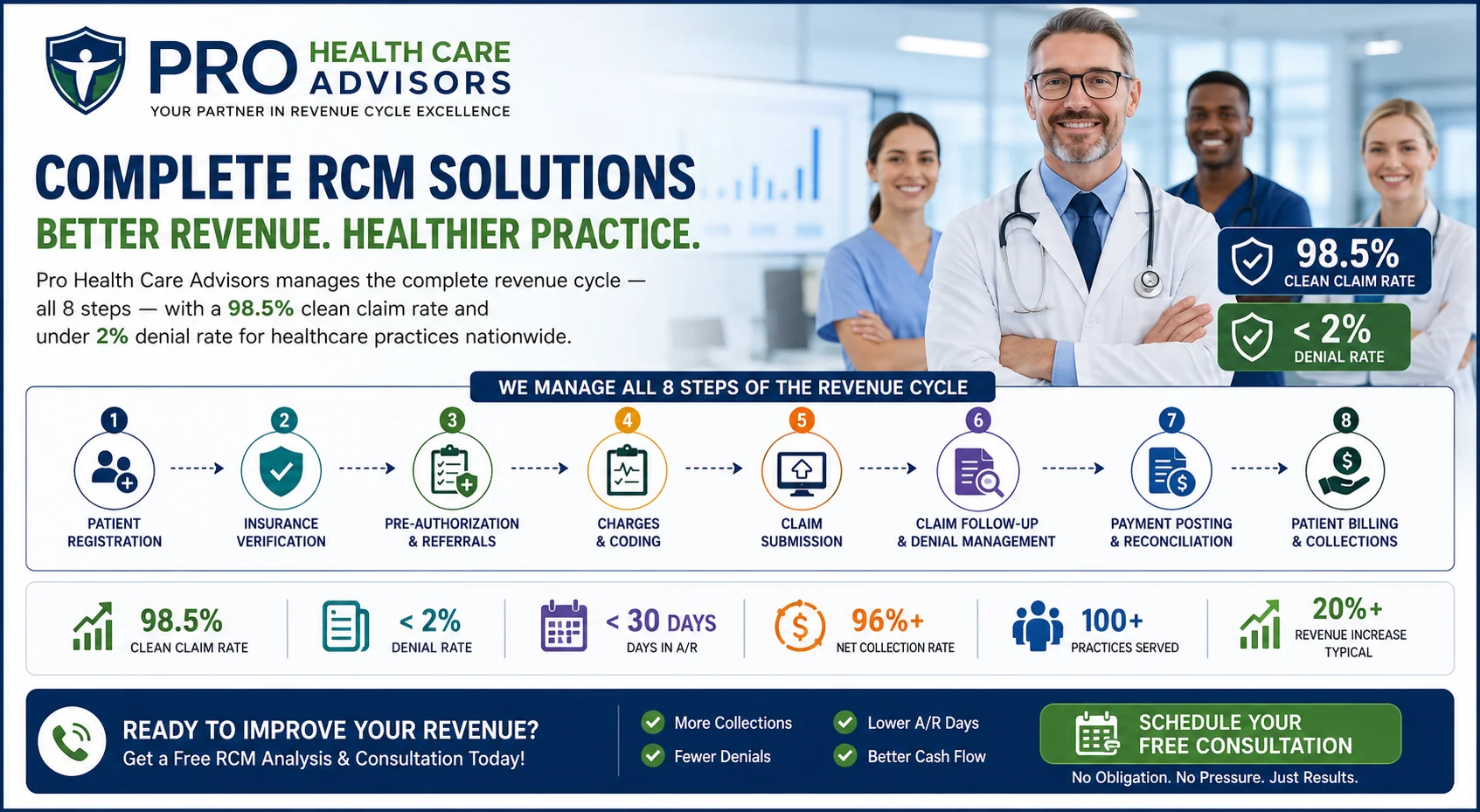
Pro Health Care Advisors provides complete, HIPAA-compliant revenue cycle management for healthcare practices across the United States — covering all 8 steps of the revenue cycle with AAPC-certified staff, real-time reporting, and performance benchmarks that exceed national averages.
Here is how we manage each step:
Registration and eligibility: Real-time insurance eligibility verification before every appointment — confirming active coverage, deductible status, copay, coinsurance, carve-out routing, and prior authorization requirements.
Charge capture and coding: AAPC-certified coders review every claim for ICD-10 specificity, CPT-diagnosis alignment, modifier accuracy, and deleted code compliance. Our CodeMAXX services add a dedicated coding accuracy layer that catches undercoding before submission.
Prior authorization: Systematic PA tracking by payer and service type — with electronic submission through payer-specific portals and proactive monitoring of authorization expirations.
Clean claim submission: Pre-submission scrubbing that maintains a 98.5 percent clean claim rate — well above industry average.
Payment posting: Every payment verified against contracted fee schedules before posting. Underpayments flagged for contract dispute. Denial codes logged by CARC and group code within 24 hours of receipt.
Denial management: Structured denial workflows with categorization, prioritization, and appeal tracking — maintaining a denial rate under 2 percent. Our creative collection solutions recover denied and aged claims that other billing teams abandon.
Patient collections: Patient balance management workflows including point-of-service collection guidance, online payment options, and structured follow-up.
Physician credentialing: Our physician credentialing service handles CAQH, PECOS, Medicaid, and commercial payer enrollment — preventing the credentialing gaps that create revenue voids for new providers.
Audit protection: Our MD Audit Shield RAC service provides documentation review and compliance monitoring that protects your practice from RAC audit findings.
We serve more than 30 specialties including cardiology, family practice, mental health, and wound care. See our full specialties list.
For more billing education, visit our articles and resources library.
Frequently Asked Questions — What Is RCM in Medical Billing
Q: What does RCM stand for in medical billing? RCM stands for Revenue Cycle Management. In medical billing, it refers to the complete end-to-end financial process that healthcare organizations use to capture, manage, and collect payment for every patient service — from scheduling through final payment. It encompasses everything from patient registration and insurance verification to claim submission, denial management, payment posting, and patient collections.
Q: What is the difference between medical billing and RCM? Medical billing is one component of RCM — it focuses on claim creation, submission, and reimbursement. Revenue cycle management is the complete financial framework that includes medical billing plus front-end functions (registration, eligibility, prior auth) and back-end functions (payment posting, denial management, patient collections). A practice that only manages billing — without managing the full RCM cycle — leaves money on the table at multiple points before and after the claim is submitted.
Q: What are the steps of RCM in medical billing? The 8 core steps of RCM are: (1) Patient registration, (2) Insurance eligibility verification, (3) Prior authorization, (4) Charge capture and coding, (5) Claim submission, (6) Payment posting and remittance processing, (7) Denial management and AR follow-up, and (8) Patient collections. Every step connects to the next — an error in step 2 generates a denial in step 7.
Q: What is a good clean claim rate for RCM? The industry benchmark is 95 percent. High-performing RCM operations maintain 98 percent or above. Pro Health Care Advisors maintains a 98.5 percent clean claim rate. Every percentage point below 98 represents claims going into a denial queue that costs staff time, appeal resources, and write-off risk.
Q: Why is RCM important for small practices? Small practices face the same billing complexity as large hospital systems — identical denial rates, prior authorization requirements, and CPT code changes — but with a fraction of the staff and resources to manage them. Effective RCM is even more important for small practices because there is less margin to absorb billing errors, denied claims, and collection failures. For more on small practice billing, see our medical billing for small practices guide.
Q: How much does outsourced RCM cost in 2026? Most reputable RCM companies charge between 4 and 8 percent of net collections. For a practice collecting $150,000 per month, that is $6,000 to $12,000 per month in service fees — typically less than the true all-in cost of in-house billing when salary, benefits, software, turnover, and denied claim losses are all counted. For the full cost comparison, see our medical billing vs in-house billing guide.
Q: What is the biggest challenge in RCM in 2026? The combination of rising claim denial rates (now averaging 11.8 percent nationally), expanding prior authorization requirements, and growing patient financial responsibility represents the most significant RCM challenge in 2026. Practices without systematic front-end workflows — real-time eligibility, prior auth tracking, pre-submission scrubbing — generate avoidable denials continuously. For more on 2026 billing trends, see our medical billing trends 2026 guide.
The Bottom Line — RCM Is Your Practice’s Financial Engine
Every dollar your practice earns has to travel through an 8-step journey to reach your bank account. At every step, there is a point where it can fall off — through an eligibility error, a coding mistake, a missed authorization, a denied claim that nobody appealed, or a patient balance that nobody followed up on.
The practices collecting the most revenue in 2026 are not necessarily the busiest. They are the ones losing the fewest dollars along that 8-step journey — because their revenue cycle management process is built to catch problems at each step, not react to them after they become denials and write-offs.
Pro Health Care Advisors builds that kind of complete, high-performance revenue cycle for practices of every size — with a 98.5 percent clean claim rate and a denial rate under 2 percent, across more than 30 specialties, nationwide.
Schedule Your Free Consultation with Pro Health Care Advisors →
No pressure. No pitch. Just a real look at your revenue cycle numbers and an honest conversation about what better RCM looks like for your specific practice.