









Running a small medical practice means balancing patient care with the administrative work required to keep your business running. Between insurance verification, medical coding, claim submissions, denial follow-up, and patient collections, billing can take up a significant amount of your team’s time.
Unlike large healthcare organizations, small practices may not have separate teams for coding, billing, compliance, and accounts receivable management. One or two employees may be responsible for several parts of the revenue cycle.
An inefficient billing process can create cash flow problems, delayed reimbursements, and unnecessary administrative pressure.
This guide explains the most common medical billing challenges for small practices, what in-house billing really costs, and practical ways to improve your revenue cycle. It also explains when working with a professional medical billing company may make sense.
Whether you operate a solo practice, a two-to-five-provider group, or an independent specialty clinic, the goal is the same: spend less time managing billing problems and more time caring for patients.

Why Medical Billing Is Challenging for Small Practices
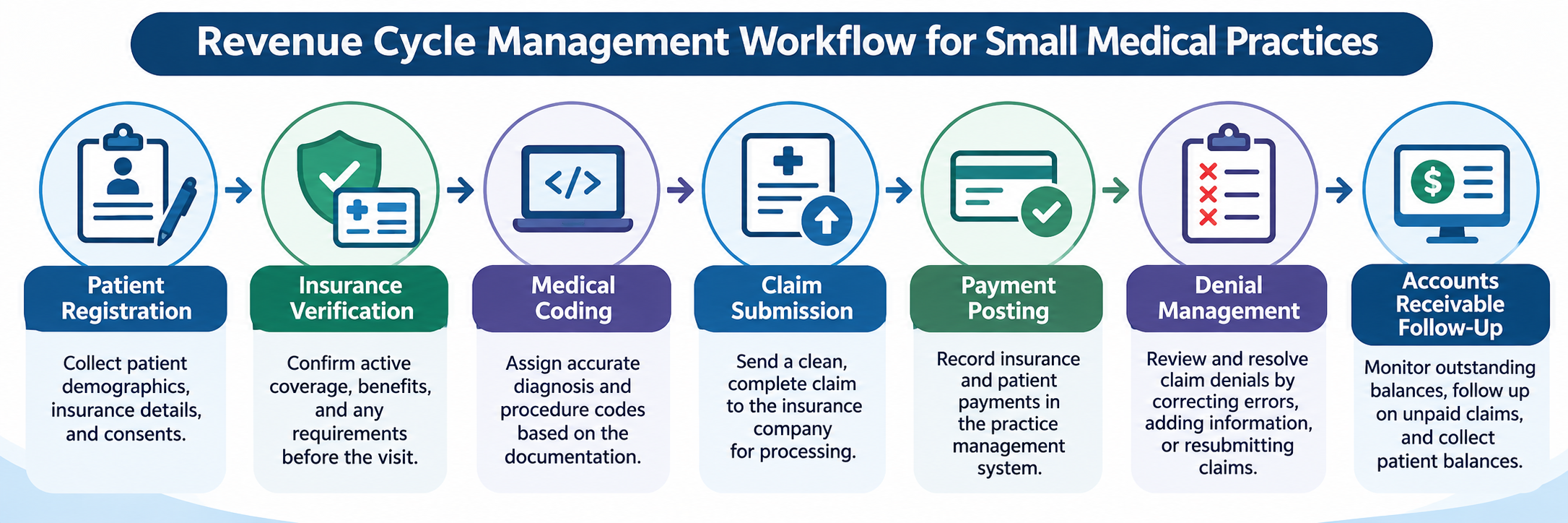
Medical billing involves more than submitting claims to insurance companies. A complete billing process includes patient registration, insurance eligibility verification, authorization checks, accurate coding, claim submission, payment posting, denial management, and accounts receivable follow-up.
Each step affects the next.
For example, incorrect patient insurance details can cause a claim rejection. Missing authorization may lead to a denial. Inaccurate coding or incomplete documentation can delay payment or create compliance concerns.
Large healthcare organizations may have dedicated employees for each task. Small practices often depend on a limited team, making it harder to maintain consistent workflows.
Common problems include:
- Limited staff available to manage billing.
- Insurance eligibility errors.
- Delayed claim submissions.
- Coding and documentation mistakes.
- Unworked or unresolved claim denials.
- Growing accounts receivable balances.
- Difficulty collecting patient payments.
- Keeping up with payer and regulatory updates.
A structured medical billing process helps small practices identify these problems before they affect cash flow.
8 Common Medical Billing Challenges for Small Practices
1. Limited Billing Staff and Resources
Small practices often operate with a lean administrative team. The same employee may handle patient registration, appointment scheduling, insurance verification, claim submission, and payment posting.
When one person manages too many responsibilities, important billing tasks can be delayed or overlooked.
Staff absences, turnover, and training requirements can make the problem worse. If only one employee understands the billing workflow, the practice may struggle to keep claims moving when that person is unavailable.
What small practices can do:
- Document billing procedures.
- Assign responsibility for each revenue cycle task.
- Review unsubmitted claims regularly.
- Cross-train administrative employees.
- Monitor accounts receivable and unresolved denials.
If your practice depends heavily on one billing employee, consider whether an external billing team could provide more consistent support.
2. Insurance Eligibility and Verification Errors
Insurance information can change between patient visits. Coverage may terminate, benefits may change, or a patient’s plan may require a referral or authorization.
When eligibility is not verified correctly, practices may submit claims to the wrong payer or provide services without confirming coverage requirements.
These problems can lead to avoidable denials and difficult patient billing conversations.
What small practices can do:
- Verify insurance before each appointment.
- Confirm patient demographics and policy details.
- Check referral and authorization requirements.
- Document verification results.
- Explain expected patient responsibility before the visit when possible.
Consistent insurance verification is an important part of effective medical billing for small practices.
3. Claim Denials and Delayed Payments
A denied claim does not always mean the service is not payable. It may indicate missing information, incorrect coding, eligibility issues, authorization problems, or a payer-specific billing requirement.
However, every denial requires attention. If a practice does not identify the reason and take appropriate action, the claim may remain unpaid.
Small practices can find denial management especially difficult because employees are already handling other administrative responsibilities.
What small practices can do:
- Review denial reports regularly.
- Group denials by reason and payer.
- Identify recurring problems.
- Correct claim errors before resubmission.
- Track appeal deadlines.
- Monitor whether corrective actions reduce repeat denials.
The goal should be to understand why claims are being denied, not simply to resubmit them.
4. Medical Coding and Documentation Problems
Accurate coding is essential for appropriate reimbursement and compliance. Incorrect ICD-10, CPT, or modifier selection can cause claim rejections, payment delays, or audit concerns.
Coding also depends on complete and accurate clinical documentation. The codes submitted must be supported by the medical record and applicable coding rules.
Small practices may not have access to specialized coding expertise for every service or specialty.
What small practices can do:
- Keep coding references and processes current.
- Review documentation before claim submission.
- Train providers and billing staff on documentation requirements.
- Conduct periodic coding audits.
- Seek qualified coding support for complex services.
Learn more in our guide: Medical Billing and Practice Management Services.
5. Prior Authorization Requirements
Some healthcare services require prior authorization before they are performed. Requirements vary by payer, plan, service, and specialty.
If authorization is missing, expired, or does not match the service provided, the claim may be denied.
For a small practice, tracking authorization requests across multiple insurance companies can create a substantial administrative burden.
What small practices can do:
- Identify services that commonly require authorization.
- Verify payer-specific requirements.
- Submit requests early enough to avoid scheduling delays.
- Track authorization numbers and expiration dates.
- Confirm authorization before the service is performed.
A reliable authorization workflow helps prevent avoidable billing problems.
6. Accounts Receivable and Payment Follow-Up
Submitting a claim is only one part of medical billing. Practices must also track payments, investigate underpayments, follow up on unpaid claims, and manage outstanding patient balances.
Without regular accounts receivable reviews, claims can remain unresolved for weeks or months.
What small practices can do:
- Review aging accounts receivable reports weekly.
- Prioritize older unpaid claims.
- Follow up with payers on delayed payments.
- Investigate underpayments.
- Track patient balances and payment arrangements.
A consistent follow-up process helps practices maintain better visibility into expected revenue.
7. Patient Collections and Higher Out-of-Pocket Costs
Patients may have deductibles, copayments, coinsurance, or outstanding balances. Collecting these amounts can be difficult when a practice does not have a consistent patient payment process.
Unclear estimates and delayed billing can also create confusion for patients.
What small practices can do:
- Explain financial responsibility before services when possible.
- Collect applicable copayments at the time of service.
- Provide clear statements.
- Offer appropriate payment options.
- Follow up on outstanding balances professionally.
Patient collections should be organized, transparent, and consistent.
8. Keeping Up With Billing and Compliance Changes
Medical billing requirements change over time. Practices must pay attention to applicable CMS policies, payer billing guidelines, coding updates, HIPAA requirements, and documentation standards.
Small practices may not have a dedicated compliance department to monitor every change.
What small practices can do:
- Review relevant CMS and payer updates.
- Keep coding resources current.
- Train staff on applicable billing requirements.
- Maintain appropriate documentation.
- Conduct periodic internal reviews.
- Seek qualified compliance guidance when needed.
For official Medicare Physician Fee Schedule information, practices can consult the CMS 2026 Physician Fee Schedule Final Rule.
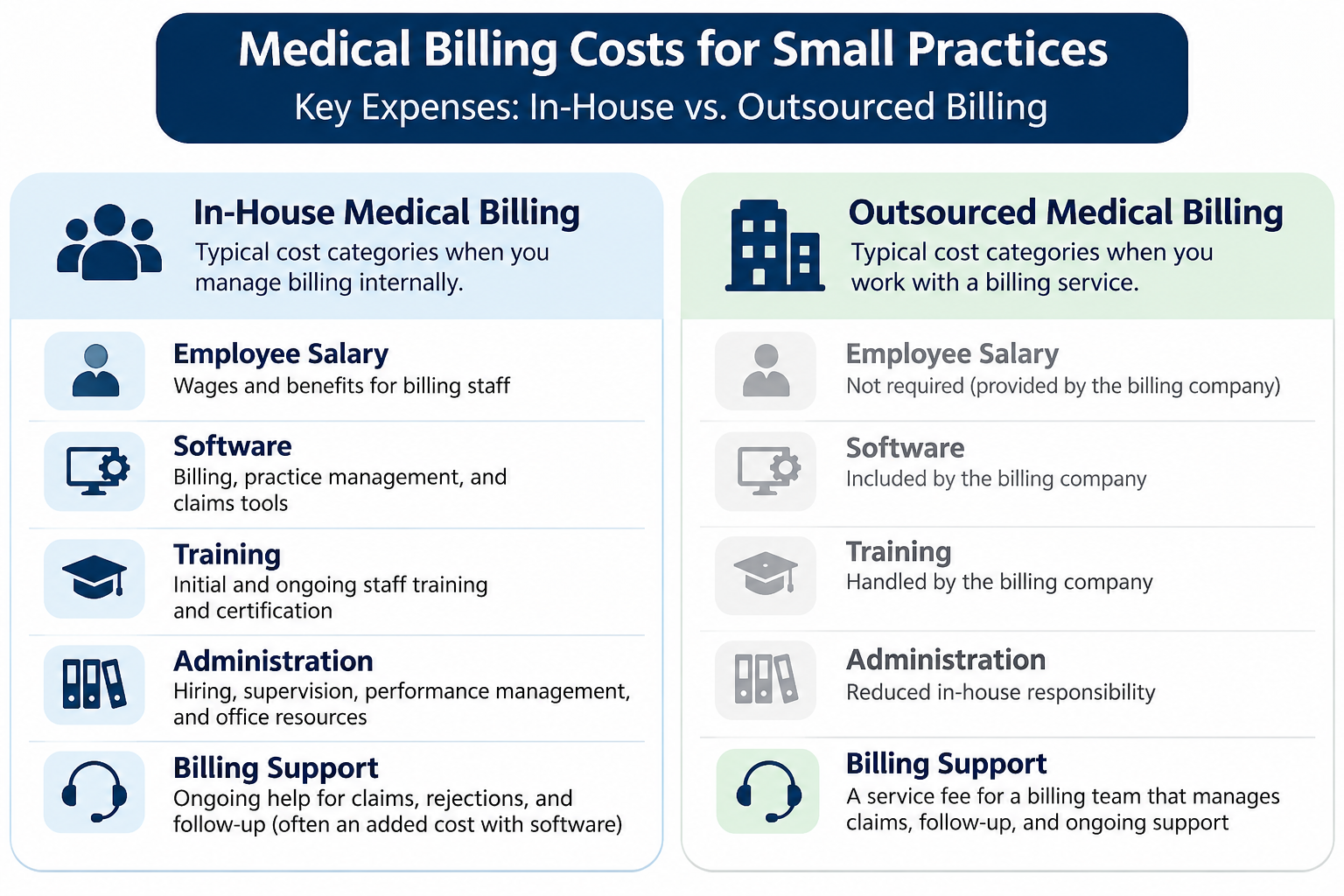
How Much Does Medical Billing Cost for a Small Practice?
The cost of medical billing depends on practice size, claim volume, specialty, staffing requirements, software, and the services included.
When evaluating in-house billing, looking only at an employee’s salary can underestimate the total cost.
A practice may also need to account for:
- Employee benefits and payroll taxes.
- Billing software and clearinghouse fees.
- Training and continuing education.
- Management and supervision time.
- Staff recruitment and turnover.
- Additional coding or denial management support.
Outsourced medical billing has a different cost structure. Many billing companies charge a percentage of collections, while others use flat fees or per-claim pricing.
The right comparison is not simply employee salary versus an outsourcing percentage. Practices should compare the complete cost of each option with the services provided and the resulting billing performance.
Before choosing a billing model, ask:
- What services are included?
- Are coding and denial follow-up included?
- Who handles insurance verification?
- How are unpaid claims monitored?
- What reports will the practice receive?
- Are there setup fees or additional charges?
- How is patient information protected?
A clear comparison helps practices choose a billing arrangement that fits their workload and budget.
5 Ways to Improve Medical Billing for Small Practices
Small practices do not need to change every billing process at once. Start by addressing the areas that have the greatest impact on claim accuracy and payment follow-up.
1. Verify Insurance Before Patient Visits
Check eligibility and coverage information before appointments. Confirm the payer, policy details, and authorization requirements when applicable.
2. Review Claim Denials Regularly
Identify the most frequent denial reasons and determine whether they are caused by registration, coding, authorization, documentation, or payer processing issues.
3. Improve Coding Accuracy
Keep coding processes current and ensure submitted codes are supported by the clinical documentation. Arrange qualified coding reviews when needed.
4. Monitor Accounts Receivable
Review aging reports regularly and assign responsibility for following up on unpaid claims. Do not allow unresolved claims to remain unnoticed.
5. Track Your Billing Performance
Useful revenue cycle metrics include:
- First-pass claim acceptance rate.
- Claim denial rate.
- Net collection rate.
- Days in accounts receivable.
- Aged accounts receivable.
- Patient collection performance.
Use consistent definitions when comparing performance over time. A clear monthly report helps identify problems and measure whether changes are working.
When Should a Small Practice Consider Outsourcing Medical Billing?
Outsourcing is not the right choice for every practice. Some small practices have experienced in-house billing employees and efficient workflows.
However, working with an external billing company may be worth considering when:
- Your billing employee is managing too many responsibilities.
- Claims are not being submitted consistently.
- Denials are increasing or not being followed up.
- Accounts receivable is growing.
- Your practice lacks specialized coding support.
- You are spending too much time supervising billing.
- Staff turnover is disrupting the revenue cycle.
- You need additional billing support as the practice grows.
An outsourced billing partner can provide access to billing, coding, claim follow-up, and revenue cycle support without requiring the practice to manage every function internally.
Read our related guide: Medical Billing and Practice Management Services.

How Pro Health Care Advisors Supports Small Medical Practices
Small and independent practices need billing support that fits their workflows, specialty requirements, and administrative resources.
Pro Health Care Advisors provides medical billing and practice management services for healthcare practices, with support for key revenue cycle activities.
Medical Billing and Claims Management
Support with claim preparation, submission, payment posting, and payer follow-up.
Medical Coding Support
Coding support designed to help practices maintain accurate claims and appropriate documentation workflows.
Denial Management
Review and follow-up of denied claims to identify issues and support appropriate resolution.
Insurance Verification and Prior Authorization
Administrative support for eligibility checks and authorization workflows.
Accounts Receivable Follow-Up
Monitoring unpaid claims and helping practices maintain visibility into outstanding balances.
Physician Credentialing
Credentialing and payer enrollment support for providers joining or expanding a practice.
Support Across Multiple Specialties
Pro Health Care Advisors serves healthcare practices across more than 30 specialties. Explore our medical billing and practice management services to learn more about available support.
Contact our team to discuss your practice’s billing workflow and determine whether our services are a good fit.

Frequently Asked Questions About Medical Billing for Small Practices
1. What is medical billing for small practices?
Medical billing for small practices is the process of managing claims and payments for healthcare services. It includes insurance verification, coding, claim submission, payment posting, denial follow-up, accounts receivable management, and patient collections.
2. Why is medical billing difficult for small practices?
Small practices often have fewer administrative employees and limited access to specialized billing and coding resources. Managing insurance requirements, claim denials, payment follow-up, and compliance can become difficult when a small team handles multiple responsibilities.
3. Should a small medical practice outsource billing?
Outsourcing may be a good option when a practice experiences frequent denials, delayed claim follow-up, staffing challenges, or limited coding resources. The decision should be based on total cost, service coverage, reporting, security, and measurable billing performance.
4. How much does outsourced medical billing cost?
Outsourced billing costs vary by company, specialty, claim volume, and service scope. Some companies charge a percentage of collections, while others use flat fees or per-claim pricing. Practices should request a detailed proposal before making a decision.
5. What billing services does a small medical practice need?
Most practices need insurance verification, accurate coding, claim submission, payment posting, denial management, accounts receivable follow-up, and patient billing. Additional needs depend on the practice’s specialty and payer requirements.
6. How can a small practice reduce claim denials?
Practices can reduce avoidable denials by verifying insurance, checking authorization requirements, improving documentation, reviewing coding accuracy, submitting clean claims, and analyzing recurring denial reasons.
7. What billing metrics should small practices monitor?
Important metrics include first-pass claim acceptance, denial rate, net collection rate, days in accounts receivable, aged receivables, and patient collection performance. Reviewing these metrics regularly helps identify workflow problems.
8. What should I look for in a medical billing company?
Look for relevant healthcare billing experience, qualified coding support, transparent pricing, clear reporting, documented security practices, denial follow-up procedures, and a service agreement that explains responsibilities.
Improve Your Small Practice’s Medical Billing Process
Managing billing should not take attention away from running your practice and caring for patients.
A consistent revenue cycle process helps small practices manage claims, identify payment problems, and maintain better control over outstanding accounts.
Pro Health Care Advisors works with healthcare practices to support medical billing, coding, denial management, and revenue cycle operations.
Ready to review your practice’s billing process?
Contact Pro Health Care Advisors to discuss your current billing challenges and explore the support your practice may need.
Request a consultation today and take the next step toward a more organized medical billing process.