AI medical billing automation is becoming an important consideration for healthcare practices looking to streamline administrative work, improve claim review, and manage revenue cycle operations more efficiently. Artificial intelligence can assist with repetitive tasks, identify potentially incomplete information, and help billing teams analyze claim data.
For medical practices in the United States, the goal of AI medical billing automation is to support accurate workflows while maintaining appropriate human oversight, patient privacy, and compliance with applicable requirements.
This guide explains seven practical applications, important limitations, and ways healthcare providers can evaluate automation tools.
What Is AI Medical Billing Automation?
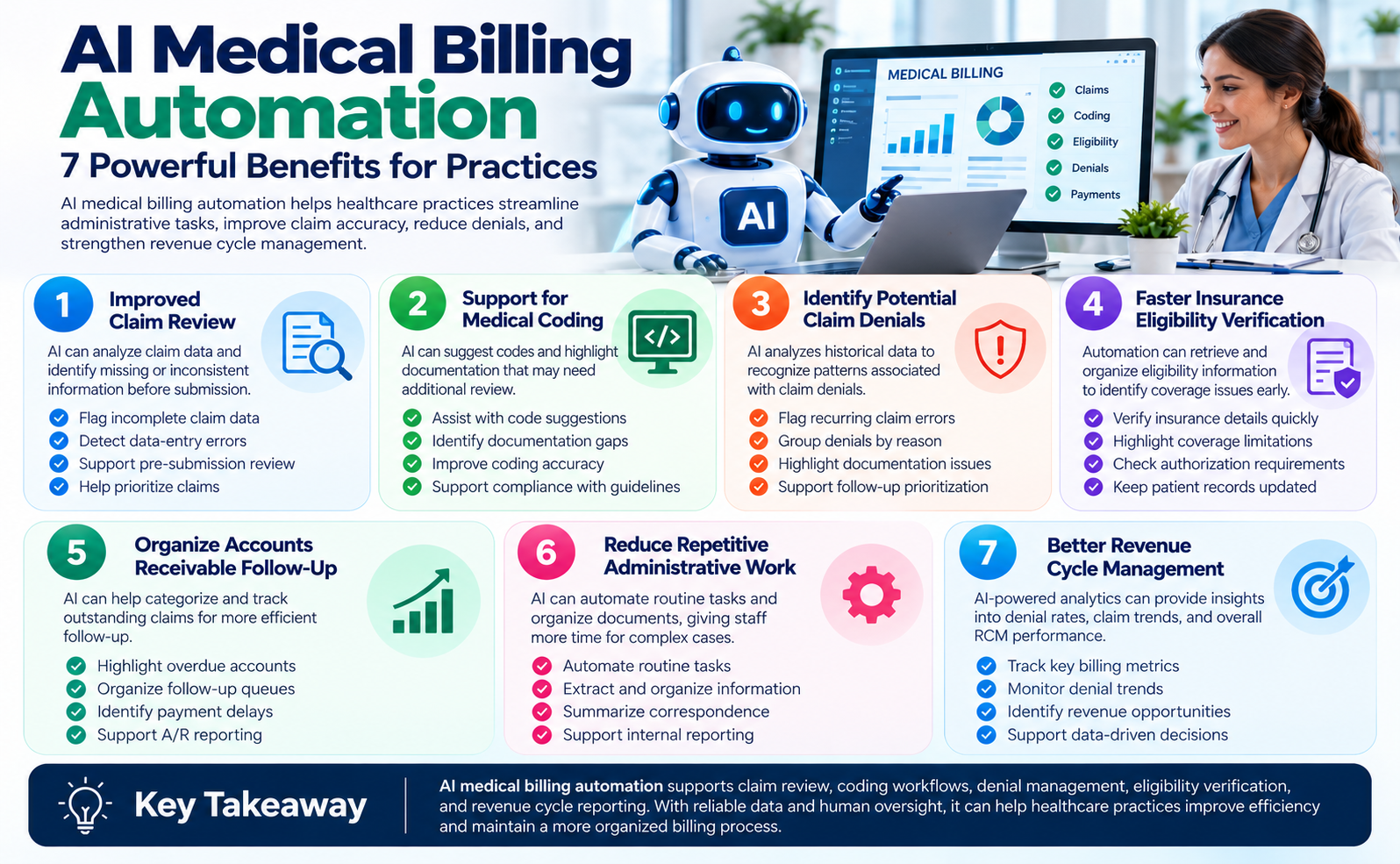
AI medical billing automation uses artificial intelligence and related software to assist with selected tasks in the healthcare billing process. Depending on the system, these tasks may include checking claim information, organizing documents, flagging potential errors, and analyzing billing trends.
Automation capabilities differ between vendors. AI-generated suggestions should be verified by qualified staff before they affect coding, claim submission, appeals, or other important decisions.
1. Improve Medical Claim Review
Incomplete or inconsistent claim information can cause processing delays and additional administrative work. AI medical billing automation tools may help flag missing fields, inconsistent entries, or information that requires further review.
Potential applications include:
- Identifying incomplete claim data.
- Flagging possible data-entry errors.
- Supporting pre-submission claim reviews.
- Helping staff prioritize claims that need attention.
These tools can support billing accuracy, but staff should verify flagged issues before making corrections or submitting claims.
2. Support Medical Coding Workflows
Medical coding requires accurate interpretation of clinical documentation and applicable coding guidelines. Some AI tools can suggest codes or identify documentation that may need additional review.
AI medical billing automation can support coding workflows, but it should not replace qualified coding professionals or applicable coding rules.
For authoritative guidance, review the American Medical Association’s CPT coding resources.
Practices should ensure that codes accurately reflect documented services and meet applicable payer requirements.
3. Identify Potential Claim Denial Risks
Claim denials can result from eligibility issues, missing authorization, coding errors, incomplete documentation, or payer-specific requirements.
Some systems use historical claim information to highlight patterns associated with previous denials. As part of AI medical billing automation, these insights may help billing teams decide which claims need closer review.
Possible benefits include:
- Flagging recurring claim errors.
- Grouping denials by reason.
- Identifying documentation that requires attention.
- Supporting follow-up prioritization.
AI cannot guarantee claim approval or predict every denial. Practices should rely on verified payer responses and appropriate professional review.
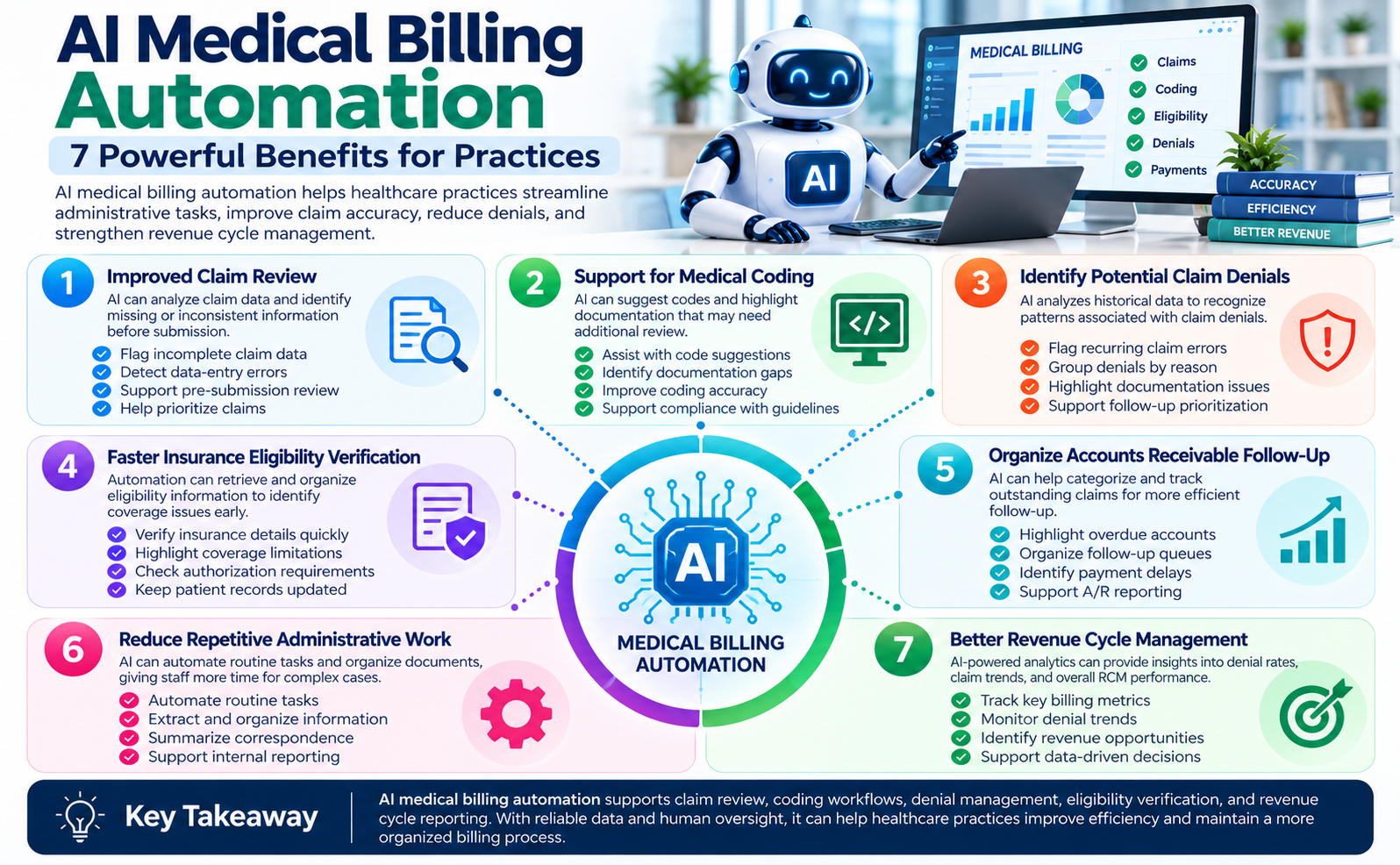
4. Support Insurance Eligibility Verification
Insurance eligibility verification helps healthcare practices check coverage information before services are provided. Certain automation systems can organize eligibility responses and flag information that may require clarification.
Using AI medical billing automation alongside established verification procedures may help staff identify potential coverage issues earlier.
Recommended practices include:
- Verifying insurance details before appointments.
- Reviewing eligibility responses for accuracy.
- Confirming applicable referral and authorization requirements.
- Updating patient records when information changes.
Eligibility verification does not guarantee reimbursement. Payment remains subject to the applicable plan terms and payer review.
5. Organize Accounts Receivable Follow-Up
Unpaid claims require regular monitoring and appropriate follow-up. Billing analytics and automation tools may help teams organize outstanding claims by age, payer, balance, or follow-up status.
Within an AI medical billing automation workflow, these insights may help staff prioritize accounts that need attention.
Useful activities include:
- Highlighting overdue accounts.
- Organizing follow-up queues.
- Identifying recurring payment delays.
- Supporting accounts receivable reporting.
Billing teams should verify claim status and follow the relevant payer’s procedures before taking action.
6. Reduce Repetitive Administrative Work
AI and workflow automation can assist with selected repetitive tasks, such as organizing documents, extracting information, summarizing correspondence, and preparing internal reports.
When appropriately implemented, AI medical billing automation may give billing professionals more time to investigate complicated claims and resolve payer questions.
Before adopting a tool, evaluate its accuracy, compatibility with existing systems, security controls, training requirements, and effect on day-to-day workflows.
7. Strengthen Revenue Cycle Management Reporting
Revenue cycle management includes patient registration, insurance verification, coding, claim submission, payment posting, denial follow-up, and accounts receivable management.
AI medical billing automation may support reporting by helping teams review trends in denial rates, outstanding balances, and claim processing. Reliable data and clearly defined metrics are essential for meaningful analysis.
For official Medicare billing and coverage information, consult the Centers for Medicare & Medicaid Services (CMS).
AI-generated reports should be checked for accuracy and interpreted in the context of the practice’s operations.
Privacy and Security Considerations
Healthcare practices must evaluate privacy and security before using AI tools with patient information. Important considerations include data storage, access controls, vendor practices, and applicable regulatory obligations.
Review the U.S. Department of Health and Human Services’ HIPAA resources for information about protecting health information.
Do not enter identifiable patient information into public AI tools unless the use has been appropriately reviewed and authorized.
How to Choose an AI Medical Billing Solution
Before adopting AI medical billing automation, healthcare practices should identify a specific administrative problem and assess whether a proposed tool can address it reliably.
Consider these questions:
- What task will the tool assist with?
- How will staff verify its output?
- Does it integrate with existing billing systems?
- What privacy and security safeguards are available?
- How will accuracy and performance be measured?
Start with a limited workflow, train staff, monitor results, and expand only when the process demonstrates value.
How Pro Health Care Advisors Supports Healthcare Practices
Technology is only one part of an effective billing process. Healthcare practices also need organized procedures for claim submission, denial follow-up, provider enrollment, and revenue cycle management.
Pro Health Care Advisors provides medical billing, physician credentialing, and revenue cycle management services for healthcare practices.
Explore our medical billing and practice management services to learn more about available support.
Practices seeking help with provider enrollment can also review our physician credentialing services.
Frequently Asked Questions
What is AI medical billing automation?
It is the use of artificial intelligence and related software to assist with selected billing tasks, such as claim review, document processing, denial analysis, and reporting.
Can AI medical billing automation prevent all claim denials?
No. It may help identify potential errors and recurring patterns, but it cannot guarantee claim approval. Accurate documentation, payer requirements, and professional review remain important.
Is AI medical billing automation suitable for small practices?
It may be useful for practices seeking help with repetitive administrative tasks. Suitability depends on cost, workflow needs, system compatibility, data security, and staff capacity.
Does AI replace medical billing professionals?
AI can assist with certain repetitive tasks, but professional oversight remains important for complex claims, coding decisions, appeals, compliance, and payer-specific issues.
How can practices protect patient information when using AI?
Practices should evaluate vendor security, data handling, access controls, and applicable privacy requirements before using AI with protected health information.
Conclusion
AI medical billing automation may support claim review, coding workflows, denial analysis, eligibility verification, accounts receivable follow-up, and revenue cycle reporting. Its value depends on reliable data, suitable implementation, privacy safeguards, and qualified human oversight.
Healthcare practices should evaluate tools carefully and measure their performance rather than assume automation alone will solve every billing challenge.
For support with medical billing, physician credentialing, and revenue cycle management, visit Pro Health Care Advisors.