







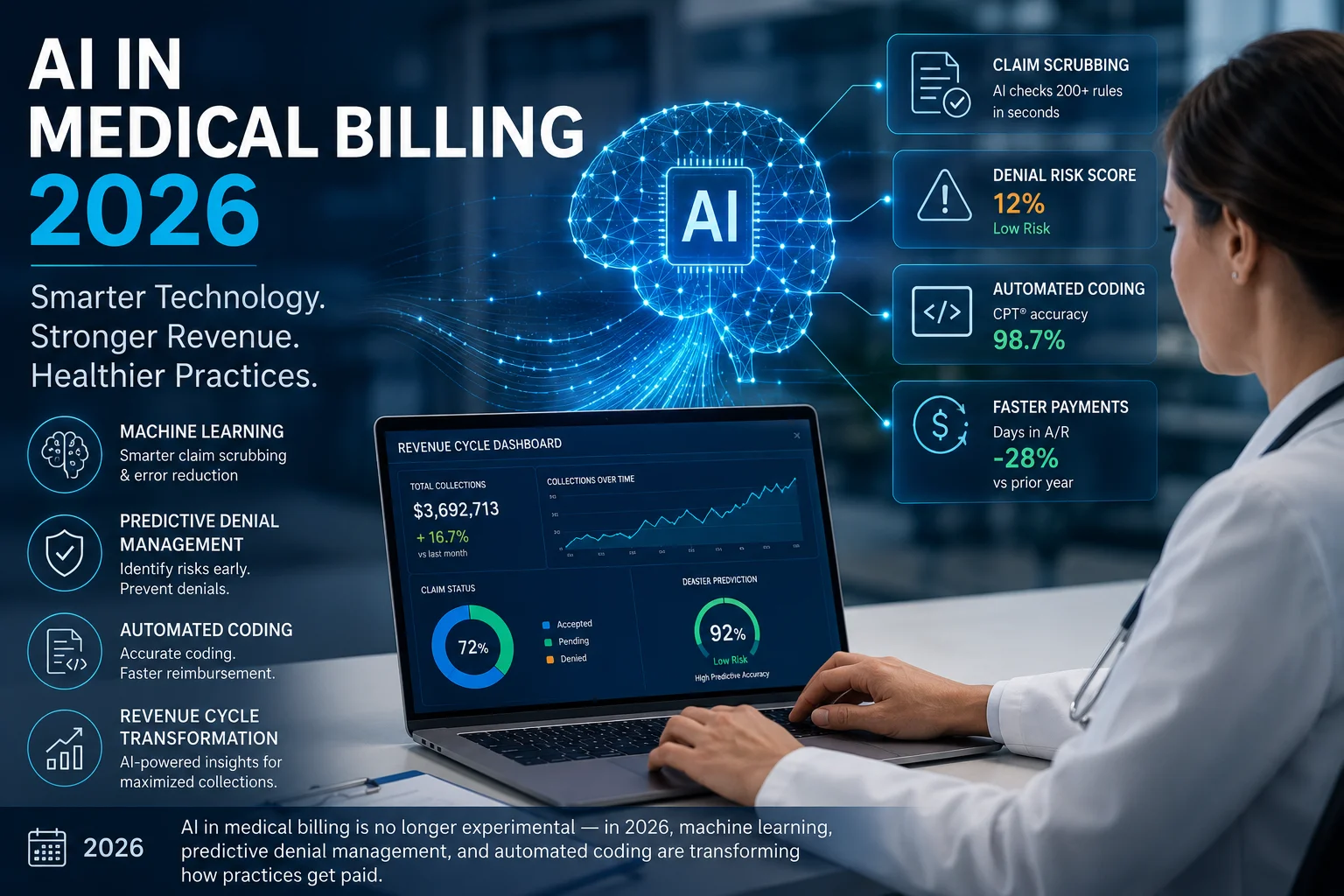
AI in Medical Billing 2026 — How Artificial Intelligence Is Transforming Practice Revenue Right Now
Something changed in medical billing this year — and it happened faster than most practices realized.
For years, “AI in medical billing” meant a spell-checker for diagnosis codes or an automated eligibility ping. Useful, but not transformational. In 2026, that definition is completely obsolete.
Organizations that implement AI-powered medical billing solutions typically see an average 15 to 25 percent improvement in first-pass claims acceptance rates, and a 20 to 30 percent reduction in accounts receivable days, leading to a direct boost in revenue.
Those are not marketing claims. Those are the measured outcomes practices across the country are reporting after implementing AI-driven revenue cycle management — and they represent a performance gap that is growing every month between practices that have adopted AI billing workflows and those that have not.
AI-powered tools can assist with charge capture, eligibility checks, and claim scrubbing, helping reduce manual workload and turnaround time. But in 2026, AI in medical billing goes far beyond those functions. Machine learning is now predicting claim denials before submission, automating prior authorization documentation, generating appeal language that wins at a higher rate, and flagging undercoding patterns that human billers consistently miss.
This guide covers exactly what AI in medical billing looks like in 2026 — what it does, what it does not do, which functions it handles better than human teams, where human expertise is still essential, and what it means for your practice’s revenue right now.
What AI in Medical Billing Actually Means in 2026 — Beyond the Buzzword
“AI” gets thrown around in healthcare marketing so freely that it has almost lost meaning. So let us be specific about what AI in medical billing actually does in 2026 — and separate that from what it cannot do.
What AI in medical billing does in 2026:
AI-powered medical billing tools handle: rules-based auto-posting and adaptive post-adjudication for payment posting, voice-activated EHR entry that reduces manual data input, clinical decision support that surfaces risk flags during patient encounters, and predictive claim denial systems that adapt to payer-specific patterns and automate AR follow-up.
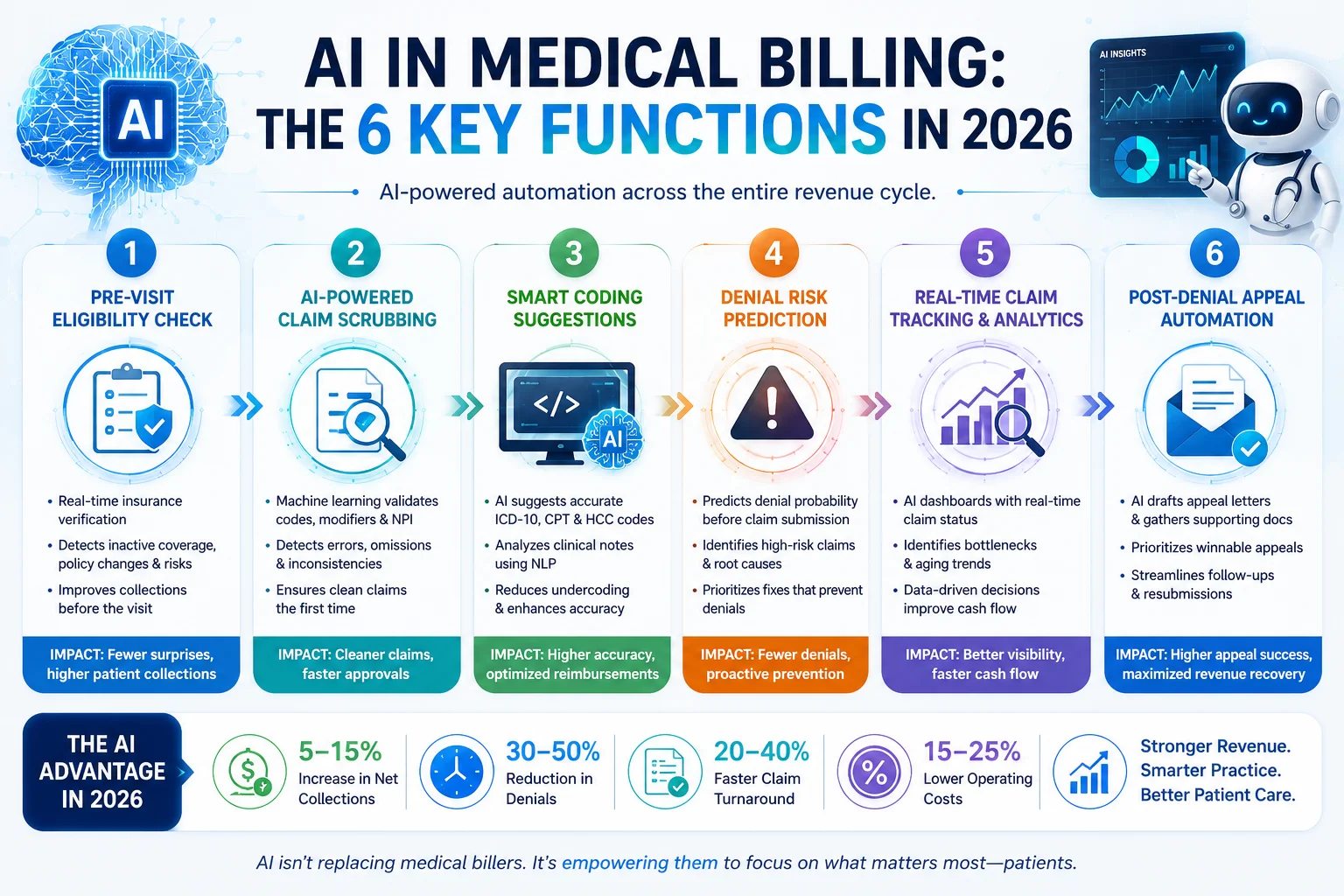
More specifically, mature AI billing systems in 2026 do the following:
1. Pre-submission claim scrubbing with denial prediction. AI-powered tools predict claim denials before submission — they analyze patterns in billing data to identify common mistakes and suggest corrections before claims ever leave your office. This is not rule-based scrubbing that checks for obvious errors. It is pattern recognition that identifies which specific claim combinations are likely to be denied by which specific payer — and flags them before submission.
2. Automated eligibility verification. AI systems check patient insurance eligibility in real time before every appointment, identifying coverage gaps, plan changes, and benefit limitations that generate CO-22 and OA-23 denials when missed. This runs continuously — not just at check-in.
3. AI-assisted coding and charge capture. AI-driven EHR software uses adaptive learning to recognize each provider’s unique workflow and improve documentation speed, accuracy, and clinical efficiency over time. In billing specifically, this means AI systems that suggest CPT codes based on documented services, flag undercoding where documentation supports a higher code level, and identify modifier requirements that human coders miss.
4. Prior authorization automation. AI tools now track authorization requirements by payer and service type, pre-populate authorization request fields from clinical documentation, and monitor authorization status in real time — reducing the 14.5 hours per week physicians currently spend on prior authorization. For more on how prior authorization has changed in 2026, see our prior authorization rules guide.
5. Automated appeal generation. Some systems are using AI to automate appeals — analyzing successful appeal letters and payer response patterns to generate appeal language that has a higher chance of overturning denials. The technology learns from outcomes and improves over time.
6. Payment posting and ERA reconciliation. Rules-based auto-posting and adaptive post-adjudication automate payment posting based on pre-defined rules, reducing manual entry from billing staff — saving time and avoiding posting errors that create account balance discrepancies.
What AI in medical billing cannot do in 2026:
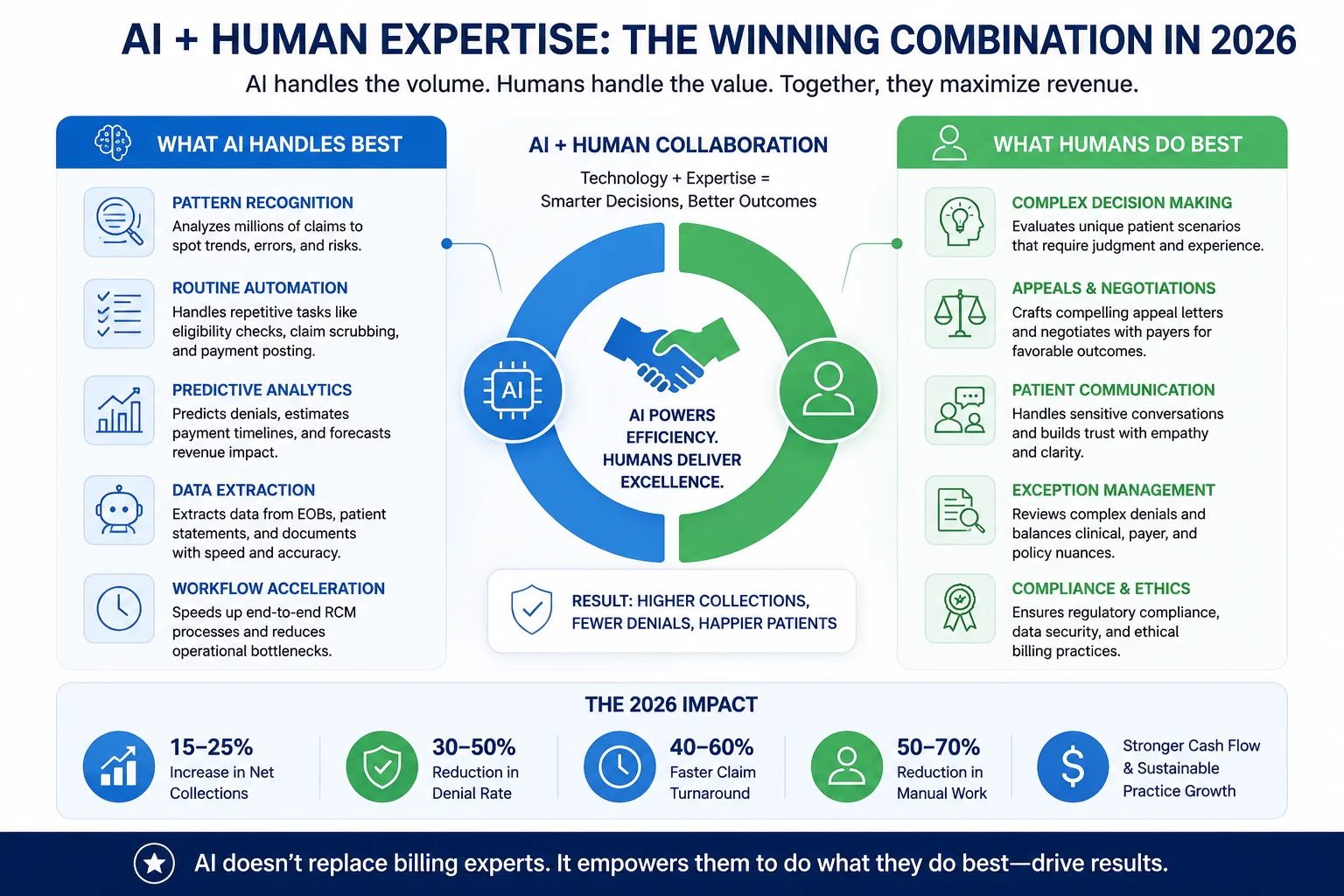
AI cannot correct contextual or clinical errors in claim submission. It cannot interpret incomplete documentation, resolve complex denial reasons, or make judgment calls on coding nuances. When a denial requires understanding why a specific clinical scenario does not match a payer’s medical necessity criteria — or when an appeal requires building a clinical argument using patient history — human expertise is still essential.
The most effective billing operations in 2026 are not fully automated. They are AI-assisted — meaning AI handles the high-volume, pattern-recognition tasks while AAPC-certified human billers handle the judgment-intensive work that algorithms cannot replicate.
The 6 Areas Where AI Is Having the Biggest Revenue Impact in 2026
1. Denial Prevention Before Claims Leave Your System
This is where AI delivers its highest measurable ROI. The real power of AI in billing shows up in its ability to handle repetitive tasks that consume hours of staff time — including catching errors that would typically result in denials before claims are ever submitted.
Traditional pre-submission scrubbing catches obvious errors — missing NPI, wrong date of birth, invalid procedure code. AI-powered scrubbing goes further: it identifies which claim combinations have historically been denied by which payer, flags documentation gaps that will trigger CO-50 medical necessity denials, and surfaces authorization gaps before CO-15 denials occur.
AI-driven predictive claim scrubbing identifies errors and missing information before submission, reducing denial rates and accelerating the revenue cycle.
The practical result: practices using AI-powered pre-submission scrubbing consistently maintain clean claim rates above 97 percent — versus the 85 to 92 percent average for practices using manual or basic rule-based scrubbing.
For more on what denial codes mean and how they are generated, see our complete medical billing denial codes guide.
2. Prior Authorization Management — The 14.5-Hour Problem
The American Medical Association reports that physicians now spend 14.5 hours per week on prior authorization. In a small or mid-size practice, that time comes directly out of clinical productivity or forces overtime on administrative staff.
AI prior authorization tools address this in three ways:
Requirement identification: AI systems maintain payer-specific authorization requirement libraries that update automatically as payer policies change. Instead of staff manually checking whether a service requires authorization with each payer, the system flags it automatically based on the scheduled service and the patient’s insurance.
Documentation pre-population: AI tools pull relevant clinical documentation from the EHR — diagnoses, prior treatments, clinical notes — and pre-populate authorization request fields, reducing the time to prepare and submit a PA request from 30 to 45 minutes to 5 to 10 minutes.
Status monitoring: AI systems track outstanding authorizations and escalate when decision timelines approach — preventing services from being rendered without authorization, which is the root cause of CO-15 denials.
The 2026 prior authorization rule changes — including the 7-day decision window requirement and mandatory specific denial reasons under CMS-0057-F — make AI-assisted PA management even more important. Practices that do not have systematic PA workflows are generating avoidable denials at a pace that compounds every month. See our prior authorization rules changed 2026 guide for the full regulatory picture.
3. Coding Accuracy and Undercoding Detection
Undercoding — billing at a lower code level than the documentation and clinical work support — costs the average practice 6 to 9 percent of net collections. It is invisible because undercoded claims get paid. They just get paid for less than they should.
AI-driven EHR software learns from each provider’s documentation patterns and suggests coding that accurately reflects the clinical work performed. For billing specifically, this means AI systems that compare the documented complexity of an encounter against the CPT level billed — and flag encounters where higher coding is supported by documentation but not reflected in the charge.
This is an area where AI-assisted coding consistently outperforms even experienced human coders, because it applies pattern recognition across thousands of encounters simultaneously — identifying systematic undercoding patterns that human reviewers would only catch in manual audits.
Our CodeMAXX services incorporate coding accuracy review that catches exactly these patterns — recovering the 6 to 9 percent of net collections that most practices are currently leaving on the table through systematic undercoding.
4. Medicare Advantage Denial Management
Denial management has particularly benefited from AI integration. Machine learning systems analyze successful appeal letters and payer response patterns to generate appeal language with higher overturn rates.
This is especially important for Medicare Advantage denials — which have increased 56 percent since 2022 and now represent one of the largest single sources of revenue loss for practices with significant MA patient volume. AI tools that analyze MA payer-specific denial patterns can identify which appeals arguments work for which payers — and generate appeal language that reflects those patterns.
For more on how Medicare Advantage denials are affecting practices and what to do about it, see our Medicare Advantage denials up 56 percent guide.
5. Patient Cost Estimation and Collections
Real-time claim adjudication allows providers to know whether a claim will be paid, how much, and if patient responsibility exists. This technology enables front-desk staff to collect accurate patient information before patients leave, dramatically reducing bad debt and improving cash flow.
AI systems that integrate payer fee schedules, patient benefit data, and real-time eligibility information can generate accurate patient cost estimates at the time of service — before the patient leaves the office. This directly improves point-of-service collection rates and reduces the surprise billing disputes that delay and reduce patient balance collection.
For more on patient collections in 2026’s high-deductible environment, see our revenue cycle management guide.
6. EHR-Billing Integration — Eliminating the Disconnect
One of the most consistent findings across 2026 research on AI in healthcare operations is that practices managing EHR and billing in separate, disconnected systems are leaving significant money on the table through charge capture failures and documentation-billing mismatches.
Practices that manage EHR and billing in separate silos are leaving money on the table. The best systems unite them.
AI-powered billing platforms that integrate with your EHR create a continuous data flow — clinical documentation triggers charge capture, charge capture feeds into claim scrubbing, scrubbing feeds into submission, and denial data feeds back into documentation guidance. This closed loop eliminates the manual handoffs where errors most commonly occur.
Our EMR/EHR services are specifically designed to support this kind of integrated workflow — where clinical documentation and billing operations are connected rather than siloed. For more on how practice management software supports this integration, see our practice management software guide.
What AI in Medical Billing Does NOT Replace — The Human Expertise That Still Matters
There is a version of the AI-in-billing story that sounds like this: “AI will replace your billing team.” That version is not accurate in 2026, and practices that believe it are setting themselves up for compliance failures and revenue losses.
AI cannot correct contextual or clinical errors in claim submission. It cannot interpret incomplete documentation, resolve complex denial reasons, or make judgment calls on coding nuances.
Here is specifically what requires human expertise that AI cannot replicate in 2026:
Complex denial appeals that require clinical reasoning. When a CO-50 medical necessity denial requires building a clinical argument using specific patient history, documented functional limitations, and treatment rationale — that is not a pattern-matching task. It is a clinical reasoning task that requires a human who understands both the clinical picture and the payer’s specific medical necessity criteria.
Specialty-specific coding judgment. Modifiers, bundling rules, and documentation requirements in high-complexity specialties like cardiology, oncology, and behavioral health involve coding decisions that require specialty-specific expertise. AI tools can flag potential issues — but the judgment call still requires AAPC-certified coders with specialty knowledge.
Payer contract interpretation. When a payment appears inconsistent with your contracted rate, determining whether it represents an underpayment, a legitimate adjustment, or a contract dispute requires someone who can read the contract, understand the fee schedule, and navigate the payer’s dispute process. AI tools can flag the discrepancy. A human has to resolve it.
Compliance and audit response. Regulatory compliance support ensures adherence to industry standards such as HIPAA and MIPS. But when an audit finding requires a response — or when documentation is being reviewed for compliance — the judgment involved in assessing risk, preparing responses, and making corrections is a human function. Our MD Audit Shield RAC service and HIPAA compliance services provide exactly this kind of human-led compliance support.
Relationship-based payer resolution. When a claim has been incorrectly denied and standard appeals have failed, escalating to a payer’s provider relations team and negotiating a resolution requires human communication skills that no AI tool currently replicates effectively.
The practices getting the best financial results from AI in 2026 are using it as a force multiplier for their human billing team — not as a replacement. AI handles the volume; humans handle the judgment.
How AI in Medical Billing Connects to Every Part of Your Revenue Cycle
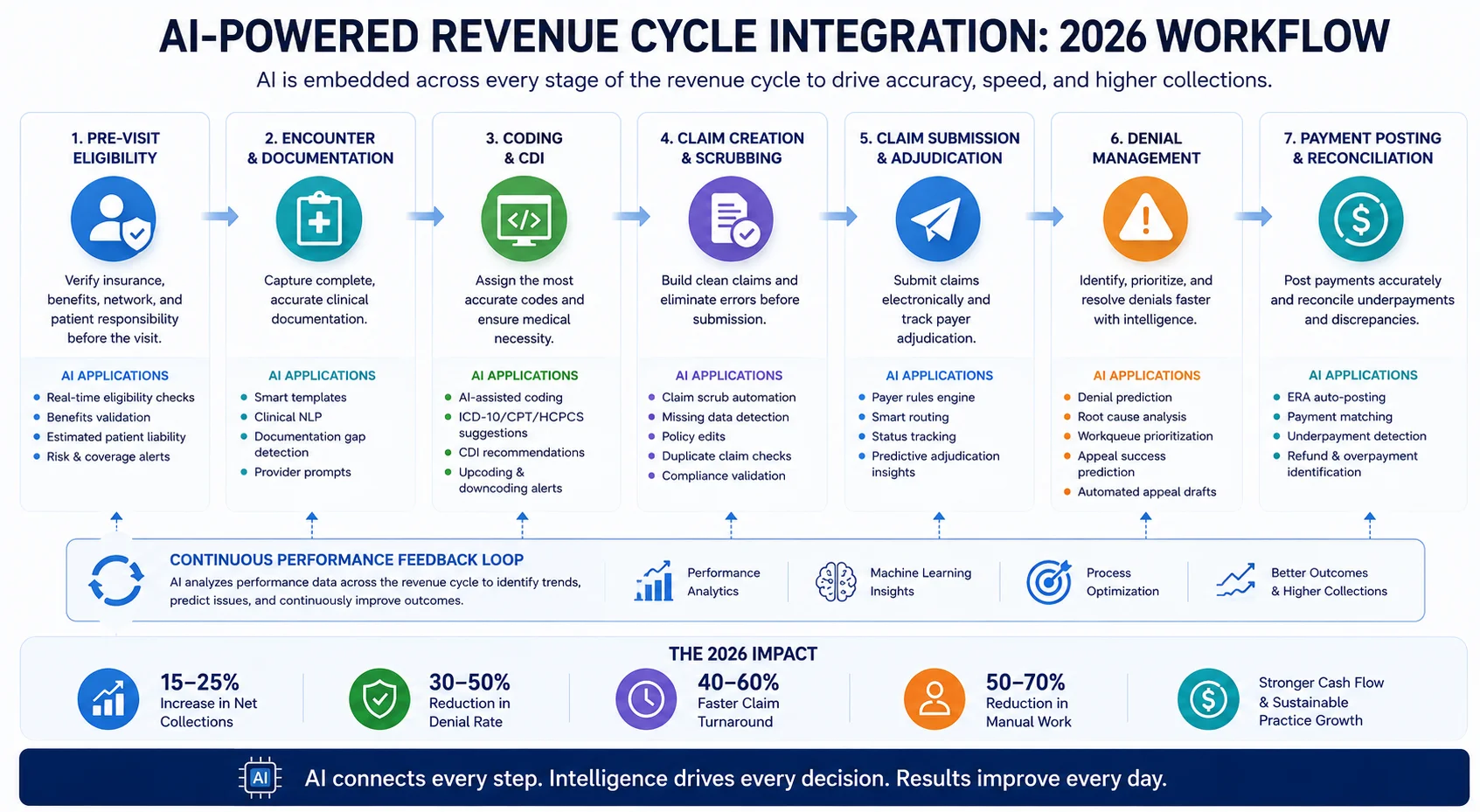
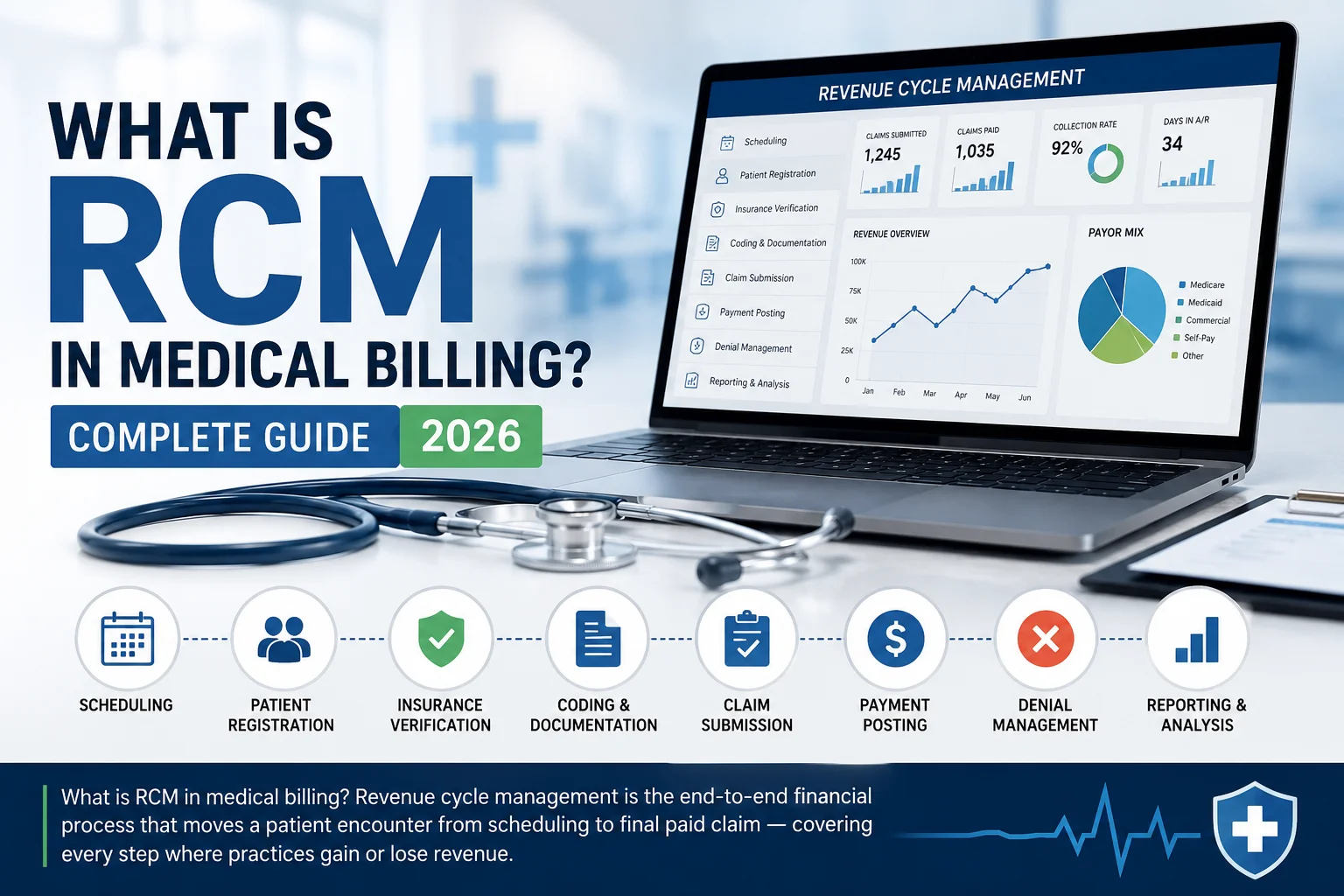
Understanding AI in medical billing requires understanding where it fits within the broader revenue cycle — not as a separate technology, but as a layer that operates across every stage of the process.
Here is how AI integration maps to the seven steps of the revenue cycle:
Preregistration: AI-powered real-time eligibility verification before every appointment — checking not just whether coverage exists, but specific benefit levels, deductibles, authorization requirements, and plan changes. For a full breakdown of the revenue cycle, see our revenue cycle management complete guide.
Registration: AI systems flag demographic and insurance data entry errors before they become CO-16 denials — catching transposed digits, mismatched insurance IDs, and outdated coverage information in real time.
Charge Capture: AI coding tools suggest CPT codes based on documented clinical work, identify undercoding where documentation supports higher code levels, and flag modifier requirements that generate denials when missed.
Claim Submission: AI denial prediction scores each claim before submission — flagging high-risk claims for human review and routing clean claims to accelerated submission. This is where the 15 to 25 percent improvement in first-pass acceptance rates is generated.
Remittance Processing: AI auto-posting rules process standard payment EOBs automatically — posting payments, identifying adjustments, and flagging amounts that do not match contracted rates. Unusual patterns are escalated to human review.
Denial Management: AI analyzes denial patterns by payer, service type, and denial code — identifying systematic issues that require upstream process changes. For CO-50 and CO-15 denials specifically, AI generates structured appeal language based on successful appeal patterns. See our denial codes guide for a full breakdown of the denial types AI handles most effectively.
Patient Collections: AI-powered cost estimation tools generate accurate patient responsibility estimates at time of service — improving point-of-service collection rates by giving patients accurate cost information before they leave the office.
The result of AI operating across all seven stages is a continuous performance feedback loop: denial data informs coding guidance, coding guidance informs documentation standards, documentation standards reduce future denials. This loop does not exist in practices running disconnected billing workflows.
What to Look for in an AI-Enhanced Medical Billing Partner
Not every billing company claiming to use AI is using it in ways that measurably improve your revenue. Here is what to verify before trusting a billing company’s AI claims:
Ask for specific performance metrics — not general capability claims. What is their clean claim rate? What is their denial rate? What is their first-pass resolution rate? AI-enhanced billing operations should be demonstrably outperforming manual billing operations on these metrics. Our medical billing and practice management services maintain a 98.5 percent clean claim rate and a denial rate under 2 percent.
Ask how their AI handles payer-specific patterns. Generic denial prediction that applies the same logic to every payer is not meaningful. Effective AI billing systems maintain payer-specific models — recognizing that what triggers a denial at Humana is different from what triggers a denial at Aetna. Ask specifically how their system handles the payers in your mix.
Ask what human expertise backs the AI. Confirm that AAPC-certified coders review AI-flagged exceptions, that human billers manage complex appeals, and that the AI is functioning as a force multiplier rather than a replacement. A billing company that has eliminated all human review in favor of full automation is a compliance risk.
Confirm EMR/EHR compatibility. AI billing tools that do not integrate with your EHR create exactly the data silos that generate charge capture failures and documentation-billing mismatches. Verify compatibility with your existing practice management system before engaging any AI-enhanced billing service.
Verify HIPAA compliance for all AI data handling. AI systems processing patient billing data are handling PHI — and every system that touches PHI must be fully HIPAA-compliant with a signed BAA. Our HIPAA compliance services include the data security framework that governs all AI-assisted billing operations for our clients.
How Pro Health Care Advisors Uses AI to Improve Practice Revenue
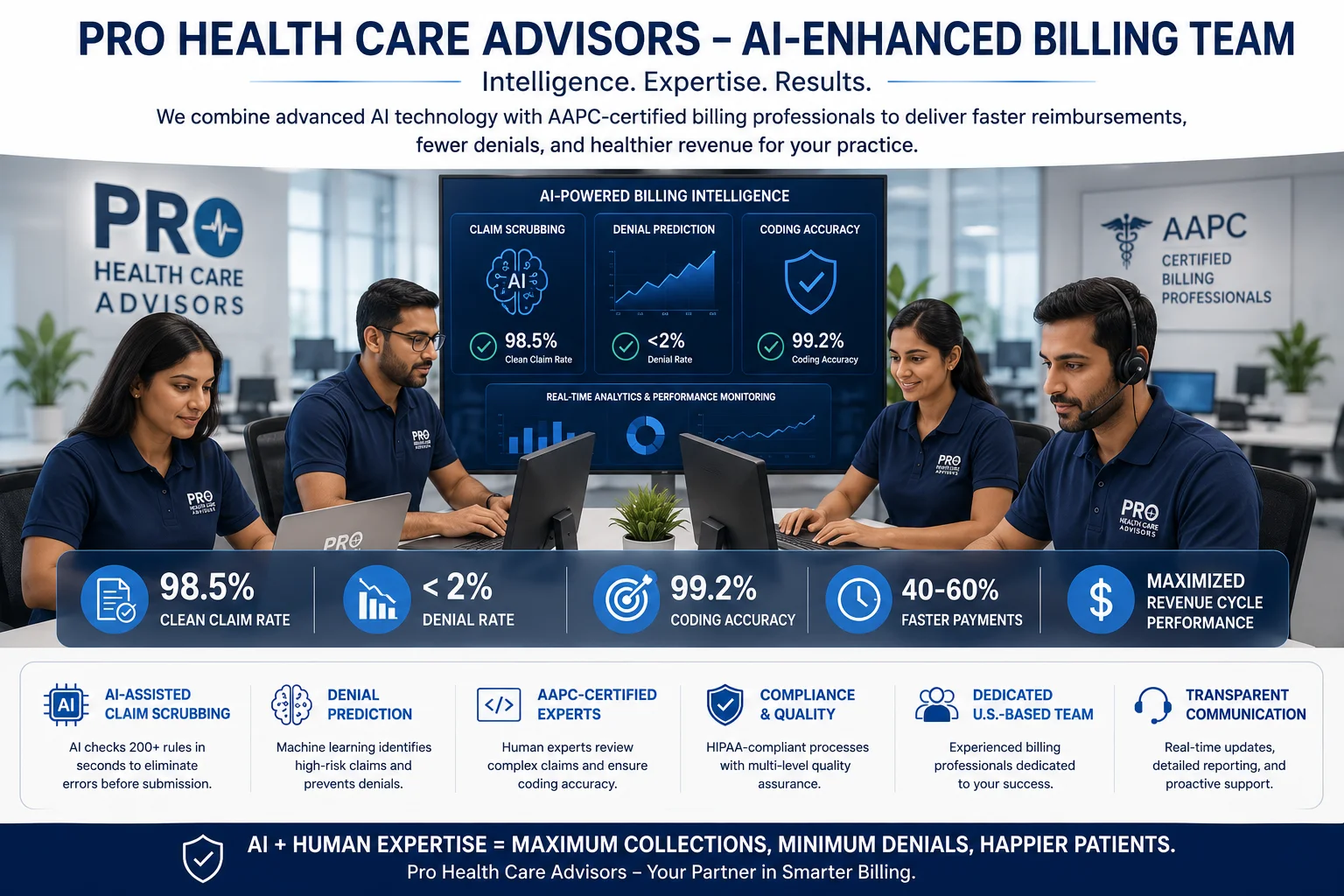
At Pro Health Care Advisors, AI is not a marketing claim — it is the operational foundation that allows our AAPC-certified billers to focus on the judgment-intensive work that actually requires human expertise.
Here is specifically how AI is embedded in our billing workflow:
AI-powered pre-submission scrubbing analyzes every claim against payer-specific denial patterns before submission — catching the errors that generate the most common denial codes (CO-16, CO-11, CO-15) before they reach the payer.
Predictive denial scoring flags high-risk claims for human review rather than letting them proceed to automatic submission — allowing our certified billers to correct issues proactively rather than reactively managing denials.
Automated eligibility verification runs real-time before every appointment across our client base — eliminating the CO-22 and OA-23 denials generated by stale insurance information.
AI-assisted coding review through our CodeMAXX services identifies undercoding patterns that suppress net collections — recovering the 6 to 9 percent of revenue that most practices are leaving on the table.
Prior authorization tracking maintains payer-specific authorization requirement data and monitors outstanding authorizations — preventing the CO-15 denials that generate when services are rendered without valid authorization.
Appeal pattern analysis uses historical appeal outcomes to generate and prioritize appeal language — improving overturn rates on denied claims that our human billers then review and submit.
The result: a 98.5 percent clean claim rate and a denial rate under 2 percent — consistently, across more than 30 specialties, for practices of every size.
For a complete picture of how these functions fit within a full revenue cycle, see our medical billing trends 2026 guide and our what is revenue cycle management guide.
We serve practices across cardiology, family practice, mental health, wound care, and more — see our full specialties list.
For more billing education and resources, visit our articles and resources library.
Frequently Asked Questions — AI in Medical Billing 2026
Q: Is AI replacing medical billers in 2026? No — and practices that believe this are making an expensive mistake. AI is a force multiplier for human billing teams, not a replacement. It handles high-volume pattern-recognition tasks — eligibility checks, claim scrubbing, denial prediction, payment posting — freeing AAPC-certified billers to focus on complex appeals, specialty-specific coding judgment, payer contract disputes, and compliance management that AI cannot perform accurately.
Q: What is the biggest benefit of AI in medical billing? Pre-submission denial prediction — the ability to identify which claims are likely to be denied before they leave your system and correct them proactively — delivers the most measurable revenue improvement. Practices using AI-powered scrubbing report 15 to 25 percent improvements in first-pass acceptance rates and 20 to 30 percent reductions in AR days.
Q: How does AI handle prior authorization in 2026? AI prior authorization tools maintain payer-specific authorization requirement libraries, pre-populate PA request fields from EHR documentation, and track authorization status in real time. They reduce the time required to prepare and submit a PA request significantly — and eliminate the CO-15 denials that occur when services are rendered without valid authorization. For the full 2026 PA rule picture, see our prior authorization rules guide.
Q: Does AI work with my existing EHR system? Most AI billing tools are designed to integrate with major EHR platforms — but compatibility varies. Confirm specific EHR compatibility before engaging any AI-enhanced billing service. Practices with EHR-billing silos — where clinical documentation and billing systems do not communicate — benefit most from AI integration that bridges that gap. See our EMR/EHR services for how we approach this integration.
Q: Is AI-assisted billing HIPAA compliant? It must be — AI systems processing patient billing data handle PHI and are legally required to operate under a signed Business Associate Agreement and full HIPAA compliance. Always verify HIPAA compliance documentation before allowing any AI tool to access patient billing data. Our HIPAA compliance services cover all AI-assisted operations in our billing workflow.
Q: How do I know if a billing company is actually using AI effectively versus just claiming to? Ask for measurable performance metrics — clean claim rate, denial rate, first-pass resolution rate, AR days. A billing company using AI effectively should demonstrate performance significantly above industry averages. Also ask specifically how their AI handles payer-specific patterns and what human expertise backstops the automation. Vague answers about “AI-powered tools” without specific performance numbers signal marketing over substance.
Q: What CPT codes now exist for AI diagnostic services? The 2026 CPT code update introduced new Category I codes for AI-driven diagnostic services — including coronary atherosclerotic plaque assessment, perivascular fat analysis for cardiac risk, and multispectral imaging for burn wounds. These are the first Category I codes formally recognizing AI as a standard clinical tool. For the full CPT update picture, see our CPT code changes 2026 guide.