
Healthcare practices can lose revenue because of claim errors, missing charges, inaccurate payment posting, and delayed insurance follow-ups. A medical billing audit checklist helps identify these problems, improve billing accuracy, and strengthen revenue cycle management.
Regular billing audits allow practices to detect recurring mistakes before they affect more claims. They also help managers evaluate workflows, investigate payment discrepancies, and assign corrective actions.
This guide explains how to use a medical billing audit checklist, which areas deserve attention, and how healthcare practices can turn audit findings into measurable improvements.
What Is a Medical Billing Audit Checklist?
A medical billing audit checklist is a structured review tool used to examine patient registration, insurance verification, clinical documentation, coding, claim submission, payments, and accounts receivable.
The goal is to determine whether billing activities are accurate, appropriately documented, and consistent with applicable payer requirements and practice policies.
A well-organized medical billing audit checklist can help practices:
- Identify claim submission errors.
- Find missing charges and potential underpayments.
- Review denial and rejection patterns.
- Verify payment posting and adjustments.
- Improve accounts receivable follow-up.
- Document corrective actions and monitor results.
For a broader overview, explore our guide to revenue cycle management in medical billing.
Why Is a Medical Billing Audit Important?
Small billing errors can create significant administrative work when they occur repeatedly. Incorrect insurance information may cause rejections, incomplete documentation may delay payment, and unexplained adjustments may affect account balances.
Using a medical billing audit checklist gives the billing team a repeatable process for finding these problems. It also helps managers identify the underlying causes instead of repeatedly correcting individual claims.
The checklist should be adapted to the practice’s specialty, payer mix, billing software, and applicable requirements.
12 Essential Medical Billing Audit Checklist Steps
1. Verify Patient Registration Information
Accurate patient information is essential for clean claim submission. Review names, dates of birth, insurance member IDs, subscriber details, and policy information.
Check for duplicate records, incomplete fields, and inconsistent updates. When errors appear repeatedly, review the registration workflow and provide staff with clear correction procedures.
Audit goal: Reduce avoidable registration errors before claims enter the billing process.

2. Review Insurance Eligibility and Authorization
Insurance coverage and benefits can vary by service and payer. Confirm that eligibility checks are documented and that staff follow applicable referral and prior authorization requirements.
Look for outdated insurance information, missing verification records, and services that require additional approval.
Related resource: Coordination of Benefits in Medical Billing.
3. Compare Clinical Documentation With Billed Services
Review whether billed services are supported by the available clinical documentation and comply with applicable coding and payer requirements.
Check for inconsistencies between documented services, diagnosis codes, procedure codes, modifiers, and units billed. Refer questionable cases to qualified coding or clinical professionals.
Never change a code simply to obtain higher reimbursement. Any correction must be supported by the record and applicable rules.
4. Examine Coding Accuracy
Coding errors can lead to denials, delayed payments, rework, and compliance concerns.
During this part of the medical billing audit checklist, review a sample of claims for:
- Incorrect or incomplete diagnosis codes.
- Unsupported procedure codes.
- Missing or inappropriate modifiers.
- Incorrect units of service.
- Duplicate coding entries.
- Relevant payer-specific edits.
Read our guide to claims scrubbing in medical billing to learn how certain errors can be identified before claim submission.
5. Identify Missing or Delayed Charges
Revenue may be lost when completed services are not transferred into the billing system or charges are entered late.
Compare completed encounters and service records with charge entries and submitted claims. Investigate encounters without corresponding charges, unusual changes in charge volume, and delays between service delivery and billing.
Document confirmed discrepancies and follow approved procedures for corrections.
6. Audit Claim Submission and Rejections
Review whether claims are submitted accurately and within applicable filing deadlines. Examine clearinghouse and payer rejections to determine whether corrections are completed promptly.
Track recurring issues by payer, provider, claim type, and error category. Assign responsibility for follow-up and retain claim submission records.
A consistent medical billing audit checklist should help the team identify recurring errors and improve the process that caused them.
Explore medical billing and practice management for related workflow guidance.
7. Analyze Denials and Root Causes
A high denial rate may indicate problems with registration, coding, authorization, documentation, or claim submission. Counting denials alone does not reveal their underlying causes.
Group denials by reason, payer, service, and workflow. Determine whether each case requires a corrected claim, appeal, additional documentation, contract review, or another appropriate action.
Record the cause, resolution, responsible team member, and any process change needed to prevent similar denials.
8. Reconcile Payments and Adjustments
Payment posting errors can make financial reports inaccurate and leave account balances unresolved.
Compare remittance advice with posted payments, adjustments, and outstanding balances. Confirm that payments are allocated to the correct accounts and that adjustments have appropriate supporting information.
Investigate duplicate entries, missing payments, unapplied cash, and unexplained differences.
Related resources:
9. Investigate Reimbursement Variances
A difference between expected and actual payment is not automatically an underpayment. Variances may reflect contractual adjustments, deductibles, coinsurance, coordination of benefits, or other legitimate factors.
Compare payment information with the applicable payer contract, fee schedule, claim details, and remittance advice.
Document the expected amount, actual payment, reason for the variance, and next action. Escalate confirmed discrepancies according to the practice’s procedures.
10. Review Accounts Receivable Follow-Up
Outstanding accounts receivable can indicate unresolved denials, missing documentation, delayed processing, or ineffective follow-up.
Review balances by aging category, payer, claim status, and amount. Prioritize accounts based on deadlines, potential recovery, and the likelihood of resolution.
Confirm that high-priority claims have documented follow-up and that unresolved balances have clear next steps.
11. Check Patient Statements and Balances
Patient statements should accurately reflect responsibility after insurance processing and applicable practice policies.
Review statement accuracy, payment allocation, credit balances, returned mail, and unresolved billing questions. Ensure that amounts transferred to patients are supported by available records and comply with applicable requirements.
Staff should follow established privacy, communication, and billing-dispute procedures.
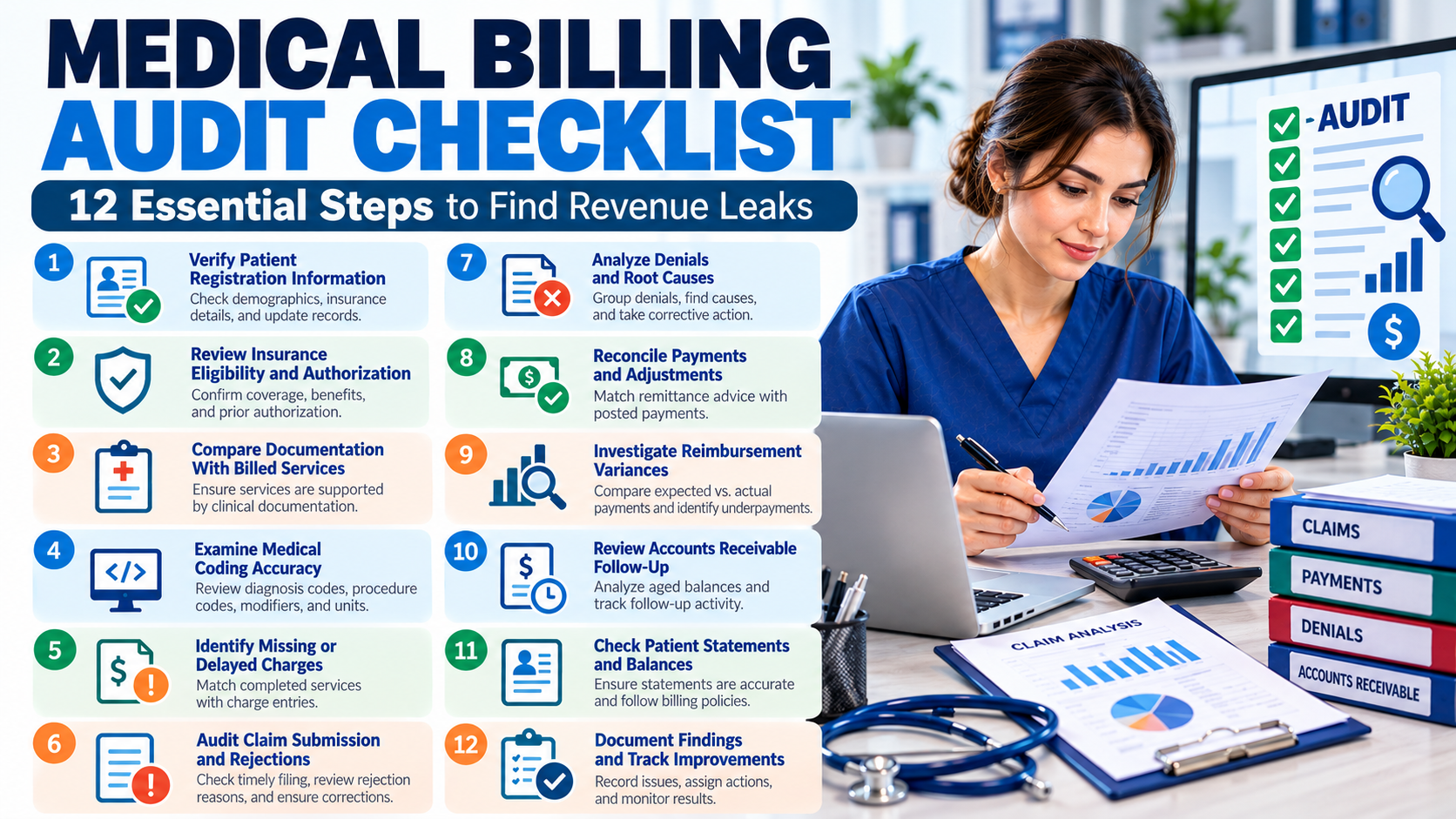
12. Document Findings and Track Improvements
A medical billing audit checklist is useful only when findings lead to corrective action. Record each issue, its root cause, potential impact, responsible person, and deadline.
A practical action plan should include:
- Finding: What was incorrect?
- Root cause: Why did it happen?
- Corrective action: What needs to change?
- Owner: Who is responsible?
- Deadline: When should it be completed?
- Validation: How will the team verify the result?
Schedule follow-up reviews to determine whether error rates, denials, and payment discrepancies have improved.
Quick Medical Billing Audit Checklist
Use this condensed checklist during routine reviews:
-
Patient demographics and insurance details are accurate.
-
Eligibility and authorization checks are documented.
-
Billed services are supported by clinical documentation.
-
Coding and modifiers are reviewed.
-
Completed services are reconciled with charges.
-
Rejected and denied claims have documented follow-up.
-
Payments and adjustments are reconciled.
-
Unapplied cash and credit balances are investigated.
-
Reimbursement variances are reviewed.
-
Accounts receivable follow-up is documented.
-
Patient statements and balances are accurate.
-
Corrective actions are assigned and rechecked.
This medical billing audit checklist can be customized to match the practice’s services, payer mix, and operational risks.
Common Medical Billing Audit Mistakes to Avoid
Reviewing Too Few Claims
A small sample may fail to reveal recurring problems. Select samples based on risk, claim volume, payer mix, and the purpose of the audit.
Focusing Only on Denials
Missing charges, payment posting errors, underpayments, and unresolved credit balances can also affect revenue. Review the entire billing workflow rather than only denied claims.
Ignoring Root Causes
Correcting individual claims without fixing the underlying process can lead to repeated errors. Use findings to improve staff training, procedures, and system controls.
Making Unsupported Corrections
Coding changes, financial adjustments, and claim corrections must be supported by documentation and applicable rules.
Skipping Follow-Up Reviews
Assign corrective actions and verify that changes were implemented successfully. Track the results to determine whether the original issue has decreased.
How Often Should Practices Conduct a Billing Audit?
Audit frequency depends on practice size, specialty, payer mix, operational risk, and previous findings.
Practices may combine routine performance reviews with periodic targeted audits. Additional reviews may be appropriate after billing system changes, new service launches, or recurring claim problems.
A consistent schedule helps teams identify issues early and measure progress.
Official Billing and Compliance Resources
Use authoritative resources to supplement internal procedures:
- Centers for Medicare & Medicaid Services (CMS) — official Medicare and Medicaid program information.
- HHS HIPAA Resources — information about health information privacy and security.
- CMS Medicare Learning Network — educational resources for healthcare providers.
Confirm the requirements that apply to your payer, services, and jurisdiction before changing billing procedures.
Frequently Asked Questions
What is a medical billing audit checklist?
It is a structured review tool covering registration, eligibility, documentation, coding, claims, payments, accounts receivable, and corrective actions.
Can a billing audit help reduce claim denials?
Yes. Audits can reveal recurring denial causes and help practices correct underlying workflow problems. Results depend on implementing and monitoring corrective actions.
Who should perform a medical billing audit?
Qualified billing staff, coding professionals, compliance personnel, or external specialists may conduct audits depending on the scope and required expertise.
Does every payment variance indicate an underpayment?
No. Differences can result from contractual adjustments, patient cost-sharing, coordination of benefits, or other legitimate factors. Review the contract and claim details before determining whether recovery is appropriate.
How can practices measure audit success?
Common measures include claim error rates, denial rates, rejection rates, days in accounts receivable, payment posting accuracy, unresolved variances, and completion of corrective actions.
A structured medical billing audit checklist helps healthcare practices identify billing weaknesses, investigate payment discrepancies, and strengthen revenue cycle performance.
Review registration, documentation, coding, claims, payments, and accounts receivable consistently. Document findings, assign corrective actions, and verify whether improvements are working.
For help improving billing workflows, explore Pro Health Care Advisors’ medical billing and practice management services.