







Healthcare Price Transparency 2026 — What Every Practice and Patient Needs to Know Right Now
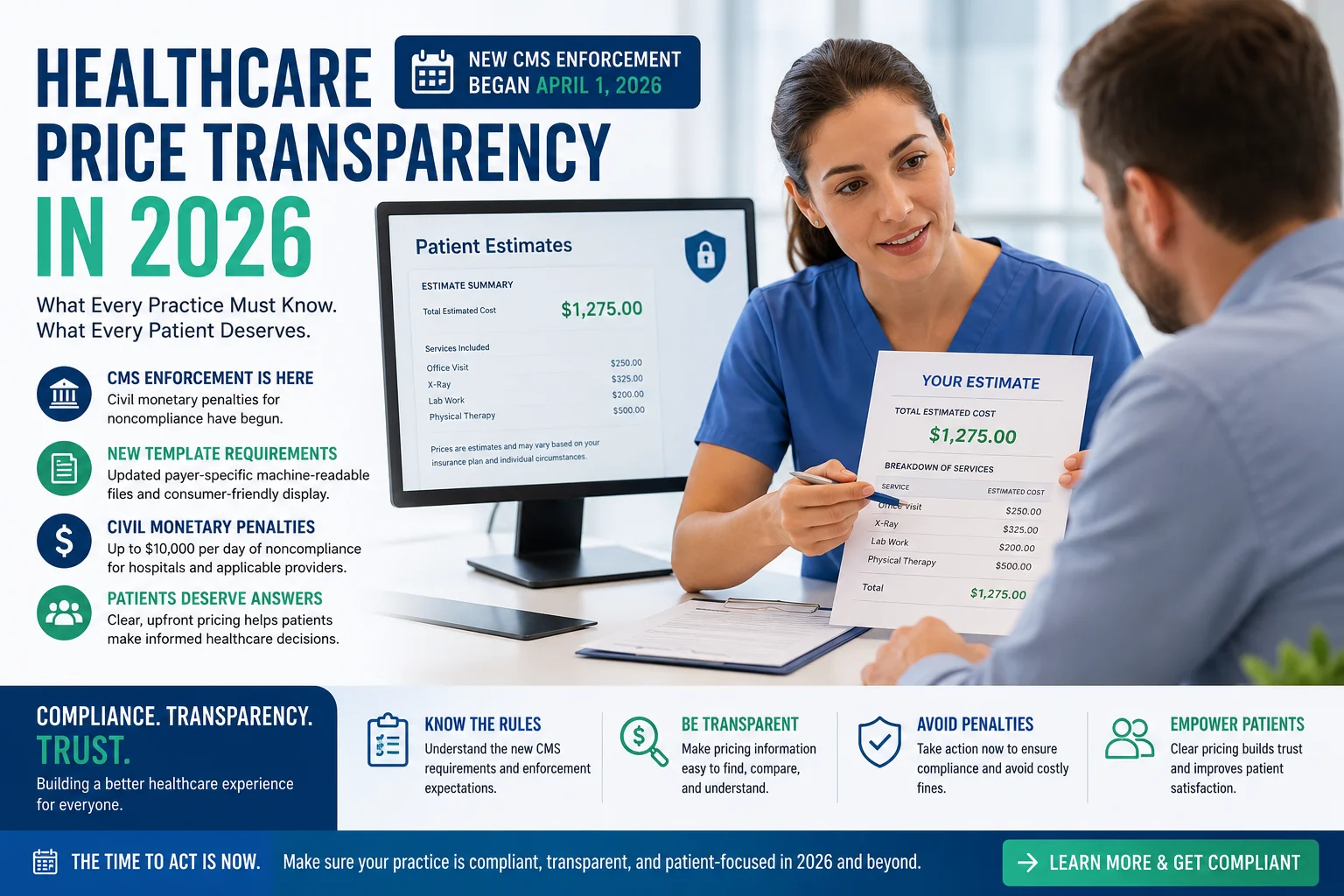
CMS began enforcing new and updated Hospital Price Transparency requirements under the CY 2026 OPPS and Ambulatory Surgical Center Payment System final rule. And unlike previous rounds of enforcement — which were widely criticized as toothless — this one has real teeth.
CMS will now automatically impose Civil Monetary Penalties on hospitals that fail to submit a Corrective Action Plan within 45 days of receiving a CAP request — rather than waiting and hoping for voluntary compliance. Penalties can reach $300 per day per violation for large hospitals — and that number compounds every single day until the hospital comes into compliance.
For patients, this means something important is finally happening: for the first time in years, the law requiring hospitals and healthcare providers to tell you what something costs before you receive it is actually being enforced. Patients want to know their out-of-pocket cost upfront, not after they receive a bill. The 2026 price transparency update is designed to make that possible.
For providers — hospitals, outpatient facilities, and practices — this means compliance is no longer optional, and the grace period is over.
This guide covers everything: what the 2026 price transparency requirements actually say, what changed from previous years, what the penalties look like, what patients can now expect to access, and what healthcare practices need to do right now to protect their revenue and their reputation.
What Is Healthcare Price Transparency — And Why Does It Matter in 2026?
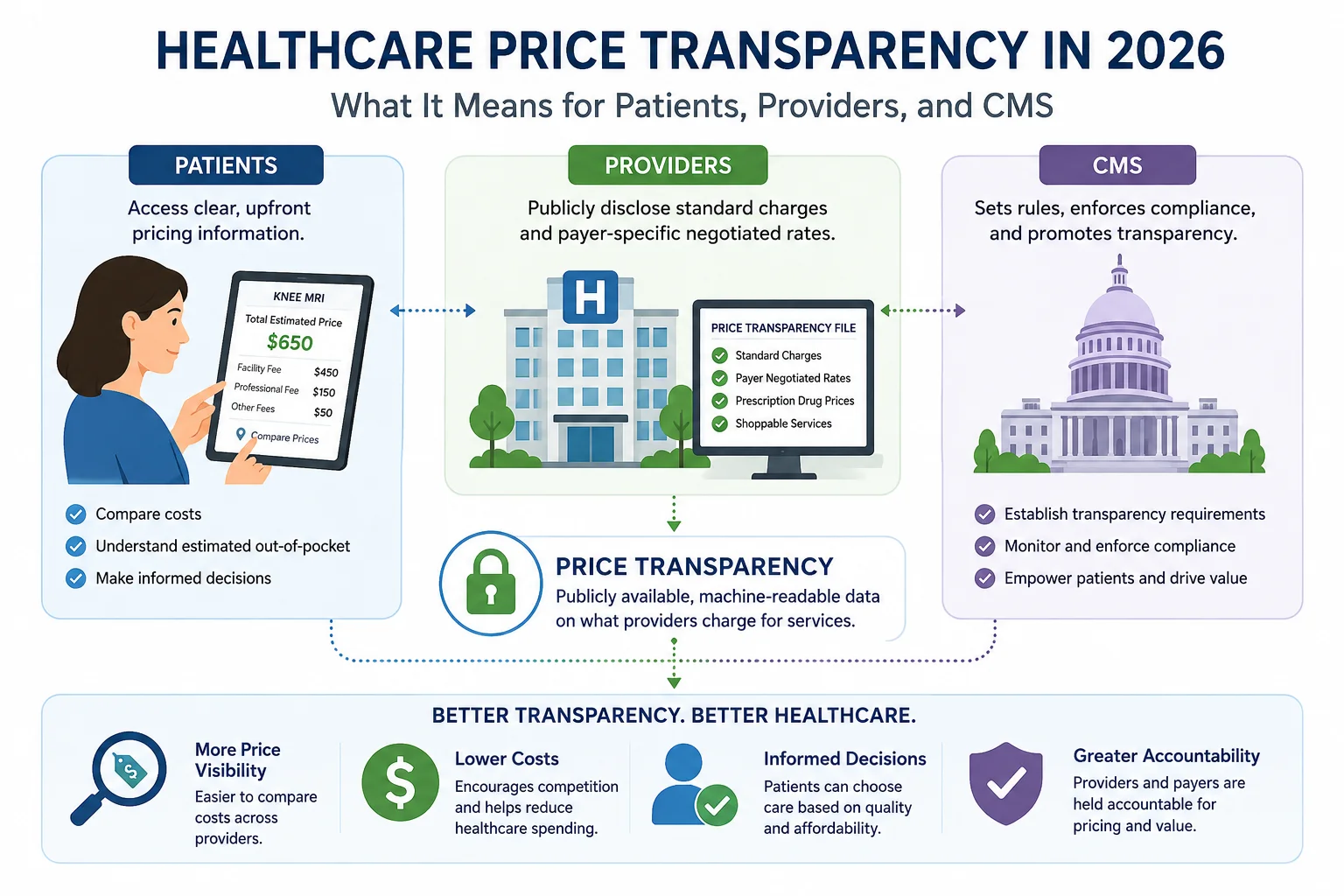
Healthcare price transparency is the requirement that hospitals and healthcare providers publicly disclose the actual prices they charge for services — including what they charge insurance companies, what cash-pay patients pay, and what the minimum and maximum negotiated rates are across payer contracts.
The concept sounds simple. The reality has been anything but.
The global subscription billing management market is valued at approximately $9.88 billion in 2026 and is projected to expand significantly to $37.02 billion by 2035 — driven in part by the growing focus on compliance and risk management, which calls for improving medical billing efficiency and reducing in-house operational costs.
Before the Hospital Price Transparency rule took effect in January 2021, patients had virtually no ability to find out what a medical procedure would cost before receiving it. They would schedule surgery, receive care, and then — weeks later — open a bill for an amount they had no way of predicting or planning for.
77 percent of providers say it takes more than a month to collect payment. 91 percent of consumers prefer electronic payment methods for medical bills. 87 percent of consumers want to make all of their healthcare payments in one place. None of these preferences can be met if patients do not know what they owe until long after care is delivered.
The 2026 update — enforced beginning April 1 — represents the most significant strengthening of price transparency requirements since the original rule took effect. It is not a minor adjustment. It is a structural change in what hospitals and providers are required to disclose, how they must disclose it, and what happens when they do not.
What Changed in 2026 — The New CMS Price Transparency Requirements
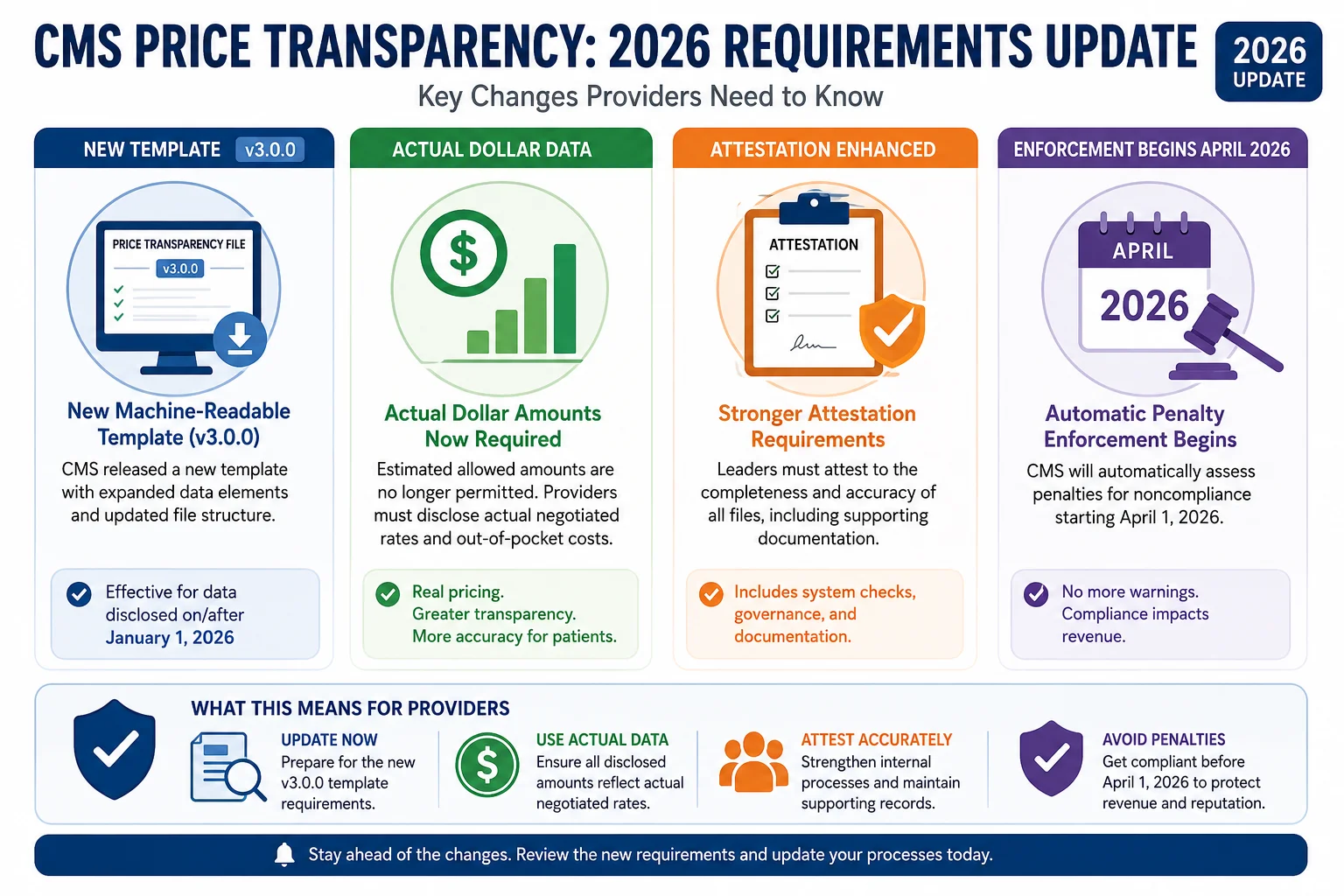
On November 21, 2025, CMS published the CY 2026 Outpatient Prospective Payment System and Ambulatory Surgical Center Final Rule, which includes several significant changes to hospital price transparency regulations.Here is exactly what changed — and what it means for providers and patients.
1. New Template Version 3.0.0 — Actual Allowed Amounts Required
This is the most operationally significant change in the 2026 update.
CMS will require hospitals to adopt a new template (version 3.0.0), which replaces the “estimated allowed amount” with columns based upon actual dollar-based data.
What does that mean in plain language? Previously, hospitals were allowed to report an “estimated” average of what they historically received from a payer. That estimate was often vague, outdated, or calculated using algorithms that made comparison nearly impossible.
Beginning January 1, 2026, hospitals must calculate and encode the 10th percentile allowed amount, the median allowed amount, and the 90th percentile allowed amount in dollars for each item or service. Hospitals must also report the total number of payment remittances used to calculate those figures.
This is real data — actual dollar amounts that patients and insurance navigators can use to compare what different hospitals actually receive for the same service. Not estimates. Not algorithms. Actual dollars.
2. Strengthened Attestation Requirement
Beginning January 1, 2026, the Rule replaces the existing affirmation statement with a new, strengthened requirement. Hospitals must now attest: “To the best of its knowledge and belief, this hospital has included all applicable standard charge information in accordance with the requirements of 45 CFR 180.50, and the information encoded is true, accurate, and complete as of the date in the file. This hospital has included all payer-specific negotiated charges in dollars that can be expressed as a dollar amount.”
Beginning January 1, 2026, hospitals must encode the name of the hospital chief executive officer, president, or senior official designated to oversee the encoding of true, accurate, and complete data.
Why does this matter? Because attesting to accuracy as a named executive creates personal accountability — not just institutional compliance. When a hospital’s CEO signs off on price transparency data, the stakes for inaccuracy are significantly higher than when the hospital submits a form.
3. Enforcement Began April 1, 2026 — Automatic Penalties Now Apply
Enforcement of new and updated Hospital Price Transparency requirements started April 1, 2026.
Under the updated enforcement process, CMS will now automatically impose a Civil Monetary Penalty on hospitals that fail to submit a Corrective Action Plan within 45 days of receiving a CAP request — rather than the previous process where CMS would wait for hospitals to propose their own timelines.
The enforcement cycle now works like this:
- CMS reviews hospital compliance — either through complaint investigation or routine auditing
- If non-compliant, hospital receives a warning notice with 90 days to correct deficiencies
- If not corrected in 90 days, CMS issues a CAP request — hospital has 45 days to submit
- If CAP is not submitted in 45 days — automatic CMP imposed
- If hospital does not come into compliance within 90 days of CAP request — additional CMP imposed
CMS adopted a policy to decrease CMPs by 35 percent in certain situations when a hospital waives its right to an ALJ hearing. However, the 35 percent reduction will not apply if the CMP is imposed due to the hospital failing to make its machine-readable file or any shoppable services public.
In other words — the discount on penalties is not available for the most serious violations. If a hospital simply has not published its price file, they face the full penalty with no reduction option.
4. Executive Order Directive — The Political Context
In February 2025, the White House issued Executive Order 14221, which called on HHS to require the disclosure of actual prices of items and services, not estimates, ensure pricing information is standardized and easily comparable across hospitals and health plans, and update enforcement policies designed to ensure compliance with the transparent reporting of complete, accurate, and meaningful data.
This executive order is what drove the 2026 CMS rulemaking. Price transparency is now a White House priority — which means enforcement intensity is unlikely to decrease. Practices and hospitals that are treating price transparency as a low-priority compliance checkbox need to reassess that position.
What Providers Must Publish — The Complete 2026 Requirements
Hospitals must publicly post: (1) A single machine-readable digital file containing standard charges for all items and services — including gross charges, discounted cash prices, payer-specific negotiated charges, and de-identified minimum and maximum negotiated charges. (2) A consumer-friendly list of standard charges for at least 300 shoppable services — or as many as the hospital provides if fewer than 300.
Here is what each of those requirements means in practice:
Machine-Readable File (MRF): A digital file — in CSV or JSON format using the CMS template — containing the complete list of charges for every item and service the hospital provides. This file must be publicly accessible, downloadable, and updated at least annually. Under the 2026 requirements, it must use Template Version 3.0.0 and include actual allowed amount data organized by the 10th percentile, median, and 90th percentile.
Consumer-Friendly Shoppable Services List: A plain-language, patient-accessible list of at least 300 shoppable services — services a patient can schedule in advance — showing the discounted cash price, payer-specific negotiated charges, and de-identified minimum and maximum negotiated charges. Hospitals can satisfy this requirement with an online price estimator tool that meets CMS specifications.
CMS will deem a hospital as having met the shoppable services requirement if the hospital maintains an internet-based price estimator tool that meets the requirements provided in 45 CFR § 180.60(a)(2).
The practical implication: every hospital in the United States is now required to have an online tool or page that shows patients what specific services cost before they receive them. For hospitals that do not have this yet — or that have it in a form that does not meet the 2026 template requirements — the enforcement clock is already running.
What the Penalties Look Like — And Who Is Actually Getting Fined
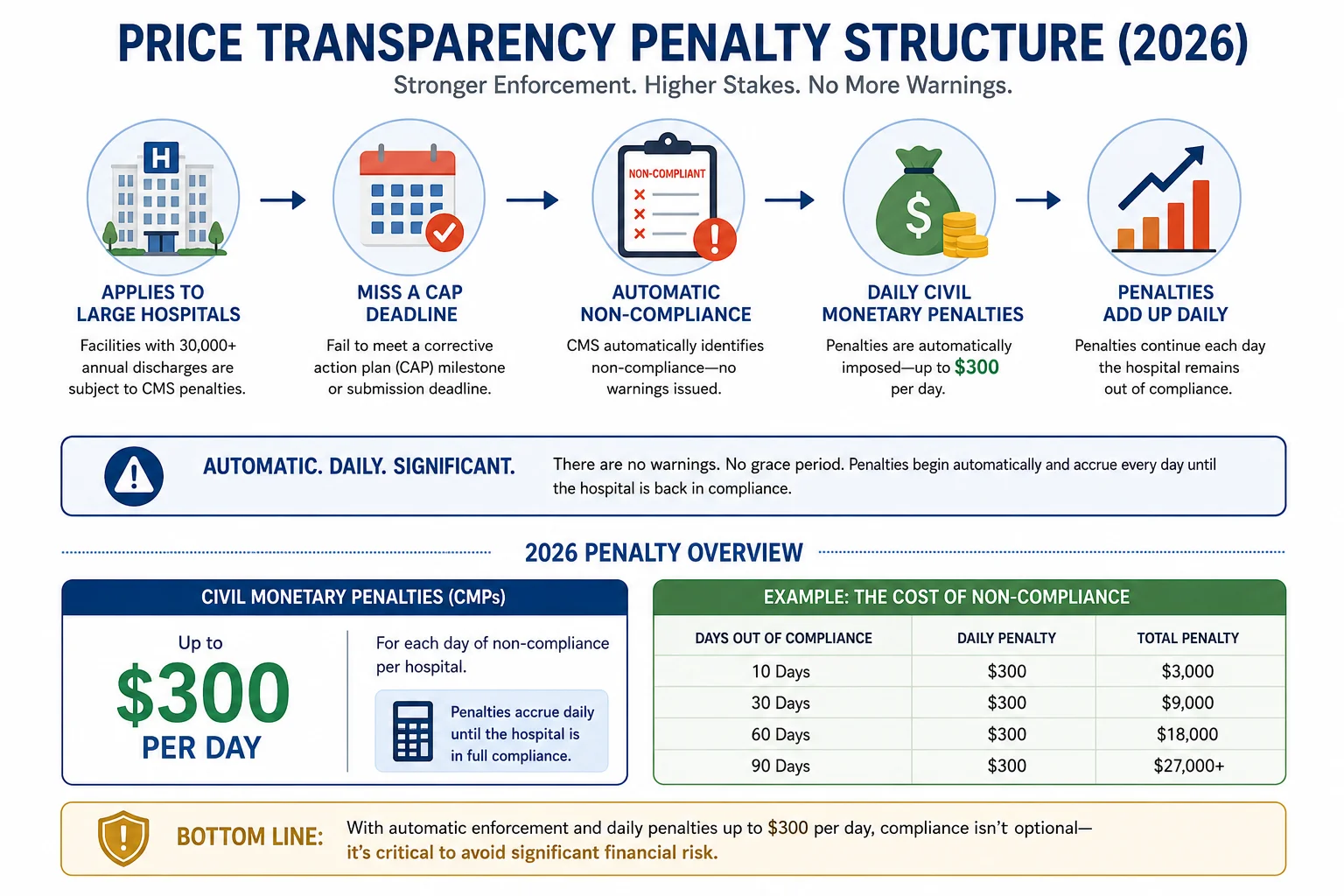
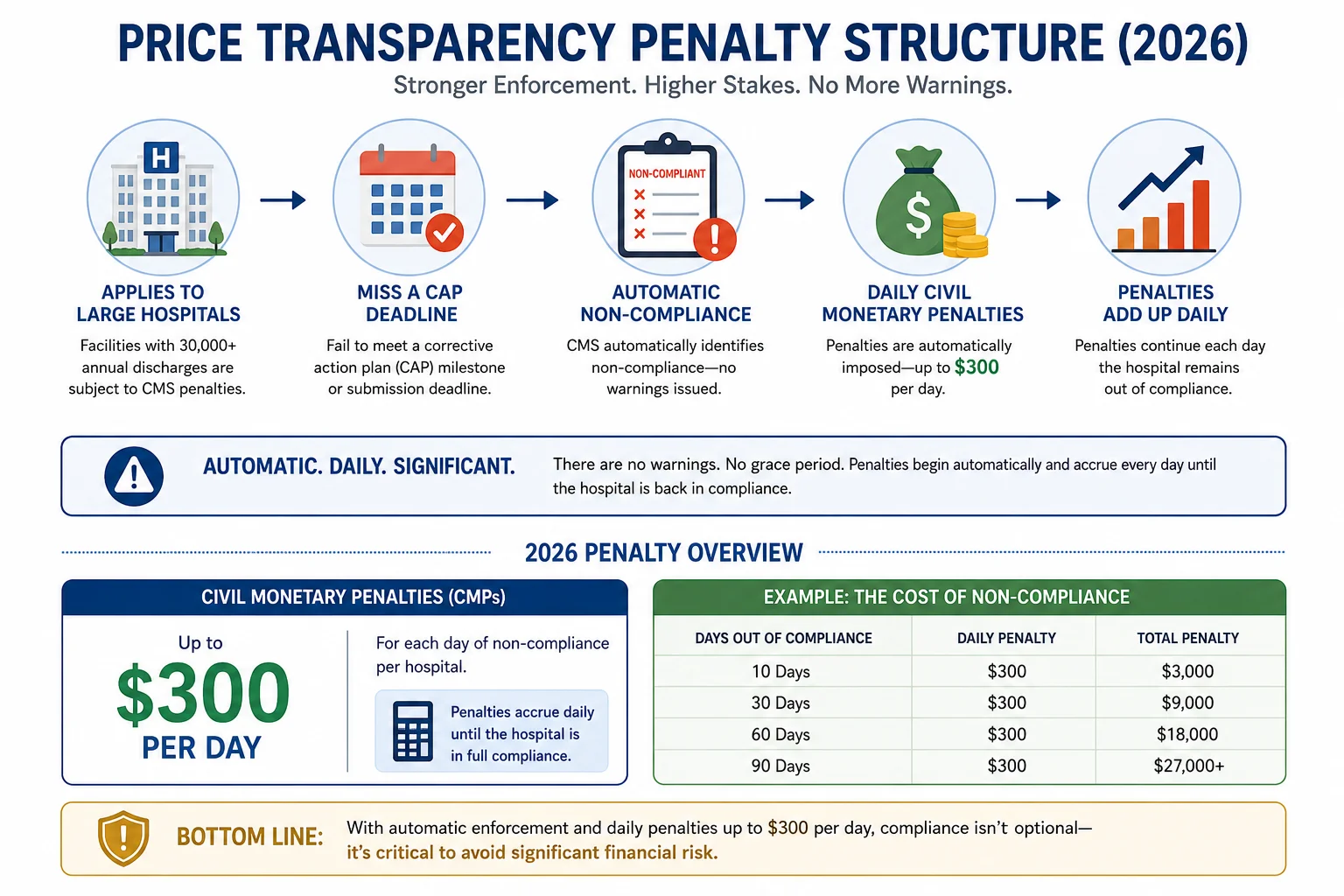
The penalty structure for price transparency non-compliance in 2026 is more aggressive than at any previous point since the rule took effect.
Civil Monetary Penalties are calculated per day of non-compliance and vary based on hospital bed size:
| Hospital Size | Maximum Daily CMP |
|---|---|
| Fewer than 30 beds | $109 per day |
| 30 to 549 beds | $219 per day |
| 550 or more beds | $300 per day |
These amounts may appear modest on their face — but they accumulate. A 500-bed hospital non-compliant for 180 days (six months) faces up to $54,000 in penalties from daily fines alone — before any additional enforcement actions.
CMS has issued more than 730 warning notices and 269 requests for CAPs as of April 2023 — and has imposed Civil Monetary Penalties on hospitals for non-compliance. Those numbers have grown significantly as enforcement has intensified through 2025 and 2026.
The Hospital Price Transparency Enforcement Activities and Outcomes dataset — updated monthly — contains information on enforcement actions CMS has taken following compliance reviews. Enforcement of new and updated requirements began April 1, 2026.
Beyond the CMPs, there is a less visible but equally significant enforcement consequence: reputational damage. CMS publishes the names of non-compliant hospitals on its website. In 2026, when patients are actively searching for cost information before scheduling care, being identified as a non-compliant hospital is a patient acquisition problem — not just a compliance problem.
What This Means for Patients — The New Rights You Have Right Now
If you are a patient reading this — here is what you are now legally entitled to know before you receive care at any US hospital.
The actual price the hospital charges for your service. Not an estimate. Not a range. The actual gross charge, the discounted cash price (what you pay if you have no insurance), and the payer-specific negotiated rate your insurance company has agreed to pay.
The hospital’s negotiated rates with your specific insurance plan. The machine-readable file contains payer-specific rates — meaning if your insurance carrier has a contract with the hospital, you can find out what that contract says your insurer will pay for the service you need.
A cost range for your service. Under the 2026 template requirements, you can now see the 10th percentile, median, and 90th percentile of what the hospital has actually been paid for a service — giving you a realistic range of what the final bill might look like.
A consumer-friendly cost list for shoppable services. For procedures you can schedule in advance — outpatient surgery, imaging, lab work, maternity care, and hundreds of other common services — the hospital must provide a plain-language cost list that does not require a data science degree to understand.
<cite index=”7-1″>Practices that fail to provide accurate estimates risk losing patients to competitors who do. People want to know their out-of-pocket cost upfront, not after they receive a bill. Billing teams must now coordinate with front desk staff to ensure price information is available and accurate.</cite>
How to find this information: Go directly to the hospital’s website and look for a “Price Transparency” or “Standard Charges” page. Download the machine-readable file or use their price estimator tool. If you cannot find it, or if the tool does not work, the hospital may be non-compliant — and you can file a complaint directly with CMS.
How Price Transparency Affects Your Practice’s Revenue Cycle
Beyond compliance, healthcare price transparency in 2026 has a direct and measurable effect on practice revenue — in ways most providers have not fully thought through.
Patients Who Know Costs in Advance Pay Faster
Real-time claim adjudication allows providers to know whether a claim will be paid, how much, and if patient responsibility exists. This technology enables front-desk staff to collect accurate patient information before patients leave, dramatically reducing bad debt and improving cash flow.
When patients know their out-of-pocket responsibility before a service — rather than receiving a surprise bill weeks later — collection rates improve. Patients who are surprised by their bill dispute it, delay payment, or default on it. Patients who expected the bill pay it.
Clear communication about costs and easy payment methods improve collection rates. The practices that succeed in this environment make it easy for patients to pay. Online payment portals, text-to-pay options, and automated payment plans remove friction from the collection process. Practices that make payment difficult will see their patient collection rates suffer.
Price Transparency Creates Competitive Pressure
Regulations requiring healthcare providers to post prices publicly are creating new challenges for billing operations. This transparency is changing patient expectations.
When patients can compare what Hospital A charges for a knee replacement versus Hospital B — and when they can see that their insurance plan has a negotiated rate at Hospital A that is significantly lower — they will choose Hospital A. Price transparency is changing patient behavior in ways that will increasingly affect patient volume and market share for providers who are not prepared.
Upfront Cost Estimates Are Now a Patient Experience Standard
Patients today expect the same level of clarity in healthcare billing that they get from online retail or banking. Practices that adopt patient-centric billing portals early will not only improve collections but also build trust and loyalty — turning billing into a positive patient experience rather than a pain point.
The practices and hospitals that offer accurate, easy-to-understand cost estimates before care — and that follow through with bills that match those estimates — are building a trust advantage that directly affects patient retention and referrals. Those that continue to operate without this capability are at a growing competitive disadvantage.
Non-Compliance Has Revenue Consequences Beyond Penalties
Being identified as a non-compliant hospital on the CMS public list creates reputational risk that affects patient acquisition — particularly as more patients consult online resources before choosing a provider. A hospital that appears on a CMS non-compliance list is a hospital that a certain percentage of price-sensitive patients will actively avoid.
The 5 Things Every Healthcare Provider Must Do Right Now
Step 1: Audit your current price transparency compliance status. If you are a hospital — when did you last verify that your machine-readable file is published, accessible, and uses the correct CMS Template Version 3.0.0? CMS claims the changes reflect its continued focus on improving the accuracy and comparability of hospital price transparency data. Hospitals can use the enforcement transition period to carefully review their machine-readable files and data sources.
Step 2: Verify your shoppable services list is complete and patient-accessible. Hospitals must display at least 300 shoppable services — or as many as the hospital provides if fewer than 300 — with plain language descriptions and pricing information. If your list is not easily findable on your website or your price estimator tool does not function correctly, you have a compliance gap that is already within CMS’s enforcement scope.
Step 3: Update to Template Version 3.0.0. CMS requires hospitals to adopt the new template (v3.0.0), which replaces the estimated allowed amount with actual dollar-based data including 10th percentile, median, and 90th percentile allowed amounts. If your machine-readable file was built for an older template, it does not meet 2026 requirements.
Step 4: Implement or update your patient cost estimation workflow. Even for physician practices not directly subject to the hospital price transparency rule — patients are now expecting cost estimates before care. Building a point-of-service cost estimation workflow into your practice’s scheduling and check-in process is both a compliance preparation and a patient experience investment. Our medical billing and practice management services include eligibility verification workflows that support accurate point-of-service cost estimation.
Step 5: Train your front desk and billing staff on the new patient expectations. Billing teams must now coordinate with front desk staff to ensure price information is available and accurate. This requires new workflows and better integration between clinical and financial systems. Staff who are unable to answer patient cost questions — or who give inaccurate estimates — create billing disputes and collection problems downstream. Training front desk staff to use your price estimator tool accurately is now a revenue protection activity.
How Price Transparency Connects to the Broader Revenue Cycle
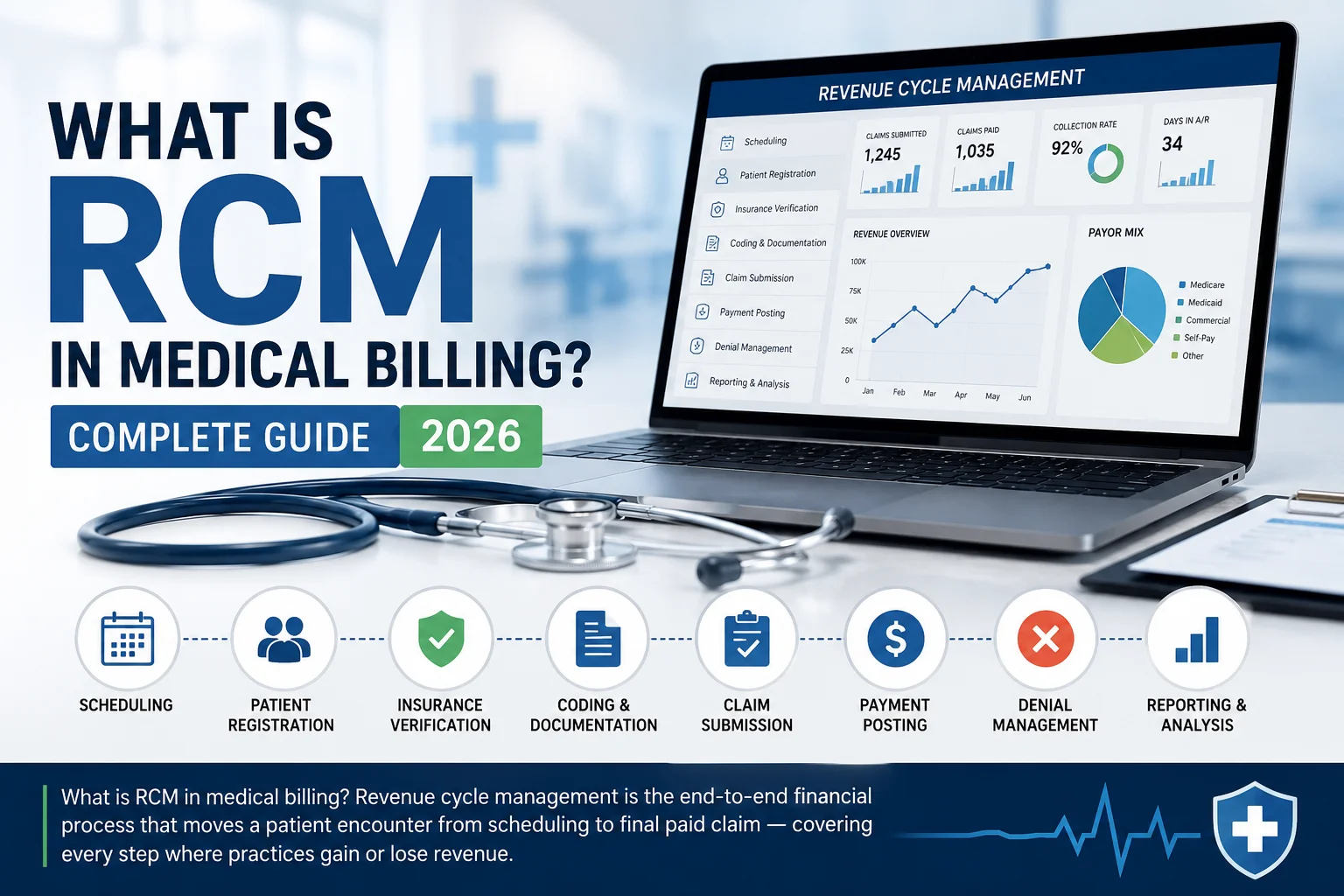
Price transparency is not an isolated compliance topic — it sits at the center of the revenue cycle changes reshaping medical billing in 2026. Here is how it connects to the other billing priorities we have covered:
Denial Management: When patients receive bills that match what they were told to expect, billing disputes go down — and so do the patient-initiated denial and adjustment requests that slow revenue cycle resolution. For more on managing denials effectively, see our complete medical billing denial codes guide.
Patient Collections: The single most effective way to improve patient collections is to collect at time of service. The single most effective way to collect at time of service is to give patients an accurate cost estimate before or during their visit. These two functions are now directly linked. See our creative collection solutions for how we approach patient balance management.
Revenue Cycle Management: Price transparency data — specifically the 10th, median, and 90th percentile allowed amounts now required in the MRF — gives practices and billing teams better data for evaluating whether payer payments are consistent with historical norms. Underpayments that previously went undetected become more visible when your price transparency data creates a documented baseline. For a complete overview of the revenue cycle, see our RCM guide.
Medical Billing Trends: Price transparency is one of the top 10 trends reshaping how practices get paid in 2026. Healthcare billing trends 2026 emphasize efficiency and transparency as key drivers — reflecting broader shifts where patient experience is as important as reimbursement speed. For the full trend picture, see our medical billing trends 2026 guide.
Credentialing: Price transparency data includes payer-specific negotiated rates — which means proper physician credentialing and enrollment directly affects what rates appear in your price file. An incorrectly enrolled provider generates billing errors that ripple into price transparency compliance. See our physician credentialing guide.
How Pro Health Care Advisors Helps Practices Navigate Price Transparency in 2026
Price transparency compliance for hospitals is primarily a data and publishing challenge. For physician practices and outpatient facilities, the more immediate challenge is the patient expectation that price transparency creates — and building the billing workflows that deliver on that expectation.
Here is how Pro Health Care Advisors supports practices navigating the 2026 price transparency environment:
Eligibility and Benefit Verification. Our real-time insurance eligibility verification captures patient-specific benefit information — deductibles, coinsurance, copays, and out-of-pocket limits — before every appointment. This is the foundation of accurate point-of-service cost estimation. Without it, cost estimates are guesses. With it, they are accurate enough to collect on.
Prior Authorization Tracking. Authorization status directly affects patient cost responsibility. Our prior authorization management ensures that services requiring authorization are approved before they are delivered — preventing the post-service billing surprises that most commonly generate patient disputes.
Patient Balance Management. Our creative collection solutions include patient billing workflows built around early, accurate communication about patient responsibility — the exact approach that improves collection rates in a high-deductible, price-transparency-aware patient environment.
HIPAA-Compliant Data Management. Price transparency data includes patient financial information that must be handled in compliance with HIPAA. Our HIPAA compliance services provide the data security framework that protects both your price transparency operations and your patient billing data.
Full Revenue Cycle Management. Our medical billing and practice management services integrate all of these functions into a single, coherent revenue cycle — from pre-visit cost estimation through final payment — with a 98.5 percent clean claim rate and a denial rate under 2 percent.
For more billing education, visit our articles and resources library.
Frequently Asked Questions — Healthcare Price Transparency 2026
Q: Does the hospital price transparency rule apply to physician practices? The Hospital Price Transparency rule — 45 CFR Part 180 — applies specifically to hospitals. However, the patient expectations it creates apply to all healthcare providers. Patients who can see hospital costs online before a visit now expect the same transparency from their physician’s office. Building cost estimation workflows into your practice is a revenue cycle best practice regardless of whether you are technically subject to the CMS rule.
Q: When did the 2026 price transparency enforcement changes take effect? The new requirements became effective January 1, 2026, but CMS delayed enforcement until April 1, 2026 to give hospitals time to implement the changes. Enforcement — including automatic Civil Monetary Penalties — began April 1, 2026.
Q: What is CMS Template Version 3.0.0 and do I need it? Template v3.0.0 replaces the estimated allowed amount with actual dollar-based data — 10th percentile, median, and 90th percentile allowed amounts. If you are a hospital required to publish a machine-readable file, your file must use this template for 2026 compliance. Older templates do not meet the new requirements.
Q: What are the penalties for price transparency non-compliance in 2026? Civil Monetary Penalties range from $109 per day for small hospitals (fewer than 30 beds) to $300 per day for large hospitals (550 or more beds). Penalties are now automatically imposed when hospitals miss CAP submission deadlines — removing the previous discretionary delay that allowed non-compliant hospitals to avoid penalties indefinitely.
Q: How can patients find hospital price information? Patients should go to the hospital’s website and look for a Price Transparency, Standard Charges, or Cost Estimator page. If no such page exists or the information is not accessible, patients can file a complaint with CMS at cms.gov/priorities/key-initiatives/hospital-price-transparency.
Q: How does price transparency affect what I collect from patients? Directly and positively — when implemented correctly. Patients who receive accurate cost estimates before care are significantly more likely to pay their bills on time and in full. Surprise bills — particularly for amounts larger than expected — generate disputes, delayed payment, and write-offs. Point-of-service cost estimation built on accurate eligibility verification is one of the highest-ROI investments a practice can make in 2026.
Q: What is the Executive Order 14221 and why does it matter? Executive Order 14221, issued in February 2025, directed HHS to require disclosure of actual prices — not estimates — and to update enforcement policies to ensure compliance with the transparent reporting of complete, accurate, and meaningful healthcare pricing data. It is the political driver behind the 2026 CMS rulemaking and signals that price transparency enforcement will remain a federal priority through at least the current administration.
The Bottom Line — Price Transparency Is Now the New Standard, Not the Exception
Healthcare price transparency in 2026 is not a compliance exercise that hospitals can satisfy with a buried PDF on their website. It is a structural shift in the relationship between healthcare providers and the patients they serve — one that the federal government is now actively enforcing, with penalties, public naming, and automatic consequences for non-compliance.
Payers keep tightening their policies, patients demand total price transparency, and compliance standards have increased. Ignoring these shifts can cost you revenue and your reputation. Understanding them helps you protect both.
For patients, this is the year when the right to know what care costs before receiving it finally has enforcement behind it.
For providers, this is the year when building patient cost estimation workflows into your revenue cycle is no longer a differentiator — it is a baseline expectation. The practices that do it well will collect faster, dispute less, and build stronger patient relationships. The ones that do not will fall further behind in both compliance and collections.
Pro Health Care Advisors helps practices build the billing workflows that meet 2026 patient expectations — accurate eligibility verification, point-of-service cost communication, patient balance management, and full revenue cycle transparency — with a 98.5 percent clean claim rate and denial rate under 2 percent.
Schedule Your Free Consultation with Pro Health Care Advisors →
No pressure. No pitch. Just a real conversation about where your practice’s billing stands in 2026 and what it would take to make it better.