







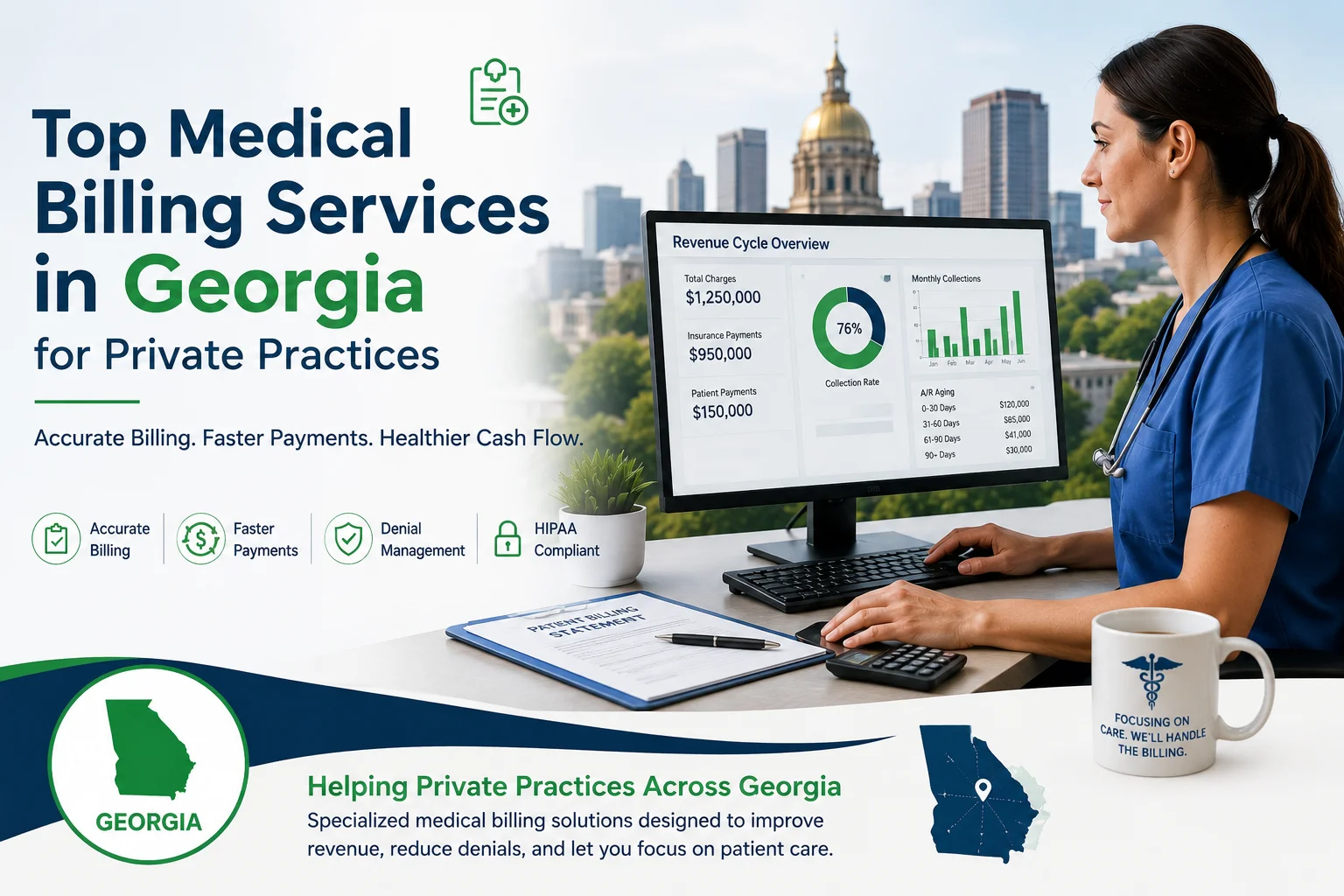
Top Medical Billing Services in Georgia for Private Practices — Why This Guide Matters 2026
Running a private medical practice in Georgia is rewarding. But somewhere between seeing patients, managing staff, and keeping up with ever-changing insurance rules, billing usually becomes the thing that quietly drains everything.
Claims pile up. Denials come back. Staff spend more time on the phone with insurance companies than on anything else. And every dollar sitting in accounts receivable is a dollar your practice earned but has not yet seen.
This guide is built specifically for private practice owners in Georgia — not hospital systems, not large group practices. The challenges a solo physician or a small specialty clinic faces in 2026 are different from what the big networks deal with. And the billing service that works for a 50-provider group may be completely wrong for a three-person family medicine office in Savannah or a behavioral health clinic in Macon.
What you will find here: what to look for in a Georgia medical billing partner, the specific regulatory landscape you are operating in right now, honest profiles of the services that consistently perform well for private practices in this state, and the questions you need to ask before signing any contract.
No fluff. No generic advice. Just what you need to make the right call.
A note on who wrote this: The team at ProHealth Care Advisors works directly with independent practices on revenue cycle health. We know what billing problems look like from the inside — and we know what good billing partnerships look like too.
Why Medical Billing in Georgia Is Its Own Challenge
Before picking a billing service, it helps to understand that Georgia has a few specific layers that make billing here genuinely different from most other states.
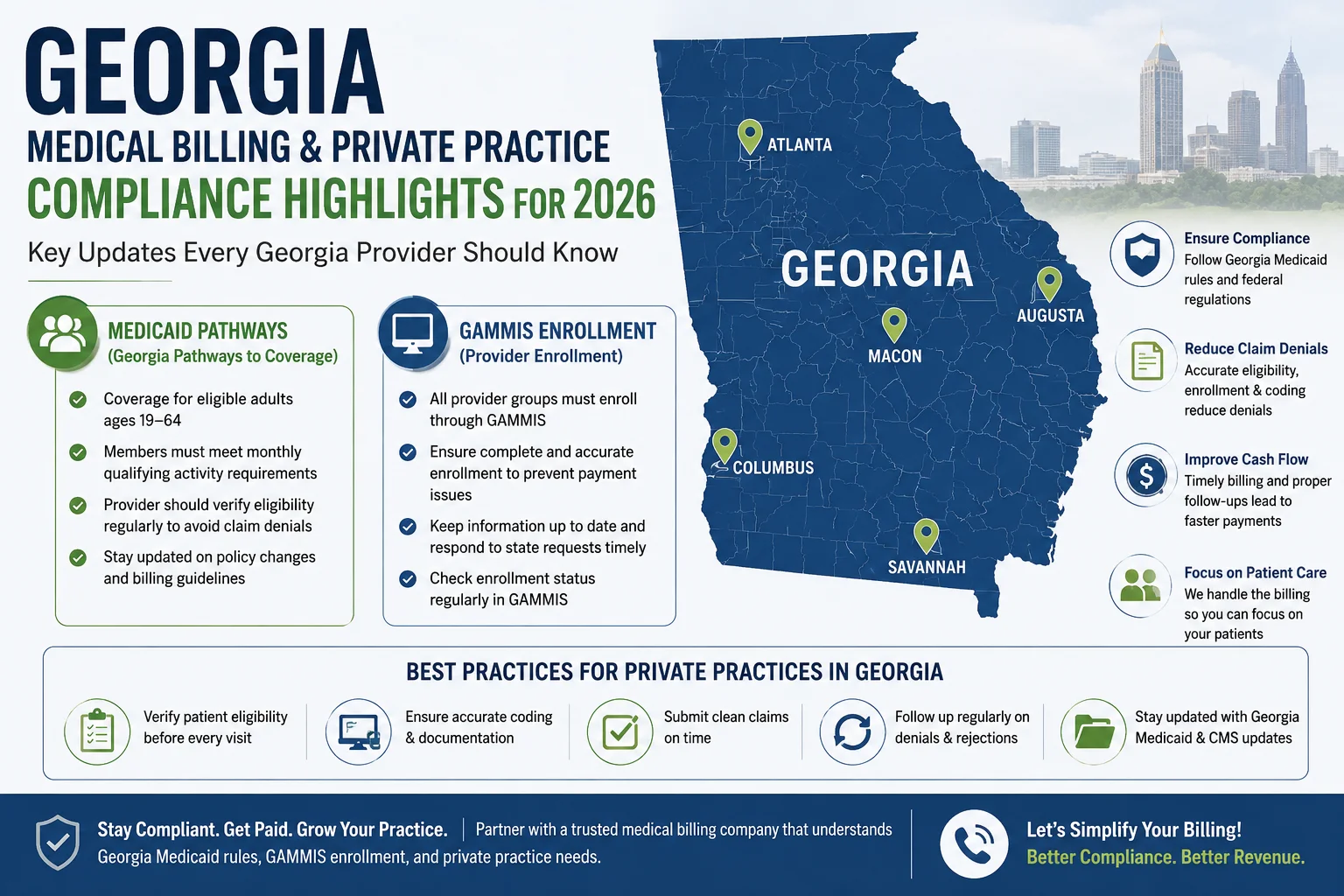
Georgia Medicaid is not simple. The state’s Medicaid program covers roughly 1.87 million Georgians as of 2026, and it operates through a combination of fee-for-service and managed care organizations (CMOs) — including Amerigroup, Peach State Health Management, and WellCare. Each CMO has different preauthorization requirements, different timely filing windows, and different documentation standards. A billing team that does not understand these distinctions will lose money for your practice consistently.
The Pathways extension brought new patients — and new billing complexity. Georgia’s Medicaid Pathways program, which extended Medicaid access to working-age adults who meet employment requirements, has brought a new wave of patients into private practices across the state since 2023. Those patients often have coverage they have never used before, which means your billing staff needs to be equipped to handle eligibility questions, coverage verification issues, and claim rejections specific to this population.
The Group/Billing Enrollment Requirement hit in 2026. Starting January 1, 2026, Georgia Medicaid put a new Group/Billing Enrollment Requirement into effect. If your practice was not enrolled correctly through the GAMMIS portal by that deadline, reimbursements could be delayed or suspended. A billing partner with Georgia Medicaid expertise would have helped you navigate this. Going forward, the same expertise matters for staying compliant as enforcement continues.
CMS 2026 changes shifted the payment landscape. The Centers for Medicare & Medicaid Services finalized the 2026 Medicare Physician Fee Schedule with significant changes — more emphasis on value-based care, expanded telehealth codes, new add-on codes for complex primary care, and stronger documentation review using AI-flagging tools for outlier claims. If your billing team is not current on these changes, you are likely leaving money on the table or risking audit flags.
Georgia’s insurance market is fragmented. A single private practice in Atlanta or Augusta may regularly submit claims to dozens of different payers — Blue Cross Blue Shield of Georgia, Cigna, Aetna, UnitedHealthcare, Humana, and multiple regional carriers — each with its own fee schedules, modifier requirements, and denial patterns. Timely filing limits for commercial payers in Georgia typically run 90 to 180 days from date of service, but this varies enough by carrier that a billing team needs to track it carefully or deadlines get missed.
None of this is meant to overwhelm you. It is meant to show you that the right billing partner for a Georgia private practice is not just any billing company — it is one that knows this specific environment.
What to Look for Before You Choose a Medical Billing Service
This is the part most guides skip over to get to their list faster. Do not skip it.
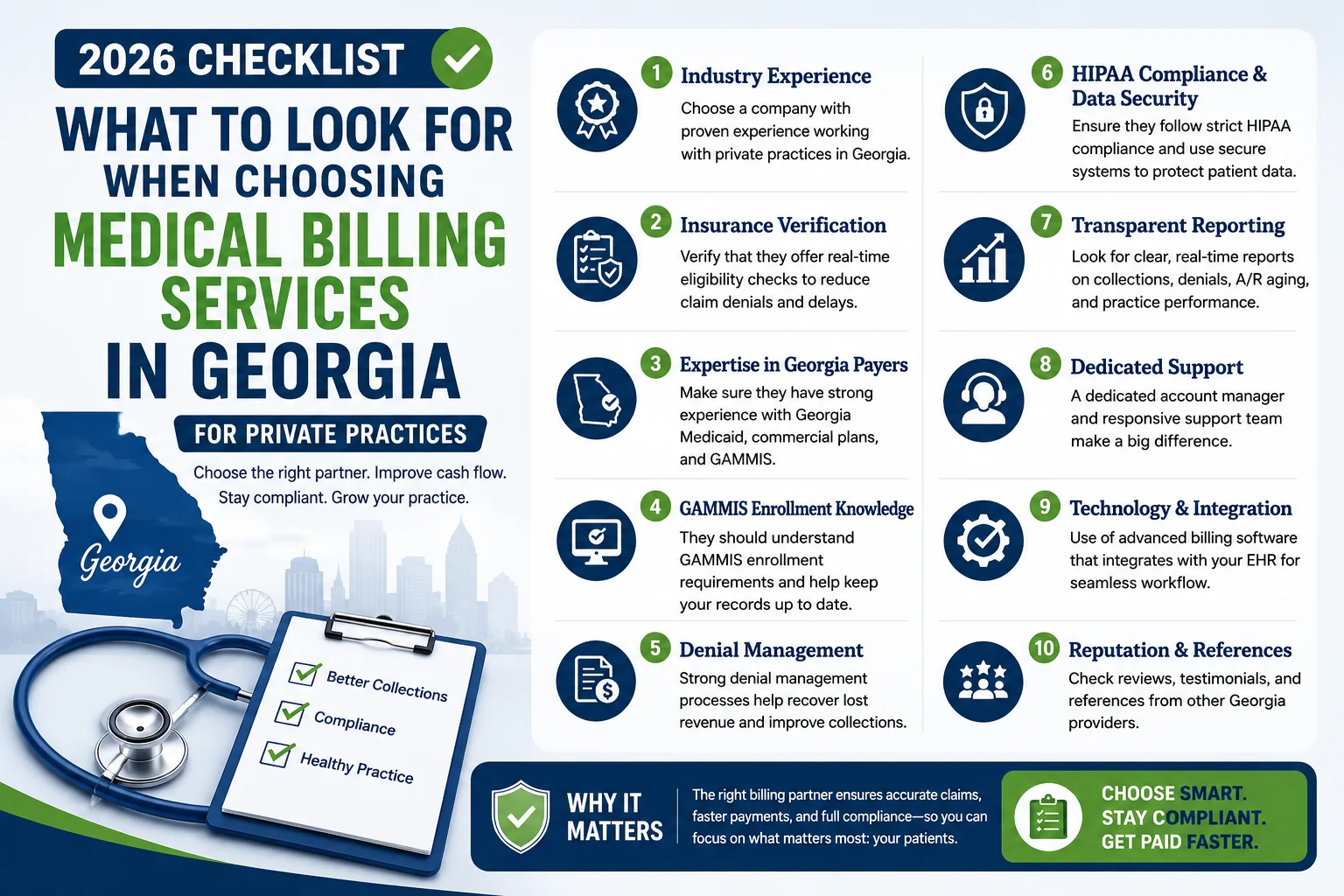
Georgia-specific payer knowledge. Ask directly: does your team handle Georgia Medicaid CMO claims? Do you know the current GAMMIS enrollment requirements? Do you track Georgia-specific timely filing windows by carrier? The answers tell you a lot about whether they actually know this state or just serve it incidentally.
Specialty experience. A billing service that excels at family medicine may struggle with behavioral health. A team that handles surgical claims well may have gaps in telehealth coding. Match the service to your specialty — not just to your state.
First-pass claim acceptance rate. This is one number that matters enormously. Industry benchmark is around 95%. Top services consistently hit 96–98%. Every claim that bounces back costs your practice time, delays cash flow, and risks missing timely filing limits if the denial management is slow.
Denial management process. Ask specifically: what happens when a claim is denied? Who works it? How fast? What is your denial overturn rate? This is where practices bleed money. A billing service that submits clean claims but has a weak denial management process is only solving half the problem.
Transparency in reporting. You should receive regular reports that show you exactly how your claims are performing — number submitted, number paid, number denied, aging AR, and collection rate. If a billing company cannot show you clear data, that is a problem.
HIPAA compliance infrastructure. This is non-negotiable. Your billing partner handles protected health information on your behalf. Ask how they store data, what their breach protocols are, and whether they carry cyber liability insurance.
Contract terms. Watch for long lock-in periods, vague termination clauses, and pricing structures that make it hard to calculate your true cost. Percentage-of-collections pricing is common and generally fair for small practices — but make sure you understand what percentage, what it is calculated on, and what services are included versus billed separately.
Top Medical Billing Services in Georgia for Private Practices
These are the services that have built a consistent track record working with Georgia private practices. Each has distinct strengths, so read through rather than picking the first name.
Capital Billing Services
Capital Billing Services has over 30 years in healthcare revenue cycle management and has been operating since 2008 as a dedicated billing firm. Their team brings together certified RCM specialists and credentialing experts — a combination that matters specifically for private practices trying to manage both billing and insurance enrollment at the same time.
Their stated focus is making healthcare more financially manageable for smaller and mid-sized practices by streamlining revenue cycle management rather than adding complexity to it. For Georgia private practices looking for a billing partner with deep RCM roots and credentialing capability under one roof, Capital Billing is worth a direct conversation.
Best for: Multi-specialty private practices, practices that also need credentialing support.
Prime Medical Billing (PMB)
Prime Medical Billing takes a notably hands-on approach to denial management — one of the areas where most billing services fall short. Their position is clear: if an electronic claim has not been paid within 30 days, something is wrong, and 95% of the time there is a specific fixable error on the claim. They take that error-finding responsibility seriously rather than waiting for the provider to flag problems.
For Georgia private practices that have experienced slow receivables or unexplained denials with previous billing vendors, PMB’s proactive follow-up model is a meaningful differentiator.
Best for: Practices with high denial volume, practices switching from underperforming in-house billing teams.
MSN Healthcare Solutions (Columbus, Georgia)
Founded in 1996 and based in Columbus, MSN is one of the few medical billing services in Georgia that has built its reputation on deep specialty expertise rather than general billing volume. Their primary focus areas are anesthesiology, pathology, and radiology — three specialties with unique billing complexity that general billing companies often handle poorly.
If your practice falls into one of these specialties, MSN’s 30 years of state-specific specialty experience is genuinely hard to match with a generalist firm. They work closely with each client on individualized growth plans rather than treating every practice as interchangeable.
Best for: Anesthesiology, pathology, and radiology private practices in Georgia.
MediBill MD
MediBill MD operates across 50+ specialties and has built a track record in Georgia despite being headquartered out of state. Their numbers for Georgia practices are strong: 97% first-pass claim acceptance rate, 98% clean claim rate, 96% collection ratio, and a stated commitment to reducing AR days. For practices dealing with slow payment cycles, those numbers represent real cash flow improvements.
They also offer continuous remote support — which matters for Georgia practices outside the major metro areas who need reliable service without geographic limitations.
Best for: Multi-specialty practices, practices in non-Atlanta markets needing strong remote support.
External resource: CMS 2026 Medicare Physician Fee Schedule overview for understanding current reimbursement rates your billing partner should be working with.
VD Billing Services
VD Billing Services is a women-owned firm offering billing solutions specifically designed for small medical and dental practices — a focus that makes them particularly relevant for solo physicians and practices with limited staff. Their certified team handles RCM, credentialing, and insurance contract renegotiation together, which for a small practice means fewer vendors to manage.
Their approach is straightforward: handle the billing complexity so the physician can focus on patients, not paperwork. For a solo practitioner or a two-to-three provider practice in Georgia, that focus on small practice realities is exactly the right fit.
Best for: Solo practitioners, small private practices, dental and medical combination practices.
Physicians Revenue Group (PRGMD)
PRGMD offers end-to-end revenue cycle management with a specific emphasis on claim submission accuracy and accounts receivable reduction. Their onboarding process is structured to minimize disruption for Georgia practices making the switch from in-house billing or a previous vendor — they provide staff training as part of setup rather than leaving practices to figure out the transition alone.
Their reporting system gives practices access to real-time financial data to support clinical and operational decisions — a feature that matters particularly for practice owners who want clear visibility into how their billing is performing week over week.
External resource: Georgia Department of Community Health — Medicaid provider resources for Georgia-specific Medicaid billing requirements your vendor should be current on.
Best for: Practices that want structured onboarding, strong reporting, and AR-focused management.
BillingParadise
BillingParadise has been operating since 2004 and works with group practices, clinics, and independent medical offices. Their strength is 24/7 availability and consistent communication — clients and reviewers consistently mention responsiveness and ongoing contact as what makes the relationship work.
For Georgia private practice owners who have been burned by billing services that were hard to reach or slow to respond to questions, BillingParadise’s communication model addresses that directly.
Best for: Group practices, practices that prioritize responsive communication and around-the-clock support.
In-House Billing vs. Outsourcing: The Honest Math for Georgia Private Practices
A lot of practice owners hesitate to outsource billing because it feels like giving up control. Here is what the numbers actually look like for a typical small Georgia private practice.
A mid-sized practice in Georgia processing around 500 claims per month typically sees a denial rate of 8–12% with in-house billing. Bringing that denial rate down from 10% to 5% through an experienced billing service accelerates cash flow by two to three weeks on hundreds of thousands in annual revenue. For many practices, that cash flow difference alone covers the cost of outsourcing.
Add to that: you stop paying for a dedicated billing staff member’s salary, benefits, training, and the time your office manager spends supervising the billing process. The billing service handles coding updates, payer enrollment renewals, and denial follow-up — work that rarely gets done consistently by in-house staff who are also handling front-desk, phones, and scheduling.
The practices that keep billing in-house successfully are typically larger groups with a dedicated billing department of three or more people who specialize in nothing else. For most private practices in Georgia — especially those with under 10 providers — outsourcing to a qualified Georgia-experienced billing service is the financially stronger move.
For more on evaluating your current revenue cycle performance, see our Revenue Cycle Health Check Guide on the ProHealth Care Advisors website.
Georgia-Specific Compliance Points Your Billing Service Must Know in 2026
This is not meant to be a complete compliance checklist — but these are the specific items that a knowledgeable Georgia billing partner should be current on right now.
GAMMIS multi-factor authentication mandate (2026). The Georgia Medicaid Management Information System implemented a multi-factor authentication requirement for all providers in 2026. Your billing service needs to be operating within this system correctly.
Group/Billing Enrollment Requirement enforcement. The January 2026 deadline for group enrollment has passed, and enforcement is ongoing. If your practice has not been enrolled at the group level in addition to the individual provider level, claims may be at risk.
Georgia Pathways reporting requirements. Providers serving Medicaid Pathways patients must meet specific reporting standards tied to the employment requirements those patients must demonstrate. Billing teams that do not understand this layer may miss documentation requirements that affect reimbursement.
Timely filing windows by payer. Commercial payers in Georgia generally allow 90–180 days from date of service. Medicare allows one year. Georgia Medicaid timely filing requirements vary by CMO. Your billing service should track these by carrier for your practice automatically — not reactively after a denial.
CMS 2026 documentation standards. The 2026 Medicare Physician Fee Schedule introduced stronger AI-assisted claim review tools on the CMS side, which means claims with weak or inconsistent documentation face higher scrutiny. Your billing partner needs to be coaching your clinical documentation to meet current standards, not just submitting whatever notes are provided.
External resource: Georgia Division of Medical Assistance — Provider Information for current Georgia Medicaid billing standards and enrollment requirements.
Questions to Ask Every Medical Billing Service Before You Sign
Use these questions in every conversation. The quality of the answers tells you almost everything.
How many Georgia private practice clients do you currently serve? You want a vendor with active, current experience in this market — not a company that handled a Georgia client once three years ago.
What is your current first-pass claim acceptance rate across your client base? Ask for a number, not a general statement. Anything below 95% deserves a follow-up question.
How do you handle denials, and what is your average overturn rate? The answer should describe a specific process with specific people accountable for it — not a vague commitment to “work denials.”
Are you current on the 2026 Georgia Medicaid Group/Billing Enrollment requirement? This is a direct test of Georgia Medicaid knowledge. A qualified service will answer without hesitation.
What does your reporting look like, and how often do I receive it? Ask to see a sample report before you sign anything.
What are your contract terms, and what does it cost to leave? Understand lock-in periods and termination conditions clearly before you commit.
Who is my dedicated point of contact? You need a name and a direct line — not a general support queue.
For more guidance on evaluating billing vendors, our Private Practice Financial Guide covers the full evaluation process in detail.
Red Flags to Watch For
Not every billing service that markets to Georgia practices is actually equipped to serve them well. Watch for these warning signs:
No Georgia-specific knowledge. If a company cannot speak to GAMMIS, Georgia CMO differences, or the 2026 Medicaid changes, they are learning on your practice’s time.
Vague pricing. Percentage-of-collections is normal. What is not normal is being unable to give you a clear number or a clear breakdown of what is included in that percentage.
Poor communication in the sales process. If they are slow to respond before you are a client, they will be slower after. This pattern is reliable.
No references from practices in your specialty. Ask for references from Georgia practices in your specialty, and call them. Billing performance in family medicine looks very different from billing performance in psychiatry or orthopedics.
Guarantees that sound too clean. No billing service can guarantee 100% collection rates or eliminate all denials. Claims that sound too perfect usually have contract fine print that tells a different story.
Frequently Asked Questions — Medical Billing Services in Georgia
What does a medical billing service in Georgia typically cost?
Most medical billing services charge between 4% and 9% of collected revenue, depending on your specialty, claim volume, and the scope of services included. Behavioral health and mental health billing typically sits at the higher end due to greater complexity. Some services charge flat monthly fees for lower-volume practices. Always clarify what is included — credentialing, denial management, and patient statement services are sometimes billed separately.
Is outsourcing medical billing right for a solo practice in Georgia?
For most solo practices in Georgia, yes. The cost of a qualified billing service is typically offset by faster reimbursements, fewer denied claims, and the elimination of in-house billing staff costs. The break-even calculation usually favors outsourcing for practices processing more than 100 claims per month.
Do Georgia medical billing services handle Medicaid Pathways patients?
The best ones do — but verify before signing. Pathways billing involves specific documentation requirements tied to the employment criteria patients must meet, and not every billing service has trained its team on this layer. Ask directly whether they have handled Pathways claims and what their process looks like.
How do I know if my current billing is performing well?
The core benchmarks to check: first-pass claim acceptance rate (target 95%+), denial rate (target under 5%), days in accounts receivable (target under 35 days for most specialties), and net collection rate (target 95–98%). If you do not currently have visibility into these numbers, that is itself a problem worth solving. See our Revenue Cycle Health Check for a starting framework.
What is the GAMMIS portal and why does it matter?
GAMMIS stands for Georgia Medicaid Management Information System. It is the state’s portal for Medicaid provider enrollment, claims submission, and eligibility verification. As of 2026, it requires multi-factor authentication for all users. Your billing service must be enrolled and operating correctly within GAMMIS to submit Georgia Medicaid claims on your behalf.
Can a medical billing service help with insurance credentialing?
Some do — and for new practices or practices adding providers, this can be genuinely valuable. Capital Billing Services and VD Billing Services are among the Georgia options that bundle credentialing with billing services. Confirm the scope before assuming it is included in the base agreement.
How long does it take to transition to a new billing service?
A well-managed transition typically takes four to six weeks. That includes transferring patient account data, setting up payer enrollment under the new service’s clearinghouse, training on documentation requirements, and establishing reporting cadence. The best billing services provide a structured onboarding process rather than leaving this to the practice to manage.