






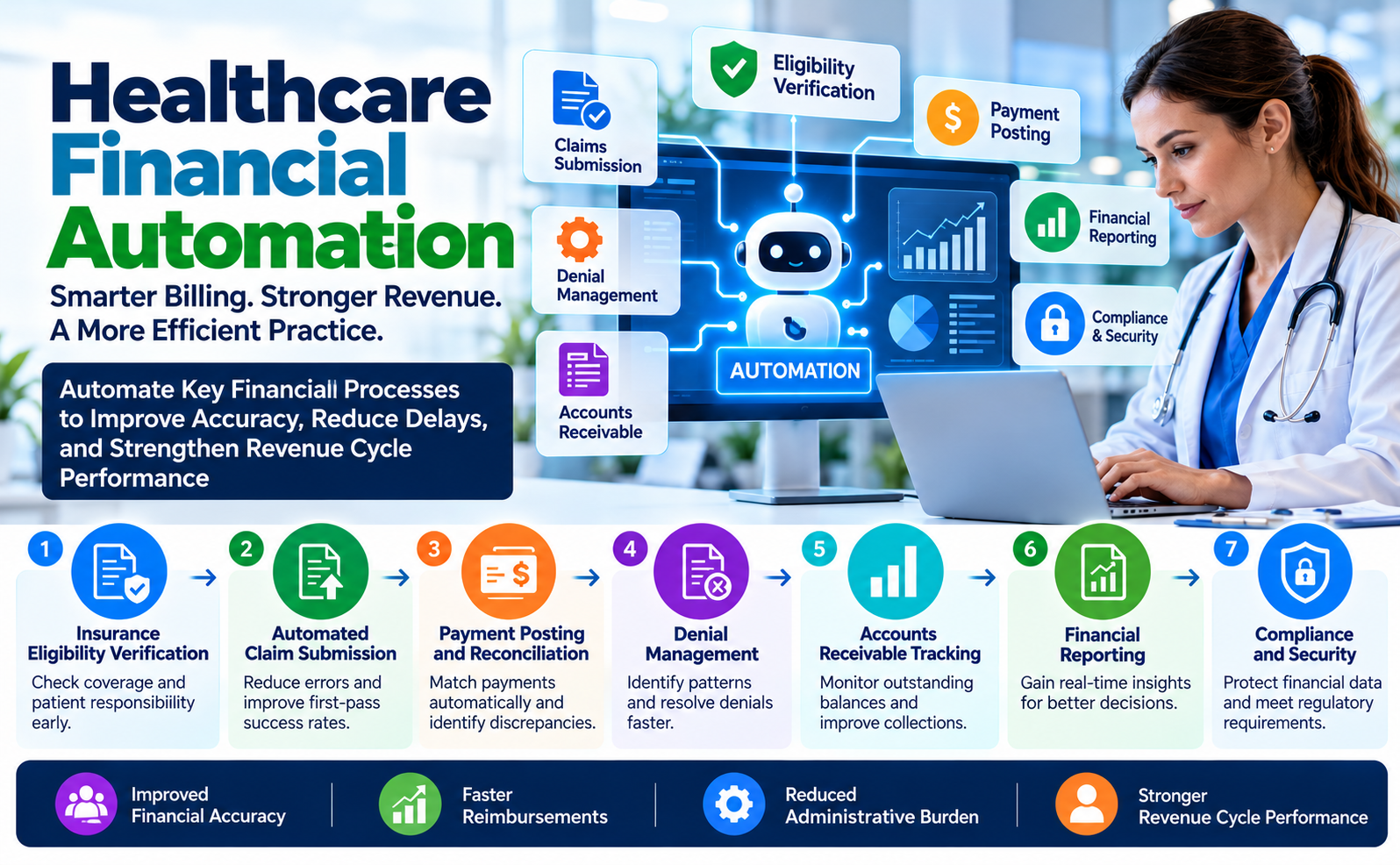
Healthcare financial automation helps medical practices manage billing, insurance claims, payment posting, and financial reporting more efficiently. Healthcare providers must meet important financial, operational, and regulatory requirements while maintaining accurate records and protecting sensitive patient information.
Manual billing workflows can lead to data-entry errors, delayed reimbursements, and missed follow-ups. By introducing suitable financial automation in healthcare, practices can streamline repetitive tasks, improve revenue cycle visibility, and make better use of their existing systems.
This guide explains seven practical ways to use automation, the financial requirements practices should consider, and how to implement technology responsibly.
What Is Healthcare Financial Automation?
Healthcare financial automation is the use of software and digital workflows to support administrative and financial tasks within a medical practice. These tasks may include insurance eligibility checks, electronic claim submission, payment reconciliation, denial tracking, and accounts receivable reporting.
Automation can handle repetitive, rule-based activities while billing professionals review exceptions and complex cases.
According to the Centers for Medicare & Medicaid Services (CMS), HIPAA Administrative Simplification requirements establish standards for certain electronic healthcare transactions, including claims and payment-related information. Learn more through the official CMS Administrative Simplification guidance.
7 Powerful Ways to Improve Healthcare Financial Automation
1. Automate Insurance Eligibility Verification
Verifying insurance eligibility before an appointment can help practices identify coverage issues early. Manual verification may become time-consuming when a practice handles many appointments and insurance plans.
Automated eligibility verification can help organize electronic inquiries, return available coverage information, and flag records that need further review.
Best practices include:
- Verify eligibility before scheduled services when possible.
- Confirm patient and insurance information is accurate.
- Review coverage limitations and authorization requirements.
- Investigate unclear or unsuccessful verification responses.
Automation does not guarantee coverage or payment, so eligibility information should be interpreted alongside applicable payer policies.
2. Improve Electronic Claim Submission
Incomplete information, coding errors, and missing documentation can cause claim rejections or denials. Automated claim checks can help identify certain issues before submission.
An effective medical billing automation workflow may check required fields, validate data formats, and flag inconsistencies for correction.
Practices should also monitor claim status and establish a process for correcting rejected claims promptly.
Explore medical billing and practice management services to learn about billing workflows, claim submission, payment posting, and denial management.
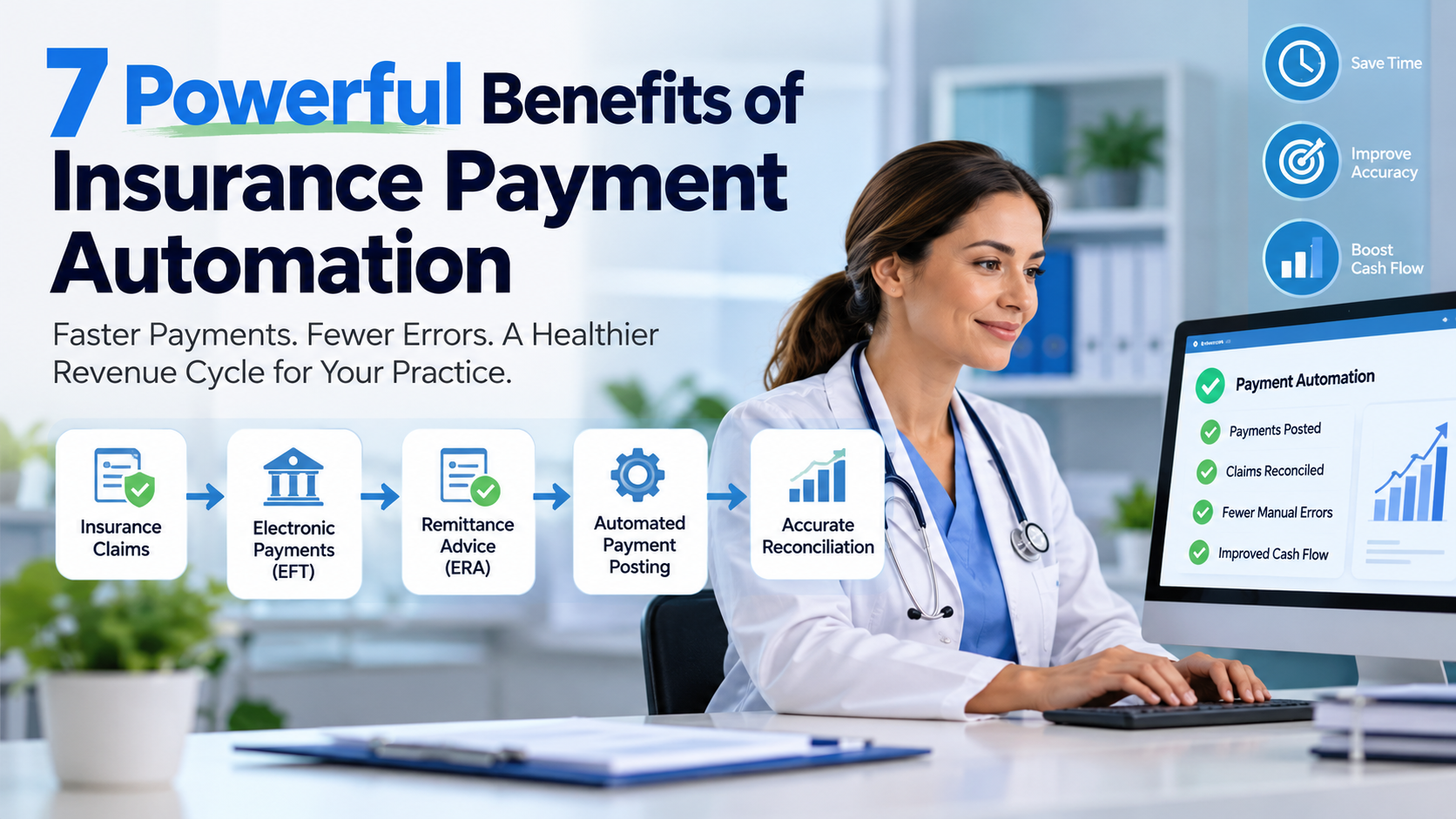
3. Streamline Payment Posting and Reconciliation
Payment posting involves recording payments from insurance companies and patients, then matching them with the appropriate accounts.
Automated payment posting can help import structured remittance information, match transactions according to defined rules, and flag discrepancies for review.
To strengthen financial accuracy, practices should:
- Reconcile posted payments against bank deposits and remittance records.
- Investigate unmatched or duplicate transactions.
- Review contractual adjustments.
- Maintain an audit trail of corrections.
- Separate automated processing from appropriate financial oversight.
These controls help practices identify discrepancies before they affect financial reporting.
4. Strengthen Denial Management
Claim denials can delay revenue and increase administrative workload. Automation can categorize denial reasons, identify recurring patterns, and prioritize claims that require attention.
An effective automated denial management process should connect denial information with the original claim, relevant documentation, and payer response.
Billing teams can then determine whether a claim requires correction, additional documentation, resubmission, or an appeal.
For related guidance, read RPA in Medical Billing to learn how robotic process automation can support repetitive billing activities.
5. Improve Accounts Receivable Tracking
Accounts receivable represents payments that remain outstanding. Without consistent monitoring, older balances may receive insufficient attention.
Financial automation in healthcare can help categorize outstanding claims, generate aging reports, and create reminders for follow-up activities.
Useful practices include reviewing aging balances regularly, identifying claims approaching payer deadlines, documenting follow-up actions, and investigating underpayments.
Automation should prioritize work based on clear rules while allowing billing professionals to assess unusual cases.
6. Enhance Financial Reporting and Budget Planning
Accurate financial reporting helps practice managers understand revenue trends, outstanding balances, payment delays, and operating costs.
Automated dashboards can combine billing data into reports that support more informed decisions. However, the usefulness of these reports depends on accurate source data and consistent definitions.
Practices should monitor metrics such as:
- Net collection rate.
- Claim denial rate.
- Days in accounts receivable.
- Payment posting accuracy.
- Outstanding patient balances.
- Operating expenses compared with budget.
Set a baseline before implementing new technology and compare results over time to determine whether the changes deliver measurable value.
7. Protect Financial Data With Appropriate Controls
Healthcare financial systems may process sensitive patient and insurance information. Automation should therefore be supported by access controls, secure data handling, audit logging, and documented procedures for resolving errors.
The U.S. Department of Health and Human Services explains security safeguards under the HIPAA Security Rule.
Practices should assess vendor responsibilities, system permissions, data retention, incident response, and business associate arrangements where applicable.
Using automated software does not automatically make a practice compliant. Organizations must evaluate their own obligations and implement appropriate safeguards.
What Financial Requirements Should Healthcare Practices Consider?
Before adopting new technology, practices should identify the financial and operational requirements the system must support.
Accurate Billing and Financial Records
Billing records should reflect services provided, appropriate coding, payer decisions, payments received, and adjustments. Automated processes need validation rules and a way to correct inaccurate records.
Regulatory and Payer Requirements
Practices must consider applicable electronic transaction standards, payer billing rules, documentation requirements, and relevant privacy and security obligations. Requirements vary according to the service, payer, and organization.
Budget and Return on Investment
Automation can involve software fees, integration work, training, maintenance, and ongoing oversight. Compare these costs with realistic potential benefits, such as reduced manual processing, fewer avoidable errors, and improved follow-up.
Avoid assuming that every automated task will produce savings. Measure actual performance after implementation.
Integration With Existing Systems
New tools should work appropriately with the practice’s existing electronic health record (EHR), practice management system, and billing workflows.
Before deployment, confirm data compatibility, access permissions, reporting capabilities, and the process for handling failed integrations.
How to Implement Healthcare Financial Automation Step by Step
A phased implementation can reduce disruption and help practices evaluate results.
Step 1: Identify the problem. Choose a process with repetitive work, frequent errors, or delays that can be measured.
Step 2: Document the current workflow. Record how information moves between registration, billing, payment posting, and reporting.
Step 3: Establish baseline metrics. Measure processing time, error frequency, denial patterns, or outstanding balances before making changes.
Step 4: Select an appropriate solution. Assess functionality, security, cost, integration requirements, and vendor support.
Step 5: Test a limited workflow. Begin with a defined process and review exceptions before expanding automation.
Step 6: Train users and assign oversight. Ensure the people responsible for billing understand automated outputs, correction procedures, and escalation rules.
Step 7: Review performance regularly. Compare results with the baseline and adjust workflows when errors or unexpected costs appear.
How Pro Health Care Advisors Supports Medical Billing Operations
Technology is only one part of a well-managed revenue cycle. Accurate coding, complete documentation, claim follow-up, payment reconciliation, and reliable reporting remain essential.
Pro Health Care Advisors provides information about medical billing and practice management support for healthcare practices.
Explore medical billing and practice management services to learn more about billing workflows, claim processing, payment posting, and accounts receivable support.
Frequently Asked Questions
What is healthcare financial automation?
Healthcare financial automation uses software and digital workflows to support billing, claims, payment posting, reconciliation, and financial reporting.
Can automation reduce medical billing errors?
Automation can identify certain missing fields, inconsistent data, and repetitive processing errors. It cannot prevent every error, so validation and human review remain important.
Does financial automation guarantee faster payments?
No. Automation may improve processing and follow-up, but reimbursement also depends on accurate claims, payer rules, documentation, coverage, and payment timelines.
Is healthcare financial automation suitable for small practices?
It can be useful when it addresses a clearly defined problem and fits the practice’s budget, software, and workflow. Starting with one measurable process can help determine whether further investment is worthwhile.
How does automation relate to HIPAA?
Automated systems that handle protected health information must be evaluated against applicable privacy and security requirements. Practices should implement appropriate safeguards and assess vendor responsibilities.
What should practices measure after implementation?
Useful measures include claim denial rates, days in accounts receivable, payment posting accuracy, processing time, outstanding balances, and total implementation costs.
Conclusion
Healthcare financial automation can help medical practices streamline repetitive billing tasks, improve financial reporting, and organize accounts receivable follow-up. Successful implementation depends on accurate data, appropriate system integration, measurable goals, and suitable security controls.
By starting with a specific operational challenge and reviewing results regularly, healthcare providers can make informed technology decisions while maintaining financial accuracy and patient data protection.
Visit Pro Health Care Advisors to explore medical billing and practice management services.