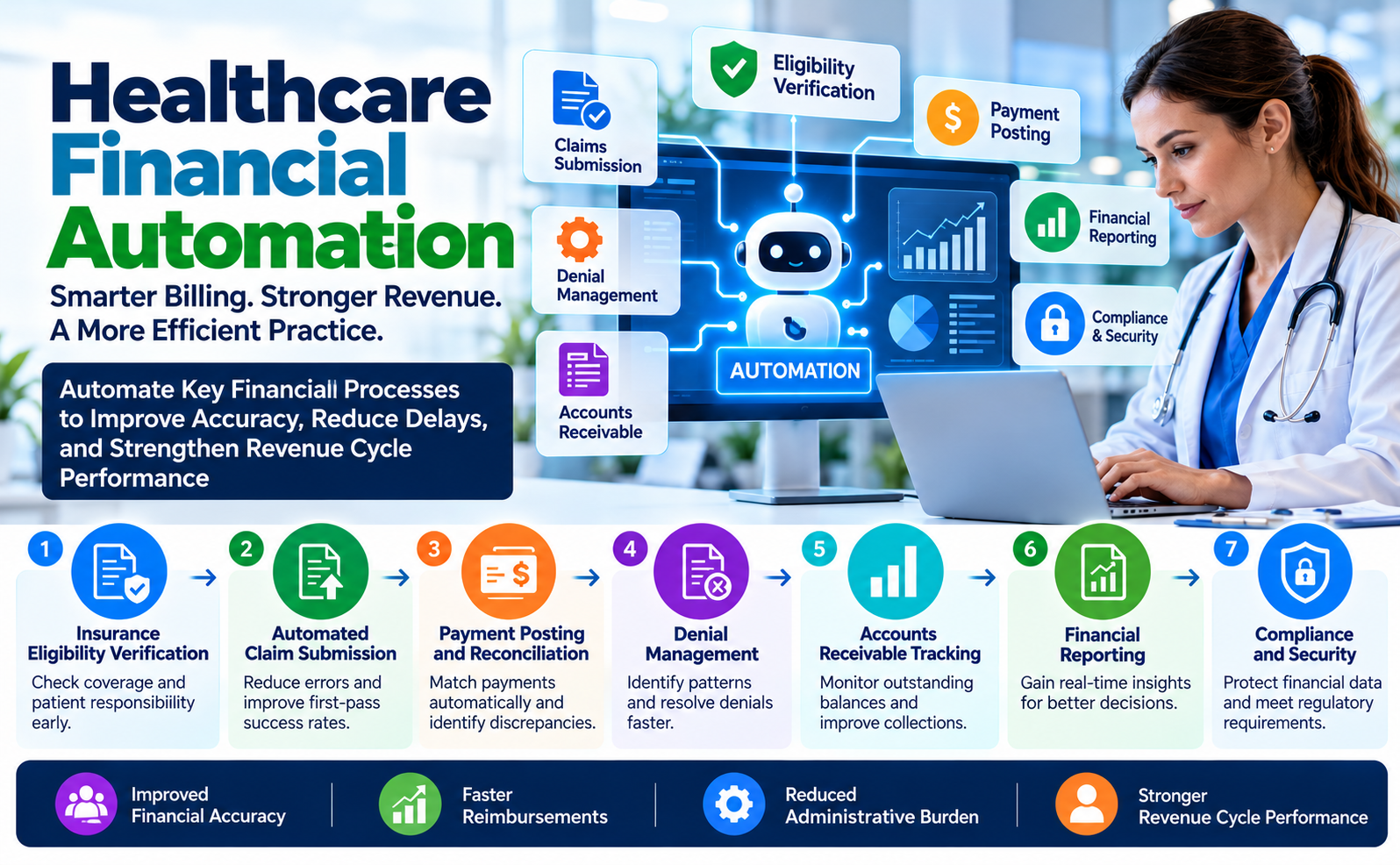









Healthcare providers across the United States face growing challenges in managing insurance claims, patient eligibility, payment posting, and denial follow-ups. Manual billing processes can consume valuable time, create avoidable data-entry errors, and delay reimbursements. Modern technology offers practical ways to improve these workflows without compromising accuracy or compliance.
RPA in Medical Billing is an increasingly relevant approach for healthcare organizations seeking to automate repetitive administrative tasks. Robotic Process Automation (RPA) uses software bots to perform rule-based activities, such as checking claim statuses, transferring data, and organizing billing records.
By implementing RPA in Medical Billing, healthcare practices can streamline repetitive work, improve workflow consistency, and give billing professionals more time to handle complex claims and exceptions.
What Is RPA in Medical Billing?
RPA in Medical Billing refers to using software robots to automate repetitive tasks within medical billing systems. These bots follow predefined instructions and interact with supported applications to complete routine digital activities.
For example, a billing team may need to check multiple insurance portals for claim updates. An RPA workflow can retrieve available status information, update a tracking spreadsheet, and flag accounts requiring additional attention.
Unlike traditional billing software, which primarily manages billing records and transactions, RPA can automate specific steps across compatible systems. It may work alongside electronic health records (EHRs), practice management software, and payer portals.
The purpose of RPA in Medical Billing is not to eliminate professional oversight. Instead, it helps reduce repetitive manual work while allowing experienced staff to focus on coding accuracy, complex denials, and payer-specific requirements.
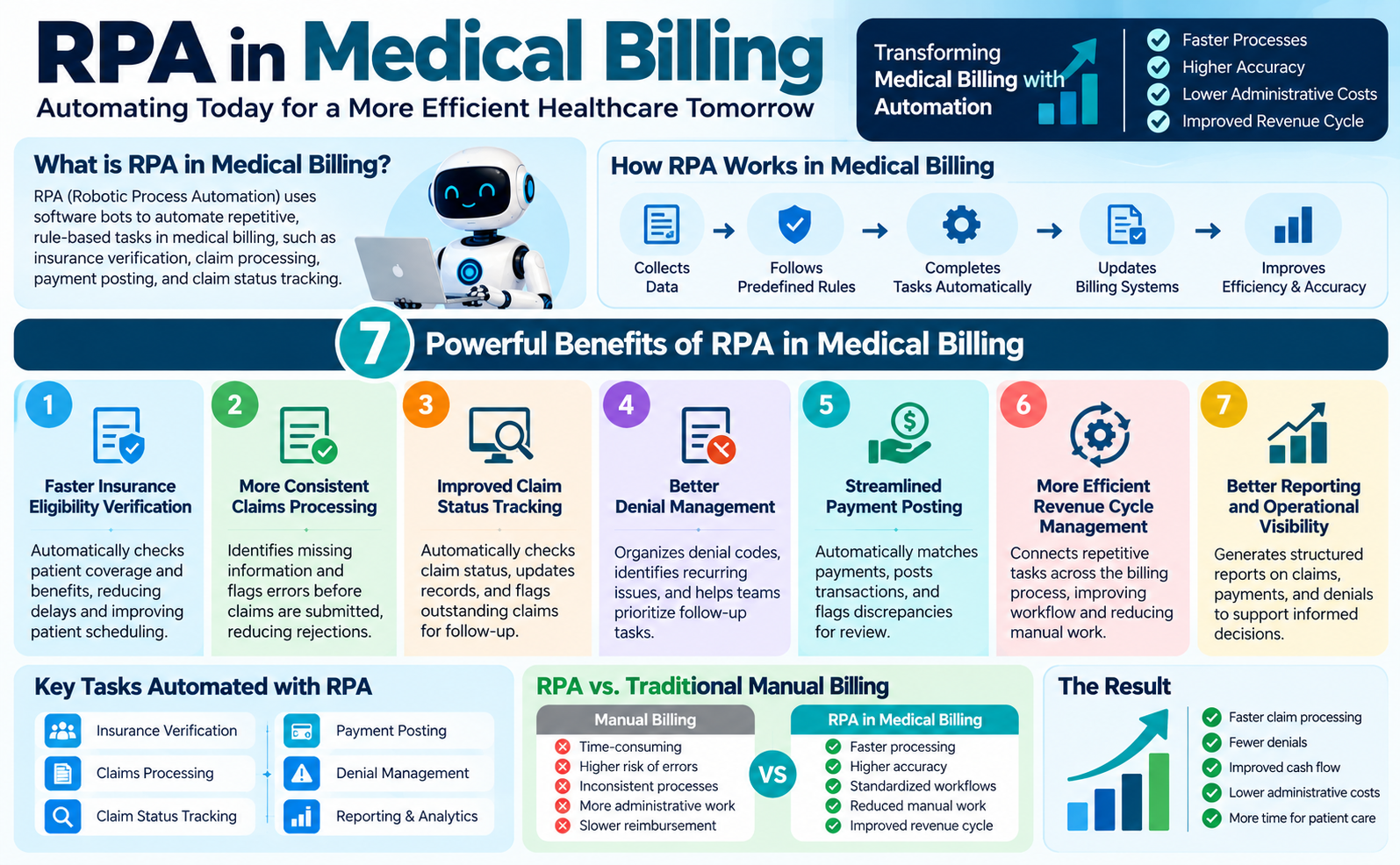
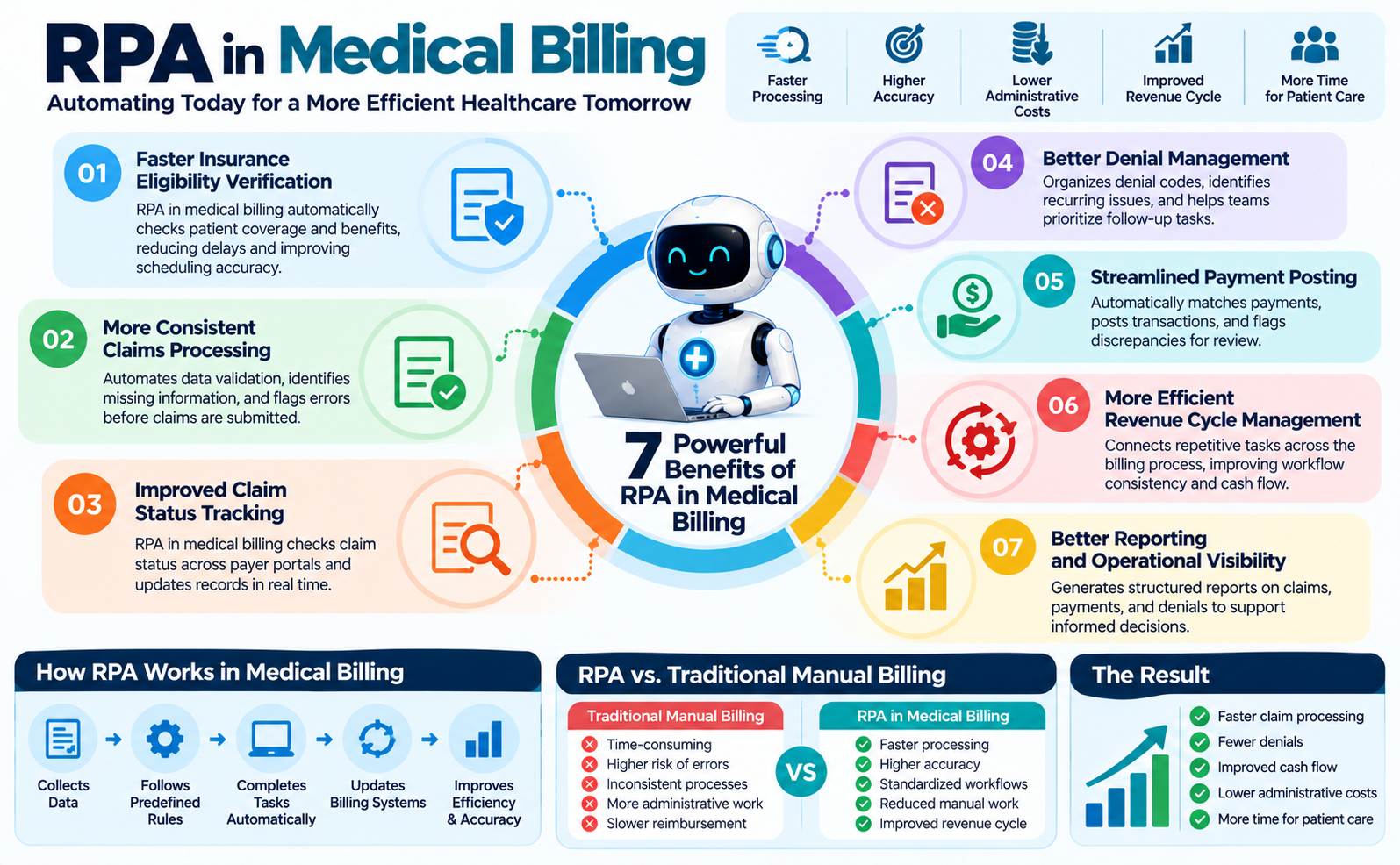
7 Powerful Benefits of RPA in Medical Billing
1. Faster Insurance Eligibility Verification
Insurance eligibility verification helps healthcare providers confirm coverage before delivering services. Manually checking benefits and patient information can create administrative delays, particularly when practices work with multiple payers.
RPA in Medical Billing can support eligibility workflows by retrieving available insurance information, checking predefined fields, and flagging incomplete records.
These automated checks can help teams identify potential coverage issues earlier. However, eligibility results should be verified against current payer responses and applicable coverage requirements.
Explore medical billing and practice management services to learn more about supporting billing workflows.
2. More Consistent Claims Processing
Incorrect patient information, missing documentation, and incomplete claim fields can lead to rejections and additional administrative work.
RPA in Medical Billing can help identify missing information, compare records against predefined rules, and route incomplete claims for review before submission.
For instance, an automation bot may flag a missing insurance identification number or an incomplete required field. A billing professional can then verify the information and correct the record.
Automated checks do not guarantee claim approval, but they can help make routine processes more consistent.
3. Improved Claim Status Tracking
Unpaid claims require regular monitoring and timely follow-up. Without a structured tracking process, billing teams may struggle to identify outstanding accounts and prioritize their workload.
Using RPA in Medical Billing, practices can automate supported claim-status checks, update tracking records, and flag claims that require follow-up.
This approach can help billing professionals organize accounts by claim age, outstanding balance, payer response, and follow-up requirements.
Consistent claim tracking also supports better visibility into accounts receivable and helps identify recurring payment delays.
4. Better Denial Management
Claim denials can delay reimbursement and increase the administrative workload. Understanding the reason for each denial is essential for selecting the correct next step.
RPA in Medical Billing can help organize denial codes, categorize common issues, identify missing information, and create review queues.
For example, a bot can flag claims associated with missing documentation or incomplete information. A qualified billing professional can investigate the issue and determine whether to correct, resubmit, or appeal the claim.
Learn more about AI medical billing automation to explore related automation approaches.
5. Streamlined Payment Posting
Payment posting involves recording insurance payments, contractual adjustments, and patient balances. Processing large volumes of transactions manually can increase the likelihood of delays and inconsistencies.
RPA in Medical Billing can help transfer structured payment information, match transactions using predefined rules, and flag discrepancies for review.
These workflows can improve the organization of payment records and help staff identify accounts requiring additional investigation.
Human review remains important when payment information is incomplete, unmatched, or inconsistent with the expected reimbursement.
6. More Efficient Revenue Cycle Management
Revenue cycle management includes activities from patient registration and eligibility verification to claim submission, reimbursement, and collections.
RPA in Medical Billing can connect repetitive steps across these workflows, helping teams organize information and reduce unnecessary manual handling.
Common applications include:
- Checking claim statuses through supported payer systems.
- Transferring billing information between compatible applications.
- Updating accounts receivable tracking records.
- Organizing payment and denial reports.
- Flagging records that require staff attention.
The benefits depend on implementation quality, data accuracy, system compatibility, and the effectiveness of the underlying billing process.
7. Better Reporting and Operational Visibility
Healthcare practices need reliable information to understand billing performance and identify areas for improvement.
RPA in Medical Billing can help collect routine data and prepare structured reports on outstanding claims, denial patterns, payment activity, and follow-up tasks.
These reports can support operational decisions and help management recognize recurring workflow issues.
Practices should establish baseline measurements before implementation so that changes in processing time, accuracy, and staff workload can be evaluated objectively.
RPA vs. AI in Medical Billing
RPA and artificial intelligence (AI) can complement each other, but they are not the same technology.
| Feature | RPA | AI |
|---|---|---|
| Main purpose | Automates predefined tasks | Analyzes information and identifies patterns |
| Typical use | Claim-status checks and data transfers | Denial-pattern analysis and risk prediction |
| Best suited for | Repetitive, rule-based workflows | Classification and complex data analysis |
| Human oversight | Required for exceptions | Important for validation and consequential decisions |
RPA in Medical Billing is particularly useful for structured workflows with clear rules. AI may add value when a task involves interpreting complex information or recognizing patterns in historical data.
Healthcare practices should select technology based on their workflow requirements, available systems, budget, and compliance obligations.
Is RPA in Medical Billing HIPAA-Compliant?
Automation does not automatically make a billing process compliant with the Health Insurance Portability and Accountability Act (HIPAA).
Medical billing workflows may involve electronic protected health information. Healthcare organizations must evaluate appropriate security safeguards, access controls, audit logging, vendor responsibilities, and risk management.
The U.S. Department of Health and Human Services provides guidance on the HIPAA Security Rule.
Before deploying RPA in Medical Billing, practices should:
- Restrict access to authorized personnel and systems.
- Protect sensitive information during storage and transmission.
- Maintain appropriate audit logs.
- Review vendor security practices and contractual obligations.
- Establish procedures for failed automations and security incidents.
- Test workflows and review their performance regularly.
A secure implementation should include human oversight, documented procedures, and periodic risk assessments.
How to Implement RPA in Medical Billing Successfully
A phased approach helps healthcare practices evaluate automation before expanding it across their operations.
Step 1: Identify Repetitive Tasks
Review existing billing workflows to identify tasks that occur frequently and follow consistent rules. Claim tracking, routine data transfers, and reporting can be useful starting points.
Step 2: Check Software Compatibility
Confirm whether your practice management platform, EHR, clearinghouse, and payer portals support the required integrations or automation methods.
Step 3: Set Measurable Goals
Establish baseline metrics such as claim acceptance rates, denial rates, days in accounts receivable, payment posting accuracy, and time spent on repetitive tasks.
Step 4: Test a Limited Workflow
Start with one suitable process. Validate data accuracy, exception handling, audit records, and workflow reliability before expanding implementation.
Step 5: Maintain Professional Oversight
Keep qualified billing professionals involved in coding review, complex claim corrections, denial appeals, and decisions that require clinical or regulatory judgment.
Choosing the Right Medical Billing Support
Technology alone cannot solve every revenue cycle challenge. Healthcare providers also need accurate billing processes, organized claim follow-up, appropriate coding support, and clear performance reporting.
When evaluating a medical billing partner, review its experience, communication practices, system compatibility, data protection measures, and ability to explain its service outcomes.
Pro Health Care Advisors provides medical billing and practice management services for practices looking to improve billing operations and revenue cycle workflows.
You can also review its specialty-specific services to understand how billing needs vary across medical disciplines.
When comparing providers, searches such as Right Medical Billing in Texas or medical billing in Richmond, Texas may also appear. Verify each provider’s actual location, service area, and automation capabilities instead of assuming that a location or brand name guarantees a particular service.
The right solution should fit your practice’s operational needs, budget, technology, and compliance requirements.
Frequently Asked Questions
What is RPA in Medical Billing?
RPA in Medical Billing uses software bots to automate repetitive administrative tasks, including claim-status checks, data transfers, and routine reporting.
Can RPA reduce medical billing errors?
It can reduce certain manual data-entry and workflow errors when properly configured and tested. It cannot eliminate incorrect source data, coding mistakes, or all claim denials.
Does RPA replace medical billing professionals?
No. RPA automates suitable repetitive tasks, while professionals remain essential for complex claims, coding review, exception handling, appeals, and compliance.
Is RPA suitable for small medical practices?
It may be suitable depending on claim volume, software compatibility, implementation costs, and the time currently spent on repetitive tasks.
How does RPA improve revenue cycle management?
It can support eligibility checks, claim tracking, payment posting, denial workflows, and reporting, helping teams organize work and identify outstanding issues.
Conclusion
RPA in Medical Billing offers healthcare providers a practical way to automate repetitive administrative work, improve claim tracking, and support more consistent revenue cycle management.
Successful implementation requires suitable workflows, compatible software, measurable goals, secure data handling, and appropriate human oversight.
Healthcare practices can begin by identifying their most time-consuming billing tasks and evaluating which processes are appropriate for automation. Combining reliable technology with experienced billing support can help create a more organized and sustainable revenue cycle.
To discuss your practice’s needs, visit Pro Health Care Advisors.