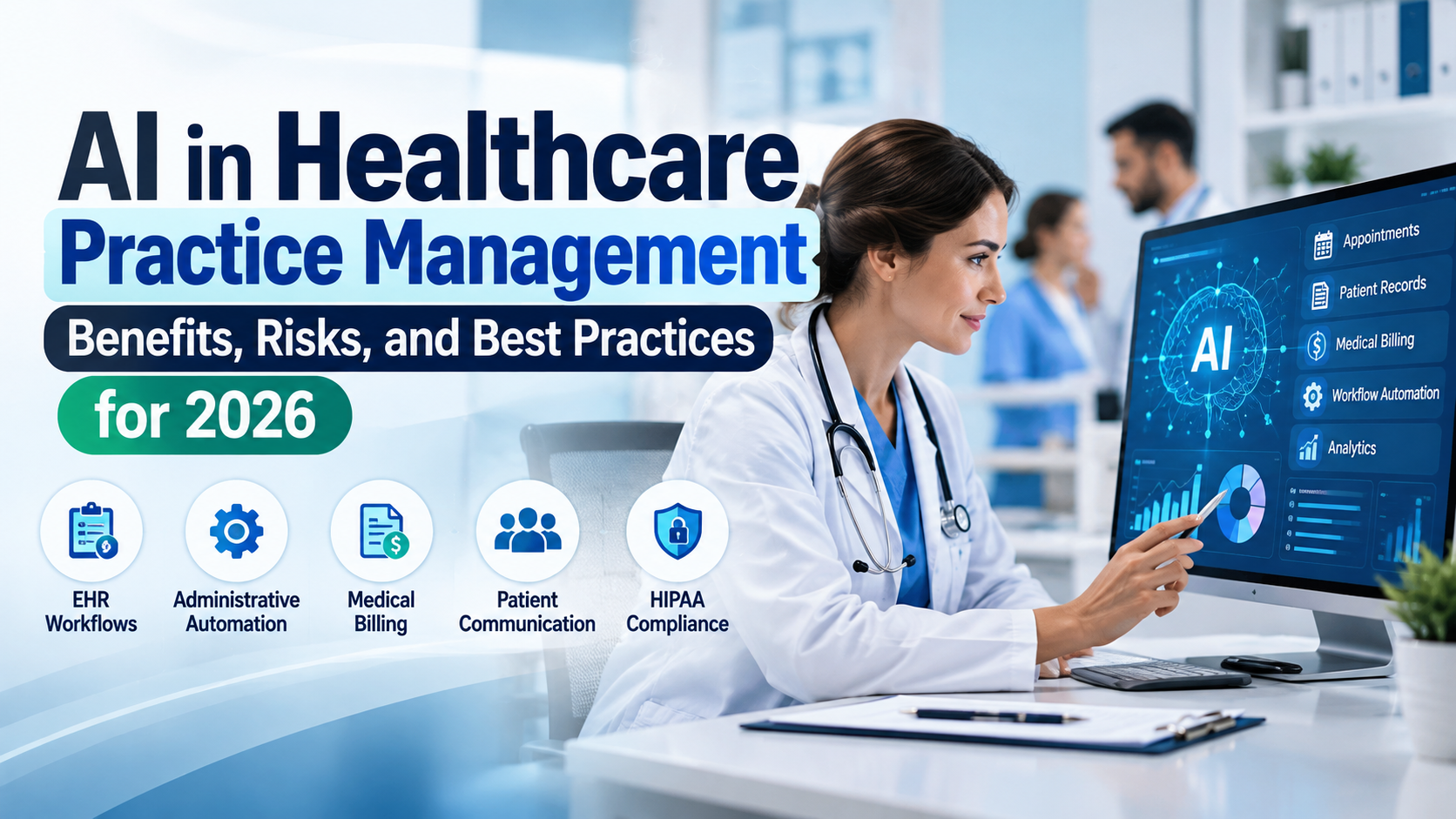
AI in healthcare practice management is transforming how medical practices handle administrative tasks, electronic health records (EHR), medical billing, and patient communication. By adopting AI in healthcare practice management, physicians and practice managers can identify opportunities to streamline workflows, reduce repetitive tasks, and improve operational efficiency.
For independent clinics and growing healthcare organizations, AI in healthcare practice management offers practical ways to improve administrative processes while maintaining a strong focus on patient care, data privacy, and regulatory compliance.
In this guide, we explore the benefits of AI in healthcare practice management, common applications, implementation strategies, and important considerations for medical practices in 2026.

What Is AI in Healthcare Practice Management?
AI in healthcare practice management involves using artificial intelligence and automation to support the administrative and operational activities of a medical practice.
These technologies can help organize information, summarize documents, identify workflow issues, and assist with routine communications. When implemented appropriately, AI in healthcare practice management can help staff manage repetitive work and focus on tasks that require professional judgment.
Common applications include:
- Electronic health record documentation support
- Appointment scheduling and patient reminders
- Medical billing and claims review
- Insurance eligibility verification
- Revenue cycle management analytics
- Administrative workflow automation
- Patient communication and reporting
The suitability of each tool depends on its capabilities, integration requirements, security controls, and intended use.
7 Benefits of AI in Healthcare Practice Management
1. Improving Electronic Health Record Workflows
Electronic health records are essential for modern healthcare, but documentation and information management can require considerable staff time.
AI in healthcare practice management can support EHR workflows by summarizing information, preparing draft documentation, and organizing administrative data. Some tools can also assist clinicians with note preparation, subject to appropriate review.
These capabilities may reduce repetitive data entry, but generated information should be verified before it is added to patient records.
Learn more about our EMR optimization services to explore ways to improve electronic medical record workflows.
2. Automating Administrative Tasks
Healthcare staff regularly manage appointment confirmations, document routing, scheduling requests, and routine patient communications.
AI in healthcare practice management can support healthcare workflow automation by identifying incomplete information, preparing routine responses, and routing tasks to the appropriate team member.
Medical practices should begin with clearly defined administrative tasks and maintain human oversight for exceptions and sensitive interactions.
3. Supporting Medical Billing and Revenue Cycle Management
Medical billing includes insurance verification, claim preparation, claim submission, payment posting, and denial follow-up.
AI-powered medical billing software may help identify missing information, flag unusual claim patterns, and prioritize claims requiring additional review.
AI in healthcare practice management can therefore support billing workflows, but coding recommendations and claim decisions still require appropriate verification.
Read our guide to AI in Medical Billing 2026 for more information.
You can also explore our medical billing and practice management services to learn about our healthcare administrative support.
4. Enhancing Patient Communication
AI-supported communication systems can help manage appointment reminders, routine administrative questions, and message routing.
For example, a system may direct billing questions to the billing department or flag clinical messages for review by an appropriate healthcare professional.
AI in healthcare practice management should support clear communication without replacing the professional judgment required for clinical questions or urgent patient concerns.
5. Improving Healthcare Analytics
Practice managers need reliable information about appointment volumes, outstanding claims, payment trends, and administrative turnaround times.
AI-enabled healthcare analytics can help identify operational patterns and highlight areas that need further investigation.
AI in healthcare practice management may support better planning when the underlying data is accurate and findings are reviewed in context. Predictions should not be treated as guarantees of future performance.
6. Increasing Administrative Efficiency
Administrative bottlenecks can affect staff productivity and the overall patient experience.
Healthcare administrative automation can help organize incoming requests, flag incomplete records, and prioritize routine work for review.
To evaluate whether AI in healthcare practice management improves efficiency, practices should establish baseline measurements and compare performance after implementation.
7. Supporting HIPAA Compliance Workflows
Healthcare organizations must protect sensitive information and evaluate the privacy and security implications of their technology.
HIPAA-compliant AI implementation requires appropriate consideration of data handling, access permissions, vendor practices, contractual requirements, and applicable safeguards.
AI in healthcare practice management does not automatically make a medical practice HIPAA compliant. Organizations must assess each tool according to its intended use and applicable requirements.
Explore our HIPAA compliance services for more information about healthcare compliance support.
For authoritative information, review the U.S. Department of Health and Human Services guidance on the HIPAA Security Rule and the minimum necessary requirement.
How to Implement AI in Healthcare Practice Management
Successful AI adoption requires planning, testing, and ongoing evaluation. Medical practices should select tools based on specific operational needs rather than adopting technology simply because it is new.

Step 1: Identify Administrative Challenges
Review the tasks that consume the most staff time or frequently require correction. Common examples include scheduling, insurance verification, documentation preparation, and billing follow-up.
Choose one problem that can be measured before introducing a new solution.
Step 2: Evaluate Existing Software
Check whether your current EHR and practice management systems already offer suitable automation features.
Review integration capabilities, user permissions, staff training requirements, and data accuracy before selecting a new tool.
Step 3: Review Privacy and Security
Evaluate how the vendor processes, stores, and uses information. Determine which agreements and safeguards are required for your intended use.
Never enter identifiable patient information into an AI platform unless your organization has verified that the use is authorized and appropriately protected.
Step 4: Start With a Small Pilot
Test the technology in one department or administrative workflow. Establish clear rules about which tasks the system can perform and which decisions require human approval.
A limited pilot helps identify integration problems before the technology is introduced across the practice.
Step 5: Measure Results
Track practical indicators such as administrative turnaround time, staff hours, documentation correction rates, claim denial patterns, and implementation costs.
Regular measurement helps determine whether AI in healthcare practice management is delivering meaningful operational benefits.
Common Mistakes to Avoid
Healthcare providers should avoid these common mistakes when adopting AI:
- Selecting software without identifying a clear business need.
- Ignoring integration with existing EHR systems.
- Assuming AI-generated information is always accurate.
- Overlooking staff training and human oversight.
- Failing to evaluate privacy and security requirements.
- Expecting automation to improve efficiency without measuring outcomes.
A structured implementation plan can help medical practices manage these risks and evaluate whether their chosen technology is suitable.
The Future of AI in Healthcare Practice Management
AI technologies continue to develop across administrative automation, EHR documentation, billing support, operational analytics, and patient communication.
For independent physicians and healthcare administrators, AI in healthcare practice management may provide opportunities to simplify repetitive processes and improve access to operational information.
The most effective approach is to prioritize solutions that address real practice needs, integrate with existing systems, protect sensitive information, and support appropriate professional judgment.
For additional context on healthcare technology, consult the official Clinical Decision Support guidance from HealthIT.gov.
How Pro Health Care Advisors Can Help
Efficient healthcare operations require organized billing processes, reliable administrative workflows, effective electronic medical record systems, and appropriate compliance procedures.
Pro Health Care Advisors offers services related to medical billing, practice management, EMR optimization, and HIPAA compliance.
If your organization is reviewing its current workflows, explore our medical billing and practice management services, learn about EMR optimization, or review our HIPAA compliance services.
Ready to improve your practice’s administrative workflows? Contact Pro Health Care Advisors to discuss your operational needs and potential next steps.

Frequently Asked Questions
What is AI in healthcare practice management?
AI in healthcare practice management uses artificial intelligence and automation to support administrative tasks such as scheduling, documentation, billing workflows, reporting, and patient communication.
How can AI help small medical practices?
AI can help small medical practices organize repetitive tasks, support documentation, streamline administrative workflows, and identify operational issues. Results depend on the selected technology and how it is implemented.
Is AI in healthcare practice management HIPAA compliant?
Not automatically. Compliance depends on the tool, its intended use, data handling, applicable safeguards, and contractual requirements. Practices should evaluate these factors before using AI with protected health information.
Can AI improve medical billing workflows?
AI tools may assist with claim review, missing-information detection, and workflow prioritization. Human expertise remains important for coding verification, complex claims, appeals, and compliance.
How should a medical practice start using AI?
Start by identifying one administrative challenge, evaluating compatible software, reviewing privacy requirements, conducting a limited pilot, and measuring the results before expanding implementation.