







AI in Medical Billing 2026 | 8 Proven Ways to Boost Your Practice Revenue
Let us be straight about something.
For years, every healthcare conference had at least three presentations about how AI in medical billing was going to “revolutionize” the revenue cycle. Bold predictions. Flashy demos. Slide decks full of futuristic graphics. And then most doctors and practice managers walked back to their offices and kept doing billing exactly the same way they always had.
That era is finished.
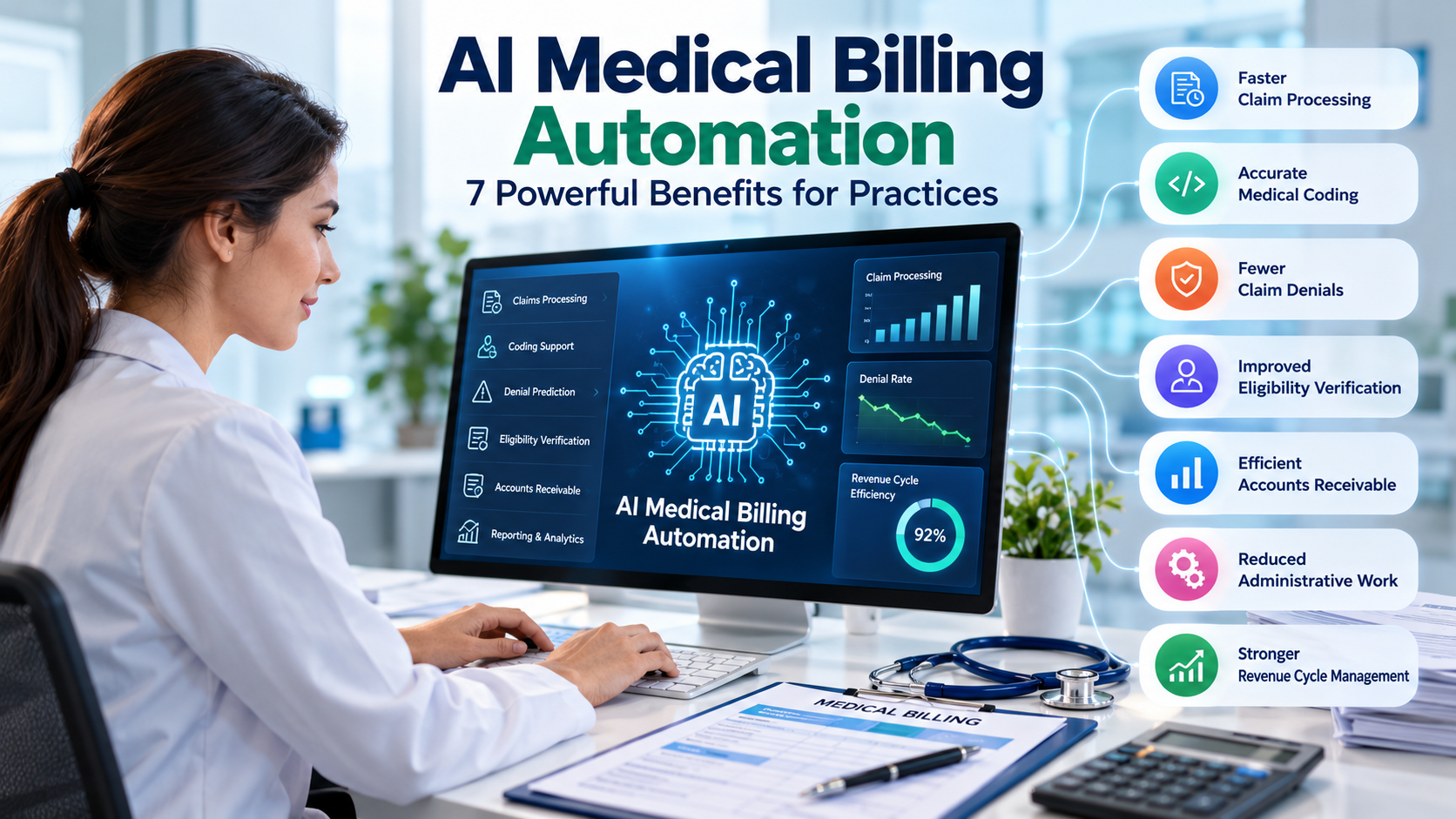
In 2026, AI in medical billing has moved from promise to daily operations. It is not a pilot program anymore. It is not something only big hospital systems can afford. And it is not coming — it is already running inside tools that thousands of practices use right now, producing results that show up directly in cash flow, denial rates, and days in accounts receivable.
According to Experian Health’s 2026 RCM research, 63% of healthcare organizations have already introduced AI in medical billing in some form. That number has more than doubled in three years. Practices that figured this out early are pulling ahead. Those still managing everything manually are running harder just to stay in the same place.
This guide is a clear-eyed look at what AI in medical billing actually does in 2026, where it delivers proven results, where it still has limits, and what all of this means for small and individual practices that need revenue to flow — without adding headcount or expensive enterprise software.
What “AI in Medical Billing 2026” Actually Means
Before jumping into the specific applications, it helps to understand what this term covers in real practice — because “AI” means very different things depending on who is using the word.
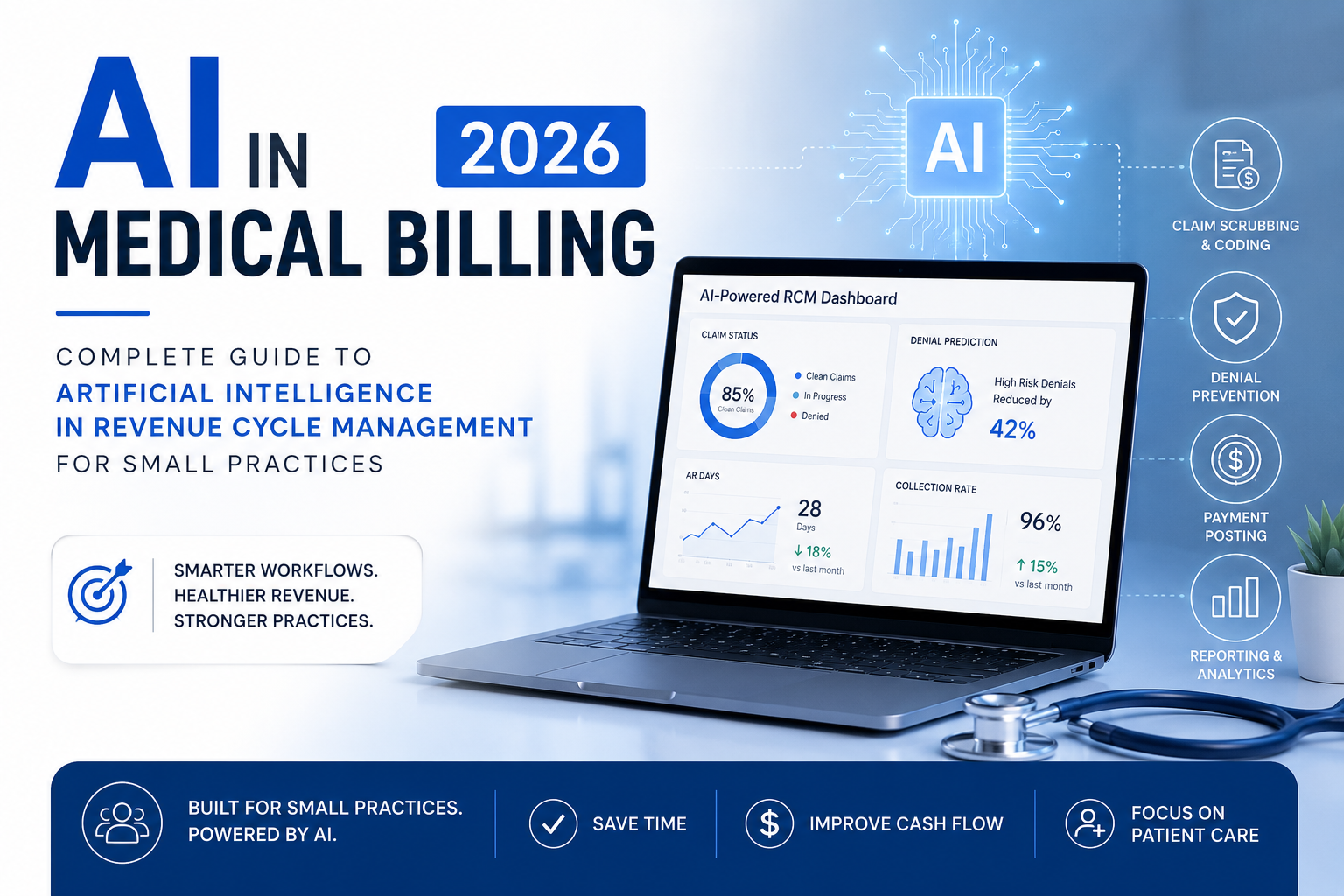
When people talk about AI in medical billing 2026, they are typically referring to four related technologies working together:
Machine Learning: Software that learns from historical billing data. A system trained on millions of past claims knows which code combinations get denied by which payers — and flags those patterns before a new claim goes out.
Natural Language Processing (NLP): Technology that reads and interprets clinical notes. This is what lets AI coding tools look at a physician’s progress note and suggest the correct CPT and ICD-10 codes — because the system understands the clinical meaning of the text, not just the individual words.
Robotic Process Automation (RPA): Software that handles repetitive tasks — checking eligibility, logging into payer portals, pulling authorization status, moving data between systems. RPA does not think, but it does the tedious work fast and without errors.
Predictive Analytics: Systems that score claims before submission based on denial probability, then route high-risk claims to human review while low-risk claims go straight out the door.
In 2026, the strongest AI in medical billing implementations combine all four capabilities — and are integrated directly into the EHR and practice management systems practices already use.
Now let us look at the eight areas where AI in medical billing 2026 is making the most measurable, proven difference.

8 Proven Ways AI in Medical Billing 2026 Changes How Practices Get Paid
Proven Way #1: Catching Claim Errors Before Submission — Not After Denial
This is where the biggest financial impact from AI in medical billing 2026 is happening — and it is the shift that matters most for small practices.
The old billing model was entirely reactive. Claims went out. Denials came back six weeks later. Staff spent hours tracking down what went wrong, fixing it, resubmitting. Meanwhile, cash sat uncollected.
The Healthcare Financial Management Association (HFMA) reports that initial denial rates climbed to nearly 12% in 2024 — a measurable year-over-year increase. Even worse, up to 65% of denied claims are never reworked at all, meaning a significant share of that lost revenue is simply written off and gone.
AI in medical billing 2026 flips that sequence.
Before a claim is submitted, AI claim scrubbers review every field — patient demographics, insurance eligibility, CPT code validity, ICD-10 alignment, modifier correctness, payer-specific rules, prior authorization status — and flag anything that does not pass. The billing team sees the issue immediately, fixes it, and sends a clean claim.
Experian Health case data shows that practices implementing AI-powered eligibility and claim verification have cut denial rates by as much as 42%. For a practice generating $100,000 per month in claims with a 10% denial rate, that means recovering roughly $4,200 per month that was previously being written off.
Proven Way #2: Real-Time Eligibility Verification Before Every Single Visit
Experian Health’s 2025 State of Patient Access survey found that 56% of providers name patient information errors as a primary cause of claim denials. Most of those errors begin at registration — wrong plan, outdated group number, coverage that lapsed last month, a mental health benefit carved out to a separate administrator.
Traditional eligibility verification meant calling payer hotlines or logging into each portal individually — often skipped entirely when the front desk is busy, and then showing up as denials weeks later.
AI in medical billing 2026 runs eligibility checks automatically for every scheduled appointment. It verifies whether the specific service being scheduled is covered, whether prior authorization is required, what the patient’s current deductible and copay status is, and whether there are coordination of benefits issues to resolve before the visit.
The result: eligibility surprises — a leading cause of front-end denials — drop significantly. Patients who show up have verified, current coverage. Billing starts clean.
Proven Way #3: AI Medical Coding — From Manual Entry to Quality Review
Medical coding is one of the most labor-intensive and error-prone steps in the entire revenue cycle. A human coder reads a clinical note, interprets what services were provided, selects the correct CPT and ICD-10 codes, applies the right modifiers, and checks the combination against payer rules — multiplied by hundreds of encounters every day.
AI in medical billing 2026 changes this entirely using natural language processing. AI coding tools read clinical documentation — progress notes, operative reports, discharge summaries — and suggest the appropriate billing codes automatically.
According to the American Medical Association’s CPT coding resources, coding accuracy is foundational to clean claim submission. AI-assisted coding improves accuracy from the typical human benchmark of 85–92% up to 95–98%, while shifting the human coder’s role from data entry to quality review and exception handling.
CodaMetrix, named the number one autonomous medical coding solution in the 2026 Best in KLAS awards, works with clients including Mass General Brigham, Mayo Clinic, and Yale Medicine. Their model demonstrates what AI coding at scale looks like in real clinical environments.
For small practices, AI in medical billing 2026 coding support is now available through billing services — not just enterprise health systems. Our CodeMAXX medical coding service applies AI-assisted coding validation to every claim we process, catching coding mismatches before submission.

Proven Way #4: Predictive Denial Management — Score Claims Before They Go Out
Every claim has a risk profile. Based on the CPT code, the diagnosis, the payer, the patient history, the provider specialty, and dozens of other variables, AI trained on millions of historical claims can predict — before submission — which claims are likely to be denied and exactly why.
High-risk claims get flagged for human review before they leave the practice. Low-risk clean claims go straight through submission without delay.
Medical Economics published analysis in April 2026 confirming that this pre-submission checkpoint is where the clearest time and cost savings are realized in independent practice settings. Predictive analytics in AI in medical billing 2026 scores claims for denial risk before submission, routing high-risk claims for human review.
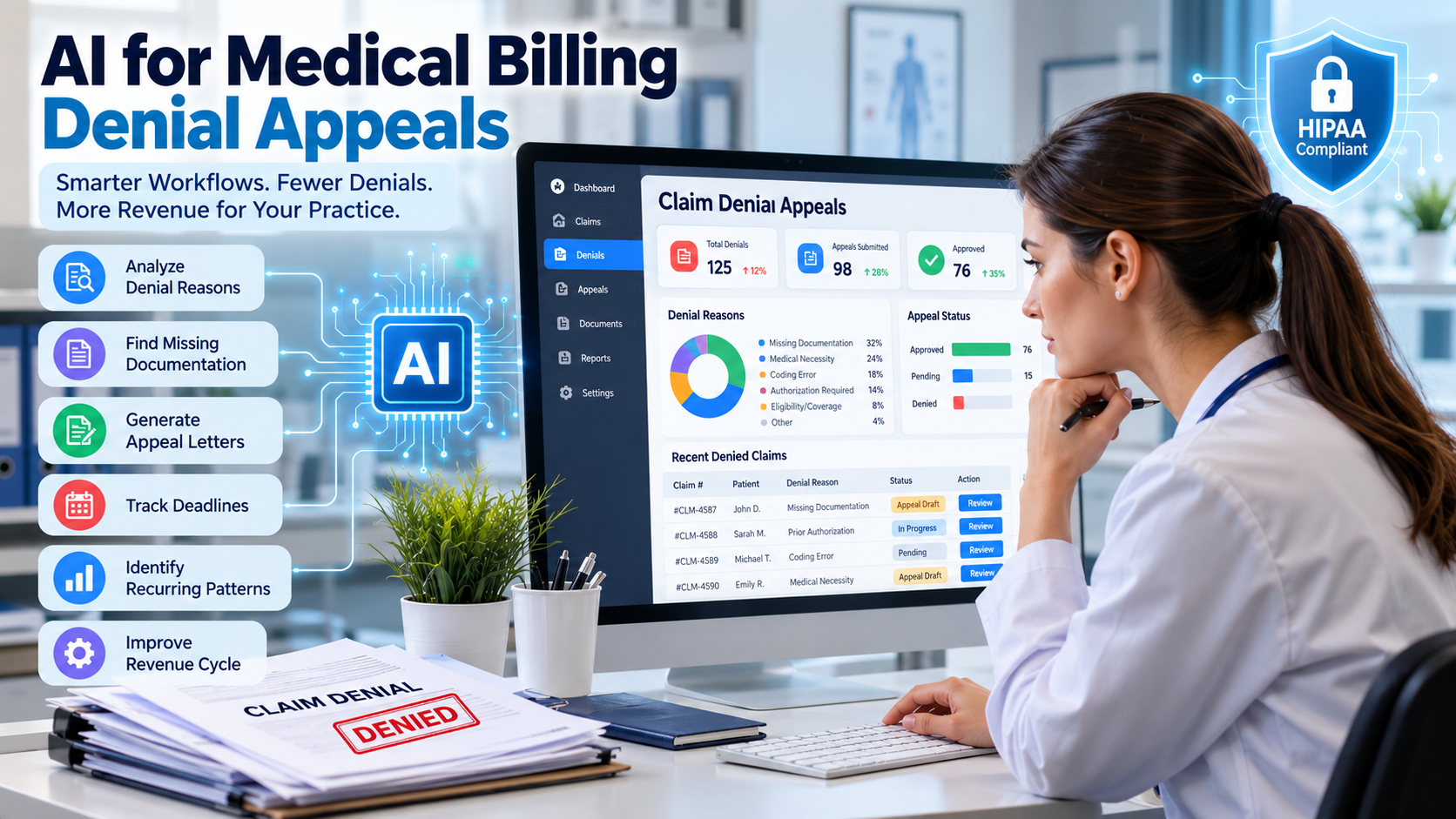
On the back end, when denials do occur, AI denial management tools categorize them by root cause, score them by recovery probability, and route them to the right workflow — appeal, corrected claim submission, or payer dispute — automatically. Staff focus energy on the denials most likely to be recovered, rather than working through a disorganized queue.
Proven Way #5: Automated Prior Authorization — Weeks Cut Down to Hours
Prior authorization remains one of the most painful administrative burdens in American healthcare. Around 70% of prior authorization processes still rely entirely on manual labor — staff logging into payer portals, finding correct forms, submitting requests, and chasing status updates for days.
AI in medical billing 2026 has made significant inroads here. AI-powered authorization systems pull relevant clinical data directly from the EHR, cross-check it against each payer’s specific requirements, and submit the request through the correct channel — without manual portal access.
For practices in high-authorization specialties — oncology, cardiology, mental health, orthopedics — the time savings compound fast. A process that previously took 3–7 days per case now completes in hours or even same-day. Staff time that was being consumed by authorization follow-up gets redirected to patient-facing work.
Proven Way #6: AI-Powered Patient Billing and Financial Experience
Most of the conversation around AI in medical billing 2026 focuses on the payer side. But AI is also changing how practices interact with patients about their financial responsibility — and that matters more than ever as high-deductible plans make patient collections a larger share of practice revenue.
AI tools are addressing the patient financial experience from three angles:
Pre-visit cost estimates: AI calculates a patient’s likely out-of-pocket cost for a scheduled appointment — based on their specific plan, current deductible status, and the services planned — and presents that estimate to the patient in advance. Patients who know what to expect are far more likely to pay without friction.
Personalized payment plans: Rather than offering one-size-fits-all terms, AI systems analyze a patient’s payment history to offer individualized terms — monthly amounts, timing, and communication channels — that match what the patient is realistically likely to pay.
Intelligent billing reminders: AI-driven communications adjust timing, frequency, and channel (text, email, portal, phone) based on each patient’s behavior patterns. The result is higher collection rates with less staff effort.
Proven Way #7: Faster Payment Posting and Underpayment Detection
Payment posting — matching insurance remittance advice to claims, applying payments, identifying contractual adjustments — is one of the most repetitive tasks in a billing office. AI-assisted payment posting handles this automatically, significantly reducing manual entry errors and speeding up daily reconciliation.
Beyond posting speed, AI in medical billing 2026 identifies when a payer has paid less than the contracted rate — which happens more often than most practices realize, and which is nearly impossible to catch manually when reviewing hundreds of payments per day.
For practices with Electronic Fund Transfer (EFT) set up with all payers, AI-powered reconciliation runs smoothly against a clean electronic payment stream — reducing paper check processing and flagging underpayments for follow-up automatically.
Traditional billing takes 30 to 45 days to process a claim. AI-powered systems in 2026 compress that to 2 to 7 business days. For a practice managing thousands of claims monthly, that compression transforms cash flow directly.
Proven Way #8: Compliance Monitoring and RAC Audit Risk Detection
This application of AI in medical billing 2026 may be the most underappreciated — and the one that carries the highest financial stakes for small practices.
AI compliance monitoring systems analyze your billing patterns over time — across your entire patient panel, all providers, all payers — and look for the same statistical anomalies that CMS Recovery Audit Contractors (RACs) use when selecting practices for audit review.
The CMS Medicare Physician Fee Schedule and RAC program both use data analytics to identify billing patterns that deviate from specialty peers. If your practice is billing a particular CPT code at a significantly higher rate than comparable practices in your region, a compliance AI system catches that pattern first — and alerts you to investigate before a CMS demand letter arrives.
This proactive monitoring is exactly what our MD Audit Shield program delivers for small practices — combining AI-powered pattern monitoring with human compliance expertise to protect practices before a problem becomes an audit.
AI in Medical Billing 2026 — The Numbers That Tell the Story
| Metric | Without AI | With AI in Medical Billing 2026 |
|---|---|---|
| Initial claim denial rate | 10–12% | 6–7% (up to 42% reduction) |
| Days in A/R average | 30–45 days | 15–25 days |
| First-pass claim acceptance | 85–88% | 92–96% |
| Medical coding accuracy | 85–92% | 95–98% |
| Prior auth processing time | 3–7 days | Same day to 24 hours |
| Payment posting | Hours daily, manual | Minutes daily, automated |
| Annual industry savings potential | — | $18.4 billion (industry estimate) |
These are not theoretical projections. These are documented outcomes from practices that have implemented AI in medical billing 2026 workflows. The gap between where most small practices are today and where these numbers sit represents real, recoverable revenue.
Where AI in Medical Billing 2026 Still Has Honest Limits
Most articles about AI in medical billing 2026 skip this part. We are not going to.
AI is not a magic fix. The practices that have struggled with AI billing implementations almost always made the same mistake: they tried to automate a broken process, expecting AI to fix the underlying problems. It does not work that way.
Here are the real limits of AI in medical billing 2026:
Complex clinical edge cases: AI suggests codes. It cannot replace a skilled coder’s judgment when a patient’s record involves an unusual diagnosis combination, a complicated surgical procedure, or a novel treatment approach. Human expertise remains essential for high-complexity encounters.
Payer contract negotiation: AI identifies that you are being underpaid. It cannot negotiate better contract rates. That still requires human relationship-building and advocacy.
Patient empathy: When a confused or upset patient calls about a bill they do not understand, AI chat tools have real limits. A skilled human who can listen, explain, and work out a solution remains the standard for difficult patient financial conversations.
HIPAA compliance requirements: Any AI tool handling protected health information must meet strict HIPAA compliance standards — encrypted data, business associate agreements, proper access controls. Not every AI billing vendor meets this bar. Verifying HIPAA compliance is not optional before adopting any AI billing tool.
The honest conclusion: AI in medical billing 2026 works best when it supports skilled humans in handling high volume, not when it tries to replace human judgment on complex decisions.
What AI in Medical Billing 2026 Means for Small Practices Specifically
The most common question we hear from small and solo practices is direct: “Does any of this actually apply to me, or is it just for large hospitals?”
The honest answer in 2026 is: yes, it applies — but the path to access it is different for small practices.
Only 14% of healthcare organizations have fully implemented AI in medical billing tools in their revenue cycle — despite 67% believing AI can improve the claims process. That gap exists partly because small practices have historically not had access to the same technology as large health systems, and partly because the upfront cost and implementation complexity of enterprise AI platforms is genuinely prohibitive for a two-physician practice.
The most practical path for most small practices right now is not buying a standalone AI billing platform. It is working with a billing service that has already built and integrated these AI capabilities — and that has the human expertise to apply them correctly for your specialty, your specific payer mix, and your documentation patterns.
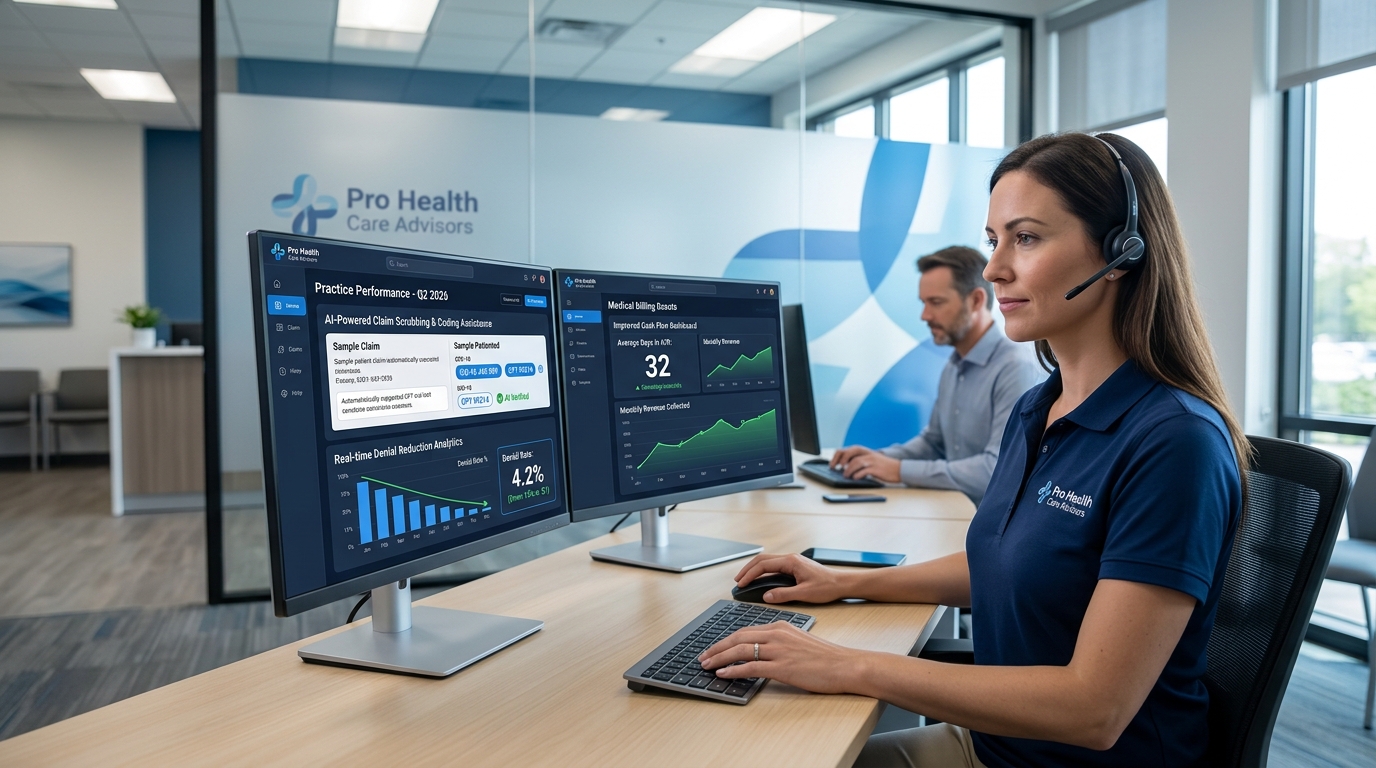
This is exactly what we do at Pro Health Care Advisors. We serve small and individual practices exclusively, and our medical billing and RCM service combines AI-assisted claim scrubbing, coding validation, denial prediction, and compliance monitoring with experienced human billers who know your practice.
You do not need to buy an enterprise AI platform. You need a billing partner who has already built these capabilities and brings them to your practice size — without the overhead.
AI in Medical Billing 2026 and Compliance — The Connection You Cannot Ignore
One area where AI in medical billing 2026 is having outsized impact — and where small practices are most exposed — is billing compliance.
The same AI analytics capabilities that review your own billing patterns are being used by CMS, RAC contractors, and commercial payers to identify practices whose billing looks anomalous compared to peers. Regulators in 2026 are applying machine learning to claims data at scale — which means billing patterns that might have gone unnoticed five years ago are now being caught automatically.
In plain language: the government is already using AI to decide who to audit. If you are not using similar analytics to review your own patterns, you are operating without a mirror.
This is why proper physician credentialing, accurate coding through services like CodeMAXX, HIPAA compliance documentation, and RAC audit protection through MD Audit Shield are not separate, isolated concerns — they are part of the same integrated revenue integrity strategy that AI in medical billing 2026 makes possible and necessary simultaneously.
Contact our team for a free billing review to understand what your current billing patterns look like from a compliance standpoint — before a payer or auditor finds something you did not know was there.
Frequently Asked Questions About AI in Medical Billing 2026
Q: Is AI in medical billing 2026 safe for patient data?
A: HIPAA compliance is non-negotiable for any AI tool that processes protected health information. Reputable AI in medical billing 2026 systems are built on HIPAA-compliant infrastructure with business associate agreements (BAAs) in place. Before adopting any AI billing tool, verify the vendor will sign a BAA, that data is encrypted at rest and in transit, and that access controls meet HIPAA minimum standards. Always verify — never assume.
Q: Will AI in medical billing 2026 replace my billing staff?
A: No — not in any realistic near-term scenario for small practices. What AI in medical billing 2026 does is shift what billing staff spend their time on. Repetitive, high-volume tasks — eligibility checks, claim status follow-up, payment posting — get automated. Human work shifts toward judgment-intensive activities: complex denial appeals, patient financial counseling, payer relationship management, and quality review. For lean billing teams, AI means the same number of people can handle significantly more volume.
Q: Which specialties benefit most from AI in medical billing 2026?
A: Every specialty benefits from AI eligibility verification and claim scrubbing. Specialties with high code complexity and historically high denial rates see the most dramatic improvements: mental health (time-based coding requirements), cardiology (high-value procedures), oncology (drug authorization complexity), orthopedics (surgical coding), and primary care (high E/M code volume). If your specialty has a chronic denial problem, AI in medical billing 2026 has targeted solutions for the specific patterns causing those denials.
Q: How much does AI in medical billing 2026 software cost for small practices?
A: Enterprise AI RCM platforms can cost tens of thousands of dollars monthly. For small practices, the most cost-effective path is working with a billing service that has already invested in AI infrastructure and delivers the benefit through better claim performance — rather than paying for a standalone platform. The right question is not the software cost; it is the impact on your denial rate, days in A/R, and net collection rate. Contact us for a free billing review to see where AI would have the highest impact for your specific practice.
Q: Can AI in medical billing 2026 help with prior authorization?
A: Significantly. Prior authorization is one of AI’s highest-impact use cases in medical billing 2026 because 70% of prior auth processes still rely entirely on manual labor. AI authorization tools pull clinical data from EHR records, cross-check payer requirements automatically, and submit requests without manual portal access. Authorization that used to take 3–7 days now completes in hours, and tracking of session limits and renewal timing happens automatically rather than depending on someone remembering.
Q: How does AI in medical billing 2026 help prevent RAC audits?
A: AI compliance monitoring in medical billing 2026 analyzes your billing patterns over time and flags statistical anomalies — the same type of anomalies that RAC audit contractors look for when selecting practices for review. If your practice is billing a particular code at a significantly higher rate than peers in your specialty and region, an AI compliance system catches that internally first — giving you time to investigate and correct the pattern before a CMS demand letter arrives. Our MD Audit Shield program provides this monitoring for small practices.
Q: What is the difference between AI and regular billing software?
A: Traditional billing software follows fixed rules — if this code, then do that. It does not learn from outcomes. AI in medical billing 2026 learns continuously from claims data. It knows, based on millions of historical claims, that a specific code combination billed to a specific payer in a specific region has a high probability of denial — and it flags that pattern before you submit. The intelligence improves over time: the more data the system processes, the better and more specific its predictions become.
Q: How do I know if my practice needs AI in medical billing 2026?
A: If your denial rate is above 5%, your days in A/R are over 30, your first-pass acceptance rate is below 90%, or you have experienced a billing audit — these are all signs that AI in medical billing 2026 tools would have a measurable positive impact. The fastest way to find out is a billing audit that reviews your current claims data against industry benchmarks. Contact our team for a free review — we will show you exactly where AI-assisted billing would improve your specific numbers.