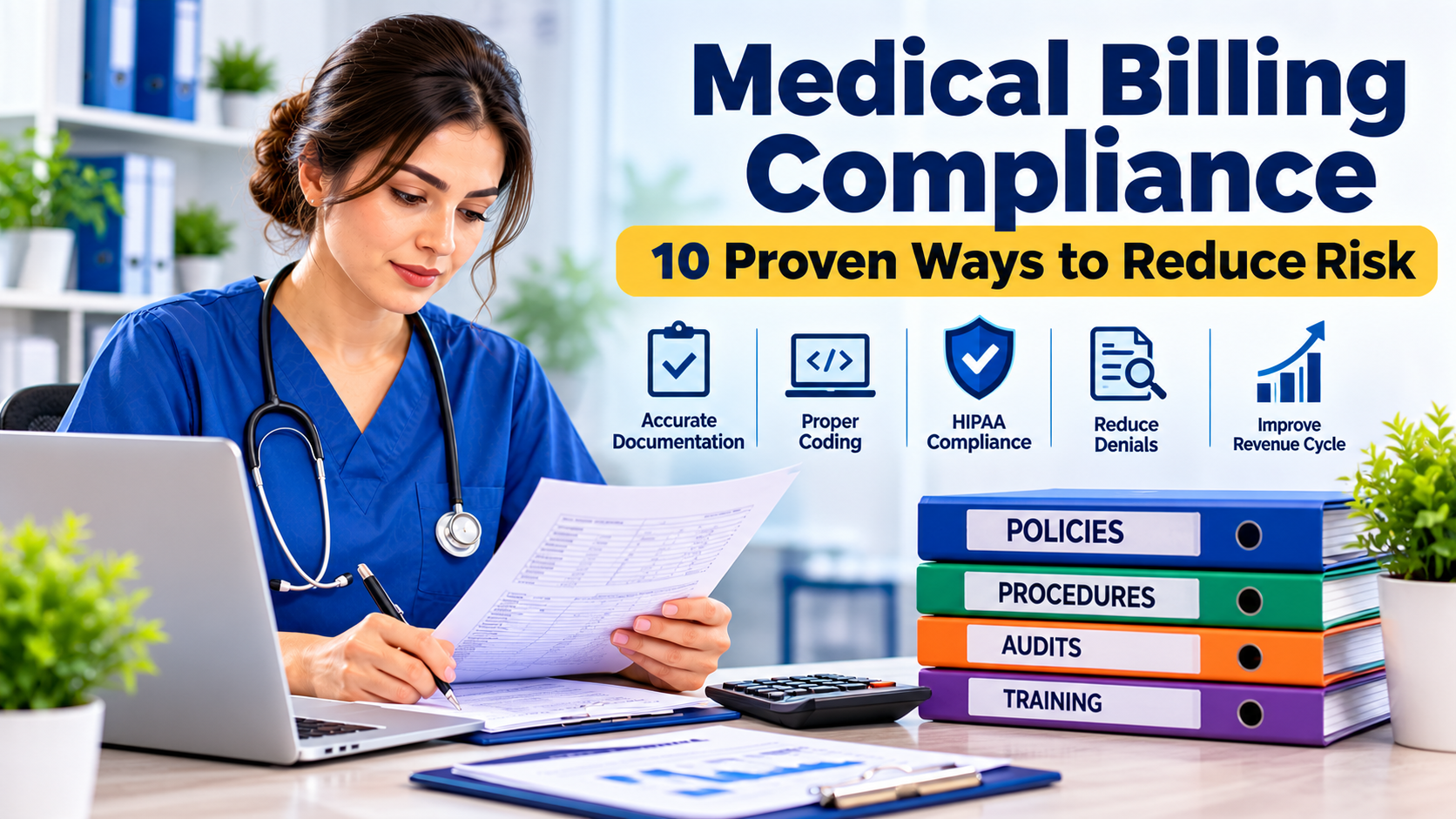
Medical billing involves more than submitting claims and collecting payments. Healthcare practices must maintain accurate documentation, use appropriate coding, protect patient information, and follow applicable payer requirements. When these responsibilities are overlooked, organizations may face claim denials, repayment demands, audits, and potential compliance concerns.
Medical billing compliance helps healthcare organizations establish consistent billing procedures, reduce avoidable errors, and support accurate reimbursement. A practical compliance program also gives employees clear instructions for handling documentation, coding questions, claim corrections, and payment discrepancies.
In this guide, we explain 10 essential steps healthcare practices can use to strengthen their billing processes and manage compliance risks.
What Is Medical Billing Compliance?
Medical billing compliance means following applicable laws, regulations, payer policies, contractual obligations, and organizational procedures when documenting, coding, submitting, and managing healthcare claims.
Requirements vary by payer, service, specialty, and jurisdiction. For example, a practice billing Medicare may need to follow program-specific documentation and coding rules, while commercial insurance claims may involve different contract requirements.
An effective medical billing compliance process helps organizations:
- Support claims with appropriate documentation.
- Improve coding and billing accuracy.
- Identify and correct recurring errors.
- Protect sensitive patient information.
- Maintain reliable billing records.
- Respond appropriately to audits and payer inquiries.
Compliance is an ongoing responsibility rather than a one-time review.
Why Is Medical Billing Compliance Important?
Billing errors can happen at several stages of the revenue cycle. Incorrect patient information, unsupported codes, duplicate claims, and inaccurate adjustments can affect reimbursement and create additional administrative work.
Strong medical billing compliance procedures help practices identify risks before they become repeated problems. They also clarify staff responsibilities and create a documented process for investigating questionable claims.
A compliance program should be appropriate for the organization’s size, services, payer mix, and risk profile. It should also be reviewed when regulations, contracts, systems, or workflows change.
10 Essential Medical Billing Compliance Practices
1. Maintain Complete and Accurate Documentation
Claims should be supported by documentation that accurately reflects the services provided and satisfies applicable requirements.
Review whether records contain the information necessary to support the billed services. Establish procedures for resolving incomplete records and handling documentation requests.
Best practices:
- Use consistent documentation procedures.
- Address missing information before claim submission when required.
- Retain records according to applicable policies and requirements.
- Ensure corrections are properly documented.
- Never create or alter records to justify a service that was not supported.
Accurate documentation supports both appropriate reimbursement and effective claim review.

2. Review Coding Accuracy Regularly
Coding errors can result in incorrect reimbursement, claim denials, repayment obligations, or compliance concerns.
Medical billing compliance reviews should examine whether diagnosis codes, procedure codes, modifiers, and units of service are supported by the documentation and applicable coding guidance.
Look for recurring patterns such as incorrect modifiers, unsupported services, duplicate coding, and inconsistent coding practices.
Qualified coding professionals should review complex cases. Practices should also provide staff with updated guidance when applicable code sets or payer requirements change.
Related resource: Claims Scrubbing in Medical Billing.
3. Verify Insurance Eligibility and Authorization Requirements
Eligibility checks help staff understand a patient’s reported coverage, while authorization and referral requirements may determine whether additional steps are needed before a service.
Establish a workflow for verifying relevant insurance information and documenting the result. The process should account for payer-specific requirements and services that require advance authorization.
Do not assume that eligibility confirmation guarantees payment. Coverage, medical necessity, benefit limitations, and other claim requirements may still affect adjudication.
4. Follow Payer Rules and Contract Terms
Healthcare practices may work with Medicare, Medicaid, and multiple commercial insurers. Each payer may have distinct billing instructions, documentation requirements, filing deadlines, and reimbursement policies.
Maintain accessible references to current payer guidance and relevant contracts. Assign responsibility for reviewing updates and communicating changes to the billing team.
When requirements are unclear, seek clarification through appropriate payer channels or qualified compliance professionals rather than guessing.
5. Prevent Duplicate and Inaccurate Claims
Duplicate claims and incorrect submissions can create unnecessary rework and may lead to payment discrepancies.
Before resubmitting a claim, determine whether the original submission was rejected, denied, or is still being processed. Follow the payer’s applicable correction and resubmission procedures.
Review system edits and staff workflows for recurring issues involving duplicate encounters, repeated submissions, incorrect patient accounts, or inaccurate service information.
A structured review of medical billing and practice management can help practices identify opportunities to improve their administrative workflows.
6. Establish Clear Payment Posting Controls
Accurate payment posting helps ensure that account balances reflect payer decisions and recorded transactions.
Compare remittance advice with posted payments and adjustments. Investigate unexplained differences, duplicate entries, unapplied cash, and credit balances.
Use appropriate review and approval procedures for adjustments and refunds. Maintain supporting documentation for financial transactions and follow established rules when correcting errors.
Payment posting controls should make it possible to trace an entry back to its supporting record.
7. Protect Patient Information
Billing teams routinely handle sensitive patient and insurance information. Access should be limited according to job responsibilities, and staff should follow applicable privacy and security requirements.
Useful safeguards include:
- Role-based system access.
- Secure handling of billing documents.
- Appropriate staff training.
- Procedures for reporting suspected incidents.
- Secure communication and data-sharing practices.
- Periodic access reviews.
Organizations subject to HIPAA should consult the official HHS HIPAA resources to understand relevant privacy and security requirements.
8. Train Staff on Compliance Responsibilities
Written policies are less effective if employees do not understand how to apply them. Provide role-specific training for registration, coding, billing, payment posting, and accounts receivable staff.
Training should explain common billing risks, documentation standards, claim correction procedures, privacy expectations, and the process for escalating concerns.
Keep records of completed training and review whether additional education is needed when audits reveal recurring errors.

9. Conduct Internal Reviews and Risk-Based Audits
Periodic reviews help identify billing weaknesses and determine whether established procedures are being followed.
Choose audit samples based on risk, claim volume, payer mix, previous findings, and changes in services or systems.
A review may examine documentation, coding, claim submission, payment posting, refunds, or another area that presents a particular risk.
Document the findings, responsible person, corrective action, and follow-up date. If a possible overpayment or other significant issue is identified, escalate it through the organization’s established compliance process and obtain qualified advice on the appropriate response.
For official program guidance, consult the Centers for Medicare & Medicaid Services and the HHS Office of Inspector General.
10. Monitor Corrective Actions and Update Policies
Identifying an error is only the first step. Organizations should determine why it occurred and implement measures to reduce the chance of recurrence.
For every significant finding, record:
- The issue identified.
- The likely root cause.
- The corrective action.
- The person responsible.
- The expected completion date.
- The method used to verify improvement.
Review policies periodically and update them when applicable requirements, payer contracts, software, or operational workflows change.
Common Medical Billing Compliance Mistakes
Relying on Outdated Billing Guidance
Old payer instructions or coding references may no longer reflect current requirements. Assign responsibility for checking updates and revising internal procedures.
Ignoring Repeated Claim Errors
Repeated errors can indicate a training, configuration, or workflow problem. Analyze trends instead of correcting each claim in isolation.
Making Unsupported Coding Changes
Coding and documentation corrections must be accurate, supported, and consistent with applicable rules. Never change claim information solely to obtain a more favorable payment.
Giving Staff Excessive System Access
Employees should have access to the information needed for their roles, not unrestricted access by default. Review permissions and remove access when job responsibilities change.
Failing to Document Corrective Actions
Without a record of what was changed and how the result was verified, organizations may struggle to demonstrate that an identified issue was addressed.
Medical Billing Compliance Checklist
Use this quick checklist as a starting point for internal reviews:
-
Billing documentation supports the services reported.
-
Coding is reviewed according to applicable requirements.
-
Eligibility and authorization procedures are documented.
-
Payer policies and contract requirements are reviewed.
-
Duplicate and inaccurate claims are investigated.
-
Payments and adjustments have supporting records.
-
Patient information is handled securely.
-
Staff receive appropriate compliance training.
-
Internal audits and findings are documented.
-
Corrective actions are completed and verified.
Adapt this list to your organization’s services and risks. It does not replace legal advice, payer-specific guidance, or a formal compliance assessment.
How Can Practices Measure Compliance Performance?
Organizations can monitor several indicators to evaluate their billing processes. Useful measures include claim error rates, denial trends, duplicate claim frequency, unresolved payment discrepancies, audit findings, training completion, and corrective action completion.
Define each measure consistently and review trends over time. A single metric should not be treated as proof of compliance; findings should be interpreted in context and investigated when necessary.
Frequently Asked Questions
1. What is medical billing compliance?
Medical billing compliance involves following applicable laws, payer requirements, contracts, documentation standards, and organizational procedures when processing healthcare claims.
2. Who is responsible for billing compliance?
Responsibility is shared across the organization. Billing staff, coding professionals, providers, managers, and compliance personnel each have responsibilities based on their roles.
3. How often should billing compliance be reviewed?
Review frequency depends on organizational risk, claim volume, payer mix, previous findings, and changes in services or requirements. Routine monitoring can be combined with targeted audits.
4. Can billing compliance reviews reduce claim denials?
They can help identify recurring errors that contribute to denials. Results depend on the quality of the review and whether corrective actions are implemented and monitored.
5. What should a practice do if it discovers a billing error?
Document the issue, investigate its cause, and follow applicable payer and organizational procedures for correction. Potential overpayments or significant compliance concerns should be escalated promptly for qualified guidance.
Final Thoughts
Strong medical billing compliance practices help healthcare organizations improve documentation, reduce avoidable errors, protect patient information, and establish more reliable billing workflows.
Start with clear procedures, staff training, regular risk-based reviews, and documented corrective actions. Review the results regularly and update your processes as requirements change.
For support with billing workflows and revenue cycle operations, explore Pro Health Care Advisors’ medical billing and practice management services.