








418 CPT Code Changes in 2026 | What Every Medical Practice Must Update Right Now
The Biggest Medical Billing Shake-Up in Years — Are You Ready?
Think of CPT codes like the address labels on a package. If you write the wrong address, your package never arrives. In medical billing, using the wrong or outdated CPT code means your claim gets denied, your payment gets delayed, and your practice loses money — sometimes without even knowing why.
Now imagine 418 of those address labels just changed overnight.
That is exactly what happened on January 1, 2026.
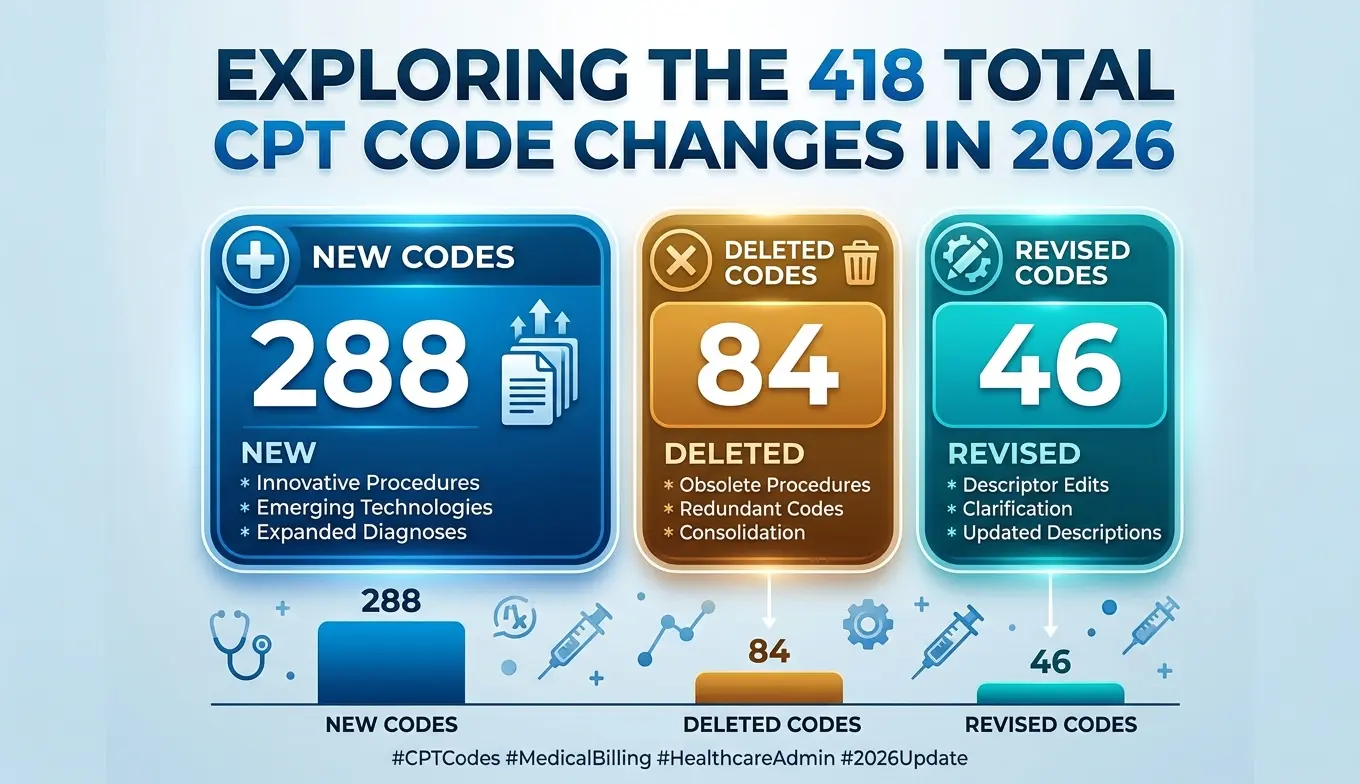
The American Medical Association (AMA) released the CPT® 2026 code set with the most sweeping update in recent memory — 288 new codes added, 84 old codes deleted, and 46 existing codes revised. Whether you run a small family practice, a specialty clinic, or a large multi-provider group, these changes affect how you document, bill, and get paid.
This guide walks you through everything — what changed, what got deleted, which specialties got hit the hardest, and exactly what your team needs to do before the next claim goes out the door.
📌 Internal Resource: If you need help reviewing your revenue cycle after these changes, visit our Medical Billing & Coding Services page for expert guidance tailored to your practice.
What Are CPT Codes and Why Do They Matter?
Before we dive into specifics, a quick refresher for anyone who is newer to medical billing.
CPT stands for Current Procedural Terminology. These codes are a standardized system created and maintained by the AMA. Every time a doctor sees a patient, performs a procedure, or orders a diagnostic test, that service gets assigned a CPT code. That code goes on the insurance claim. The insurance company looks at the code, compares it to their coverage rules, and decides how much — or whether — to pay.
There are over 10,000 CPT codes in use today. They are updated every year, typically effective January 1st. Missing even one update can mean claim denials, compliance issues, or underbilling for services your practice actually performed.
The 2026 update is not routine. It is one of the largest single-year overhauls in recent history, and practices that are not prepared are already feeling the consequences.
418 Changes at a Glance: The Numbers That Matter
Here is a quick breakdown of what the 2026 update actually contains:
| Category | Number of Changes |
|---|---|
| New Codes Added | 288 |
| Existing Codes Deleted | 84 |
| Existing Codes Revised | 46 |
| Total Changes | 418 |
According to the AMA, proprietary laboratory analyses (PLA) accounted for the largest portion of new codes, making up about 27% of all new additions. Category III codes — which cover newer, experimental procedures that may eventually become standard care — also made up a significant share.
But the changes that will affect most everyday practices fall into four main areas. Let us cover each one in plain language.
Area 1: Remote Patient Monitoring (RPM) — New Short-Term Codes Finally Arrive
Remote Patient Monitoring, or RPM, is when your practice uses technology to track a patient’s health data from outside the office. Think: blood pressure cuffs that send readings to your EHR automatically, glucose monitors that sync to your dashboard, or wearables that flag abnormal heart rhythms.
Until now, existing RPM codes like 99454 and 98976-98978 required that data be transmitted on at least 16 out of 30 days before a practice could bill. That rule locked out a huge group of patients — those who only need short-term monitoring, like someone recovering from a minor cardiac event or managing a temporary condition.
The 2026 update fixes this.
Five new Category I CPT codes now allow practices to bill for remote monitoring periods as short as 2 to 15 days within a 30-day window. A growing body of clinical research has shown that patients benefit from monitoring over shorter durations, and the AMA responded by creating codes that actually match how care is delivered.
Key new RPM codes to know:
- Remote physiologic monitoring, device supply (short-term)
- Remote physiologic monitoring, treatment management services — first 10–19 minutes (previously required 20 minutes minimum)
- Remote therapeutic monitoring, respiratory system, device supply (short-term)
What this means for your practice: If you have been avoiding RPM billing because your patients did not qualify under the old 16-day rule, you now have a path to bill — and get paid — for those shorter monitoring episodes. Staff should be trained on the new time thresholds and documentation requirements before submitting claims under these codes.
📌 Related Read: Learn how proper RPM documentation ties into broader revenue cycle management best practices on our website.
Area 2: Augmented Intelligence (AI) Services — Medicine Meets Machine
This is the section that signals where healthcare is heading.
For the first time, CPT codes now formally recognize AI-assisted clinical services. These are not general “computer-assisted” codes from years ago. These are specific codes designed for services where an AI algorithm meaningfully contributes to diagnosis or clinical decision-making.
Notable new AI-related codes include:
- AI-assisted coronary plaque assessment — used when AI software analyzes imaging data to quantify plaque buildup in coronary arteries
- Perivascular fat analysis — a newer diagnostic technique where AI identifies fat tissue around blood vessels, a marker linked to cardiovascular risk
- Augmentative and assistive AI services — broader category for services where AI tools augment a clinician’s ability to assess or treat patients
What this means for your practice: If your facility uses AI-powered diagnostic software — especially in cardiology, radiology, or pathology — you may now have proper codes to bill for the AI component separately. This could represent significant lost revenue for practices that have been providing these services without appropriate billing codes.
Cardiology practices in particular should audit their current AI-assisted imaging workflows to identify newly billable services.

Area 3: Hearing Device Services — 12 New Codes for Modern Audiology
Hearing healthcare has quietly undergone a revolution. Over-the-counter hearing aids became legal to sell without a prescription in 2022. Patients now connect their hearing devices to smartphones. The old CPT framework simply did not cover many of the services audiologists and ENT specialists provide today.
The 2026 update adds 12 new hearing device codes that cover:
- Assessment of dexterity, visual ability, and psychosocial factors before fitting hearing devices
- Validation of device performance and sound quality after fitting
- Training and support for patients using personal devices (like smartphones) connected to hearing aids or cochlear implants
- Patient education services for new device users
The American Speech-Language-Hearing Association (ASHA) has noted that these new codes are designed to capture professional audiology services for today’s hearing devices — including evolving technologies and patient care models that did not exist when older codes were written.
What this means for your practice: If you are an audiologist, ENT physician, or hearing specialist, you have 12 new tools to accurately bill for services you may have been documenting without proper codes. Review your encounter types from the past 12 months and compare them against the new code descriptions to identify any unbilled services.
Area 4: Lower Extremity Revascularization — A Complete Overhaul
This is perhaps the most dramatic structural change in the entire 2026 update. The lower extremity revascularization section — covering procedures that restore blood flow to legs and feet, often in patients with peripheral artery disease — has been completely rebuilt from scratch.
All previous codes in this section have been deleted and replaced with 46 brand-new codes covering a defined range (37254–37299). The new framework is built around a territory-based approach, meaning codes are now organized according to which section of the leg or foot is being treated, rather than just the type of procedure.
The overhaul reflects:
- Technological advances in minimally invasive vascular procedures
- A shift toward outpatient settings — procedures that once required hospital admission are increasingly done in ambulatory surgical centers
- Better specificity for reporting advanced revascularization therapies that blend techniques
What this means for your practice: If you are a vascular surgeon, interventional cardiologist, interventional radiologist, or podiatrist who performs or assists in revascularization procedures, your entire coding workflow for lower extremity cases needs to be reviewed. Using deleted codes will result in automatic claim denials. This section cannot be updated halfway — it requires a complete mapping of old codes to new ones.

Area 5: Behavioral Health Telehealth — Expanded Flexibility
While not as widely discussed as the four areas above, the 2026 update includes meaningful expansions for behavioral health providers.
Several behavioral health codes have been added to CPT Appendices P and T, which identify services that may be delivered via audio-video or audio-only telehealth — and are considered equivalent to in-person care by the CPT Editorial Panel.
This matters because it gives psychiatrists, psychologists, licensed clinical social workers, and counselors more billing flexibility for patients who cannot access in-person care — particularly in rural areas, underserved communities, and vulnerable populations.
What this means for your practice: If your behavioral health providers have been documenting telehealth services but were uncertain about billing equivalency, these appendix updates provide clearer guidance. Confirm that your billing software recognizes the updated appendix assignments before submitting telehealth claims.
📌 Need help navigating telehealth billing rules? Our team at ProHealth Care Advisors can help you set up compliant telehealth billing workflows.
The 84 Deleted Codes: The Silent Killer of Your Revenue Cycle
Let us talk about what a lot of billing guides skip over — the deletions.
Of the 418 total changes, 84 codes were fully removed from the 2026 CPT code set. These are not revised or updated. They are gone. If your practice submits a claim using a deleted code after January 1, 2026, that claim will be denied.
The most high-risk deletions are in the lower extremity revascularization section — where the entire old code family was eliminated and replaced. But deletions are scattered across multiple specialties.
Here is how to protect yourself:
- Pull a list of all CPT codes your practice billed in the past 12 months
- Cross-reference that list against the 2026 deletion list (available in the AMA’s official CPT 2026 manual)
- Flag every code on your list that appears in the deletions
- Work with your billing team or billing software vendor to identify the correct replacement code
- Update your charge capture tools, EHR superbills, and coding reference materials
This is not a one-time task. It is a systematic review that should happen at the start of every calendar year — but 2026 demands extra attention given the volume of deletions.
What Your Practice Should Be Doing Right Now
If you are reading this and you have not already completed a 2026 CPT update review, here is a realistic action plan:
Step 1: Update Your CPT Manual and EHR System
Purchase or access the official AMA CPT 2026 manual. Contact your EHR vendor to confirm they have pushed the 2026 code updates. If you are on a cloud-based system, this may have happened automatically — but verify it.
Step 2: Conduct a Superbill Audit
Your superbill — the list of frequently-used codes for your specialty — is often the most common source of outdated code submissions. Pull yours and compare it line-by-line against the 2026 changes.
Step 3: Train Your Coding and Front-Desk Staff
Staff who enter charges or select codes at the point of care need to know what changed. This is especially true for practices in vascular surgery, audiology, cardiology, and any specialty using AI-assisted diagnostics.
Step 4: Confirm Payer Adoption Timelines
Here is something most billing guides forget to mention: the fact that a code is official in the CPT 2026 set does not automatically mean every insurance company will reimburse it on January 1. Payers — including commercial insurers and Medicare — set their own timelines for recognizing new codes. Contact your top five payers to confirm which new 2026 codes they have activated and which are still under review.
Step 5: Monitor for Claim Denials in the First 90 Days
The first quarter after a major code update is always the highest-risk period for denials tied to coding changes. Set up a denial dashboard in your billing system specifically to track denials related to “invalid code” or “code not covered” reason codes.

Which Specialties Are Most Affected by the 2026 CPT Changes?
While every practice should review the updates, some specialties have more at stake than others:
Vascular Surgery & Interventional Cardiology/Radiology — The complete overhaul of lower extremity revascularization codes affects every vascular procedure you bill. This is the highest-priority update in the entire 2026 release.
Cardiology — New AI-assisted diagnostic codes for coronary plaque assessment and perivascular fat analysis represent new billing opportunities. AI-assisted imaging workflows should be reviewed.
Audiology & ENT — 12 new hearing device codes require staff training and superbill updates for any practice fitting or managing hearing devices.
Primary Care & Internal Medicine — New short-term RPM codes open up billing opportunities for patients who need monitoring for fewer than 16 days. This is especially relevant for practices managing hypertension, diabetes, and post-discharge patients.
Behavioral Health — Updated telehealth appendix assignments provide clearer billing pathways for audio-video and audio-only mental health services.
Pathology & Lab Medicine — Proprietary laboratory analyses (PLA) account for 27% of all new codes. Labs offering specialized genetic or molecular testing should review the PLA additions carefully.
Common Mistakes Practices Are Making Right Now
Based on billing patterns seen in early 2026, here are the errors showing up most often:
Using deleted revascularization codes. Some practices are still submitting the old lower extremity codes because their EHR was not updated properly. This results in automatic claim rejection.
Billing new RPM codes without updated documentation templates. The new short-term RPM codes come with specific documentation requirements — particularly around the number of days monitored and the clinician time spent on management. Submitting the code without matching documentation creates audit exposure.
Assuming payers have already adopted all new codes. Not all insurers have activated the 2026 AI diagnostic codes. Claims for AI-assisted services may need to be held or appealed depending on your top payers.
Skipping the appendix review. The telehealth appendix updates for behavioral health are easy to overlook but can meaningfully affect reimbursement for practices with a high telehealth volume.
A Word on Compliance and Audit Risk
Whenever there is a major coding update, there is also an uptick in billing audits. The Centers for Medicare and Medicaid Services (CMS) and private payers routinely review claim patterns following large code set changes, looking for practices that are:
- Billing deleted codes
- Using new codes without proper supporting documentation
- Upcoding (using a more complex code than the service warrants) during the transition period
- Applying modifiers incorrectly in combination with new codes
The best defense against an audit is the same as the best practice for clean billing: accurate documentation, up-to-date coding references, and a trained team. If your practice has not had an internal coding audit in the past 12 months, 2026 is the year to do one.
📌 ProHealth Care Advisors offers compliance review and medical billing audit services. Contact our team here to schedule a review before your next audit cycle.
Where to Find Official 2026 CPT Resources
Do not rely on unofficial summaries alone. For your practice’s billing decisions, always reference official sources:
- AMA CPT 2026 Code Set — Official Release — The authoritative source for all 2026 changes
- AAPC CPT 2026 Overview — AAPC’s breakdown for coders and billers
- CMS Physician Fee Schedule — For Medicare reimbursement rates tied to new codes
- ASHA Hearing Device Coding Guidance — For audiologists navigating the 12 new hearing codes
Final Thoughts: Small Practices, Big Stakes
Here is the honest truth: large hospital systems and multi-specialty groups typically have dedicated coding compliance teams who have already worked through these changes. Small and mid-sized independent practices often do not — which means the responsibility falls on a handful of people wearing many hats.
If that sounds like your team, do not try to process 418 changes alone. Focus on the areas most relevant to your specialty, use the action plan above as your roadmap, and do not hesitate to bring in outside expertise if your denial rate starts climbing in the first half of 2026.
Medical billing is not just paperwork. It is the financial engine of your practice. Getting the codes right means your team gets paid for the work they do every single day.
The 2026 updates are a lot — but they are manageable. One step at a time.
Frequently Asked Questions (FAQ)
Q: When did the 2026 CPT code changes take effect?
A: All new Category I CPT codes became effective January 1, 2026. Some Category II and III codes may have different timelines.
Q: Do all insurance companies cover the new 2026 CPT codes right away?
A: Not necessarily. The AMA releases the codes, but individual payers set their own adoption timelines. Always verify with your top payers before billing a newly added code.
Q: Where can I get the full list of deleted CPT codes for 2026?
A: The complete list is available in the official AMA CPT 2026 manual. Your EHR or billing software vendor should also have this list integrated into their system updates.
Q: How do the new short-term RPM codes differ from the existing ones?
A: Existing RPM codes required 16 or more days of data transmission within a 30-day period. The five new 2026 codes allow billing for shorter monitoring episodes — as few as 2 days within a 30-day window.
Q: What should I do if I accidentally submitted a deleted CPT code?
A: The claim will likely be denied. Correct the code, add any required documentation for the replacement code, and resubmit. Track these as corrected claims in your billing system.