Healthcare billing is an essential part of running a successful medical practice. Healthcare providers need an accurate and efficient billing system to receive payments for medical services, manage insurance claims, and maintain financial stability. From patient registration to final payment collection, every step of the billing process affects the financial performance of a healthcare organization.
Managing healthcare billing can be challenging because insurance requirements, medical coding rules, claim submission procedures, and reimbursement policies vary among payers. Errors in patient information, incomplete documentation, and incorrect codes can result in delayed payments or insurance claim denials.
Professional medical billing services help healthcare providers manage these administrative responsibilities more efficiently. By improving claim accuracy, monitoring outstanding payments, and following established billing procedures, medical practices can strengthen their financial operations and focus more on patient care.
In this guide, we will explore the medical billing process, explain the importance of medical billing and coding, discuss common billing challenges, and examine how healthcare billing services can support medical practices.
What Is Healthcare Billing?
Healthcare billing is the process of preparing, submitting, tracking, and managing claims for medical services provided to patients. It allows healthcare providers to request reimbursement from insurance companies and collect payments from patients for covered and non-covered services, according to applicable benefits and financial policies.
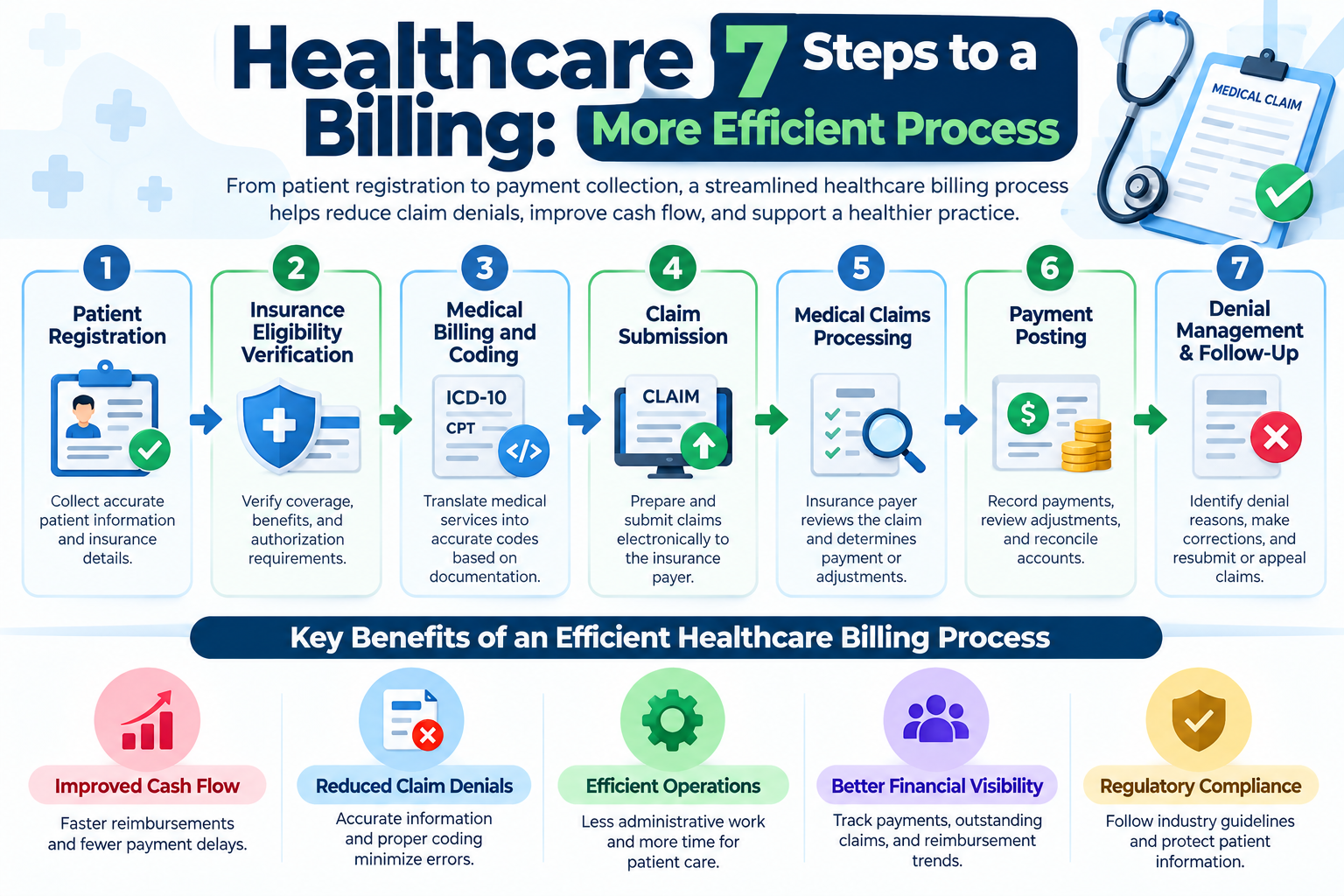
The healthcare billing process includes patient registration, insurance eligibility verification, medical documentation review, claim preparation, electronic submission, payment posting, and follow-up on unpaid claims.
Effective billing requires accurate information, organized workflows, and an understanding of payer requirements. When these activities are managed properly, healthcare organizations can reduce avoidable administrative errors and improve the visibility of their outstanding accounts.
Healthcare billing is also closely connected to revenue cycle management. While billing focuses on preparing and managing claims, revenue cycle management covers the broader financial process, from scheduling appointments and verifying insurance to collecting the final payment.
Why Is Healthcare Billing Important?
An effective healthcare billing system supports the financial health of medical practices, hospitals, and independent healthcare providers.
1. Improves Cash Flow
Accurate claim submissions and consistent payment follow-up can help reduce avoidable reimbursement delays. When practices monitor outstanding claims and resolve billing problems promptly, they can improve financial visibility and plan their operating expenses more effectively.
2. Reduces Insurance Claim Denials
Insurance claim denials can occur because of incorrect patient information, missing documentation, coding errors, authorization requirements, or coverage limitations.
A structured healthcare billing workflow helps identify common errors before claims are submitted. Reviewing denial patterns can also help billing teams address recurring issues and reduce preventable rework.
3. Supports Accurate Financial Records
Proper payment posting, reconciliation, and accounts receivable monitoring help healthcare providers maintain reliable financial records. These activities make it easier to identify outstanding balances, review reimbursement patterns, and evaluate billing performance.
4. Reduces Administrative Work
Billing teams must manage payer rules, claim statuses, patient balances, payment records, and follow-up activities. Organized workflows and suitable billing technology can reduce repetitive tasks and help administrative staff work more efficiently.
5. Allows More Time for Patient Care
When healthcare billing operations are organized, providers and their teams can spend less time resolving avoidable administrative problems and more time supporting patients.
Understanding the Medical Billing Process
The medical billing process involves several stages that work together to support accurate claims and timely reimbursement. Each stage requires attention to detail to prevent avoidable errors.
Step 1: Patient Registration
The process begins with collecting accurate patient information, including contact details, insurance policy information, and other required registration details.
Incorrect demographic information or outdated insurance records may cause claim rejections. Maintaining accurate patient records is therefore an important first step.
Step 2: Insurance Eligibility Verification
Before providing services, healthcare staff should verify the patient’s insurance eligibility and review relevant benefit information.
Depending on the payer and service, verification may include checking coverage dates, deductibles, copayments, coinsurance, referral requirements, and prior authorization requirements.
This step helps providers identify potential billing issues and communicate expected patient financial responsibilities.
Step 3: Medical Billing and Coding
Medical billing and coding are closely related but distinct activities.
Medical coding translates clinical documentation into standardized diagnosis and procedure codes. For example, ICD-10-CM codes are used for diagnoses, while CPT codes are commonly used to describe medical procedures and services in applicable settings.
Medical billing uses these codes, along with patient and provider information, to prepare claims for submission.
Accurate medical billing and coding help ensure that claims reflect the documented services and meet relevant payer requirements. Incomplete documentation or incorrect coding can lead to payment delays, claim denials, and compliance concerns.
Step 4: Medical Claims Processing
After the necessary information has been reviewed, the billing team prepares and submits the claim to the appropriate insurance payer.
Medical claims processing involves reviewing submitted information, evaluating coverage and reimbursement requirements, and determining the appropriate payment or claim disposition.
Electronic claims systems can help streamline information exchange. However, processing times and payment decisions depend on payer policies, claim accuracy, and other circumstances.
Step 5: Payment Posting
When the payer processes a claim, the billing team records the payment and reviews the explanation of benefits or electronic remittance advice.
Payment posting helps identify contractual adjustments, patient responsibility, underpayments, and remaining balances. Accurate reconciliation also supports reliable financial reporting.
Step 6: Denial Management
When a claim is denied, the billing team reviews the explanation, identifies the reason, and determines whether correction, resubmission, or an appeal is appropriate.
A consistent denial management process helps healthcare providers address recurring problems, follow applicable deadlines, and pursue eligible reimbursement.
Step 7: Patient Billing and Collections
After insurance processing, patients may have remaining financial responsibilities under their insurance benefits and applicable billing policies.
Clear statements, transparent communication, and convenient payment methods can help patients understand their balances and make payments more easily.
Benefits of Professional Medical Billing Services
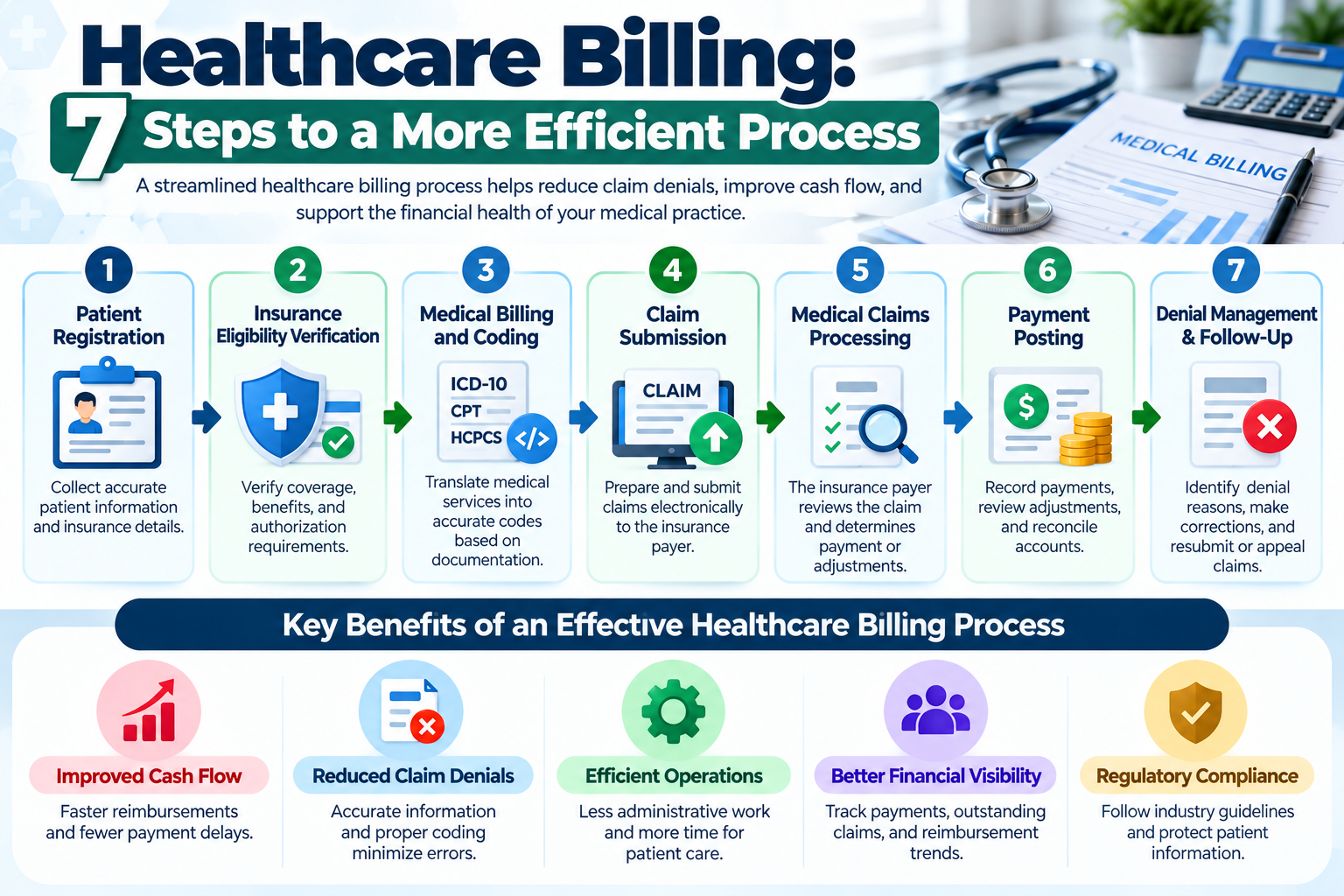
Professional medical billing services can help healthcare providers manage administrative tasks associated with claim preparation, submission, payment posting, and accounts receivable follow-up.
For practices with limited administrative resources, external billing support may provide access to specialized knowledge and structured workflows.
Improved Claim Accuracy
Professional billing teams can review claims for missing information, inconsistent data, and common submission errors. These reviews may help reduce avoidable rejections and support more efficient reimbursement.
Better Denial Management
A medical billing team can categorize denials, investigate the reasons for nonpayment, coordinate corrections, and monitor appeals.
Analyzing recurring denial patterns helps practices identify improvements in patient registration, documentation, authorization procedures, and coding.
Consistent Accounts Receivable Follow-Up
Outstanding claims require regular monitoring. Professional billing support may help practices prioritize unpaid claims according to age, value, payer requirements, and applicable filing deadlines.
Consistent follow-up improves visibility into outstanding balances and supports timely action.
Access to Specialized Expertise
A medical billing company may offer trained billing personnel, billing software, reporting tools, and established operational procedures.
The services available depend on the provider’s contract and may include claim submission, payment posting, denial follow-up, and financial reporting.
More Efficient Administrative Operations
Outsourcing selected billing tasks can help healthcare practices reduce internal workload and allocate staff resources more effectively.
Before choosing a service provider, practices should review the scope of services, communication standards, reporting frequency, security measures, and pricing structure.
Healthcare Billing Services for Different Medical Practices
Healthcare billing services can support different types of healthcare organizations, although the specific requirements vary by specialty and payer.
Physician Practices
Independent physicians must manage insurance verification, claim submission, payment posting, and patient balances while maintaining their clinical schedules.
Organized billing workflows can help reduce administrative complications and improve financial oversight.
Hospitals and Healthcare Facilities
Hospitals and larger healthcare facilities may handle complex billing operations involving multiple departments, service types, insurance plans, and reimbursement requirements.
Consistent procedures and accurate financial reporting are important for coordinating these activities.
Specialty Medical Practices
Specialties such as cardiology, orthopedics, dermatology, and other clinical disciplines may have specific documentation and coding requirements.
Billing workflows should reflect the services provided and the relevant payer policies.
Growing Medical Practices
As a practice grows, claim volume and administrative responsibilities may increase. Healthcare billing services can provide additional operational support when internal staff or systems cannot efficiently handle the workload.
Practices should evaluate their individual needs before deciding whether to expand their in-house team or use an external billing partner.
In-House Billing vs. Outsourced Medical Billing Services
Healthcare providers generally choose between managing billing internally and outsourcing selected responsibilities to a third-party provider.
In-house billing offers direct control over staffing, processes, and daily operations. However, practices must manage employee training, software costs, workload distribution, and ongoing process improvements.
Outsourced medical billing services allow providers to delegate agreed-upon billing tasks to an external company. Depending on the arrangement, outsourcing may provide access to specialized expertise and established workflows without requiring the practice to manage every billing function internally.
Before selecting either option, compare the total cost, service quality, claim volume, denial patterns, accounts receivable performance, and reporting requirements.
A reliable medical billing company should clearly explain its services, fees, security practices, communication procedures, and performance reporting. Practices should also maintain appropriate oversight of outsourced activities.
What to Look for in a Medical Billing Company
Selecting a medical billing company requires careful evaluation. The right partner should understand your practice’s needs and provide transparent information about its processes.
Industry Experience
Ask about experience with your medical specialty, payer mix, claim volume, and relevant coding requirements.
Transparent Reporting
Look for clear reporting on claim submissions, payment activity, outstanding accounts receivable, denials, and other agreed-upon performance indicators.
Effective Denial Management
Understand how the company reviews denials, investigates root causes, manages appeals, and communicates unresolved issues.
Data Security and Compliance
Review access controls, secure data handling, staff training, vendor agreements, and applicable HIPAA obligations.
Communication and Support
Establish expectations for response times, regular reporting, escalation procedures, and communication with your internal staff.
Clear Pricing
Compare service fees and understand which activities are included. Consider the total cost of the arrangement rather than evaluating pricing alone.
How to Improve Healthcare Revenue Cycle Management
Healthcare revenue cycle management connects administrative and financial activities throughout the patient journey. Improving these processes can help providers understand reimbursement performance and identify avoidable inefficiencies.
Verify Insurance Information Early
Confirm coverage and authorization requirements before services whenever practical. Update patient records when information changes.
Maintain Complete Documentation
Ensure clinical records accurately describe the services provided and support the associated codes and claims.
Submit Accurate Claims Promptly
Review claims for missing information, inconsistent data, and relevant payer requirements before submission.
Monitor Accounts Receivable
Review unpaid claims regularly and prioritize follow-up based on age, value, claim status, and filing deadlines.
Analyze Denial Trends
Track denial reasons and identify recurring issues by payer, service type, or workflow stage. Use the results to improve procedures and staff training.
Measure Billing Performance
Healthcare organizations can monitor several key performance indicators to evaluate their billing operations:
- Clean claim rate: The percentage of claims submitted without errors requiring correction, based on a consistent definition.
- Denial rate: The proportion of claims denied during a defined reporting period.
- Days in accounts receivable: An estimate of the average time receivables remain outstanding.
- Net collection rate: The proportion of collectible revenue actually collected over a defined period.
- First-pass resolution rate: The percentage of claims resolved without additional corrective work, according to the metric’s defined methodology.
Reviewing these indicators consistently can help management identify opportunities for improvement. Results should be interpreted in the context of specialty, payer mix, reporting methods, and claim complexity.
The Role of Technology in Healthcare Billing
Modern billing systems help healthcare organizations manage claims, maintain financial records, and track reimbursement activity.
Electronic claim submission, eligibility verification tools, claim-editing software, and reporting dashboards can reduce repetitive administrative work and improve visibility into billing performance.
Automation can identify missing information or common errors before claims are submitted. However, technology does not eliminate the need for accurate documentation, knowledgeable staff, and appropriate oversight.
Healthcare providers should select systems that fit their workflows and support appropriate access controls and information security.
Healthcare Billing Compliance and Patient Data Protection
Healthcare billing involves sensitive patient information, making privacy and security essential considerations.
In the United States, applicable HIPAA requirements address the privacy and security of protected health information. Healthcare providers and relevant business associates should maintain appropriate safeguards, access controls, training procedures, and vendor oversight.
Billing records should be handled through secure processes, and practices should evaluate third-party billing arrangements to ensure applicable legal and contractual obligations are addressed.
For official guidance, visit the U.S. Department of Health and Human Services HIPAA resources.
Healthcare providers that bill Medicare can also consult the Centers for Medicare & Medicaid Services coding and billing resources for relevant information.
How Pro Healthcare Advisors Supports Healthcare Providers
Managing healthcare billing requires consistent attention to claim accuracy, payer requirements, payment posting, denial follow-up, and financial reporting.
Pro Healthcare Advisors provides medical billing and practice management solutions for healthcare providers seeking support with administrative and billing operations.
Depending on the services selected, professional support may help practices organize billing workflows, manage claims, monitor outstanding payments, and evaluate opportunities to improve revenue cycle performance.
When considering a billing partner, healthcare providers should ask about service coverage, claim follow-up procedures, reporting, data security, communication, and performance measurement.
Learn more about Pro Healthcare Advisors and explore its medical billing and practice management services.
Frequently Asked Questions About Healthcare Billing
What Is Healthcare Billing?
Healthcare billing is the process of preparing and submitting claims for medical services, tracking insurance payments, managing denied claims, and collecting outstanding balances from responsible parties.
What Are Medical Billing Services?
Medical billing services help healthcare providers manage claim preparation, electronic submission, payment posting, denial follow-up, accounts receivable, and related billing activities. The precise scope depends on the service provider.
What Is the Difference Between Medical Billing and Coding?
Medical coding translates clinical documentation into standardized diagnosis and procedure codes. Medical billing uses those codes and other required information to submit claims, manage payments, and resolve outstanding balances.
What Causes Insurance Claim Denials?
Common reasons include incorrect patient information, inactive coverage, missing documentation, coding errors, authorization requirements, and payer-specific claim rules.
What Is Revenue Cycle Management in Healthcare?
Revenue cycle management covers the financial process from patient registration and insurance verification through claim submission, reimbursement, and final payment collection.
Should a Medical Practice Outsource Its Billing?
Outsourcing may be useful when a practice needs additional expertise, more consistent follow-up, or reduced administrative workload. The decision should consider cost, service quality, security, claim volume, and operational needs.
How Can Healthcare Billing Improve Cash Flow?
Accurate claims, timely submission, consistent denial management, and regular accounts receivable follow-up can help reduce avoidable payment delays and improve visibility into outstanding revenue. Actual results depend on payer policies and practice performance.
How Do I Choose the Right Medical Billing Company?
Evaluate industry experience, service scope, pricing, reporting transparency, denial management procedures, communication standards, data security, and the company’s ability to support your practice’s requirements.
Conclusion
Healthcare billing is an essential part of maintaining the financial stability of medical practices. Accurate documentation, effective medical billing and coding, timely claim submission, and consistent denial follow-up all contribute to a more organized reimbursement process.
Professional medical billing services may help healthcare providers manage administrative responsibilities, monitor outstanding claims, and improve billing workflows. By reviewing performance indicators and addressing recurring problems, practices can make better-informed operational decisions.
For healthcare providers seeking support with billing and practice management, Pro Healthcare Advisors offers services designed to support healthcare operations.
Visit Pro Healthcare Advisors to learn more about its available solutions and explore the medical billing and practice management services.