AI for medical billing denial appeals is becoming a practical option for small medical practices that want to improve billing workflows, organize claim documentation, and reduce repetitive administrative tasks. When insurance companies deny claims, billing teams must identify the denial reason, review supporting records, prepare appeals, and follow payer deadlines.
For small practices with limited staff, these responsibilities can consume valuable time and delay reimbursement.
In this guide, we explain seven powerful ways to use AI for medical billing denial appeals, how to protect patient information under HIPAA, and how small healthcare organizations can introduce AI responsibly.
What Is AI for Medical Billing Denial Appeals?
AI for medical billing denial appeals refers to using artificial intelligence to assist with denied-claim review, documentation checks, appeal letter drafting, denial categorization, and follow-up tracking.
These tools can help billing professionals organize information and identify potential issues before an appeal is submitted. However, AI does not guarantee payment or replace the professional judgment required to review medical claims.
For small practices, the objective is to combine automation with accurate documentation, payer-specific procedures, and human oversight.
Why Small Practices Need AI for Medical Billing Denial Appeals
Claim denials can create additional administrative work, delay payments, and make revenue cycle management more complicated.
Small medical practices may face challenges such as:
- Limited staff available for denial follow-up.
- Missing or inconsistent supporting documentation.
- Difficulty tracking appeal deadlines.
- Repeated billing errors.
- Time-consuming manual claim reviews.
- Limited visibility into recurring denial patterns.
AI for medical billing denial appeals can help organize these activities and highlight areas that require attention.
The most effective approach is not to automate every billing decision. Instead, practices should begin with repetitive administrative tasks and evaluate the results before expanding their use of AI.
7 Powerful Ways to Use AI for Medical Billing Denial Appeals
1. Use AI for Medical Billing Denial Appeals to Identify Denial Reasons
The first step in resolving a denied claim is understanding why the insurance payer rejected it.
AI-assisted tools can help categorize denial codes, summarize payer correspondence, and organize information from remittance advice and billing records.
Common denial categories include:
- Missing or incomplete documentation.
- Eligibility and coverage problems.
- Coding inconsistencies.
- Missing prior authorization.
- Duplicate claim submissions.
- Medical necessity documentation concerns.
- Timely filing issues.
Billing professionals should verify the original denial reason and review the relevant payer requirements before deciding how to proceed.

2. Use AI for Medical Billing Denial Appeals to Draft Appeal Letters
Preparing appeal letters manually can require substantial administrative effort.
AI can assist with creating an initial draft based on verified claim details, the denial reason, relevant documentation, and applicable payer instructions.
An appeal draft may include the claim reference, a factual explanation of the issue, supporting documentation, and a request for reconsideration.
Before submission, a qualified staff member should verify every statement. AI must not invent clinical findings, authorization details, billing codes, or payer policies.
3. Use AI for Medical Billing Denial Appeals to Find Missing Documentation
An appeal may be incomplete if relevant supporting records are missing.
AI-assisted document review can flag potentially missing information, inconsistent dates, or discrepancies between claim records and draft letters.
For example, a billing team might use an approved tool to identify that a referenced authorization document is not present in the reviewed file.
Staff should then determine whether the document is required, locate the correct record, and confirm that the appeal addresses the actual denial reason.
A standardized pre-submission checklist can make this process more consistent.
4. Use AI for Medical Billing Denial Appeals to Track Deadlines
Missing an appeal deadline can limit a practice’s options for challenging a denial.
AI-assisted workflow tools can help organize deadlines, assign follow-up tasks, and flag claims that require immediate attention.
Useful workflow features include:
- Deadline reminders.
- Claim status tracking.
- Staff task assignments.
- Follow-up notifications.
- Escalation for overdue tasks.
Practices should verify deadlines using the applicable payer instructions, contracts, and relevant requirements. Automated reminders should support—not replace—an established tracking process.
5. Use AI for Medical Billing Denial Appeals to Analyze Recurring Patterns
Repeated denials may indicate that a practice needs to improve its documentation, authorization procedures, or claim submission workflow.
AI-assisted analytics can help organize denial data by payer, denial category, service type, or time period.
Practice administrators can use these findings to investigate recurring issues and decide whether staff training or workflow changes are needed.
Useful metrics include denial rate, appeal turnaround time, appeal overturn rate, repeat denials, and administrative time spent on rework.
Compare results against a baseline to determine whether AI is producing measurable improvements.
6. Use AI for Medical Billing Denial Appeals to Improve Documentation Workflows
Medical billing depends on accurate information moving between clinical documentation, electronic medical records, and billing systems.
AI may help identify inconsistencies or highlight information that requires further review. It can also assist with organizing documentation requests and preparing summaries for billing staff.
However, AI should not create unsupported clinical information or replace the medical record.
For better results, practices should establish clear documentation standards and use appropriate review procedures.
Learn more about EMR optimization services to explore ways to improve documentation and administrative workflows.

7. Use AI for Medical Billing Denial Appeals to Measure Results
Introducing AI without measuring performance makes it difficult to determine whether the investment is worthwhile.
Small practices should track a defined set of metrics before and after implementing an AI-assisted workflow.
Consider measuring:
- Denial rate by payer.
- Average appeal preparation time.
- Percentage of appeals submitted before deadlines.
- Appeal overturn rate.
- Repeat denial frequency.
- Documentation error rate.
- Staff time spent on manual corrections.
Use consistent reporting periods and comparable claim categories. Changes in payer policies, claim mix, and staffing can also affect results.
The goal is to determine whether AI improves workflow quality and efficiency—not simply whether it produces more documents.
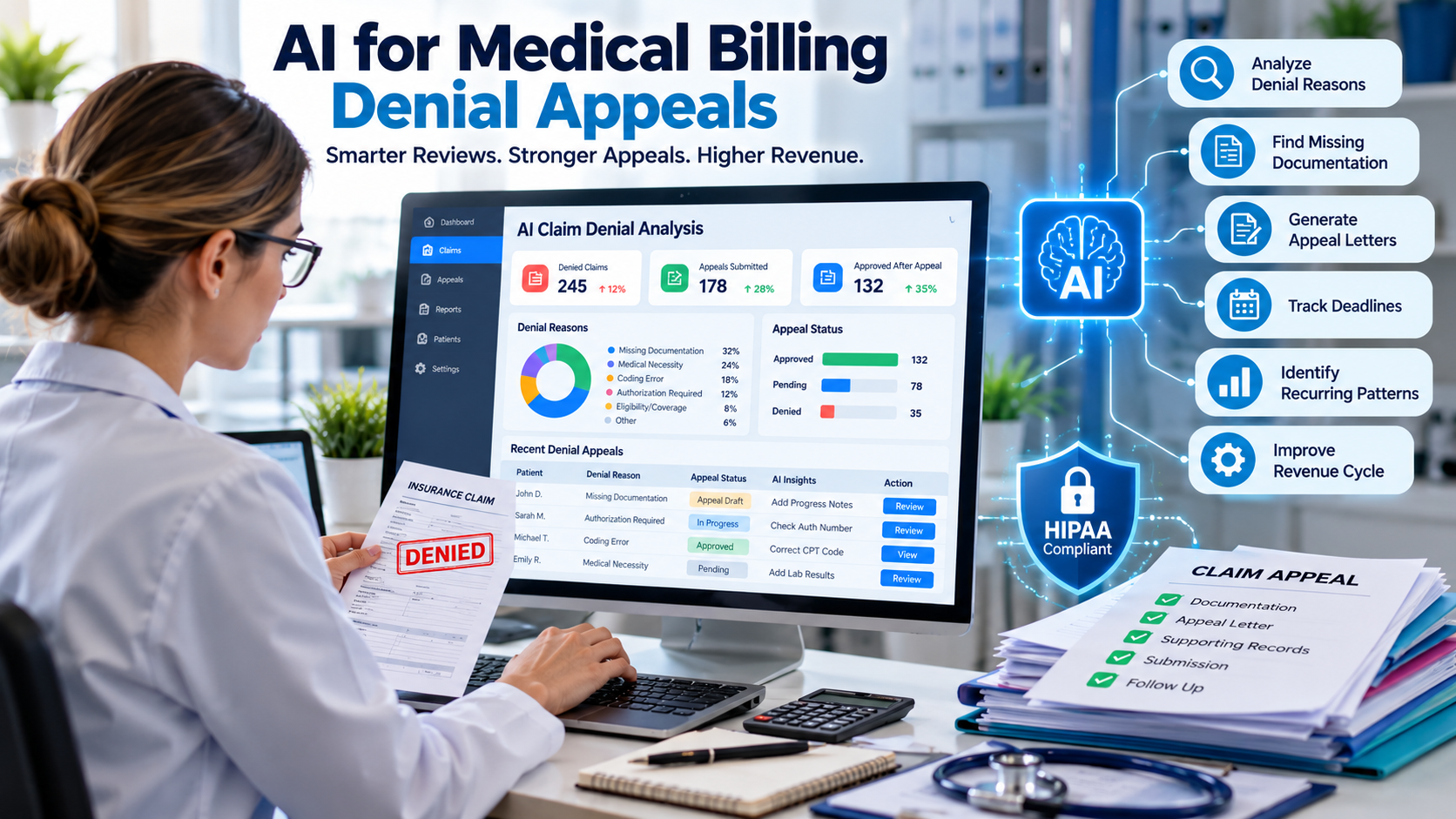
HIPAA Compliance for AI for Medical Billing Denial Appeals
Patient privacy and data security must remain priorities when implementing AI in healthcare billing.
A practice should understand how its AI vendor receives, processes, stores, and retains information before allowing the system to handle protected health information (PHI).
Important safeguards include:
Evaluate the vendor. Review its security controls, contractual terms, data retention policies, and intended healthcare use cases.
Review BAA requirements. Determine whether a Business Associate Agreement is required for the vendor or other parties handling PHI on the practice’s behalf.
Limit data access. Give tools and employees access only to the information necessary for their responsibilities.
Review data usage. Understand whether submitted information is retained or used for model training.
Train staff. Establish clear rules about approved AI tools, patient information, and incident reporting.
Maintain human oversight. Require appropriate review of claim information, appeal drafts, and submission decisions.
For official guidance, consult the HHS HIPAA and Cloud Computing resource and HHS Business Associates guidance.
A vendor’s marketing claims alone do not establish HIPAA compliance. Practices should assess their specific legal, contractual, and security obligations.
How Small Practices Can Start Using AI for Medical Billing Denial Appeals
Small practices can begin with a limited, clearly defined workflow instead of trying to automate their entire revenue cycle.
Step 1: Review your existing process. Document how your team receives denials, reviews records, prepares appeals, and tracks deadlines.
Step 2: Choose one use case. Consider denial categorization, documentation checks, or appeal draft preparation.
Step 3: Establish safeguards. Review vendor suitability, data access, security policies, and applicable BAA requirements.
Step 4: Test the workflow. Start with synthetic or appropriately de-identified data where practical.
Step 5: Require human review. Verify source records, payer instructions, and appeal content before submission.
Step 6: Measure performance. Compare processing time, documentation accuracy, deadline compliance, and appeal outcomes.
Step 7: Refine the process. Address errors and expand only when the workflow demonstrates reliable performance.
Common Mistakes to Avoid With AI for Medical Billing Denial Appeals
Even useful AI tools can introduce problems when implemented without proper controls.
Avoid these mistakes:
- Submitting AI-generated appeal letters without review.
- Entering PHI into unapproved AI tools.
- Relying on generic appeal templates without checking payer requirements.
- Trusting AI-generated information without verifying source records.
- Ignoring deadlines and follow-up responsibilities.
- Measuring success only by speed.
- Automating decisions without clear accountability.
A documented process with appropriate human oversight helps practices use AI more responsibly.
How Pro Health Care Advisors Can Support Your Practice
AI for medical billing denial appeals works best when supported by reliable billing processes, accurate documentation, and effective administrative management.
Pro Health Care Advisors offers services relevant to medical practices seeking support with their healthcare operations.
Explore these resources:
- Medical Billing and Practice Management for billing and administrative support.
- EMR Optimization Services for electronic medical record workflows.
- HIPAA Compliance Services for compliance-related support.
- Physician Credentialing and Provider Enrollment for credentialing and enrollment assistance.
The right approach depends on your current workflow, staffing, payer requirements, and operational needs. A review of your existing processes can help identify opportunities to improve documentation, denial tracking, and billing efficiency.
Frequently Asked Questions About AI for Medical Billing Denial Appeals
Can AI write medical billing denial appeal letters?
Yes. AI can help draft appeal letters from verified claim information and relevant documentation. A qualified person should review the final draft for accuracy and payer-specific requirements before submission.
Is AI for medical billing denial appeals HIPAA-compliant?
It depends on the tool, how it processes information, the vendor’s contractual arrangements, and the safeguards in place. Practices should evaluate applicable HIPAA requirements and BAA obligations before using AI with PHI.
Can AI prevent all medical claim denials?
No. AI may help identify potential errors, missing information, and recurring patterns, but it cannot guarantee that claims will be paid or appeals approved.
Is AI suitable for small medical practices?
It can be useful for small practices when the selected task is appropriate, the costs are justified, and the workflow includes proper privacy controls and human review.
What should practices measure when using AI for medical billing denial appeals?
Useful metrics include denial rates, appeal turnaround time, deadline compliance, appeal overturn rates, documentation errors, and administrative time spent on rework.
Final Thoughts on AI for Medical Billing Denial Appeals
AI for medical billing denial appeals can help small medical practices organize claim information, prepare appeal drafts, identify documentation gaps, and monitor recurring billing problems.
The best results come from combining appropriate automation with accurate records, payer-specific procedures, human oversight, and suitable privacy safeguards.
Start with one workflow, establish a performance baseline, and measure the results before expanding.
If your practice needs support with billing operations and administrative workflows, explore Pro Health Care Advisors’ medical billing and practice management services.