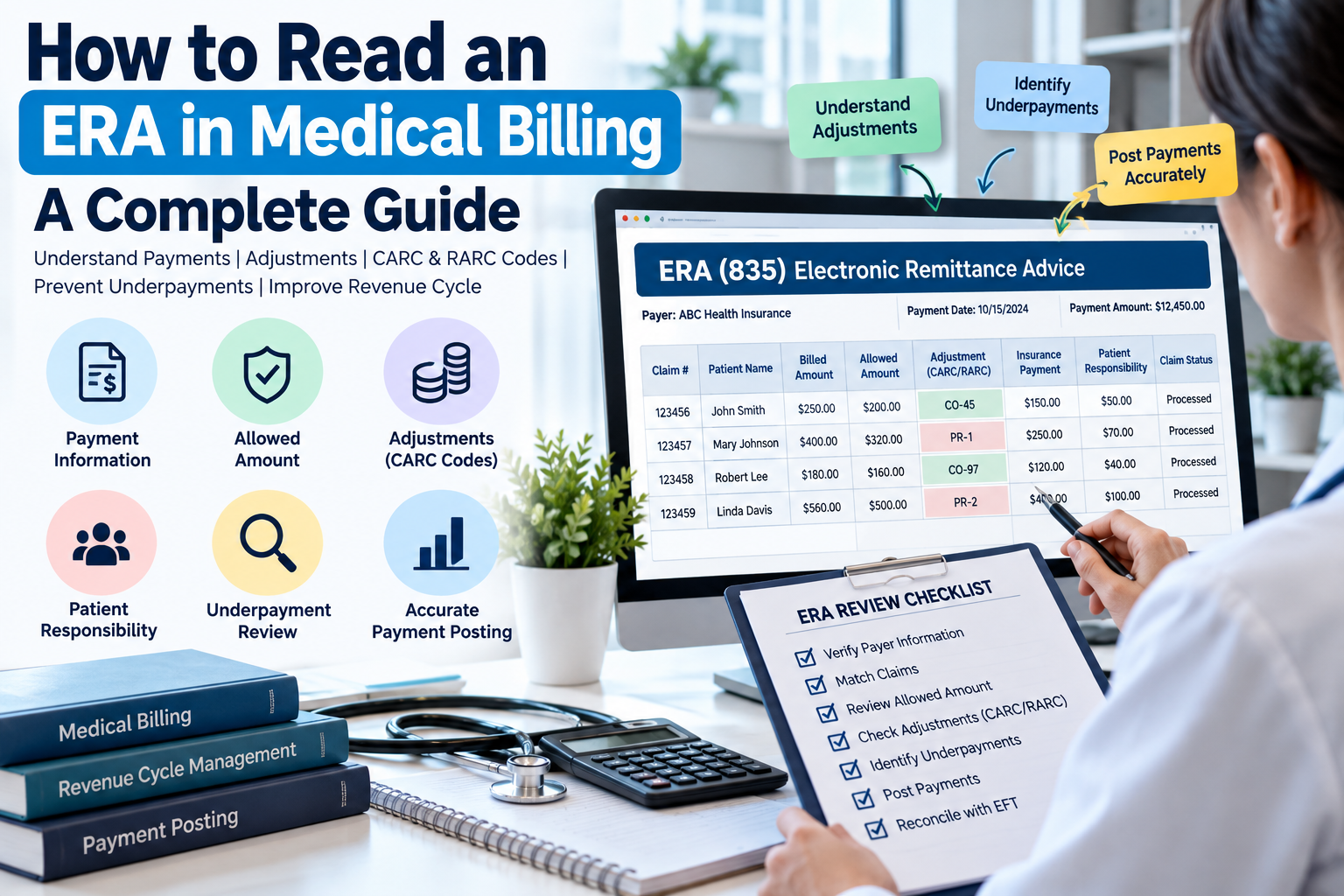
When an insurance payer processes a healthcare claim, the practice receives more than just a payment. It also receives information explaining how that payment was calculated. For many healthcare practices, that information arrives through an Electronic Remittance Advice (ERA).
Understanding how to read an ERA in medical billing is essential for accurate payment posting, accounts receivable management, denial follow-up, and revenue reconciliation. An ERA can show what the payer allowed, what was paid, what was assigned to patient responsibility, and why an amount was adjusted.
The challenge is that an ERA can contain multiple claims, adjustment codes, remark codes, payment details, and provider-level information. If your billing team posts the payment without reviewing those details, underpayments and other revenue issues can remain hidden.
This guide explains how to read an ERA in medical billing, what the most important fields mean, how ERA differs from an EOB, and how practices can use remittance data to identify revenue that needs further action.
What Is an ERA in Medical Billing?
An Electronic Remittance Advice (ERA) is an electronic document that communicates how a health insurance payer adjudicated a healthcare claim.
An ERA typically contains information about:
- Claim status
- Amount billed
- Allowed amount
- Insurance payment
- Patient responsibility
- Contractual adjustments
- Other adjustments
- Denial or adjustment reasons
- Remittance advice remark codes
- Payment information
- Claim and provider identifiers
For Medicare, CMS explains that an ERA provides final claim adjudication and payment information and can include adjustment information at the line, claim, or provider level. Medicare ERAs use standardized adjustment codes such as Claim Adjustment Group Codes, CARCs, and RARCs.
The ERA is also commonly associated with the X12 835 Health Care Claim Payment/Advice transaction, the standardized electronic transaction used for healthcare payment and remittance information.
For a billing team, the practical purpose is simple:
The ERA tells you what the payer did with the claim and why.
Why Is ERA Important in Medical Billing?
ERA processing is not simply a data-entry task.
A payment can appear correctly posted while an important problem remains hidden. For example, a payer may process a claim but pay less than the amount your practice expected under its contract.
If the billing team posts the payment and closes the account without reviewing the reimbursement details, the difference may never be investigated.
An effective ERA review helps practices:
- Post insurance payments accurately
- Identify patient responsibility
- Detect payment discrepancies
- Recognize denied or partially paid claims
- Identify potential underpayments
- Reduce posting errors
- Keep accounts receivable accurate
- Reconcile payer payments with bank deposits
- Improve payer performance reporting
CMS notes that ERA information can be automatically posted into billing or accounting applications, reducing manual posting work compared with paper remittance.
That automation is valuable—but automation should not replace financial review.
ERA vs. EOB: What Is the Difference?
One of the most common questions in medical billing is the difference between an EOB and an ERA.
EOB — Explanation of Benefits
An Explanation of Benefits explains how an insurance claim was processed. It commonly shows:
- Charges
- Allowed amounts
- Insurance payments
- Deductibles
- Coinsurance
- Copayments
- Patient responsibility
- Adjustments
An EOB is generally presented in a human-readable format.
ERA — Electronic Remittance Advice
An ERA communicates similar adjudication information electronically and is designed to work with healthcare billing and accounting systems.
The standardized ERA transaction is associated with the X12 835 Health Care Claim Payment/Advice transaction.
Simple way to remember it
EOB = explanation of claim processing
ERA = electronic remittance/payment information used by the provider’s billing workflow
For high-volume medical practices, ERA processing can significantly reduce manual payment-posting work.
How to Read an ERA in Medical Billing: Step-by-Step
The easiest way to understand an ERA is to review it in a consistent order.
Step 1: Verify the Payer and Payment Information
Start by confirming who issued the remittance.
Check:
- Payer name
- Payment date
- Payment amount
- Check or EFT information
- Trace or reassociation information
- Provider information
This first step prevents payments from being posted to the wrong payer or account.
CMS explains that EFT and ERA transactions can be connected through payment and trace information, allowing providers to match the electronic payment with the associated remittance.
Step 2: Match the ERA to the Correct Claims
An ERA may contain information for multiple claims.
For every claim, verify:
- Patient name or identifier
- Claim number
- Date of service
- Provider
- Procedure or service information
- Billed amount
- Payment amount
The goal is to make sure the payment is being applied to the correct patient account and encounter.
Incorrect claim matching can create inaccurate patient balances and unreliable accounts receivable reports.
Step 3: Review the Billed Amount
The billed amount represents what the provider submitted to the payer.
Do not assume that the billed amount is the amount the payer should pay.
Insurance reimbursement is affected by factors such as:
- Contracted rates
- Benefit coverage
- Deductibles
- Coinsurance
- Copayments
- Secondary insurance
- Contractual adjustments
CMS specifically notes that ERA information can explain adjustments based on contract agreements, benefit coverage, secondary payers, copayments, and coinsurance.
Step 4: Check the Allowed Amount
The allowed amount is important because it helps establish how the payer calculated reimbursement.
For contracted providers, the allowed amount may reflect the applicable contractual reimbursement methodology.
Your billing team should compare the payer’s processed amount against the expected reimbursement according to the applicable payer contract or fee schedule.
This is where payment posting becomes more than simply entering a payment.

Step 5: Review the Insurance Payment
Next, verify how much the payer actually paid.
Compare:
Expected reimbursement → Actual payer payment
If the actual payment is lower than expected, investigate before closing the account.
Possible explanations may include:
- Contractual adjustment
- Patient responsibility
- Deductible
- Coinsurance
- Copayment
- Secondary payer responsibility
- Denial or partial denial
- Payer processing issue
- Potential underpayment
Not every difference represents an error. The key is determining why the difference exists.
Understanding CARC, RARC, and Group Codes
One of the most important parts of an ERA is the adjustment information.
CMS identifies three important categories of codes used to explain claim adjustments:
- Claim Adjustment Group Code
- Claim Adjustment Reason Code (CARC)
- Remittance Advice Remark Code (RARC)
CMS Health Care Payment and Remittance Advice guidance
These codes help the billing team understand why the payer did not pay the entire submitted charge.
Group Codes
Group codes help indicate who is financially responsible for an adjustment.
For example, CMS explains that:
- CO generally indicates Contractual Obligation
- PR indicates Patient Responsibility
The group code should always be interpreted together with the related adjustment reason and the actual claim circumstances.
CARC
A Claim Adjustment Reason Code provides the standardized reason associated with a claim adjustment.
CARCs are particularly useful when analyzing:
- Denials
- Partial payments
- Patient responsibility
- Contractual adjustments
- Other payer adjustments
RARC
A Remittance Advice Remark Code can provide additional information that helps explain an adjustment or claim processing decision.
A billing team should not look at a CARC in isolation. The surrounding claim information and remark codes can provide important context.
How to Identify a Medical Billing Underpayment From an ERA
One of the most valuable uses of ERA review is detecting potential underpayments.
An underpayment occurs when the amount actually reimbursed appears lower than the amount the provider should receive under the applicable contract or reimbursement arrangement.
The basic comparison is:
Expected allowed/reimbursement amount − Actual payer reimbursement = Potential variance
For example:
| Item | Amount |
|---|---|
| Expected reimbursement | $180 |
| Actual insurance payment | $145 |
| Potential variance | $35 |
The $35 difference should not automatically be called an underpayment.
Your billing team should first determine whether the difference is explained by:
- Patient deductible
- Coinsurance
- Copayment
- Contractual adjustment
- Secondary insurance
- Non-covered service
- Correct payer processing
- Other documented adjustment
Only after those factors are reviewed should the remaining variance be investigated as a potential underpayment.
This distinction matters because not every lower payment is a billing error.
A Practical ERA Underpayment Checklist
Before closing a paid claim, ask:
Patient and Claim
- Is this the correct patient?
- Is the date of service correct?
- Is the claim number correct?
- Is the correct provider attached?
Payment
- What was billed?
- What was allowed?
- What was paid?
- What amount was assigned to the patient?
Adjustments
- What contractual adjustment was applied?
- Are the adjustment codes appropriate?
- Is patient responsibility supported?
- Are there additional payer adjustments?
Contract
- What does the payer contract or fee schedule allow?
- Does the actual reimbursement match the expected amount?
- Is there a variance that requires investigation?
Follow-Up
- Does the claim need an appeal?
- Does the claim require corrected submission?
- Should the account be routed to AR?
- Is this a recurring payer issue?
This process turns payment posting into a revenue-control function rather than simple bookkeeping.
ERA Payment Posting: Common Mistakes to Avoid
Even with electronic remittance, errors can occur.
1. Posting the Payment Without Reviewing Adjustments
A billing system may automatically post a payment, but the team should still review exceptions and significant variances.
2. Treating Every Adjustment as a Write-Off
An adjustment should not automatically be accepted as unrecoverable.
The billing team should understand why the adjustment occurred and whether it is supported by the payer’s processing and contractual terms.
3. Ignoring Small Variances
A $10 variance may appear insignificant on one claim.
But if the same issue occurs across hundreds or thousands of claims, the cumulative impact can become substantial.
4. Closing Paid Claims Without Contract Comparison
A claim can be marked “paid” even when the reimbursement requires further review.
Payment status does not necessarily mean the reimbursement was correct.
5. Failing to Reconcile ERA and EFT
The ERA explains the payment. The EFT transfers the funds.
The two should be reconciled so the billing team knows that the payment received in the bank corresponds to the remittance being posted.
CMS describes EFT and ERA as complementary processes and explains the use of trace information to support payment reassociation.
ERA, EFT, and Payment Reconciliation
ERA and EFT are related but serve different purposes.
ERA: Explains how claims were processed and how payment was calculated.
EFT: Transfers the actual funds electronically.
A strong revenue cycle workflow connects the two.
For example:
Payer adjudicates claim → ERA is generated → EFT is received → ERA is matched to payment → Claims are posted → Variances are reviewed → Exceptions move to AR
This creates a more reliable payment-posting process.
CMS recommends providers enroll for both EFT and ERA transactions with participating health plans where applicable.
How ERA Data Can Improve Your Revenue Cycle
ERA information should not disappear after payment posting.
It can be used to identify recurring patterns.
For example, a practice can analyze ERA data by:
- Payer
- Provider
- CPT/HCPCS code
- Location
- Specialty
- Adjustment reason
- Denial reason
- Payment variance
- Date of service
This can reveal patterns such as:
“Payer A consistently pays Procedure X below our expected reimbursement.”
or:
“Provider B has an unusually high number of patient-responsibility adjustments.”
or:
“A particular service is repeatedly being denied for the same reason.”
These patterns allow the practice to move from reactive billing to proactive revenue cycle management.
If your practice needs help managing payment posting, AR follow-up, and claim resolution, see Pro Health Care Advisors’ medical billing and practice management services.

When Should a Practice Outsource ERA and Payment Posting?
Not every practice needs to outsource its entire revenue cycle.
However, outsourcing can become valuable when:
- ERA volume is creating posting backlogs
- Staff are missing payment variances
- AR is increasing
- Underpayments are not being audited
- Denials are not routed quickly
- Manual EOB posting consumes staff time
- The practice lacks payer-specific reimbursement expertise
- Management does not have reliable revenue reporting
A specialized billing team can combine payment posting with AR recovery and denial management, allowing payment discrepancies to move directly into the appropriate follow-up workflow.
For practices dealing with aging insurance balances, Creative Collection Solutions from Pro Health Care Advisors can support AR recovery and payer follow-up.
ERA Processing and Medical Coding Work Together
Payment discrepancies are sometimes caused upstream.
If a claim is coded incorrectly, submitted with an inappropriate modifier, or does not accurately represent the documented service, the resulting payment may be lower than expected.
That is why ERA review should connect with coding quality.
Pro Health Care Advisors provides CodeMAXX medical coding services covering ICD-10, CPT, and HCPCS coding, including specialty-focused coding review.
The goal is not simply to post the payment correctly.
The goal is to understand why the payment was what it was—and whether the practice actually received what it earned.
A Simple ERA Review Workflow for Medical Practices
A practical workflow can look like this:
1. Receive ERA
↓
2. Match ERA to EFT/payment
↓
3. Match claims to patient accounts
↓
4. Verify billed and allowed amounts
↓
5. Review insurance payment
↓
6. Review patient responsibility
↓
7. Review CARC/RARC and adjustment information
↓
8. Compare reimbursement with contract expectations
↓
9. Flag denials, variances, or potential underpayments
↓
10. Post payment and route exceptions for follow-up
↓
11. Reconcile the account
↓
12. Analyze recurring payer trends
This workflow creates a feedback loop between payment posting, coding, denial management, and accounts receivable.
Frequently Asked Questions About ERA in Medical Billing
What does ERA stand for in medical billing?
ERA stands for Electronic Remittance Advice. It provides electronic information about how an insurance payer processed healthcare claims, including payments and adjustments.
What is an 835 ERA?
An 835 is the X12 Health Care Claim Payment/Advice transaction used to communicate healthcare payment and remittance information electronically. X12 defines the 835 transaction as the format for health care claim payment/advice in an electronic data interchange environment.
What is the difference between an ERA and an EOB?
An EOB explains how an insurance claim was processed in a human-readable format. An ERA provides remittance information electronically for provider billing and payment workflows.
Can an ERA show why a claim was denied?
Yes. ERA data can contain adjustment and remark information, including standardized CARC and RARC codes that help explain claim adjustments.
How can an ERA help identify underpayments?
Compare the payer’s actual reimbursement with the amount your practice expects based on the applicable payer contract or fee schedule. Then review adjustments, patient responsibility, and other payment factors before treating the difference as a potential underpayment.
Should ERA payments be reconciled with EFT?
Yes. Matching ERA information with the corresponding EFT helps ensure that the payment received matches the remittance information used for posting. CMS describes reassociation mechanisms that help connect EFT payments with the corresponding ERA.
Why is accurate payment posting important?
Accurate payment posting keeps patient accounts and accounts receivable records correct while helping the practice identify denials, payment discrepancies, and potential revenue leakage.
Can medical billing companies handle ERA processing?
Yes. Many medical billing and revenue cycle management companies provide payment posting, reconciliation, denial follow-up, AR management, and payment variance review as part of their services.
Final Takeaway
Learning how to read an ERA in medical billing is about more than understanding where a payment should be posted.
The real value comes from understanding why the payer paid that amount.
A strong ERA review process helps healthcare practices:
- Post payments accurately
- Understand adjustments
- Identify patient responsibility
- Detect potential underpayments
- Reconcile payments
- Improve AR management
- Recognize recurring payer problems
- Protect earned revenue
CMS confirms that ERA provides detailed claim adjudication and adjustment information, while standardized X12 transactions make electronic remittance processing possible at scale.
For practices that want to improve the entire process—from claim creation to payment posting and AR recovery—Pro Health Care Advisors’ medical billing and practice management team can help build a more organized revenue cycle.
The objective is simple:
Don’t just post what the payer paid. Understand what the payer paid, why it was paid, and whether your practice received everything it was entitled to receive.