







TOP MEDICAL BILLING COMPANIES IN CALIFORNIA 2026 — WHAT EVERY PROVIDER MUST KNOW BEFORE CHOOSING ONE
Think about the last time you received a bill that made absolutely no sense.
Maybe it was for something you were certain your insurance covered. Maybe the amount looked completely wrong. Maybe you spent 40 minutes on hold being bounced between departments before anyone could explain what happened.
Now flip that experience around.
That frustration — the confusion, the delays, the feeling that money is disappearing into a system nobody fully understands — is exactly what your practice feels every time your billing company drops the ball. Denied claims pile up. Payments slow down. Staff spend hours chasing corrections instead of supporting patients.
And in California, the chances of that happening are higher than almost anywhere else in the country.
California is the largest state healthcare system in the United States — by patient volume, by payer diversity, and by regulatory complexity. It has a Medicaid program called Medi-Cal that operates under rules completely different from every other state. It has commercial insurance carriers with authorization requirements that shift faster than most billing teams can track. And in 2026, California has added new layers of compliance and payment reform that are catching underprepared practices off guard.
This guide is for California healthcare providers who want the honest picture — what makes billing here so uniquely difficult, what to look for in a company that can handle it, and how Pro Health Care Advisors serves practices across the Golden State.
Why California Medical Billing Is in a Category of Its Own
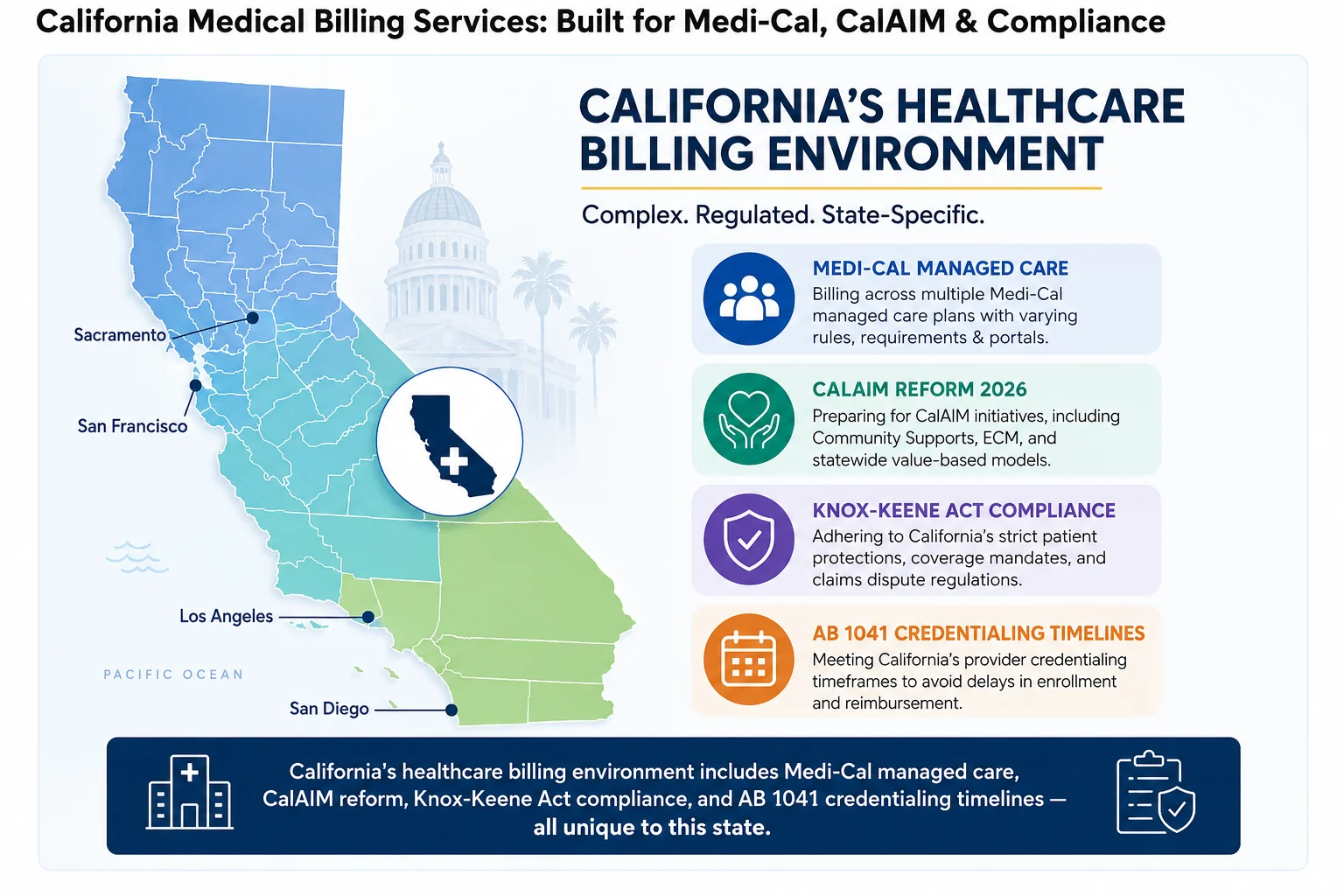
Most billing companies say they serve California. Far fewer actually understand what that means. Here is what makes this market uniquely demanding in 2026.
Medi-Cal Is Not Standard Medicaid — Not Even Close
Most states run Medicaid through a relatively straightforward system. California does not. Medi-Cal operates through a managed care model with multiple competing health plans — each running their own prior authorization protocols, coding requirements, and denial patterns.
Medi-Cal’s billing requirements are among the most intricate for healthcare providers anywhere in the country. Its claim denial rate is significantly higher than other insurers, and practices must allocate additional administrative resources just to ensure claims are compliant with Medi-Cal’s specific documentation guidelines.
Here is the part that stings: Medi-Cal pays about two-thirds of what Medicare reimburses for comparable services. Lower margins already. Every denied claim and every day of payment delay costs your practice proportionally more.
Billing companies that apply standard commercial billing assumptions to Medi-Cal claims generate avoidable denials — often without realizing what is triggering them.
Proposition 35 Changed the Financial Landscape in 2026
California voters passed Proposition 35 in November 2024, and its effects are fully in play this year. The measure made the Managed Care Organization tax permanent, directly funding higher payments to physicians and hospitals. As of 2026, Medi-Cal now pays doctors at least 87.5 percent of Medicare rates for primary care, maternity care, and mental health services.
That is genuinely good news for California providers who see Medi-Cal patients. But here is the catch: to collect those higher reimbursements, your billing team needs to submit claims correctly under the new rate structure. Practices with outdated billing workflows are leaving those increased reimbursements uncollected.
CalAIM Is Reshaping Behavioral Health Billing Statewide
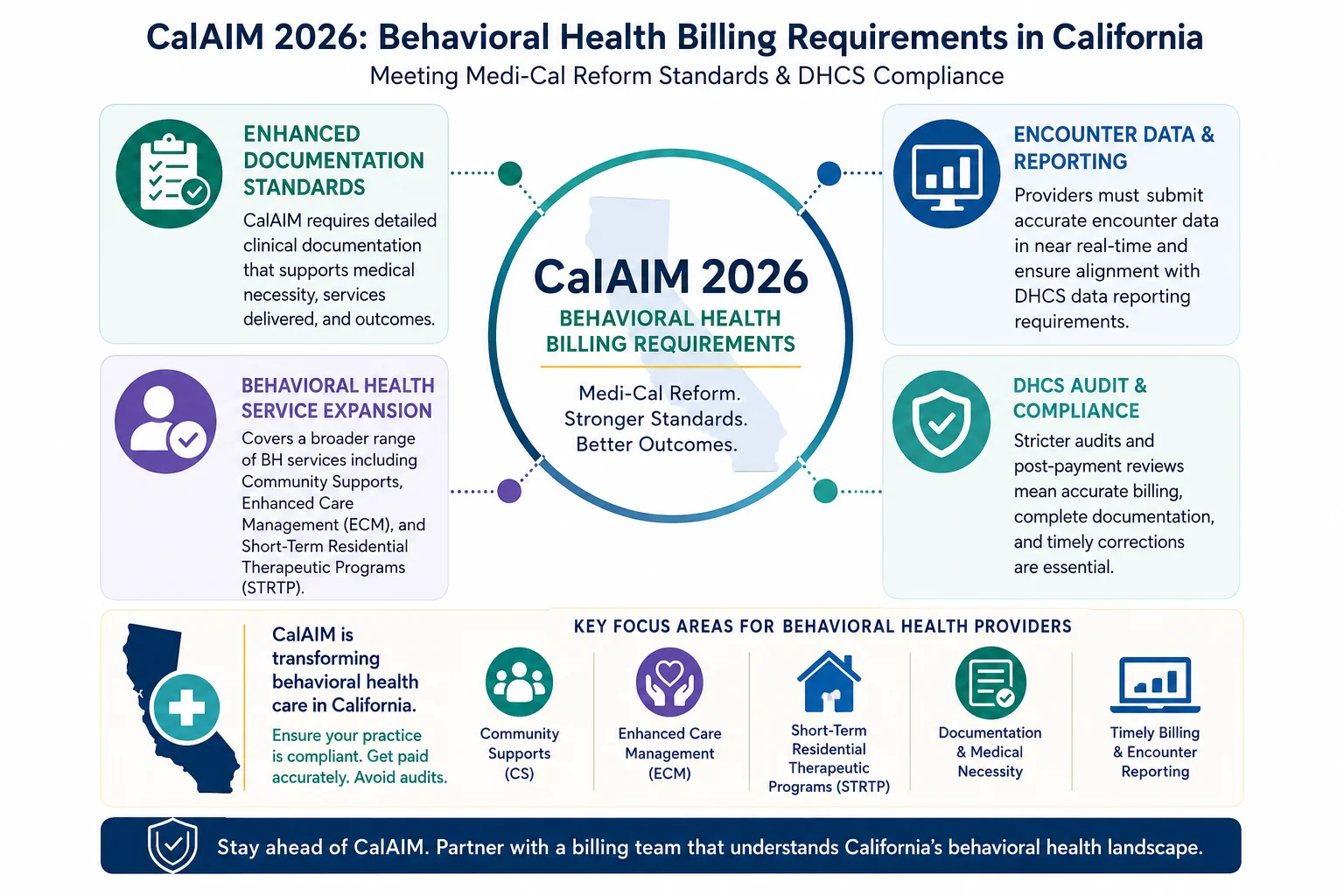
If your California practice provides mental health, substance use, or behavioral health services, you are operating under CalAIM — California’s sweeping Medi-Cal reform that standardized billing across behavioral health specialties statewide.
CalAIM introduces stricter documentation, audit, and reporting expectations. Every billed behavioral health service — from therapy sessions to Enhanced Care Management — must demonstrate medical necessity, align with DHCS documentation standards, and be traceable through encounter data. Failure to comply leads to denials, payment recoupments, and audit findings.
This is not a theoretical risk. Behavioral health practices across California are facing audits and payment recoupments directly tied to CalAIM documentation failures — many of them did not know there was a problem until months of revenue had already walked out the door.
Our mental health billing services are built around CalAIM compliance — including proper use of Enhanced Care Management codes, Community Supports documentation, and encounter data tracking standards.
The Knox-Keene Act Creates Billing Obligations Most Practices Miss
California’s Knox-Keene Health Care Service Plan Act regulates managed care plans operating in the state and creates compliance obligations for providers billing those plans that simply do not exist anywhere else. Claims are increasingly denied in California, and its unique payer ecosystem makes recovery difficult without genuine local expertise — precisely because of obligations like Knox-Keene that out-of-state billing companies do not know to look for.
A billing team without California-specific compliance knowledge will not flag Knox-Keene issues proactively. That knowledge gap shows up directly in unrecovered revenue.
AB 1041 — California’s New 90-Day Credentialing Mandate
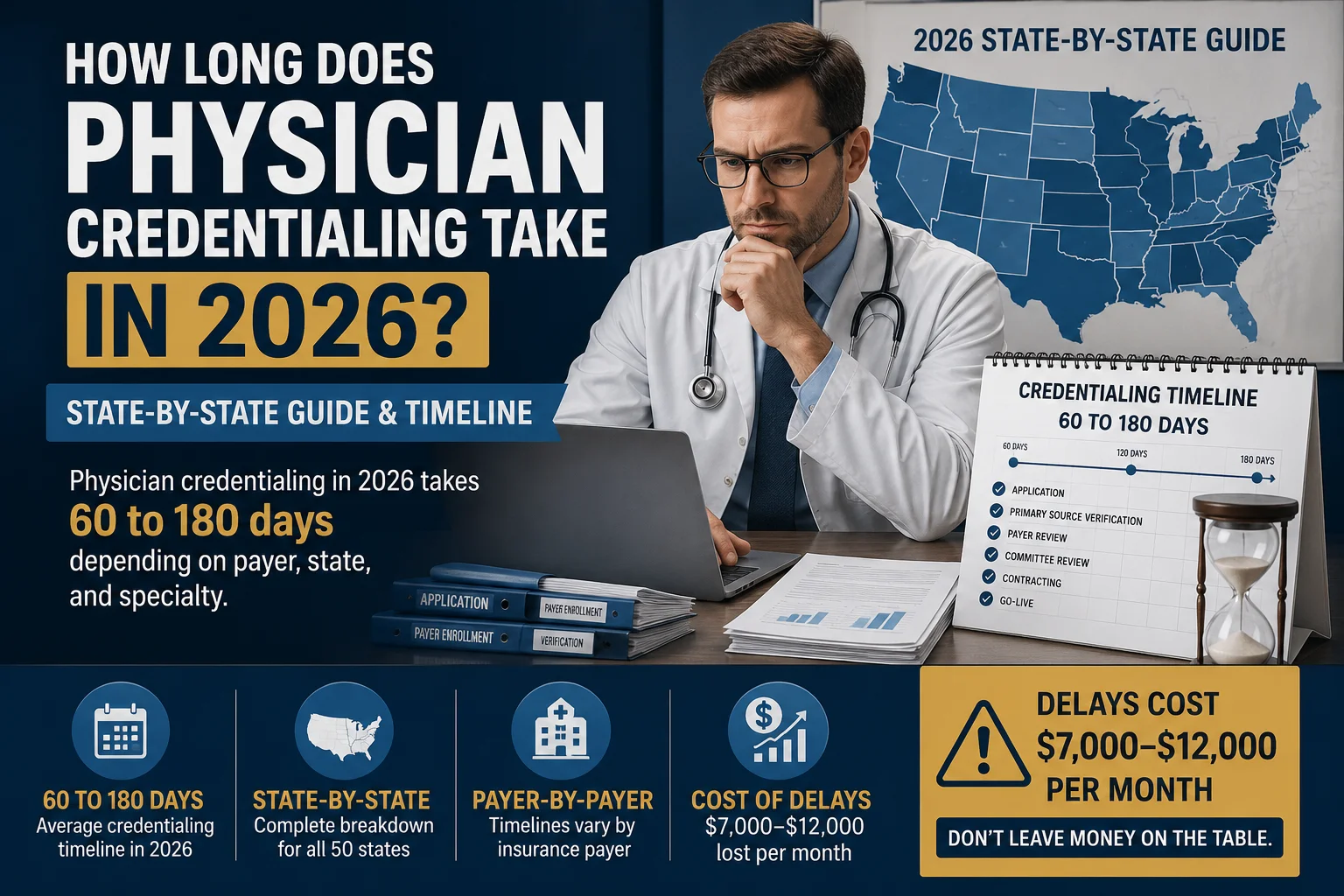
As of January 1, 2026, California’s AB 1041 legislation requires payers to complete physician credentialing within 90 days of receiving a complete enrollment application. This creates both an opportunity and a risk for California practices.
The opportunity: a billing company that also handles credentialing and submits accurate, complete enrollment applications can get your providers billing new payers faster than ever.
The risk: incomplete or disorganized credentialing applications still delay enrollment beyond 90 days — and every day of credentialing delay is a day your provider is delivering care you cannot bill for.
Our physician credentialing services are specifically built around application accuracy, CAQH verification, and follow-up tracking that moves enrollment through the AB 1041 timeline without avoidable delays.
7 Things That Separate a Great California Billing Company from an Average One
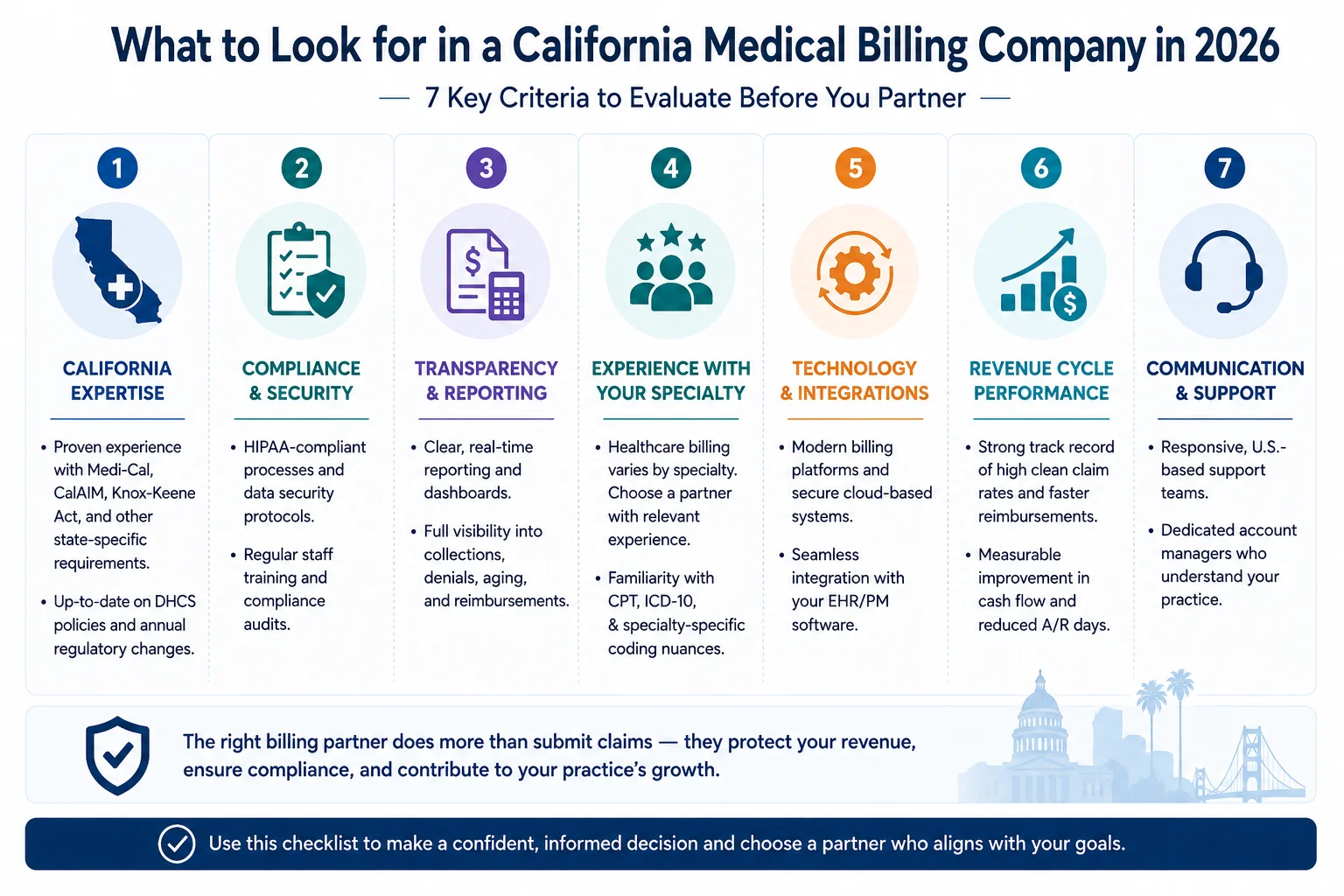
Every billing company will say the right things in a sales call. Here is how to see past the pitch.
1. Clean Claim Rate — Your Financial Baseline
California’s claim denial rates consistently run above national averages — driven by Medi-Cal managed care complexity, intense commercial insurance competition, and prior authorization requirements that vary widely across carriers. Your clean claim rate — the percentage of claims accepted on first submission — is the single most important number to ask about.
The national benchmark sits around 95 percent. The best companies in 2026 operate at 98 percent or higher.
Our medical billing and practice management team at Pro Health Care Advisors maintains a 98.5 percent clean claim rate — a real financial advantage in California’s above-average denial environment.
2. Medi-Cal Managed Care Experience — Non-Negotiable
Ask any prospective billing company: Which Medi-Cal managed care plans have you actively billed in the past 12 months?
A California-experienced team should be able to name specific plans — LA Care Health Plan, Inland Empire Health Plan, Partnership HealthPlan of California, Health Net Community Solutions — and explain exactly how billing for those plans differs from fee-for-service Medi-Cal.
Vague answers mean they have not done this work. Do not trust your Medi-Cal volume to them.
3. Commercial Payer Experience Across California’s Dominant Carriers
California’s commercial insurance market is dominated by Anthem Blue Cross of California, Blue Shield of California, Health Net, and Kaiser Permanente. The AMA reports that physicians spend an average of 13 hours per week on prior authorization alone — and in California, with this level of commercial payer complexity, that burden is even heavier without systematic workflows in place.
4. CalAIM and Behavioral Health Billing Compliance
For any practice billing behavioral health services under CalAIM, this is not optional expertise — it is a requirement. Ask directly: How do you handle CalAIM encounter data documentation and DHCS audit preparation?
If they cannot answer in clear, specific terms, they will not protect you from the audits already reaching underprepared California behavioral health practices.
5. HIPAA Compliance With a Signed Business Associate Agreement
HIPAA requires any company handling your patient data to operate under a signed Business Associate Agreement before receiving any PHI. No exceptions. Our HIPAA compliance services include documented security protocols, BAA management, and risk assessment practices built into every client relationship from day one.
6. AAPC-Certified Coding Staff
AAPC-certified coders are trained and tested across the full range of ICD-10, CPT, and HCPCS accuracy. Non-certified staff produce a consistent low-level stream of coding errors that quietly reduce your collections without triggering obvious alarm bells until the damage is already done.
Always ask for certifications before trusting your coding to any billing team.
7. Real-Time Reporting — Not Monthly Summaries
Monthly reports are not enough in 2026. You need dashboard-level visibility into your AR aging, denial rates, clean claim performance, and collection timelines at any time — so you can make smart financial decisions, not just react to problems after the fact.
Red Flags That Should End a Conversation Immediately
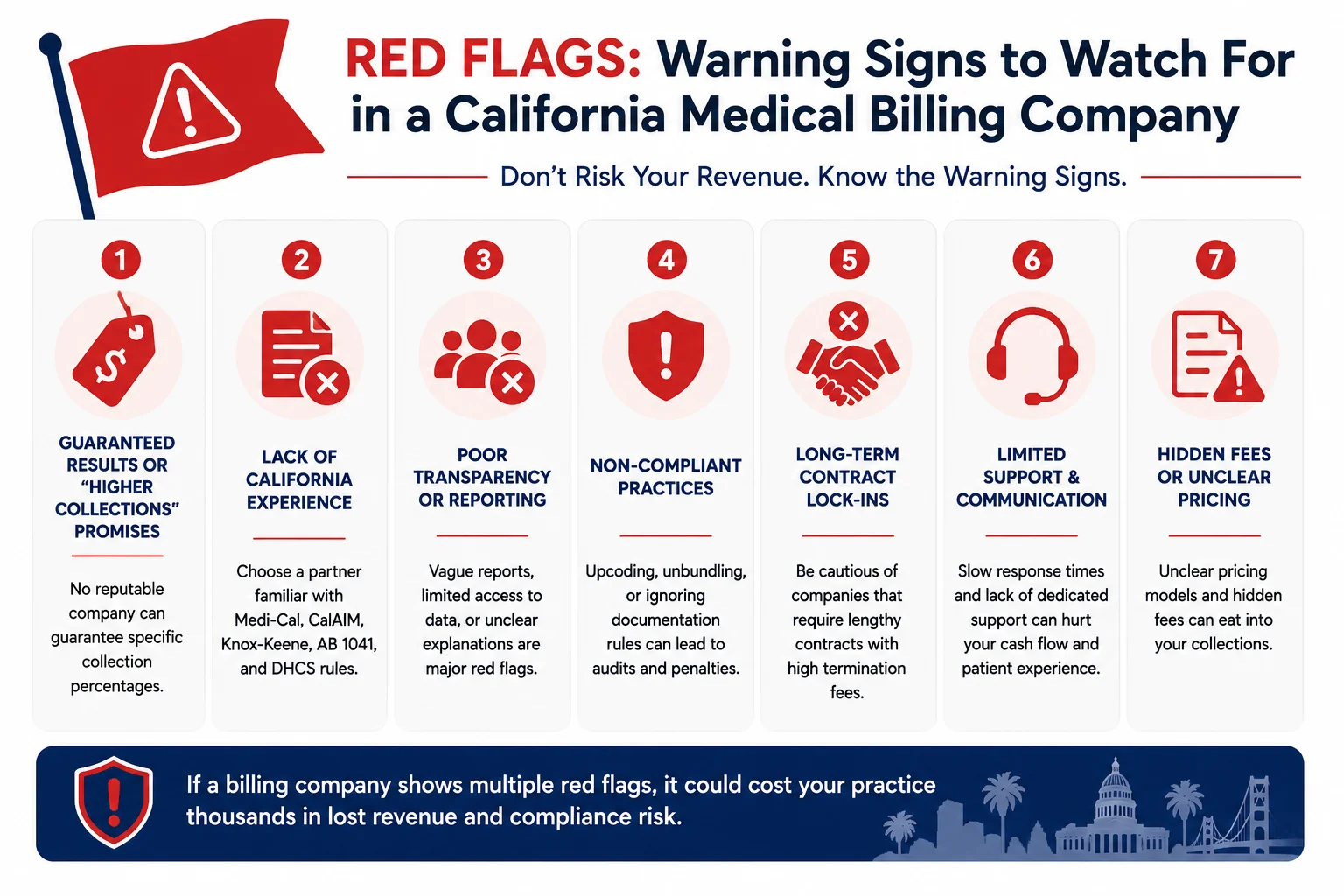
They cannot quote you their clean claim rate. If they do not track this number, they are processing claims — not managing your revenue.
They have never billed a Medi-Cal managed care plan. Medi-Cal managed care billing is completely different from fee-for-service Medi-Cal. Many national billing companies handle the latter but not the former.
They cannot explain CalAIM. If a billing company serving California behavioral health providers cannot describe CalAIM documentation requirements in specific terms, walk away.
They charge flat fees regardless of your collections. Percentage-of-collections pricing aligns their income with your revenue. Flat fees remove that accountability entirely.
They do not offer credentialing services. Under AB 1041, credentialing accuracy matters more than ever. Separate billing and credentialing vendors create coordination failures that delay revenue for new providers.
They quote a price before asking about your specialty or payer mix. Real analysis comes before real pricing. A company that skips the analysis is selling, not advising.
How Pro Health Care Advisors Serves California Healthcare Practices
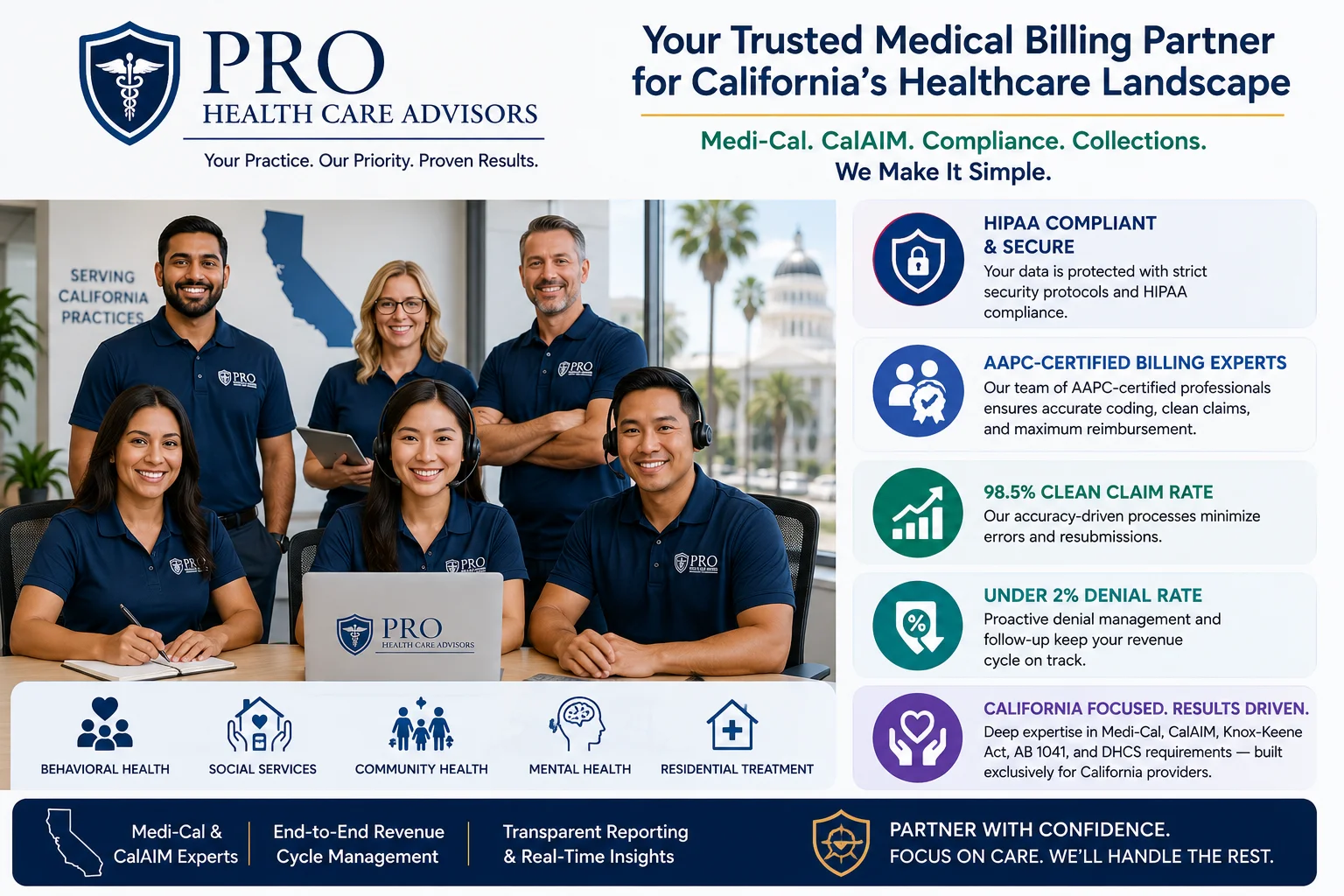
Pro Health Care Advisors is a HIPAA-compliant medical billing and revenue cycle management company serving healthcare practices across the United States — including practices throughout California facing Medi-Cal complexity, CalAIM compliance requirements, commercial payer navigation, and AB 1041 credentialing timelines.
98.5% Clean Claim Rate in California’s Above-Average Denial Environment
Our AAPC-certified billing team submits at 98.5 percent clean — which means your AR queue stays shorter, your payments arrive faster, and your staff spends less time firefighting corrections.
Under 2% Denial Rate
The gap between a 12 percent denial rate and a 2 percent denial rate on a $3 million practice is not a minor operational difference — it is hundreds of thousands of dollars. That is the range we operate in for California practices. And our creative collection solutions are built to recover any denied or aged claims that need attention.
Medi-Cal Managed Care Billing — Done Correctly
We understand California’s Medi-Cal managed care structure — the documentation requirements, authorization workflows, and encounter data standards that prevent avoidable denials. We stay current on Proposition 35 rate changes and ensure correct claim submission under the new reimbursement structure.
For more on our California-specific expertise, see our California medical billing and credentialing page.
CalAIM-Compliant Behavioral Health Billing
For behavioral health, substance use, and community health providers under CalAIM, we handle Enhanced Care Management coding, Community Supports documentation, DHCS encounter data standards, and audit preparation. We build CalAIM compliance into every submission as the baseline.
See our mental health billing services for a full breakdown.
Physician Credentialing Under AB 1041
Our credentialing team submits complete, accurate enrollment applications designed to move through California’s new 90-day payer timeline without avoidable delays. See our physician credentialing service for full details.
Audit Protection Through MD Audit Shield
California practices — particularly those with significant Medi-Cal, Medicare Advantage, or behavioral health volume — carry meaningful RAC audit exposure in 2026. Our MD Audit Shield RAC service provides documentation review, compliance monitoring, and audit response preparation that protects your practice.
CodeMAXX — Coding Accuracy Built for California’s Payer Mix
Coding errors are one of the leading causes of claim denials in California — particularly under Medi-Cal managed care and Knox-Keene regulated commercial payers. Our CodeMAXX services add a dedicated layer of coding accuracy review before submission, catching errors that would otherwise return as denials.
Specialties We Serve Across California
We work with practices across more than 30 specialties:
- Cardiology — complex coding, high audit risk. See cardiology billing.
- Family Practice — high Medi-Cal volume, Proposition 35 rate navigation. See family practice billing.
- Mental Health and Behavioral Health — CalAIM compliance, ECM coding, DHCS audit preparation. See mental health billing.
- Wound Care — Medi-Cal and Medicare Advantage navigation. See wound care billing.
- And many more — see our full specialties list.
California’s Medicare Advantage Problem Is Growing Alongside Medi-Cal
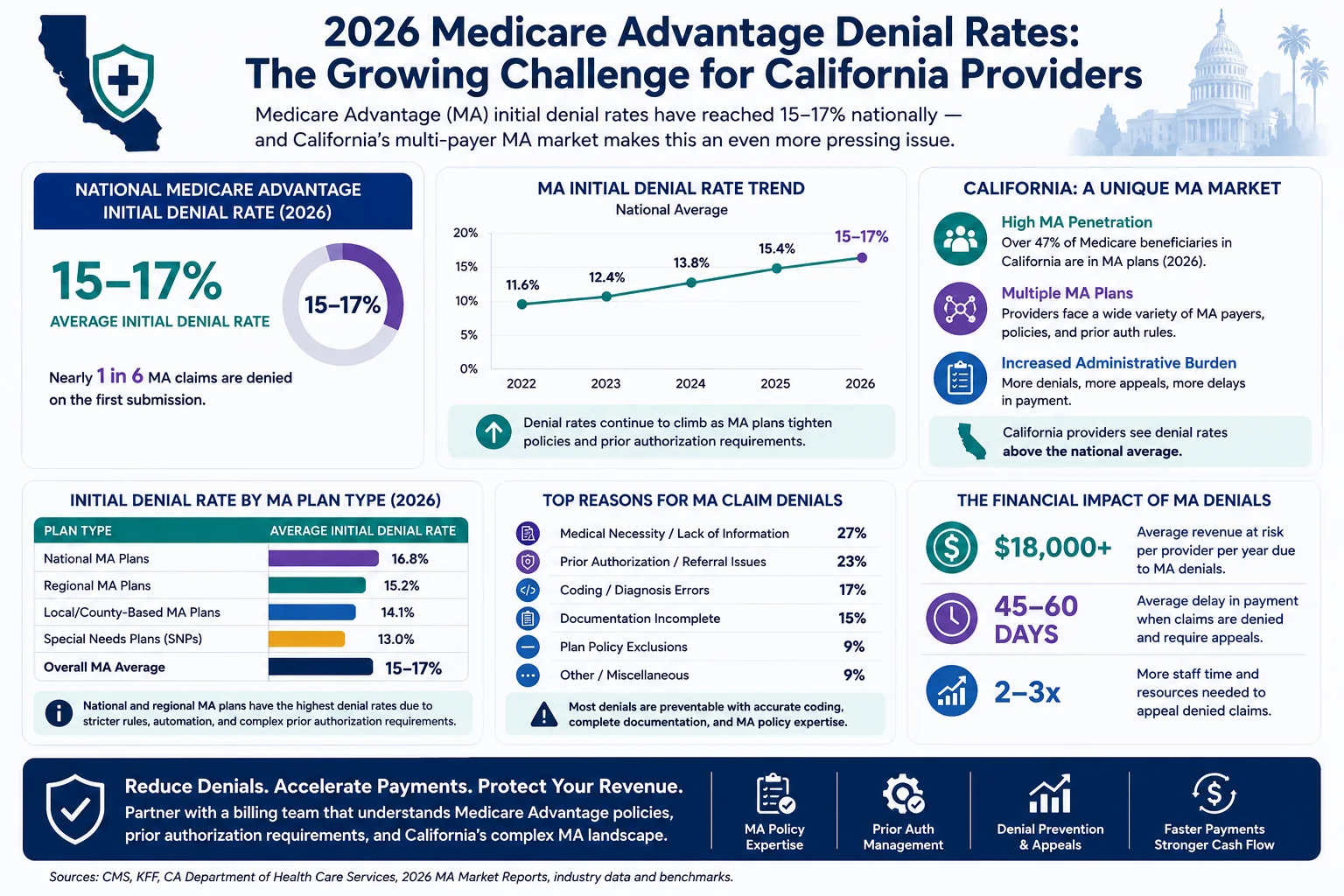
Medi-Cal gets most of the attention in conversations about California billing complexity — but Medicare Advantage is a growing challenge here too.
Initial denial rates across Medicare Advantage have averaged around 15.7 percent nationally — more than double the rate under traditional Medicare. And 38 to 41 percent of providers now experience denial rates at or above 10 percent.
In California, the Medicare Advantage market includes Kaiser Permanente, Aetna, Anthem Blue Cross, and UnitedHealthcare — each with different prior authorization rules, coverage determinations, and appeal workflows. California’s multi-payer complexity requires payer-specific coding intelligence that billing companies without genuine state-level experience consistently fail to deliver.
We published a detailed guide on how Medicare Advantage denials have climbed 56 percent since 2022 and what practices need to do about it right now: Medicare Advantage Denials Up 56% — What Private Practices Must Do.
How to Switch Billing Companies in California Without Losing Revenue
Step 1: Pull a full AR aging report before doing anything. Know what is outstanding, what is denied, what is past 90 days, and what has been written off. This snapshot is your baseline.
Step 2: Clarify who works your existing claims during the transition. Make sure there is no gap where claims go unworked between your old and new billing companies.
Step 3: Confirm EMR and practice management system compatibility. Switching billing companies should not require switching software. Verify upfront.
Step 4: Set specific 90-day performance benchmarks. Agree in writing on clean claim rate, denial rate, and AR aging targets your new billing company will meet within the first 90 days.
Step 5: Ask for a California-specific onboarding plan. Any billing company serious about California should describe exactly how they will handle your Medi-Cal managed care plans, CalAIM requirements, and California commercial payer workflows from day one.
Frequently Asked Questions — California Medical Billing 2026
Q: What makes Medi-Cal billing harder than standard Medicaid billing? Medi-Cal operates through a managed care model with multiple competing health plans, each with different authorization requirements, coverage rules, and denial patterns. Standard Medicaid billing processes from other states generate avoidable denials when applied to California’s Medi-Cal managed care environment.
Q: Does CalAIM affect all California providers or just behavioral health? CalAIM primarily affects behavioral health, substance use, and community health providers — but its encounter data and documentation standards apply to any practice billing Enhanced Care Management or Community Supports under Medi-Cal.
Q: How does Proposition 35 change what I collect in 2026? Proposition 35 raised Medi-Cal rates for primary care, maternity care, and mental health services to at least 87.5 percent of Medicare rates. To capture those increases, claims must be submitted correctly under the new rate structure. Practices with outdated workflows may not be collecting everything they are now entitled to.
Q: What is the AB 1041 credentialing rule? AB 1041, effective January 1, 2026, requires California payers to complete physician credentialing within 90 days of a complete enrollment application. Complete, accurate applications are the key — incomplete submissions still create delays beyond 90 days.
Q: What percentage do California medical billing companies charge? Most reputable companies charge between 4 and 9 percent of net collections. Percentage-based pricing aligns the billing company’s income with your revenue performance.
Q: How do I know if a billing company actually understands California? Ask them to name the Medi-Cal managed care plans they have actively billed in the past year. Ask how they handle CalAIM documentation. Ask about Knox-Keene Act compliance obligations. Vague answers confirm they do not have genuine California expertise.
For more billing resources, visit our articles and resources library.