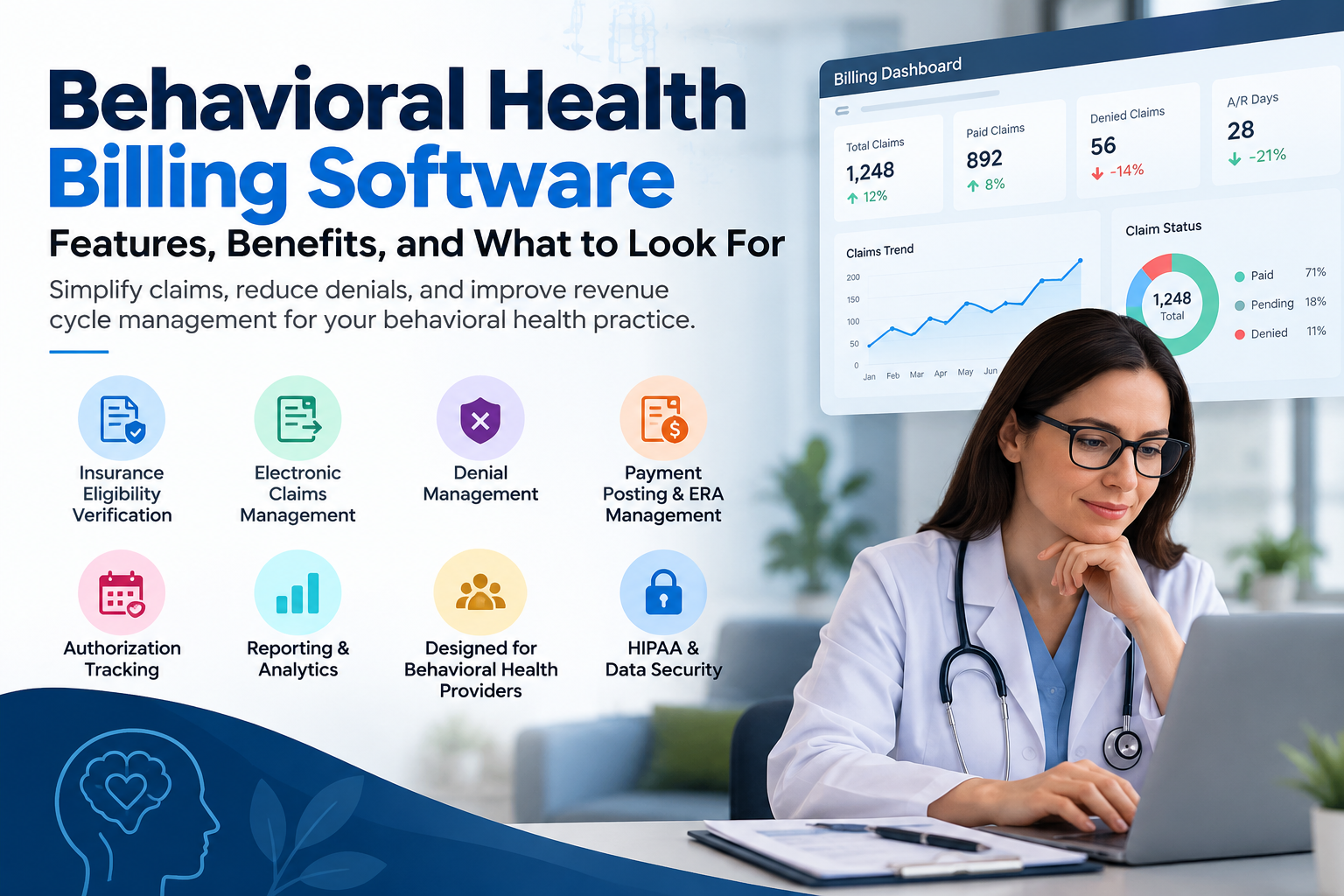
Behavioral health practices deal with billing challenges that can be different from those faced by general medical practices. Insurance eligibility, authorization requirements, claim submission, documentation, payment posting, and denial follow-up can all affect how quickly a practice gets paid.
Behavioral health billing software can help organize these workflows in one system. Depending on the platform, it may support eligibility verification, electronic claims, payment posting, denial tracking, reporting, and other revenue-cycle tasks.
The right system should not simply have a long list of features. It should fit the way your behavioral health practice actually handles patients, claims, payers, and payments.
What Is Behavioral Health Billing Software?
Behavioral health billing software is technology designed to help behavioral health providers manage financial and administrative workflows associated with patient services.
Depending on the product, a behavioral health billing system may help practices:
- Verify insurance eligibility
- Track authorizations
- Create and submit claims
- Monitor claim status
- Post payments and adjustments
- Track denied claims
- Manage patient balances
- Generate financial reports
- Monitor accounts receivable
- Connect billing with practice-management or EHR workflows
The exact capabilities vary between vendors, so practices should evaluate the software against their own payer mix and billing workflow.
Why Behavioral Health Practices Need Specialized Billing Workflows
Behavioral health practices may handle psychotherapy, psychiatry, counseling, medication management, and other services with their own documentation and coding requirements.
A general medical billing workflow may not be configured for every behavioral health scenario.
For example, a practice may need to coordinate:
- Provider information
- Patient insurance information
- Eligibility status
- Authorization requirements
- Procedure codes
- Diagnosis information
- Modifiers
- Place of service
- Claim status
- Remittance information
A billing system that keeps these pieces organized can make it easier for staff to identify problems before or after a claim is submitted.
7 Important Features of Behavioral Health Billing Software
1. Insurance Eligibility Verification
Eligibility problems can lead to avoidable claim issues.
A useful behavioral health billing system should make it easy for staff to verify coverage and document the result.
Look for workflows that help staff identify:
- Active or inactive coverage
- Patient responsibility
- Deductibles
- Copay or coinsurance information
- Coverage dates
- Payer information
- Authorization requirements
Eligibility information should still be verified according to the payer’s requirements because coverage can change.

2. Electronic Claims Management
Electronic claims submission can reduce manual work compared with paper-based processes.
Your software should make it possible to:
- Create claims
- Submit claims electronically
- Track claim status
- Identify rejected claims
- Correct errors
- Resubmit when appropriate
A good workflow should make rejected or returned claims easy to identify instead of allowing them to sit unnoticed.
3. Behavioral Health Denial Management
Denial management is one of the most important parts of revenue cycle management.
A billing system should help staff identify:
- Why a claim was denied
- Which payer issued the denial
- Which patient or claim is affected
- Whether correction is possible
- Whether an appeal is appropriate
- When follow-up is required
Instead of simply measuring the number of denied claims, practices should look for patterns.
For example, if the same payer repeatedly rejects claims because of missing information, the practice can investigate the workflow causing those errors.
4. Payment Posting and ERA Management
Electronic remittance information can help billing teams reconcile payments with submitted claims.
Useful software may provide:
- Electronic remittance workflows
- Payment posting
- Adjustment tracking
- Patient responsibility
- Outstanding balances
- Claim-level payment information
The goal is to keep the practice’s financial records aligned with payer responses.

5. Authorization Tracking
Some behavioral health services may require authorization depending on the payer, plan, service, provider, and patient circumstances.
Software with authorization tracking can help staff record:
- Authorization number
- Approved services
- Number of authorized sessions
- Effective dates
- Expiration dates
- Remaining visits
The software should support staff workflows rather than replace verification with the payer.
6. Reporting and Revenue Cycle Analytics
Reports can help practice owners and billing managers understand financial performance.
Useful reports may include:
- Accounts receivable
- Aging
- Claim status
- Denial reasons
- Payments by payer
- Outstanding patient balances
- Collections
- Days in A/R
- Revenue by provider
The most useful reports are those that lead to an action.
For example, a denial report can reveal whether one payer, provider, service, or workflow is responsible for a disproportionate number of rejected claims.
7. HIPAA and Data Security Considerations
Behavioral health practices handle protected health information, so security and contractual requirements matter when selecting software.
If a vendor creates, receives, maintains, or transmits PHI on behalf of a covered entity, the vendor may qualify as a HIPAA business associate. HHS explains that covered entities generally need an appropriate business associate agreement when a business associate handles PHI on their behalf. HHS.gov
When evaluating software, ask:
- Does the vendor provide a BAA when required?
- How is PHI protected?
- Who can access billing information?
- Are user permissions available?
- What happens to data if the contract ends?
- How are security incidents handled?
Do not rely solely on a vendor’s “HIPAA compliant” marketing statement. Ask what contractual and technical protections actually apply to your arrangement.
Behavioral Health Billing Software vs. General Medical Billing Software
The difference is not necessarily that one system is “better” than another.
The key question is whether the software supports the workflows your practice needs.
A behavioral health practice should evaluate whether the system handles:
| Workflow | What to Check |
|---|---|
| Eligibility | Real-time or supported eligibility workflows |
| Claims | Electronic claim submission |
| Denials | Denial tracking and follow-up |
| Authorization | Authorization tracking |
| Payments | ERA/payment posting |
| Reporting | A/R and denial reporting |
| Documentation | Integration with existing workflow |
| Security | Appropriate HIPAA safeguards and BAA where required |
How to Choose Behavioral Health Billing Software
Before purchasing a system, make a list of your current billing problems.
For example:
Problem: Claims are frequently rejected.
Ask:
Can the system identify common claim errors before submission?
Problem: Staff cannot easily track denials.
Ask:
Does the system provide denial reason and follow-up tracking?
Problem: Payments take too long to reconcile.
Ask:
How does the system handle electronic remittance and payment posting?
Problem: Staff cannot see A/R clearly.
Ask:
Which A/R and aging reports are available?
This approach is more useful than choosing software based only on the number of features listed on a sales page.
When Software Alone May Not Be Enough

Billing software provides infrastructure, but it does not automatically solve every revenue-cycle problem.
A practice may still need people who understand:
- Payer requirements
- Coding
- Claim corrections
- Denial analysis
- Appeals
- Eligibility
- Credentialing
- Payment reconciliation
For a small practice, software may be enough for an organized in-house billing workflow.
For a growing practice, combining software with experienced medical billing support may make more sense.
Behavioral Health Billing Software and Revenue Cycle Management
Software should be viewed as one part of the revenue cycle.
A typical workflow looks like:
Patient Registration
↓
Eligibility Verification
↓
Authorization Check
↓
Documentation & Coding
↓
Claim Submission
↓
Claim Tracking
↓
Payment Posting
↓
Denial Management
↓
A/R Follow-Up
The goal is not simply to submit more claims.
The goal is to create a reliable process from patient registration through final payment.
Frequently Asked Questions
What is behavioral health billing software?
Behavioral health billing software helps practices manage billing and revenue-cycle workflows such as eligibility, claims, payments, denials, patient balances, and reporting.
What features should behavioral health billing software have?
Important features can include eligibility verification, electronic claims, authorization tracking, denial management, payment posting, A/R reporting, and appropriate security controls.
Is behavioral health billing software HIPAA compliant?
It depends on the vendor and the specific arrangement. If a software vendor handles PHI on behalf of a covered entity, HIPAA business-associate requirements may apply, including an appropriate BAA. HHS.gov
Can behavioral health billing software reduce denials?
Software can help identify certain errors and organize denial workflows, but it cannot guarantee that claims will be paid. Staff still need appropriate coding, documentation, payer verification, and follow-up processes.
Should a behavioral health practice use software or a billing service?
It depends on the practice’s size, internal staff, billing volume, payer mix, and complexity. Some practices manage billing internally with software, while others use professional billing support alongside their software.
Final Thoughts
Choosing behavioral health billing software should start with your actual billing workflow rather than a feature checklist.
Look for a system that supports eligibility, claims, authorization tracking, payment posting, denial management, reporting, and appropriate protection of patient information.
For practices that need additional help with billing operations, Pro Health Care Advisors can also support medical billing and revenue-cycle workflows.