How to Reduce Medical Billing Denials in 2026 | Pro Health Care Advisors
May 28, 2026
How to Reduce Medical Billing Denials in 2026 | A Complete Guide for Healthcare Practices
Let’s be honest about something that keeps a lot of practice managers and physicians up at night.
You saw a patient. You provided real, meaningful care. Your team coded the visit, submitted the claim — and then weeks later, a denial letter showed up. No payment. Just a rejection code and a wall of bureaucratic language that takes another hour to decode.
This is not a rare problem. According to the American Medical Association (AMA), claim denials are one of the biggest financial threats facing healthcare practices in 2026 — and the numbers are not improving on their own.
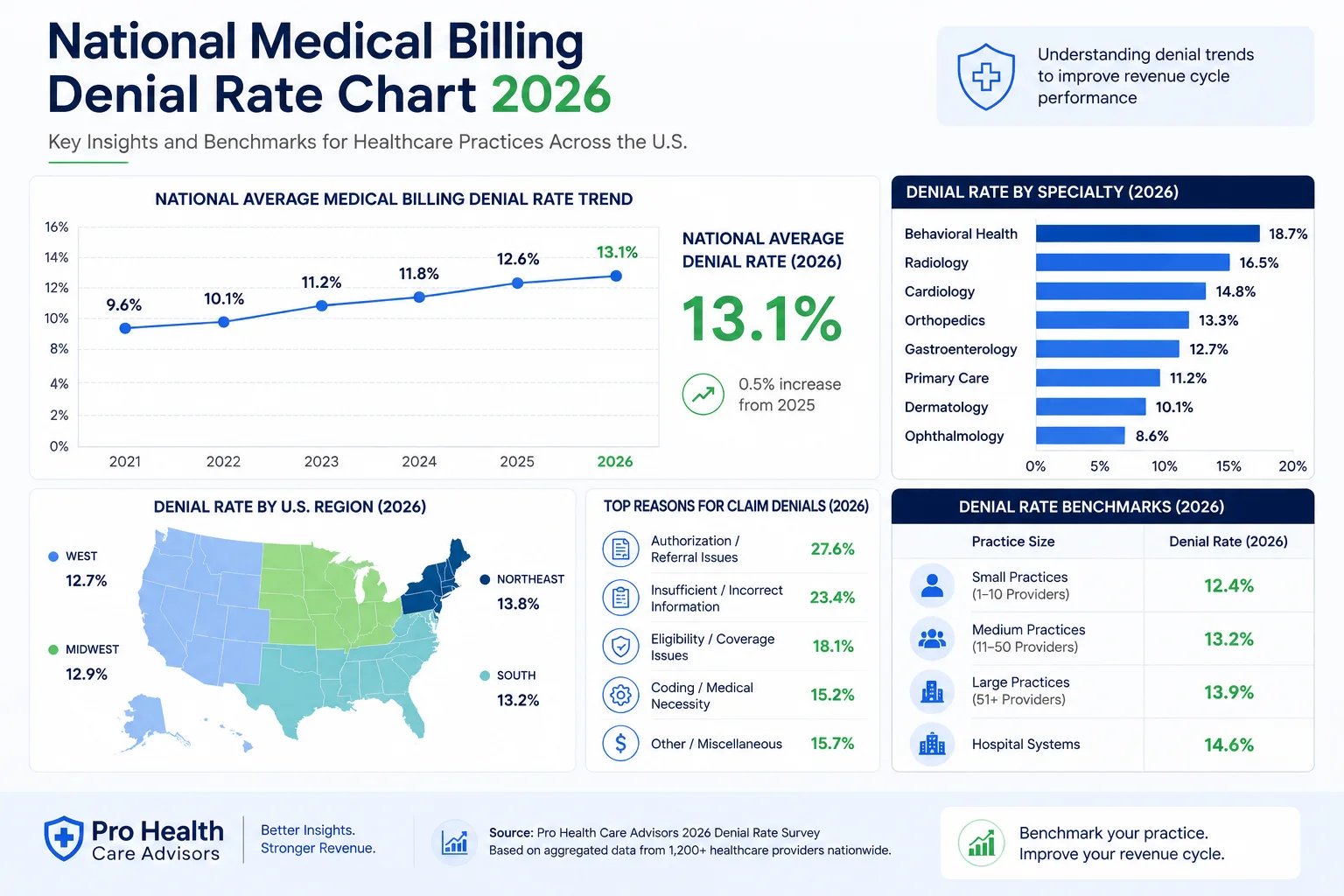
The national average denial rate has climbed to 12% in 2026. That translates to roughly $12,000 lost for every $100,000 billed — money your practice already earned, but never actually collected.
The good news? Most denials are completely preventable. Not some. Most.
This guide breaks down exactly why denials happen, what you can do about it — starting today — and how professional medical billing services can protect your revenue before a denial even has a chance to occur.
What Exactly Is a Medical Billing Denial?
Before we get into solutions, let’s make sure everyone is on the same page — whether you’re a physician who’s been practicing for 25 years or a front-desk coordinator who started last month.
A medical billing denial happens when an insurance company looks at your claim and refuses to pay it. That refusal can happen for dozens of different reasons — wrong code, missing documentation, patient not covered on the date of service, prior authorization wasn’t obtained, and many more.
There are two types of denials you need to understand:
Hard Denials — These are final. The claim cannot be resubmitted as-is. These often happen due to timely filing limits being exceeded or services not being covered at all under the patient’s plan.
Soft Denials — These are fixable. The payer is telling you something is missing or incorrect, but if you correct it and resubmit, you can still get paid.
The difference between a practice that stays financially healthy and one that struggles often comes down to how quickly and accurately they handle both types.
Why Denial Rates Are Getting Worse in 2026
If it feels like getting paid from insurance companies has gotten harder over the last few years, that’s because it genuinely has.
Here’s what’s driving the spike:
More complex payer rules. Insurance companies update their coverage policies, coding requirements, and prior authorization lists constantly. What was billable last year may require a modifier this year. What was covered may now need step therapy documentation.
The 2026 CMS Prior Authorization API Rule. The Centers for Medicare & Medicaid Services (CMS) now requires certain payers to implement electronic prior authorization processing. While this is good for patients long-term, the transition period has created significant confusion and rejections for practices that weren’t prepared.
Staffing shortages in billing departments. Many practices lost experienced billing staff post-pandemic and have not been able to fully rebuild. Inexperienced billers miss things. Errors cost money.
AI-driven payer audits. Insurance companies are using automated review systems to flag claims for denials faster than ever before. A minor inconsistency that a human reviewer might overlook gets automatically rejected.
The environment is challenging — but your practice does not have to accept a 12% denial rate as the new normal.
National medical billing denial rates 2026
The 7 Most Common Reasons Claims Get Denied (And What to Do About Each One)
1. Insurance Eligibility Was Not Verified Before the Visit
This is the single most common — and most preventable — source of denials. A patient’s coverage changes. They switch jobs. Their spouse’s employer changes plans. Their cobra runs out. And nobody checked before the appointment.
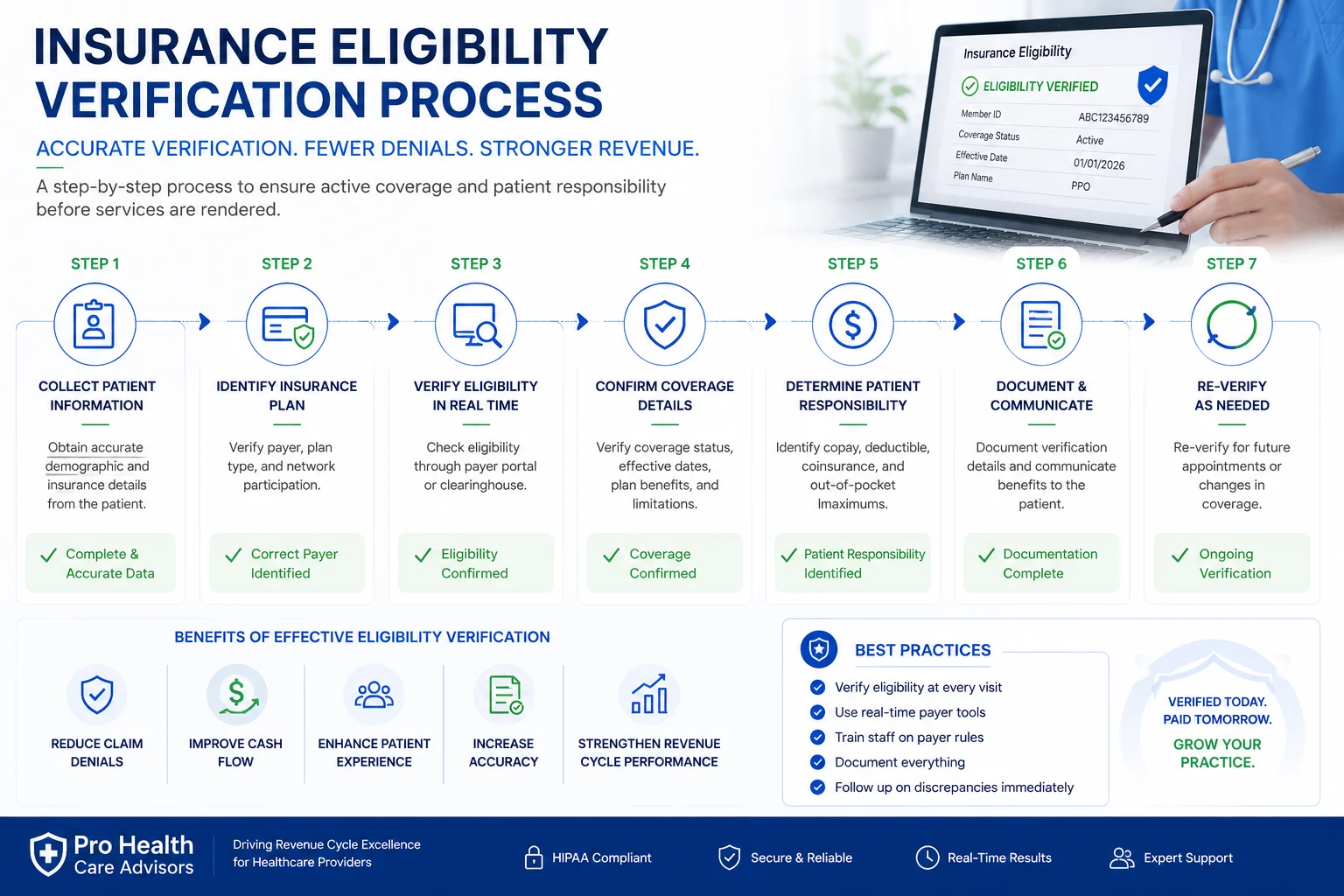
The fix: Verify insurance eligibility for every patient before every visit — not just new patients. This means checking coverage status, deductible amounts, copay requirements, and in-network status. Our team at Pro Health Care Advisors runs eligibility verification before every single appointment, catching coverage issues at the scheduling stage rather than weeks after a denial.
💡 Quick stat: According to MGMA data, front-end eligibility errors account for more than 23% of all initial claim denials.
insurance eligibility verification process medical billing
2. Missing or Incorrect Prior Authorization
Procedures, surgeries, specialty referrals, advanced imaging (MRI, CT scans), and many medications require prior approval from the insurance company before the service is provided. If that approval wasn’t obtained — or if the service was slightly different from what was approved — the claim gets denied.
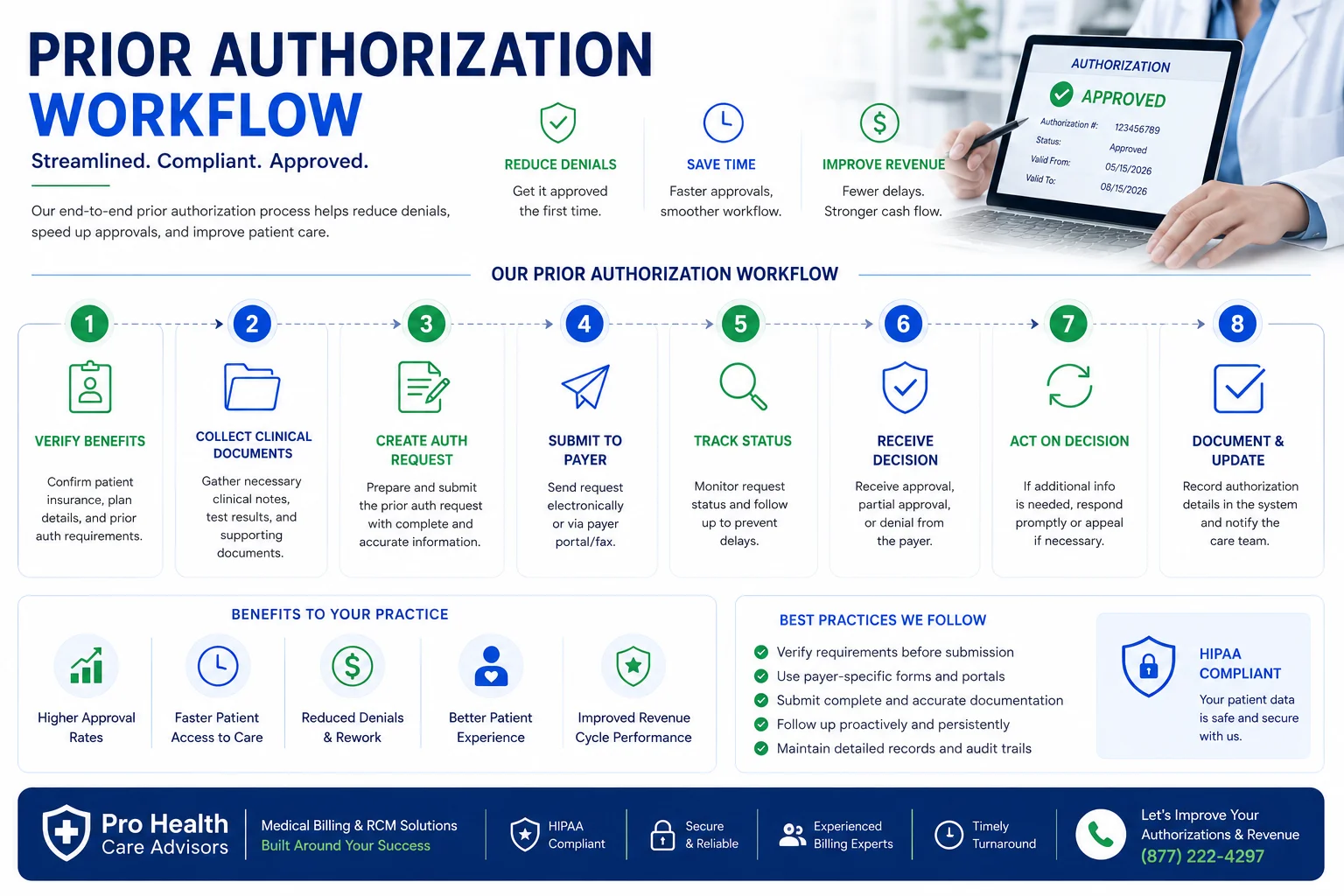
The fix: Build a clear prior authorization workflow into your scheduling process. Before booking any procedure that commonly requires approval, check the patient’s plan requirements. Submit requests early enough to receive a decision before the appointment. And always document the authorization number on the claim.
This is an area where working with a medical billing and practice management team makes a significant difference. We track authorization requirements by payer, submit requests electronically where required under the 2026 CMS rule, and follow up until approval is confirmed.
prior authorization workflow medical billing services
Medical coding is genuinely complex. ICD-10 has over 70,000 diagnosis codes. CPT has thousands more for procedures. Each payer has its own rules about which code combinations are acceptable, which need modifiers, and which will trigger an automatic review.
A single wrong digit. A missing modifier. A code that doesn’t match the documented diagnosis. Any of these will result in a denial — or worse, a compliance audit.
The fix: Use AAPC-certified coders who specialize in your practice’s specialty. A coder who primarily works with cardiology practices understands the nuances of cardiac procedure coding in a way a generalist might not. Our CodeMAXX Services team provides specialty-focused ICD-10, CPT, and HCPCS coding with real-time claim scrubbing to catch errors before submission.
Submitting the same claim twice — whether by mistake or because a resubmission wasn’t properly flagged — results in automatic denial of the second submission as a duplicate.
The fix: Use billing software with duplicate claim detection. Every claim should have a unique identifier, and your system should flag any submission that matches a previously submitted date of service, procedure, and patient combination.
5. Timely Filing Limits Exceeded
Every insurance payer has a deadline by which claims must be submitted after the date of service. Miss that window — even by one day — and the claim is denied permanently. There is no appeal process for timely filing violations in most cases.
The fix: Submit claims within 24 to 48 hours of the date of service whenever possible. Build a tracking system so no claim sits in a queue for more than a few days. For practices with large volumes, this is one of the strongest arguments for outsourcing to a medical billing services partner who submits claims daily.
6. Incomplete Patient Demographics or Insurance Information
Wrong insurance ID number. Misspelled patient name. Incorrect date of birth. These seem like small mistakes, but they cause immediate rejections because the payer cannot match the claim to a covered member.
The fix: Collect and verify all patient demographic and insurance information at every visit — not just at initial registration. People move. They change insurance. Their name changes after marriage. A quick eligibility check at check-in catches these issues before they become denials.
7. Lack of Medical Necessity Documentation
Even when a service is covered under a patient’s plan, the insurance company can deny a claim if the supporting documentation doesn’t clearly establish that the service was medically necessary. This happens frequently with specialty procedures, mental health services, and high-cost medications.
The fix: Train your providers to document clearly and specifically. “Patient complains of pain” is not sufficient. “Patient presents with persistent left knee pain rated 7/10 for 6 weeks, not responsive to conservative treatment including NSAIDs and physical therapy, requiring orthopedic evaluation” tells a story that justifies the service. Our team reviews clinical documentation flags before submission to identify gaps that could trigger a medical necessity denial.
How a Strong Revenue Cycle Management Process Prevents Denials
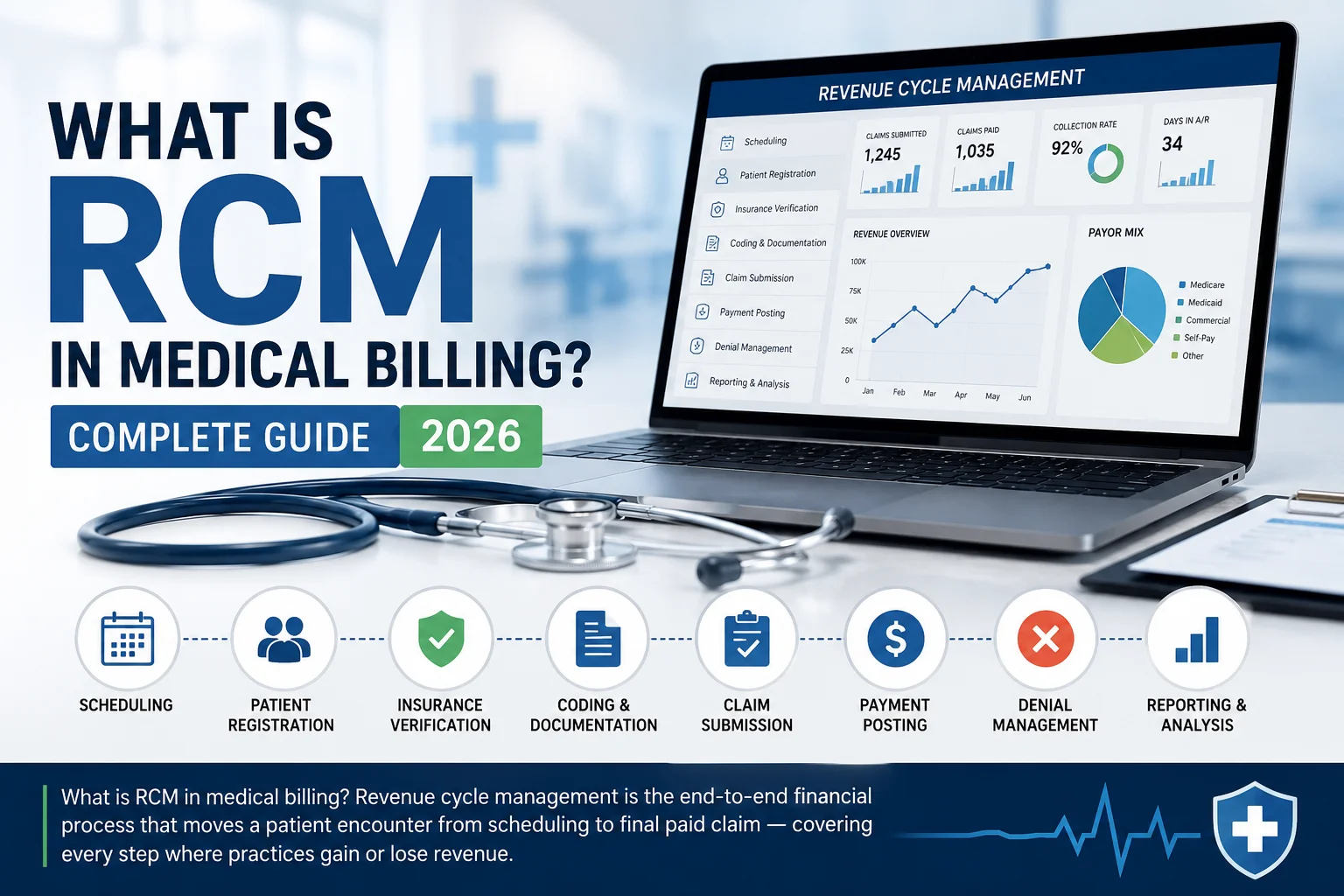
Revenue cycle management (RCM) is not just a billing function. It’s the entire financial journey of a patient encounter — from the moment they call to schedule an appointment to the moment their balance is paid in full.
When every step of that journey is managed correctly, denials drop dramatically. Here’s what a strong RCM process looks like in practice:
Step 1 — Pre-Registration:
Collect patient demographics, insurance information, and referral details before the appointment. Verify everything electronically.
Step 2 — Eligibility Verification:
Confirm active coverage, benefits, deductible status, and in-network standing at least 24 hours before the visit.
Step 4 — Charge Capture:
Ensure every service provided is documented and assigned the correct charge. Nothing should fall through the cracks.
Step 5 — Medical Coding:
AAPC-certified coders review the encounter, assign accurate ICD-10 and CPT codes, and apply appropriate modifiers.
Step 6 — Claim Scrubbing:
Before submission, AI-assisted claim scrubbing reviews each claim against payer-specific rules to catch errors.
Step 7 — Electronic Claim Submission:
Clean claims are submitted electronically within 24 hours of the date of service.
Step 8 — Payment Posting:
Remittances are posted accurately. Underpayments are identified and followed up.
Step 9 — Denial Management:
Every denial is reviewed, categorized, corrected, and appealed where appropriate. Denial patterns are tracked to prevent recurrence.
Step 10 — Patient Collections:
Patient responsibility amounts are communicated clearly and collected efficiently.
This is exactly the process our team follows for every practice we support through Pro Health Care Advisors. The result: a 98.5% clean claim rate and a denial rate of less than 2%.
The Role of Physician Credentialing in Preventing Denials
Here’s something that often gets overlooked: denials don’t always come from billing mistakes. Sometimes they come from credentialing gaps.
If a provider is not yet enrolled with a payer — or if their enrollment has lapsed — claims submitted under their NPI will be denied automatically. The service was rendered. The claim was coded correctly. The eligibility was verified. But the provider isn’t recognized as in-network, and the denial hits anyway.
Physician credentialing is the process of enrolling providers with insurance payers and maintaining those enrollments over time. It’s not glamorous work, but it is foundational to getting paid.
In 2026, most commercial payer credentialing takes 60 to 120 days from initial application to approval. Medicare and Medicaid can take even longer. Any gap in that process means claims pile up unpaid.
Our credentialing specialists manage the entire process — from CAQH verification and application submission to active follow-up with payers until approval is confirmed. We also track re-credentialing deadlines so enrollments never lapse quietly.
What Is a RAC Audit and How Does It Connect to Denials?
RAC stands for Recovery Audit Contractor. These are private companies hired by CMS to identify Medicare overpayments and billing errors — and recover that money from practices.
A RAC audit can result in significant repayment demands, and the billing patterns that trigger audits are often the same patterns that also generate denials: inconsistent coding, insufficient documentation, services billed without medical necessity support.
The best protection against a RAC audit is the same thing that prevents denials: accurate coding, thorough documentation, and clean billing practices from the start.
Our MD Audit Shield – RAC service is specifically designed to help practices identify and correct vulnerability patterns before an audit occurs — and to provide support if one does.
HIPAA Compliance and Its Connection to Clean Claims
You might wonder what HIPAA has to do with denial rates. More than most people realize.
HIPAA-compliant billing processes use secure, standardized electronic transaction formats that payers require for clean claim acceptance. A claim submitted through a non-compliant system or without proper Business Associate Agreement (BAA) protection creates both a compliance risk and a payment risk.
Beyond that, HIPAA-compliant data handling protects patient information throughout the billing process — which is not just legally required, it’s the foundation of patient trust.
Every process at Pro Health Care Advisors is fully HIPAA-compliant. We sign BAAs with every client, use AES-256 encrypted data handling, and conduct regular compliance reviews — including alignment with the No Surprises Act.
Should You Outsource Medical Billing? An Honest Look
This is a fair question and it deserves a straight answer.
In-house billing makes sense for some practices. If you have a small, stable patient volume, a very experienced billing staff, and payer relationships that are simple and consistent, keeping billing internal can work.
But for most practices — especially those experiencing growth, provider additions, payer mix complexity, or staffing challenges — the math strongly favors outsourcing.
Consider this:
The average medical billing specialist salary in the U.S. is $45,000–$60,000 per year, plus benefits, training, software licenses, and turnover costs.
The national average denial rate for in-house billing teams is 12%.
Our clients see denial rates below 2% and collection improvements of 30% or more.
The difference isn’t the people — it’s the systems, the specialty expertise, the volume of payer experience, and the dedicated denial management processes that a billing services firm brings.
Key Performance Metrics Every Practice Should Track
Whether you handle billing in-house or work with a partner, these are the numbers you should be watching every month:
Clean Claim Rate — The percentage of claims accepted on first submission without correction. Best-in-class: 98%+
Denial Rate — The percentage of claims denied by payers. Industry average: 12%. Best-in-class: under 2%.
Days in Accounts Receivable (AR) — How many days, on average, it takes to collect payment after service. Best-in-class: under 30 days.
First Pass Resolution Rate — The percentage of claims paid on the very first submission. Directly tied to clean claim rate.
Cost to Collect — How much you spend to collect each dollar of revenue. This is where outsourcing often shows the clearest financial advantage.
Denial Write-Off Rate — How much revenue is permanently lost due to uncollected denials. This should be as close to zero as possible.
If you don’t know your current numbers for these metrics, that’s the first problem to solve. You cannot improve what you don’t measure.
A 90-Day Action Plan to Reduce Your Denial Rate
You don’t have to fix everything at once. Here’s a realistic 90-day roadmap:
Days 1–30: Assess and Identify
Pull your denial data from the last 6 months
Categorize denials by reason code
Identify your top 3 denial categories by volume and by dollar amount
Audit your eligibility verification process for gaps
Days 31–60: Fix the Front End
Implement real-time eligibility verification for every appointment
Build a prior authorization checklist by payer and procedure type
Review your registration process for demographic data accuracy
Ensure all providers are currently credentialed with all active payers
Days 61–90: Strengthen the Back End
Set up a denial tracking system if you don’t have one
Establish a clear appeals process with responsibility assigned
Review coding accuracy for your highest-volume procedures
Set target metrics for the next quarter and assign accountability
If this feels like a lot — it is. This is why many practices find that partnering with a medical billing services company is the most efficient path to results.
How Pro Health Care Advisors Achieves a 98.5% Clean Claim Rate
We get asked this question often. The answer isn’t a single thing — it’s a system.
Our AAPC-certified billers specialize in specific medical specialties. A mental health biller understands mental health coding. A cardiology biller understands cardiology coding. Specialty expertise eliminates a huge percentage of coding errors at the source.
We verify eligibility for every patient before every visit — electronically, in real time. We manage prior authorizations end to end, from initial submission to approval documentation. We scrub every claim against payer-specific rules before it goes out the door. And when a denial does happen, we categorize it, appeal it where appropriate, and track the pattern to prevent recurrence.
Frequently Asked Questions About Medical Billing Denials
What is the most common reason for medical billing denials?
Insurance eligibility errors are the single most common cause. Verifying coverage before every appointment prevents the majority of these.
Can denied claims be appealed?
Yes — most soft denials can be corrected and resubmitted. Hard denials may require a formal appeal with supporting documentation. Our team manages appeals as part of our standard denial management process.
How long do you have to appeal a denied claim?
Timelines vary by payer. Most commercial payers allow 90 to 180 days from the denial date. Medicare generally allows 120 days. Missing the appeal window results in permanent write-off.
What is a clean claim?
A clean claim is one that is submitted with all required information, accurate coding, and no errors — allowing the payer to process and pay it without requesting corrections or additional information.
How does outsourced medical billing reduce denials?
Outsourced billing companies handle high volumes of claims across multiple practices and payers. This gives them a pattern-recognition advantage that in-house teams — especially smaller ones — simply cannot replicate. Specialty expertise, dedicated denial management, and continuous system updates all contribute to lower denial rates.
Is outsourced medical billing HIPAA-compliant?
Yes, when done through a qualified partner. Any billing company handling Protected Health Information must sign a Business Associate Agreement (BAA) with your practice. Pro Health Care Advisors is fully HIPAA-compliant and signs BAAs with every client.