







Best Mental Health Billing Software in 2026 | 7 Platforms Compared for Therapists and Counselors
Sunday night. Notes finally done. You open your billing software to submit the week’s claims.
Twenty minutes later, you are still trying to figure out why three claims from Tuesday are showing errors. The error message is vague. The help documentation is six pages long. By the time you sort it out, it is past 10 PM and you still have not reconciled last week’s payments.
Sound familiar?
According to the American Psychological Association, 45% of mental health providers name administrative overload — not caseload — as a top cause of burnout. Not too many patients. Paperwork. Billing. The stuff that happens after the session ends.
The right mental health billing software does not eliminate that work entirely. But it changes the experience so completely that practices often wonder how they survived without it. Claims go out clean. Payments post automatically. Eligibility issues surface before the patient arrives rather than after the claim is denied. And Sunday nights look a lot less like a second shift.
The wrong mental health billing software, on the other hand, quietly bleeds your practice of revenue you never knew you were losing. Industry data shows that up to 15% of potential revenue disappears into billing inefficiencies every year. For a practice generating $150,000 annually, that is $22,500 walking out the door in denied claims, underpayments, and administrative mistakes.
This guide cuts through the marketing noise. We have analyzed the top seven mental health billing software platforms available in 2026 — comparing them on the criteria that actually determine whether your practice gets paid, not just on which interface looks prettiest.
What Makes Mental Health Billing Software Different from General Medical Billing Software
Before we get into the platforms, here is something worth understanding — because it explains why general-purpose medical billing software often fails therapists, counselors, and psychiatrists.
Mental health billing has three features that set it apart from almost every other specialty:
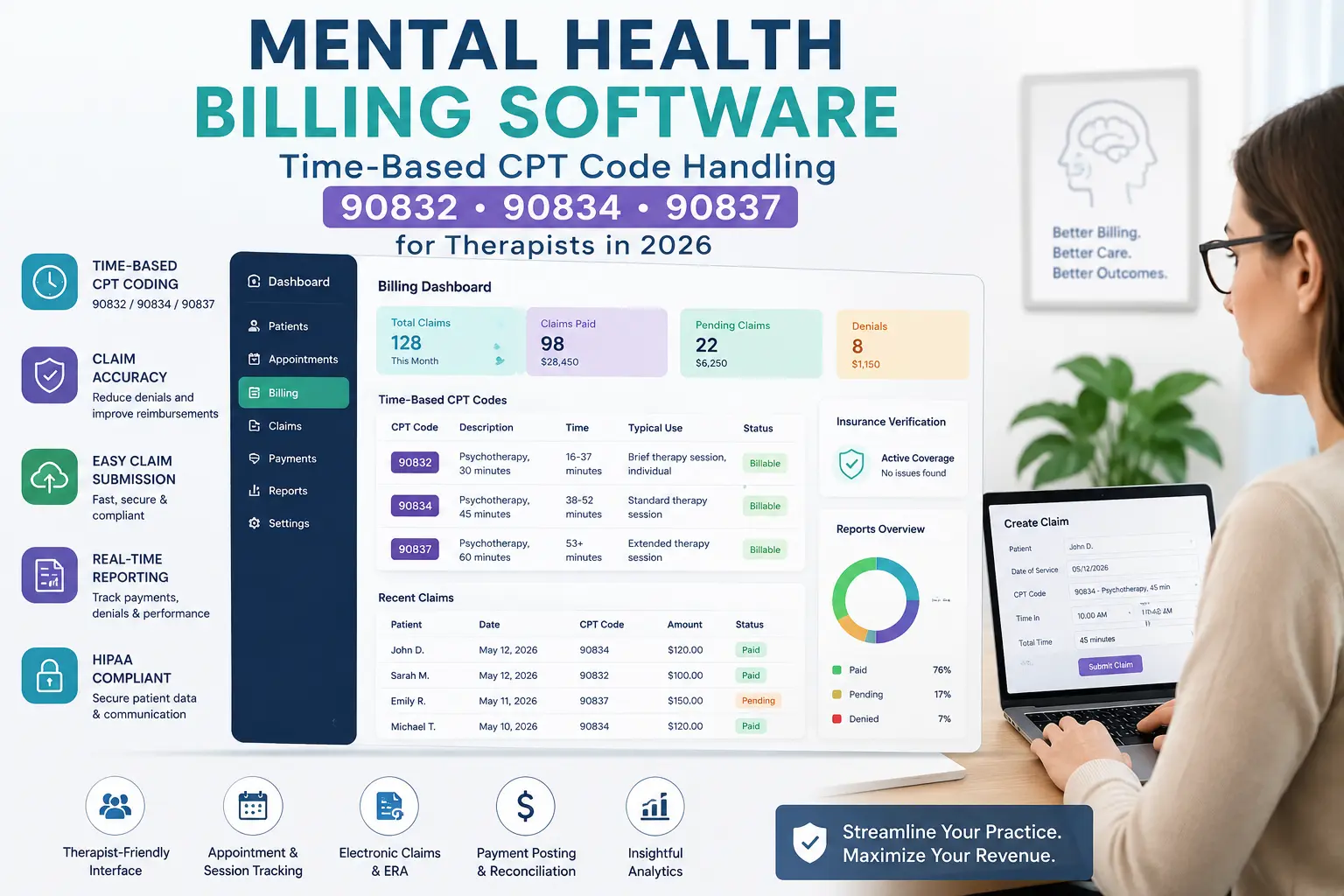
Feature 1: Time-based CPT codes are everything. In mental health billing, the codes are almost entirely time-based. The difference between billing CPT 90834 (38–52 minutes) and CPT 90837 (53+ minutes) is not a different service — it is a documented time difference of eleven minutes that changes the reimbursement by roughly $40–50 per session. Good mental health billing software understands this and validates session length against the code selected before the claim goes out. General medical billing software often does not.
Feature 2: Behavioral health carve-outs create payer confusion. Many patients have their mental health benefits administered by a separate company from their medical insurance. A patient with Blue Cross Blue Shield for medical might have their therapy covered through Optum Behavioral Health or Beacon Health Options. Billing the wrong payer is one of the most common mental health billing errors. The best mental health billing software either catches this automatically or makes the carve-out relationship visible at the eligibility check stage.
Feature 3: Documentation and billing are clinically connected. In mental health, the session note is not just a clinical record. It is the billing document. Start and stop times, specific interventions, patient response, progress toward treatment goals — these documentation elements directly determine which code is appropriate and whether the claim will survive a payer audit. The best mental health billing software connects documentation directly to billing, so the note and the claim tell the same story.
With that context, here are the seven platforms that matter most in 2026.
The 7 Best Mental Health Billing Software Platforms in 2026
Platform #1: SimplePractice — Best Overall for Solo Therapists
Best for: Solo therapists, LCSWs, LPCs, psychologists, and small group practices (up to 5 providers) Starting price: $34.95/month (Starter), $49.95/month (Essential), $69.95/month (Plus) HIPAA compliant: Yes — Business Associate Agreement (BAA) available
SimplePractice consistently ranks as the most widely used mental health billing software in the United States — and for good reason. It was built specifically for behavioral health providers, and every feature reflects that focus.
What works well:
- Insurance billing with direct claims submission to major payers and automatic ERA posting
- Handles both in-network and out-of-network clients through superbills and Good Faith Estimates
- Client portal for self-pay invoicing, payment collection, and intake paperwork
- Integrated telehealth with billing — the session and the claim are connected
- Easy to learn — most therapists are fully operational within a week
Where it struggles:
- Pricing climbs steeply for group practices — adding providers gets expensive quickly
- Reporting and denial analytics are functional but not deep
- Multi-provider billing oversight feels like a secondary concern in the interface design
- Some users report that insurance billing works best when claims are relatively straightforward — complex cases require more manual work
Billing accuracy for mental health: SimplePractice validates CPT code selections and catches common errors before submission. Its clearinghouse connection covers the major commercial payers and Medicare. The platform handles behavioral health billing nuances better than any general medical billing software.
The honest take: If you are a solo therapist or a practice with two to three providers who wants clean, reliable billing in a polished, easy-to-use interface — SimplePractice is the right choice for 2026. If you are scaling past five providers or need deep denial analytics and revenue cycle reporting, look at the enterprise options below.
Platform #2: TherapyNotes — Best for High-Volume Insurance Billing
Best for: Therapists and counselors with high insurance billing volume, group practices Starting price: $59/clinician/month (annual), $69/month (monthly); group discounts available HIPAA compliant: Yes — BAA available
TherapyNotes has been a fixture in behavioral health for over a decade — and its billing engine is the reason it stays on every serious therapist’s shortlist. While SimplePractice wins on user experience and interface polish, TherapyNotes wins on billing depth.
What works well:
- Electronic claims submission to over 1,000 payers with built-in clearinghouse
- One-click superbill generation tied directly to the session note
- Automated ERA posting with reconciliation reporting
- Specialized note types for psychotherapy that flow naturally into billing — progress note fields prompt the documentation elements that billing requires
- 24/7 customer support with billing-specific knowledge
- Robust financial reporting with claim-level detail
Where it struggles:
- Interface is functional but less modern than SimplePractice — some therapists find the design dated
- Limited customization for complex workflow needs
- Telehealth is available but not as integrated into the billing workflow as some competitors
Billing accuracy for mental health: TherapyNotes understands mental health CPT codes at a deep level — including time-based validation, modifier requirements, and the documentation requirements that tie session notes to billing codes. Its built-in coding logic is specifically designed to reduce denial rates from technical errors, not just formatting issues.
The honest take: For practices where the primary concern is billing accuracy and financial performance — not interface aesthetics — TherapyNotes is the strongest mental health billing software on this list. If you run a high-volume insurance practice and denials are your biggest problem, TherapyNotes is built for that.
Platform #3: TheraNest — Best Budget Option for Small Practices
Best for: Solo therapists and small groups needing integrated billing at lower cost Starting price: $39/month (Solo, 30 clients), $49/month (Group, 100 clients), $69/month (Professional, 300 clients) HIPAA compliant: Yes — BAA available
TheraNest sits at the intersection of affordability and genuine functionality — a combination that is harder to find than it sounds in mental health billing software. It supports electronic claims submission to over 2,000 payers, ERA auto-posting, insurance eligibility verification, and superbills, all within a pricing structure that works for practices just getting their billing systems established.
What works well:
- Electronic claims submission to over 2,000 payers — one of the broadest clearinghouse connections on this list
- Batch claims submission — useful for practices processing high weekly claim volumes
- ERA auto-posting reduces manual payment entry significantly
- Insurance eligibility verification built into the scheduling workflow
- Patient payment processing integrated with billing
- Solid for solo or small-group practices without complex multi-provider reporting needs
Where it struggles:
- Reporting capabilities are adequate but not as strong as TherapyNotes or enterprise platforms
- Interface can feel less intuitive than SimplePractice for users new to EHR systems
- Customer support response times have been reported as slower than competitors
Billing accuracy for mental health: TheraNest handles the core mental health billing requirements well — time-based CPT code support, superbill generation, and standard denial management. It is not the deepest billing engine on this list, but for practices billing primarily to a focused set of commercial payers, it delivers reliable results at a price point that matters.
The honest take: If budget is the primary constraint and you need a platform that handles the fundamentals without the premium price tag, TheraNest is the most capable option at its price point. Do not expect enterprise-level analytics, but do expect your claims to go out correctly and your ERAs to post automatically.
Platform #4: Valant — Best for Outcomes Tracking with Billing Integration
Best for: Behavioral health practices that want clinical outcomes data tied directly to billing and RCM Starting price: Custom pricing (typically $100–$250/month per provider based on features) HIPAA compliant: Yes — BAA available
Valant occupies a specific niche in the mental health billing software market — it is for practices that want not just billing and scheduling, but integrated clinical outcomes measurement that connects patient progress data to revenue cycle management.
What works well:
- Full behavioral health EHR with integrated billing — not bolted on from a general medical platform
- Advanced outcomes tracking and measurement-based care tools
- Revenue cycle analytics that connect clinical performance to financial performance
- Electronic claims, ERA posting, and denial management
- Strong reporting for practices that need to demonstrate outcomes data to payers or for value-based care arrangements
Where it struggles:
- Pricing is higher than SimplePractice or TheraNest — not ideal for solo practitioners watching expenses closely
- Steeper learning curve — the additional functionality requires more onboarding time
- Overkill for practices that primarily need clean billing without advanced outcomes tools
Billing accuracy for mental health: Valant’s billing engine was built for behavioral health — it understands the CPT code requirements, documentation standards, and payer-specific rules that trip up general medical billing systems. Its denial management workflow is more sophisticated than the consumer-focused platforms above.
The honest take: If your practice is moving toward value-based care arrangements, needs to report outcomes data to payers, or wants deep integration between clinical quality and financial performance — Valant is the only platform on this list that addresses that need meaningfully. For pure billing optimization without the outcomes layer, one of the other platforms will serve you better at lower cost.
Platform #5: ICANotes — Best for Psychiatry and Prescribers
Best for: Psychiatrists, psychiatric nurse practitioners (PMHNPs), and prescribing behavioral health providers Starting price: Contact for pricing (typically $75–$155/month per provider) HIPAA compliant: Yes — BAA available
ICANotes is built for the specific workflow of a prescribing psychiatric practice — where billing involves not just psychotherapy codes but also E/M codes, medication management add-ons (90833, 90836, 90838), e-prescribing, and the intersection of clinical documentation with prescribing records.
What works well:
- Fast note-taking system specifically designed for psychiatric documentation — structured templates reduce note completion time significantly
- E-prescribing integrated with clinical records
- Handles the combination billing patterns psychiatrists use — E/M codes paired with psychotherapy add-ons
- Integrated billing with clearinghouse connection for electronic claims
- Audit-ready documentation — notes are structured to support the medical decision-making complexity that E/M code selection requires
Where it struggles:
- Interface feels clinical rather than consumer-friendly — the design prioritizes efficiency over aesthetics
- Less suitable for non-prescribing therapists and counselors who do not need the psychiatric documentation features
- Telehealth capabilities exist but are less polished than SimplePractice’s integrated virtual visit system
Billing accuracy for mental health and psychiatry: ICANotes handles the specific billing complexities of psychiatric practice better than any general therapy platform — particularly the E/M plus psychotherapy add-on combinations that trip up billing systems designed only for non-prescribing therapists.
The honest take: If you are a psychiatrist or PMHNP looking for mental health billing software that understands your specific documentation and billing workflow — including e-prescribing, medication management billing, and psychiatric E/M coding — ICANotes deserves a serious look. For non-prescribing therapists, one of the earlier platforms will be a better fit.
Platform #6: Tebra (formerly Kareo) — Best for Multi-Specialty Practices
Best for: Practices that treat mental health patients alongside other medical specialties, or group practices with mixed provider types Starting price: Approximately $150/month (non-physician), $300/month (full EHR/PM suite) HIPAA compliant: Yes — BAA available
Tebra entered the mental health billing software conversation when Kareo (a medical billing platform) merged with PatientPop (a patient engagement platform) and rebranded. The result is a practice management platform that serves behavioral health — but did not start from behavioral health.
What works well:
- Strong patient engagement features including automated reminders, online booking, and patient portal
- Revenue cycle management with real-time billing dashboards and denial tracking
- Handles multi-specialty practices where mental health is one of several specialties billed
- Patient marketing and reputation management features for practice growth
- Automated billing system with claim tracking and denial alerts
Where it struggles:
- Mobile capabilities score below competitors — users report slow load times and limited mobile functionality
- Mental health-specific billing nuances (time-based codes, behavioral health carve-outs) require more manual configuration than platforms built from the ground up for behavioral health
- Higher price point than SimplePractice or TheraNest for comparable core billing functionality
- Customer support response times vary
Billing accuracy for mental health: Tebra handles mental health billing adequately — but it is a platform designed for general medical practices that has been extended to support behavioral health, not one designed from the ground up for therapists and counselors. The billing engine works, but practitioners report needing more configuration to handle mental health-specific scenarios cleanly.
The honest take: If you run a mixed practice — primary care plus behavioral health, or a group with medical and therapy providers — Tebra’s ability to handle multiple provider types in one system has real value. For a pure mental health or therapy practice, platforms built specifically for behavioral health will deliver better billing accuracy with less configuration effort.
Platform #7: Ease Health — Best for Group Practices (6+ Clinicians)
Best for: Group behavioral health practices with 6 or more clinicians Starting price: Custom pricing — contact for demo HIPAA compliant: Yes — BAA available
Ease Health is the newest platform on this list and the one generating the most attention in 2026 among multi-clinician behavioral health practices. Unlike every other platform here, Ease was built from the ground up as a unified system combining EHR, Revenue Cycle Management (RCM), and Client Relationship Management (CRM) — three systems that most practices run separately.
What works well:
- Unified EHR, billing RCM, and client management — referral tracking, intake conversion, clinical documentation, and billing all connected in one system
- Purpose-built for behavioral health group practices — multi-provider billing oversight, team permissions, and coordinated workflows
- Advanced RCM analytics with real-time visibility into denial patterns and revenue performance
- AI-assisted documentation that integrates into billing workflows
- Designed for the complexity of a growing multi-clinician practice — not a solo-therapist platform stretched to fit a team
Where it struggles:
- Custom pricing model means no public price transparency — requires a demo to get numbers
- Newer platform means less community support and fewer long-term user reviews than SimplePractice or TherapyNotes
- May be more platform than a 2–3 person practice needs
Billing accuracy for mental health: Ease Health’s RCM component is more sophisticated than any of the consumer-focused platforms — real-time denial tracking, revenue cycle reporting, and billing oversight tools designed for practice administrators managing multiple clinicians.
The honest take: If you run a group behavioral health practice with six or more clinicians and you are tired of managing EHR, billing, and intake in three separate systems — Ease Health is the most compelling platform in 2026. For smaller practices, the investment and complexity may exceed what is needed.
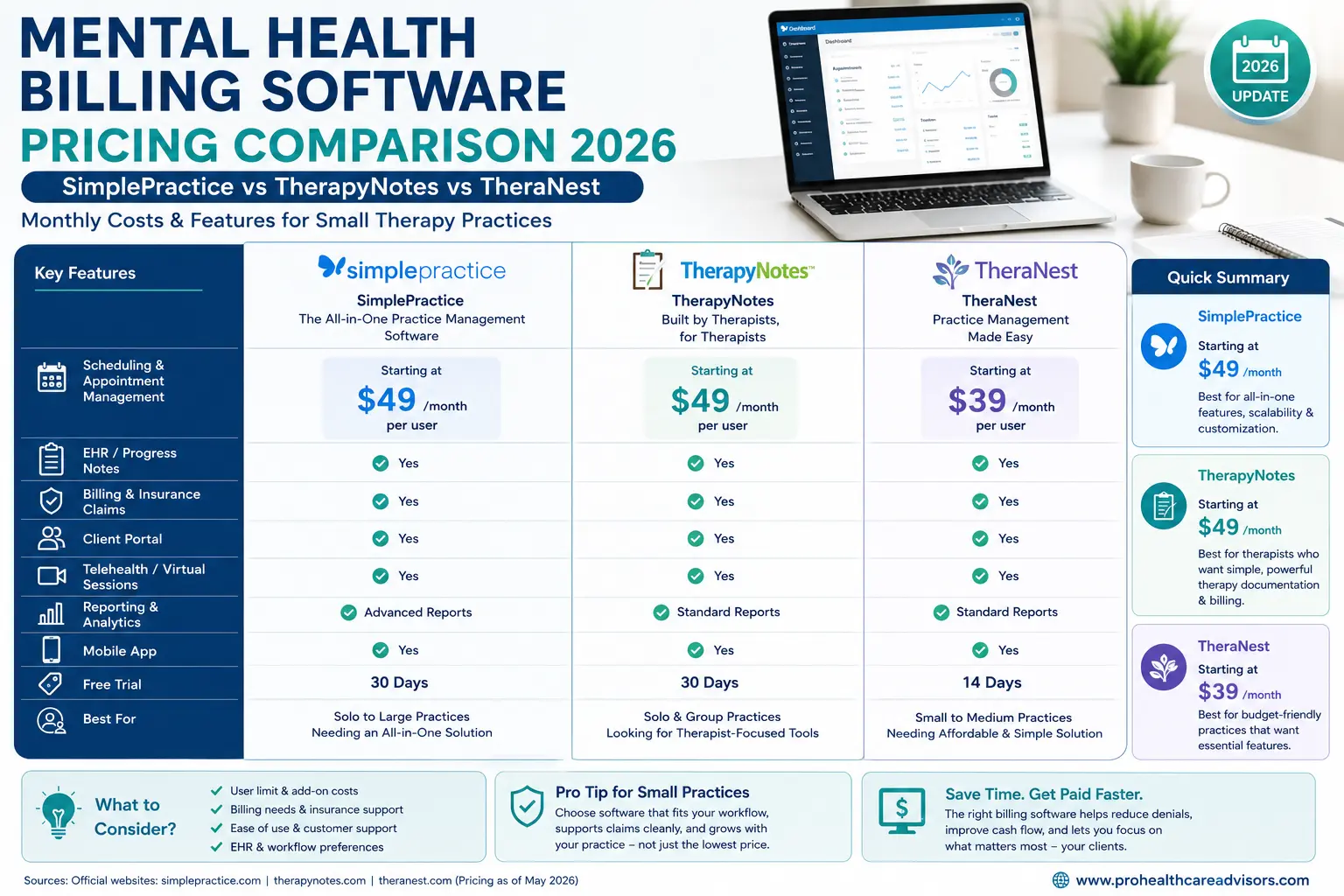
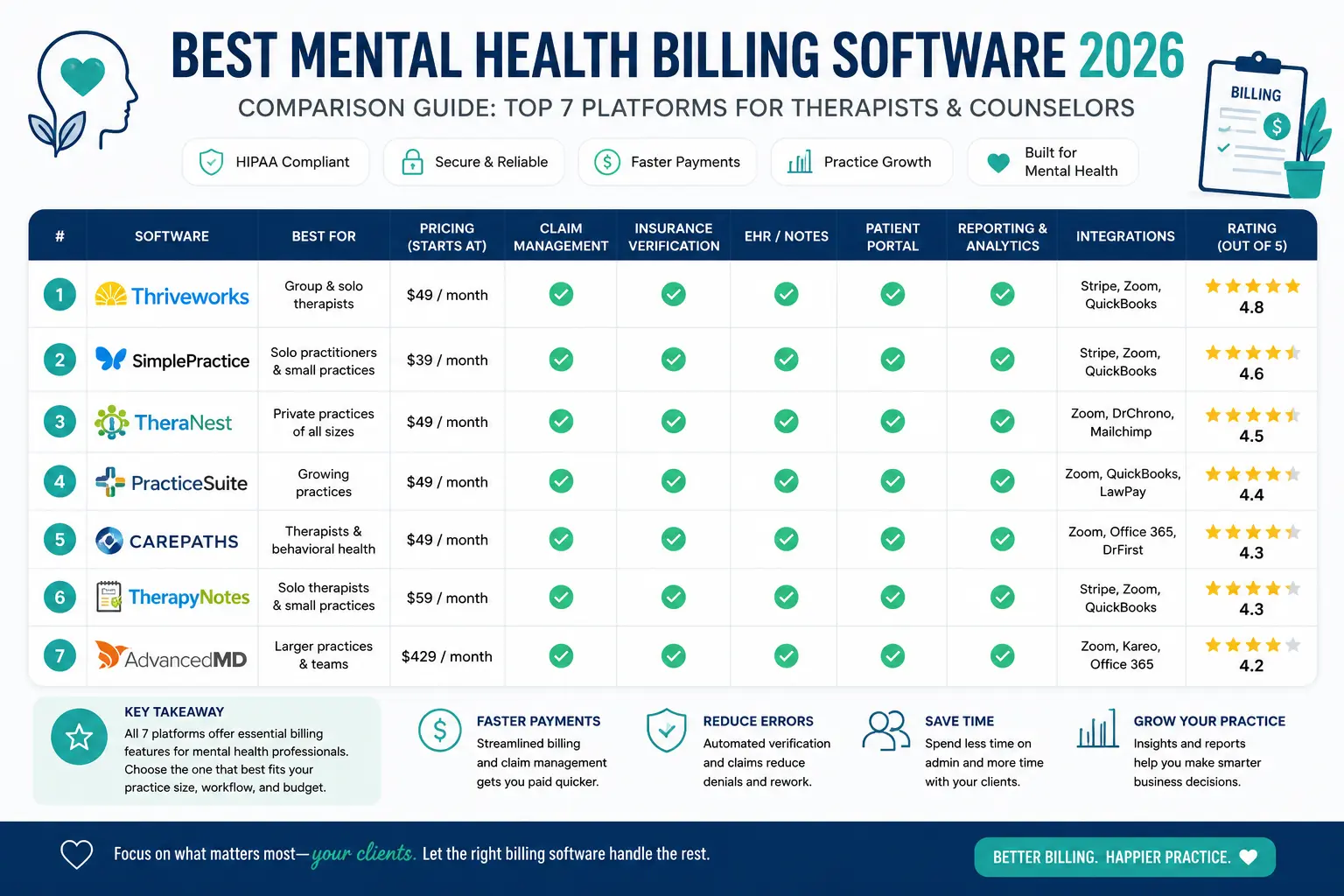
Mental Health Billing Software Comparison Table — 2026
| Platform | Best For | Starting Price | Payer Connections | Telehealth | HIPAA BAA | Billing Depth |
|---|---|---|---|---|---|---|
| SimplePractice | Solo & small practice | $34.95/mo | Major payers | ✅ Integrated | ✅ | Good |
| TherapyNotes | High-volume insurance | $59/clinician/mo | 1,000+ payers | ✅ Available | ✅ | Excellent |
| TheraNest | Budget-conscious small practice | $39/mo | 2,000+ payers | ✅ Available | ✅ | Good |
| Valant | Outcomes + billing | Custom | Major payers | ✅ Available | ✅ | Very Good |
| ICANotes | Psychiatry / prescribers | Custom | Major payers | ✅ Available | ✅ | Very Good |
| Tebra | Multi-specialty practices | $150/mo | Major payers | ✅ Available | ✅ | Good |
| Ease Health | Group practices (6+) | Custom | Major payers | ✅ Available | ✅ | Excellent |
7 Features Your Mental Health Billing Software Must Have in 2026
Beyond the platform reviews, here are the seven non-negotiable features to verify before choosing any mental health billing software in 2026.
Feature 1: Time-Based CPT Code Validation
Your software must understand that mental health billing is time-based — and it must validate that the CPT code selected matches the documented session time before the claim goes out. A platform that lets you bill 90837 on a 45-minute session without a warning is a platform that will cost you money in denials and compliance exposure. Test this specifically during your free trial.
Feature 2: HIPAA Compliance with a Signed BAA
This is not optional. Any software that handles protected health information (PHI) — and every mental health billing platform does — must be HIPAA compliant and must provide a signed Business Associate Agreement. Before committing to any platform, ask directly: “Will you sign a BAA?” If the answer is no, or if they cannot explain their HIPAA compliance infrastructure clearly, move on immediately.
According to CMS behavioral health billing guidance, maintaining compliant documentation and billing records is a baseline requirement for all providers billing Medicare and Medicaid for mental health services.
Feature 3: Behavioral Health Carve-Out Awareness
Ask during demos specifically: “What happens when a patient’s mental health benefits are administered by a different company than their medical plan?” The platform should either detect this automatically through eligibility verification or clearly flag it for manual review. This single issue is responsible for a significant share of mental health billing denials that most practices never trace back to the root cause.
Feature 4: Electronic Eligibility Verification
Real-time eligibility verification before every appointment — not just at intake — is essential in 2026. Coverage changes. Plans renew. Deductibles reset. The platform should make it easy (ideally automatic) to run eligibility checks the day before every session.
Feature 5: ERA Auto-Posting and Underpayment Detection
Manual payment posting is one of the most error-prone and time-consuming tasks in a billing office. Your mental health billing software should post electronic remittance advice (ERA) automatically — and should flag any payment that is below your contracted rate for that payer. Underpayments are more common than most practices realize, and manual posting almost never catches them.
Feature 6: Denial Tracking and Root Cause Reporting
A platform that shows you a list of denied claims is table stakes. What matters is whether the software helps you understand why claims are being denied — and whether those denial patterns reveal a systemic issue (wrong modifier on a specific payer, documentation gap for a particular CPT code) that you can fix once and stop paying for repeatedly.
The Healthcare Financial Management Association (HFMA) benchmarks the average cost to rework a single denied claim at $25 to $117. If your platform is not helping you prevent denials, it is costing you money on every one that gets through.
Feature 7: Telehealth Billing Integration
With telehealth now a permanent part of behavioral health practice, your mental health billing software must handle telehealth billing correctly — including Modifier 95, Place of Service codes (POS 10 for home, POS 02 for other locations), audio-only billing with Modifier 93, and state-specific telehealth parity rules.
The CMS Mental Health Parity and Addiction Equity Act requires that mental health telehealth benefits cannot be more restrictive than medical telehealth benefits. Your billing software should make it easy to apply the correct billing elements for every virtual session — without requiring you to remember the rules manually for every payer.
The Question Nobody Asks: Software vs. Professional Billing Service
Here is the honest conversation that most mental health billing software comparison guides avoid entirely.
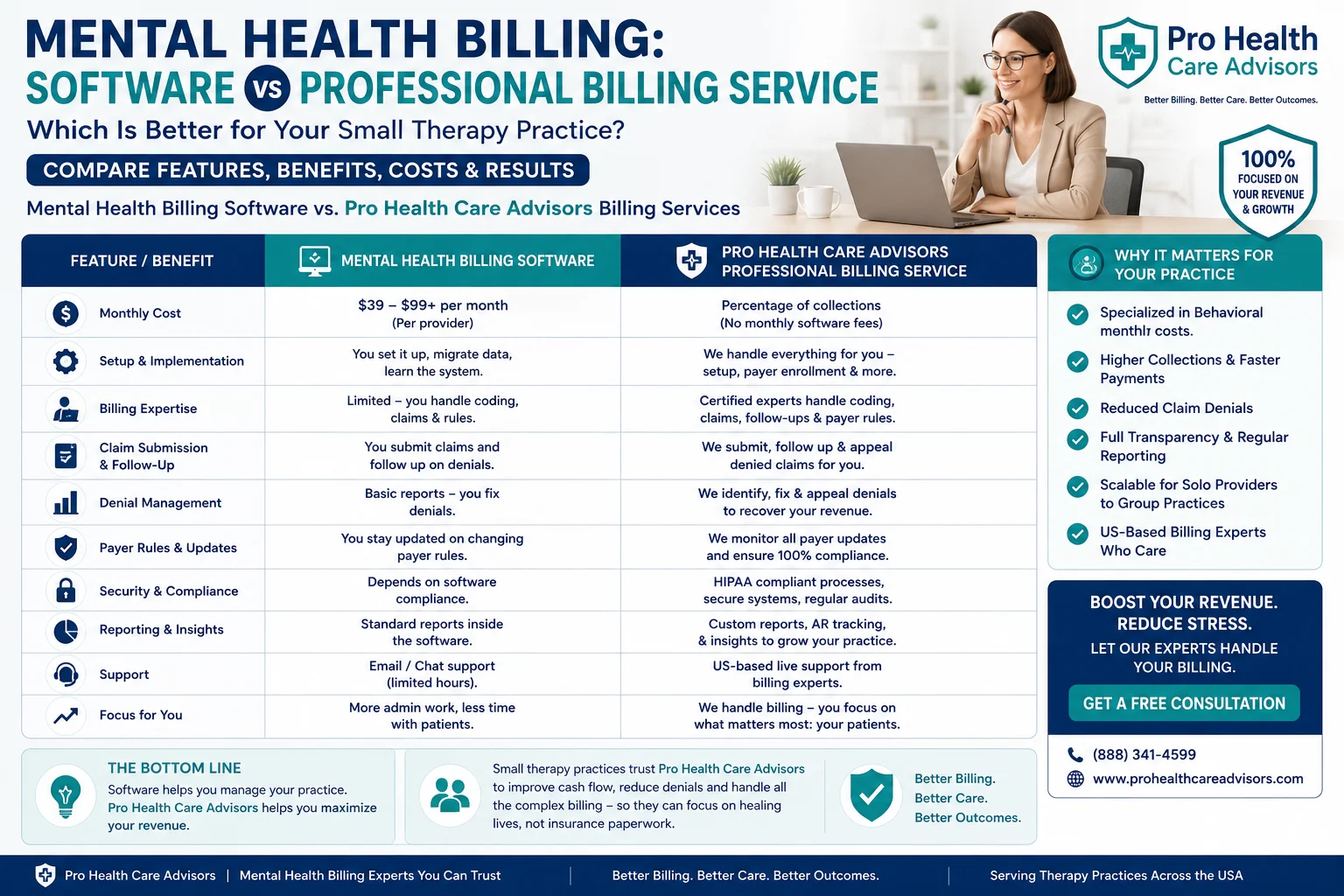
Buying mental health billing software gives you a tool. Using that tool correctly, consistently, and at a level of billing expertise that minimizes denials and maximizes collection — that requires either dedicated billing expertise on your staff or significant time investment from the clinician doing the billing themselves.
The AMA reports that physicians and their staff spend an estimated 14.5 hours per week on prior authorizations alone. For a solo therapist or small practice handling their own billing alongside clinical work, the administrative burden is one of the leading contributors to burnout — not the number of patients.
The math worth running for your practice:
A solo therapist billing $120,000 per year in-house, managing their own software:
- Software cost: $600–$840/year (SimplePractice Essential plan)
- Time cost: 5–8 hours/week on billing administration × 50 weeks = 250–400 hours/year
- Average denial rate for self-managed mental health billing: 8–12%
- Revenue lost to denials and administrative inefficiency: $9,600–$14,400/year
A solo therapist billing $120,000 per year through a professional billing service:
- Service cost: 6–8% of collections = $7,200–$9,600/year
- Time cost: Less than 1 hour/week for practice-side coordination
- Average denial rate with professional billing: 3–5%
- Revenue recovered vs. self-managed: Often $5,000–$10,000+/year
For many practices, the cost of professional billing service is offset by the revenue recovered and the time freed for clinical work that the therapist is actually trained and compensated to do.
Our mental health billing and practice management service handles the complete billing cycle for mental health providers across the country — from eligibility verification before every session through denial management and appeals after the fact. We understand time-based CPT codes, behavioral health carve-outs, telehealth billing rules, and the documentation requirements that keep claims clean through payer audits.
We also handle physician credentialing for mental health providers — including Medicare enrollment for LPCs and LMFTs under the 2024 Medicare expansion, and credentialing with all major commercial payers.
Mental Health Billing Software Checklist — Evaluate Before You Buy
Use this checklist when trialing any mental health billing software. If a platform cannot pass all of these during the free trial, do not buy it.
HIPAA and Security:
- Platform provides a signed Business Associate Agreement (BAA)
- Data encrypted at rest and in transit
- Access controls — individual logins, not shared passwords
- Audit logs track who accessed what records when
Mental Health Billing Specifics:
- Time-based CPT code validation (90832/90834/90837)
- Handles behavioral health carve-out payers
- Telehealth billing with correct modifiers (95 and 93)
- POS code selection for telehealth (10 vs 02)
- Superbill generation for out-of-network clients
- Good Faith Estimate generation (required under the No Surprises Act)
Eligibility and Authorization:
- Real-time eligibility verification — not just at intake
- Prior authorization tracking with session limit alerts
- Alerts when authorized sessions are approaching limit
Claims and Payments:
- Electronic claim submission to your payers
- ERA auto-posting
- Denial tracking with reason code visibility
- Underpayment detection against contracted rates
- Patient payment portal for copays and balances
Reporting:
- Claim acceptance rate by payer
- Denial rate and denial reason breakdown
- Days in A/R report
- Revenue by provider (for group practices)
- Outstanding balance report
Support:
- Billing-specific customer support — not just technical support
- Response time under 24 hours for billing questions
- Knowledge base with mental health billing-specific documentation
How the Right Mental Health Billing Software Connects to Compliance
Software choice is not just a convenience decision — it is a compliance decision.
The Office of Inspector General (OIG) and CMS Recovery Audit Contractors actively monitor mental health billing patterns. Practices that consistently bill 90837 when session notes support 90834, or that submit crisis codes (90839) for routine sessions, or that bill telehealth with incorrect POS codes — these patterns show up in payer data analytics and can trigger audit scrutiny.
Good mental health billing software reduces compliance risk by validating code selections against documentation before claims go out. But software alone does not eliminate audit risk — especially if the underlying documentation habits are not strong.
This is where professional billing expertise adds value that software cannot replicate. A billing specialist who reviews mental health claims knows to ask: does this documentation support the code selected? Is the time documented specifically enough to defend this claim in an audit? Are the modifiers applied consistently across this payer’s requirements?
Our MD Audit Shield program monitors mental health billing patterns specifically for the anomalies that attract RAC audit attention — and helps practices correct them before a demand letter arrives. For mental health providers billing Medicare or Medicaid, this monitoring is not optional. It is the difference between proactive protection and reactive crisis management.
We also help practices maintain HIPAA compliance standards — because the software you use handles protected health information, and HIPAA compliance is not just about the software’s security architecture. It is about your entire workflow, staff training, and documentation practices.
Contact our team today for a free billing review. We will show you exactly where your current billing — software or manual — is leaving revenue on the table.
Frequently Asked Questions: Mental Health Billing Software 2026
Q: What is the best mental health billing software for a solo therapist in 2026?
A: For most solo therapists, SimplePractice is the strongest starting point — it balances ease of use, billing functionality, telehealth integration, and a polished client experience in one HIPAA-compliant platform. Starting at $34.95/month, it is accessible for a practice just establishing its billing systems. TherapyNotes is the better choice if your primary concern is billing accuracy and insurance claim volume rather than interface aesthetics. Both are purpose-built for behavioral health and understand time-based CPT codes at a level that general medical billing software does not.
Q: Is SimplePractice good for insurance billing in 2026?
A: Yes — SimplePractice handles insurance billing well for the common payers and straightforward claim types that most solo and small-group mental health practices encounter. It supports direct claims submission, ERA auto-posting, and eligibility verification. Where it begins to show limits is in multi-provider billing oversight, advanced denial analytics, and complex payer-specific scenarios. For high-volume insurance billing with detailed revenue cycle reporting, TherapyNotes or Valant are stronger.
Q: What mental health billing software works best for group practices?
A: For group practices with six or more clinicians, Ease Health is the strongest platform in 2026 — it was built specifically for multi-clinician behavioral health practices with unified EHR, RCM, and client management in one system. For smaller group practices (two to five providers), SimplePractice and TherapyNotes both scale reasonably well, with TherapyNotes offering stronger multi-provider billing reporting.
Q: Do LPCs and LMFTs need different billing software than psychologists?
A: No — the billing software requirements are essentially the same. The difference is in how the platform handles the specific billing rules for each provider type. LPCs and LMFTs who became Medicare providers starting in 2024 need to ensure their platform handles Medicare billing at the 75% Physician Fee Schedule rate and does not allow them to bill E/M or add-on codes (90833, 90836) that require prescribing authority. Any of the platforms on this list can handle LPC and LMFT billing — but verify Medicare billing support specifically if you are newly enrolled. Our physician credentialing team handles Medicare enrollment for LPCs and LMFTs.
Q: What is the difference between mental health billing software and a billing service?
A: Mental health billing software is a tool — it gives you the infrastructure to submit claims, post payments, and track denials. A billing service provides the expertise and human follow-through to use that infrastructure correctly. The software does not catch a behavioral health carve-out payer error on its own — a billing specialist does. The software does not write a compelling prior authorization appeal — a billing expert does. Many practices find that the two work best together: software for workflow and data management, professional billing expertise for the judgment-intensive work that determines whether claims actually get paid.
Q: How much does mental health billing software cost in 2026?
A: Pricing varies significantly. Solo-focused platforms like SimplePractice start at $34.95/month. TherapyNotes runs $59/clinician/month on an annual plan. TheraNest starts at $39/month. Enterprise platforms like Valant, ICANotes, and Ease Health use custom pricing that typically ranges from $100 to $300+ per provider per month depending on features. The relevant cost calculation is not just the software fee — it is the software fee plus the time cost of managing billing yourself, plus the revenue cost of denials that professional billing expertise would prevent.
Q: Does mental health billing software help with telehealth billing in 2026?
A: All of the platforms on this list support telehealth billing to some degree. The important distinctions are whether the platform automatically applies the correct telehealth modifier (95 for audio/video, 93 for audio-only), whether it prompts for Place of Service code selection (POS 10 for home, POS 02 for other locations), and whether it handles the billing correctly for each specific payer. SimplePractice has the most integrated telehealth-to-billing workflow. TherapyNotes handles telehealth billing but requires more manual confirmation of modifiers. Verify telehealth billing handling specifically during any platform demo.
Q: What happens if my mental health billing software does not catch a coding error?
A: The claim gets denied — or worse, it gets paid incorrectly and creates overpayment risk that shows up in an audit months later. Billing software catches the errors it is programmed to catch, but it cannot replace the clinical and regulatory expertise of a billing specialist who knows your specialty, your payer mix, and the documentation requirements that make mental health claims defensible. For mental health providers billing Medicare or Medicaid, this distinction matters especially. Our CodeMAXX coding service provides a human coding quality layer on top of whatever software your practice uses — catching the errors that automated systems miss.