







By Sandy Kaur, Founder, Pro Health Care Advisors
ICD-10 coding errors in radiology are one of the most expensive problems in the specialty, because a radiology claim lives or dies on the diagnosis code. The radiologist reads the study, but the payer reads the claim — and when the ICD-10 code does not match the ordered procedure, does not name the correct side, or does not support medical necessity, the claim is denied before anyone looks at the images.
Quick Answer
The most common ICD-10 coding errors in radiology are vague or unspecified diagnosis codes, missing laterality on extremity and breast imaging, and mixing up screening and diagnostic mammography. Together they cause most radiology denials. The fix: code from the radiologist’s final report and the ordering physician’s documented indication, and check medical necessity before the claim leaves the building.
Why ICD-10 Coding Errors in Radiology Cost Practices So Much
Radiology is a high-volume, low-margin business. A single CT or MRI pays well, but a single denial costs the practice the entire technical and professional fee. Unlike an office visit, an imaging study cannot be re-performed to fix the paperwork — once the patient has left the scanner, the only thing left to correct is the code. That is why ICD-10 coding errors in radiology are so expensive: they turn completed, high-cost work into unpaid work.
The risk is growing. Payers now run automated medical-necessity edits that compare the ICD-10 code against the CPT code before a human ever sees the claim, and local coverage determinations list exactly which diagnoses support each advanced imaging study. A vague code such as R51, headache, unspecified, will not support a brain MRI, and a screening code on a diagnostic study will not survive an audit. Our radiology billing and credentialing services check every claim for diagnosis-to-procedure match, laterality, and medical necessity before it is submitted, so denials are prevented instead of appealed.
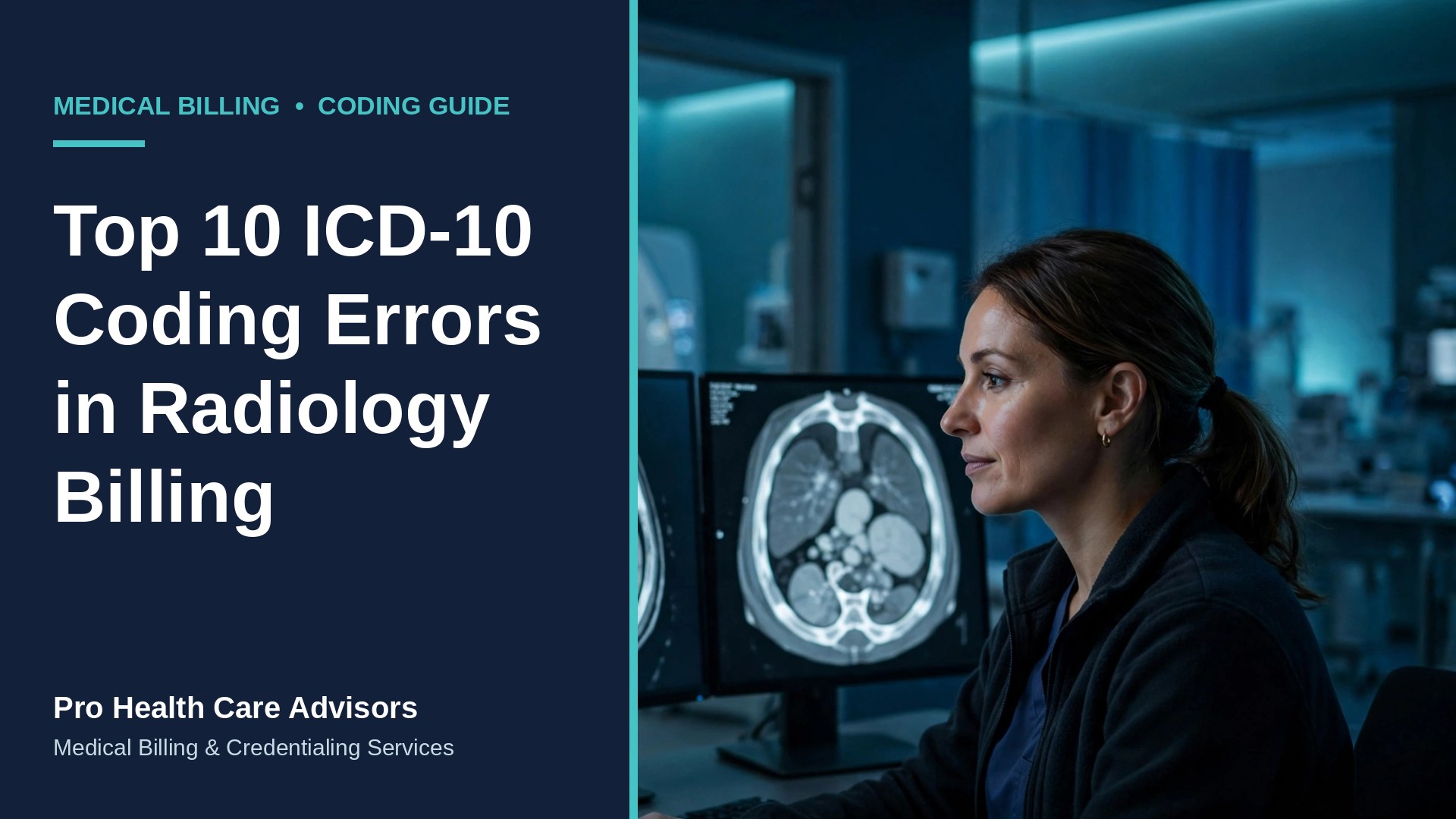
The Top 10 ICD-10 Coding Errors in Radiology Billing
The ten errors below are the most common ICD-10 coding errors in radiology we see in practice. The pattern is not unique to imaging — the top 10 ICD-10 coding errors in podiatry billing and the top 10 ICD-10 coding errors in dermatology billing follow the same logic. The lesson is the same: the diagnosis must show why the service was necessary.
1. The Diagnosis Does Not Match the Ordered Procedure
The error: Every imaging order carries a reason for the study — the ordering physician’s documented indication. The error happens when the claim reports a diagnosis that does not match that order: the order says “evaluate knee pain” and the claim carries an unrelated back-pain code.
Why claims deny: Payers match the diagnosis to the procedure first. When the diagnosis does not support the procedure, the claim fails the medical-necessity edit and is denied — even when the study was appropriate.
The fix: Code the diagnosis from the ordering physician’s documented indication, confirmed against the radiologist’s final report. If the two disagree, query the ordering physician before the claim goes out.
2. Missing Specificity on Laterality for Extremity Imaging
The error: ICD-10-CM demands laterality for most extremity, breast, and paired-organ codes, yet claims still go out with unspecified codes — M25.50, pain in unspecified joint, instead of M25.561, pain in right knee.
Why claims deny: Many payers deny unspecified laterality codes outright, and even when the claim pays, the unspecified code weakens the record on review.
The fix: Make laterality a required field in the coding workflow. A claim for a knee, shoulder, wrist, ankle, or breast study should not close until the side is confirmed from the report.
3. Screening vs Diagnostic Mammography Confusion
The error: Screening mammography (77067) and diagnostic mammography (77065 unilateral, 77066 bilateral) are different services with different diagnosis rules, but they are coded as if they were interchangeable.
Why claims deny: Z12.31 supports a screening mammogram only, so on a diagnostic mammogram it denies. The reverse error is just as costly: a diagnostic code on a screening study can turn a covered preventive service into a patient-billed charge.
The fix: Ask one question before coding any mammogram: was this study ordered because the patient had a sign, symptom, or prior abnormal finding? If yes, it is diagnostic — 77065 or 77066 with the diagnostic code. If no, it is screening — 77067 with Z12.31.
4. Modifier 26 and TC Billing Errors
The error: A radiology study has two parts — the technical component (TC), for the equipment and staff, and the professional component (modifier 26), for the radiologist’s interpretation. Errors happen when both are billed by a practice that owns only one part.
Why claims deny: Payers pay each component once. A duplicate component or a global claim from a provider who did not perform both parts triggers a denial or an overpayment recovery.
The fix: Map every imaging site to its billing arrangement: who owns the scanner, who reads the study, and whether the claim is global, professional-only, or technical-only.
5. Duplicate and Frequency Errors on Repeat Imaging
The error: Repeat imaging is common — a follow-up CT, a second view, a comparison study — but the claim is submitted as if it were the first, with the same CPT code billed twice on the same day and no modifier.
Why claims deny: Payers run duplicate and frequency edits that reject the second claim automatically, even when the repeat study was medically necessary.
The fix: Flag every repeat study at scheduling and at coding. Use modifier 76 for a repeat by the same physician, or modifier 77 for a repeat by a different physician, and document the clinical reason.
6. ABN and Medical Necessity Failures for Advanced Imaging
The error: CT and MRI are expensive, and payers cover them only for specific diagnoses. The error is ordering advanced imaging with a vague diagnosis — R51, headache, unspecified, for a brain MRI — with no Advance Beneficiary Notice (ABN) on file when Medicare is likely to deny it.
Why claims deny: Vague symptom codes are the single biggest cause of ICD-10 coding errors in radiology denials for advanced imaging. A code that is not on the local coverage determination fails the edit, and without a signed ABN the practice cannot bill the patient either.
The fix: Check the diagnosis against the LCD before the study, not after. When the diagnosis does not support the study, get a more specific documented indication — or issue an ABN and let the patient decide.
7. Coding Signs and Symptoms Instead of a Confirmed Diagnosis
The error: ICD-10-CM guidelines are clear: when a definitive diagnosis is documented, code the diagnosis — not the symptoms that led to it. Yet claims still carry R-codes for pain, swelling, or dizziness when the report confirms a fracture, a tumor, or an infection.
Why claims deny: A symptom code tells the payer too little to support medical necessity for many imaging studies, and auditors recoup payments when the record shows a confirmed diagnosis that was never coded.
The fix: Code from the radiologist’s final report, not from the order. When the report confirms a diagnosis, report it as the primary diagnosis and list symptoms only as secondary codes.
8. NCCI Bundling Errors on CT Abdomen and Pelvis
The error: A combined CT of the abdomen and pelvis is reported with a single code, 74177, but claims still split it into two codes — 74176 for the abdomen and 72192 for the pelvis.
Why claims deny: NCCI edits bundle the component codes into the comprehensive code, so the split claim denies the second component as bundled — or as a duplicate.
The fix: Train coders on the combined-code rule: one order for abdomen and pelvis means 74177, with contrast use coded as documented. Never override a bundling edit without documentation.
9. Supervision Requirements Missed for Contrast Studies
The error: Contrast-enhanced studies carry supervision and documentation requirements — who supervised the contrast, and whether the contrast type and dose are recorded. Claims go out with the contrast code billed but no supervision documented.
Why claims deny: Medicare’s supervision rules for diagnostic imaging tie payment to the level of supervision the study required, and that is why contrast coding errors so often end in denials rather than payments.
The fix: Document supervision for every contrast study — the supervising physician, the contrast agent and dose, and any reaction or monitoring. Do not bill contrast when the report says the study was done without it.
10. Misusing Z-Codes for Screening Studies
The error: Z-codes describe the reason for an encounter, not a disease — and they are used as if they were diagnoses. A screening CT colonography (74261/74262) is billed with a symptom code instead of Z12.11, or a low-dose CT lung cancer screening (71271) goes out without Z12.2.
Why claims deny: Screening services are covered only when the claim proves the patient was being screened — the right Z-code, the right procedure code, and the right risk history. The wrong Z-code fails the coverage edit and the claim is denied.
The fix: Keep a short screening-code card at every coding station: mammography Z12.31, colon screening Z12.11, lung screening Z12.2, and the procedure codes each one pairs with.
Pre-Bill Checklist: Catch ICD-10 Coding Errors in Radiology Before You Submit
Run every imaging claim through this list before it is submitted — it takes two minutes and catches the ICD-10 coding errors in radiology that cause most denials.
- The ICD-10 code matches the ordered CPT code and the documented indication.
- Laterality is specified for every extremity, breast, and paired-organ study.
- Screening mammography (77067 with Z12.31) is separated from diagnostic mammography (77065/77066).
- Modifier 26 and TC match who owns the equipment and who read the study.
- Repeat imaging is checked for duplicate and frequency edits, with modifier 76 or 77 when repeated.
- Advanced imaging (CT/MRI) carries a specific, covered diagnosis — not a vague symptom code such as R51.
- Signs and symptoms are coded only until a confirmed diagnosis is documented in the final report.
- NCCI edits are checked, including CT abdomen and pelvis 74177 components and contrast supervision.
How Pro Health Care Advisors Helps Radiology Practices
Radiology billing is unforgiving: ICD-10 coding errors in radiology — one wrong code, one missing side, one screening code on a diagnostic study — can cost a practice more in a month than a full audit would. Pro Health Care Advisors reviews every radiology claim for diagnosis-to-procedure match, laterality, modifier 26 and TC accuracy, and medical necessity before it is submitted, and we track every denial to its root cause. The same discipline that catches ICD-10 coding errors in anesthesiology billing protects radiology revenue too. If denials are eating your imaging revenue, request a free billing audit.
Frequently Asked Questions
What are the most common ICD-10 coding errors in imaging?
Vague or unspecified diagnosis codes, missing laterality, and mixing up screening and diagnostic mammography. These are the ICD-10 coding errors in radiology we see most often, and they are the easiest to prevent with a pre-bill checklist.
What is the difference between screening and diagnostic mammography coding?
Screening mammography (77067) is for patients with no signs or symptoms and is reported with Z12.31. Diagnostic mammography (77065 unilateral or 77066 bilateral) is for patients with a lump, pain, discharge, or an abnormal prior study, and is reported with the diagnostic code that describes the finding.
When should modifier 26 be used in radiology billing?
Modifier 26 marks the professional component — the radiologist’s interpretation — and is used when your practice reads the study but does not own the equipment or employ the technologist. If your practice owns the scanner and reads the study, bill globally with no modifier.
Can I bill a CT abdomen and a CT pelvis separately?
No. When both are performed in the same session, report the combined code 74177 (CT abdomen and pelvis with contrast) rather than billing the abdomen and pelvis codes separately. NCCI edits bundle the separate codes into the combined code, so a split claim denies the second component.
Why was my MRI denied for medical necessity?
The most common reason is a vague or unspecified diagnosis that does not appear on the payer’s coverage list for that MRI — for example, R51, headache, unspecified, for a brain MRI. Other common causes are ICD-10 coding errors in radiology such as a diagnosis that does not match the ordered procedure. Check the LCD, get a more specific documented indication, and correct and resubmit the claim.
What should I do if a claim is denied for an ICD-10 error?
First, read the denial reason and the remittance code — it usually names the exact problem. Correct the diagnosis, laterality, or modifier, and resubmit or appeal within the payer’s deadline. Then fix the root cause: most ICD-10 coding errors in radiology repeat until the workflow changes, so add the failed check to your pre-bill list.
Sources: CMS ICD-10, CDC ICD-10-CM, and American College of Radiology.