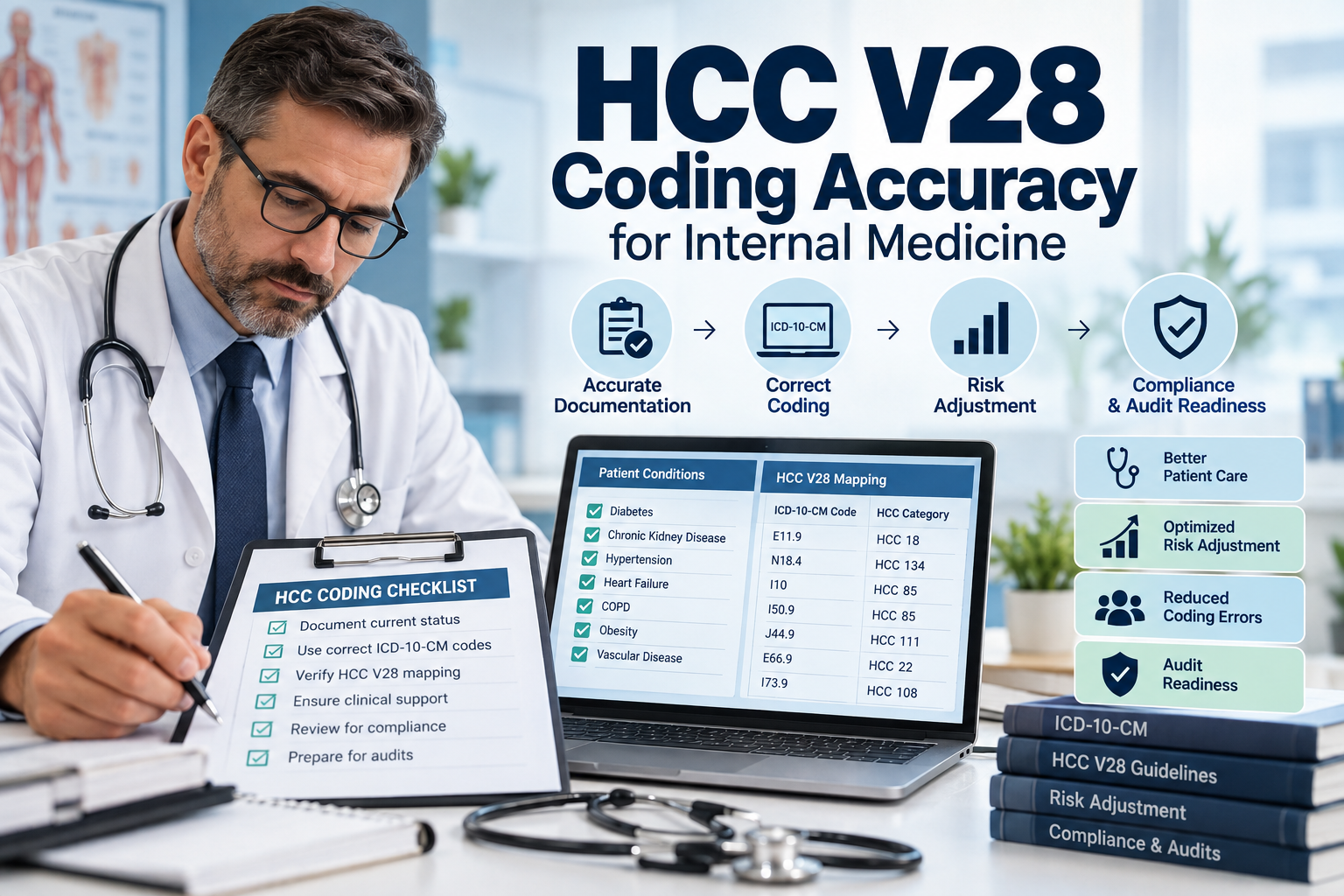
HCC V28 coding accuracy is an important consideration for internal medicine practices serving Medicare Advantage patients. Internal medicine physicians frequently manage multiple chronic and complex conditions during the same encounter, making accurate clinical documentation and ICD-10-CM coding essential.
Conditions such as diabetes, chronic kidney disease, heart failure, COPD, vascular disease, obesity, and other chronic illnesses require documentation that clearly reflects the patient’s current clinical status.
The transition to the updated CMS-HCC risk adjustment model also means that practices should review older coding workflows and ensure their processes reflect current requirements.
For calendar year 2026, CMS completed the planned phase-in of the 2024 CMS-HCC model for applicable non-PACE Medicare Advantage organizations. This makes HCC V28 coding accuracy an important area for practices that want a consistent and defensible risk-adjustment workflow.
The goal is not to report as many diagnoses as possible. The goal is to make sure clinically supported conditions are accurately documented, appropriately coded, and supported by the patient’s medical record.
What Is HCC V28?
HCC stands for Hierarchical Condition Category.
CMS uses HCCs as part of its Medicare Advantage risk adjustment methodology. Diagnosis information is grouped into condition categories that are used in the risk-adjustment process.
The model commonly referred to as V28 is the 2024 CMS-HCC risk adjustment model.
The updated model changed several aspects of the previous methodology, including condition categories, diagnosis mappings, hierarchies, and other technical components.
For current information, coding teams should use the official CMS 2026 Model Software and ICD-10-CM Mappings rather than relying only on older HCC reference sheets.
Understanding which model applies is the first step toward better HCC V28 coding accuracy.
Why HCC V28 Coding Accuracy Matters in Internal Medicine
Internal medicine practices commonly care for patients with several chronic conditions.
For example, one patient may have:
- Type 2 diabetes
- Chronic kidney disease
- Heart failure
- Hypertension
- COPD
- Obesity
- Peripheral vascular disease
The presence of these conditions in an old problem list does not automatically mean that every diagnosis should be reported during every encounter.
The current medical record should support the condition being coded.
A reliable HCC V28 coding accuracy process should consider:
- Whether the diagnosis is documented.
- Whether the medical record supports the diagnosis.
- Whether the condition was appropriately addressed.
- Whether the ICD-10-CM code accurately reflects the documentation.
- Whether the diagnosis is treated appropriately under the applicable CMS-HCC model.
When these elements work together, internal medicine practices can address both missed supported conditions and unsupported diagnoses.
HCC V28 Coding Accuracy: V24 vs. V28
One of the biggest challenges for medical coding departments is the transition from older HCC workflows to V28.
V28 should not be treated as a simple replacement chart for V24.
The updated CMS-HCC model includes changes to diagnosis mappings, condition categories, hierarchies, and other model components.
CMS has described the 2024 model as including updated data and clinical revisions to the risk-adjustment methodology.
For 2026, CMS completed the planned phase-in of the 2024 CMS-HCC model for applicable non-PACE organizations.
This means practices should review any old V24-based workflow that is still being used.
Problems With Outdated HCC References
Internal medicine practices may still have:
- V24 coding cheat sheets
- Old HCC spreadsheets
- Previous-year suspecting reports
- Legacy EHR prompts
- Outdated provider education
- Old diagnosis-to-HCC mapping tables
These resources can create confusion when treated as current guidance.
For stronger HCC V28 coding accuracy, coding teams should verify diagnosis mappings and model information using current CMS resources.
Documentation Is the Foundation of HCC V28 Coding Accuracy
Accurate HCC coding starts with accurate clinical documentation.
A coder should not create clinical specificity that the provider did not establish.
For example, if a patient has laboratory findings associated with chronic kidney disease, the coder should not independently assign a CKD stage simply because the laboratory results appear to suggest one.
The documentation should support the diagnosis and appropriate level of specificity.
Useful documentation may include:
- Current disease status
- Severity
- Stage
- Complications
- Associated conditions
- Relevant symptoms
- Medication management
- Monitoring
- Treatment
- Assessment
- Follow-up plans
The goal is not to make medical notes unnecessarily long. The goal is to make the patient’s clinical condition clear.
Strong documentation is therefore one of the most important foundations of HCC V28 coding accuracy.
Common Internal Medicine Conditions Requiring Careful HCC Review
Diabetes
Diabetes is one of the most common chronic conditions managed by internal medicine physicians.
Documentation should accurately identify the type of diabetes and any clinically established complications when appropriate.
Coders should not infer a complication simply because a medication, laboratory result, or other indirect indicator appears in the record.
The diagnosis should be supported by the provider’s documentation.
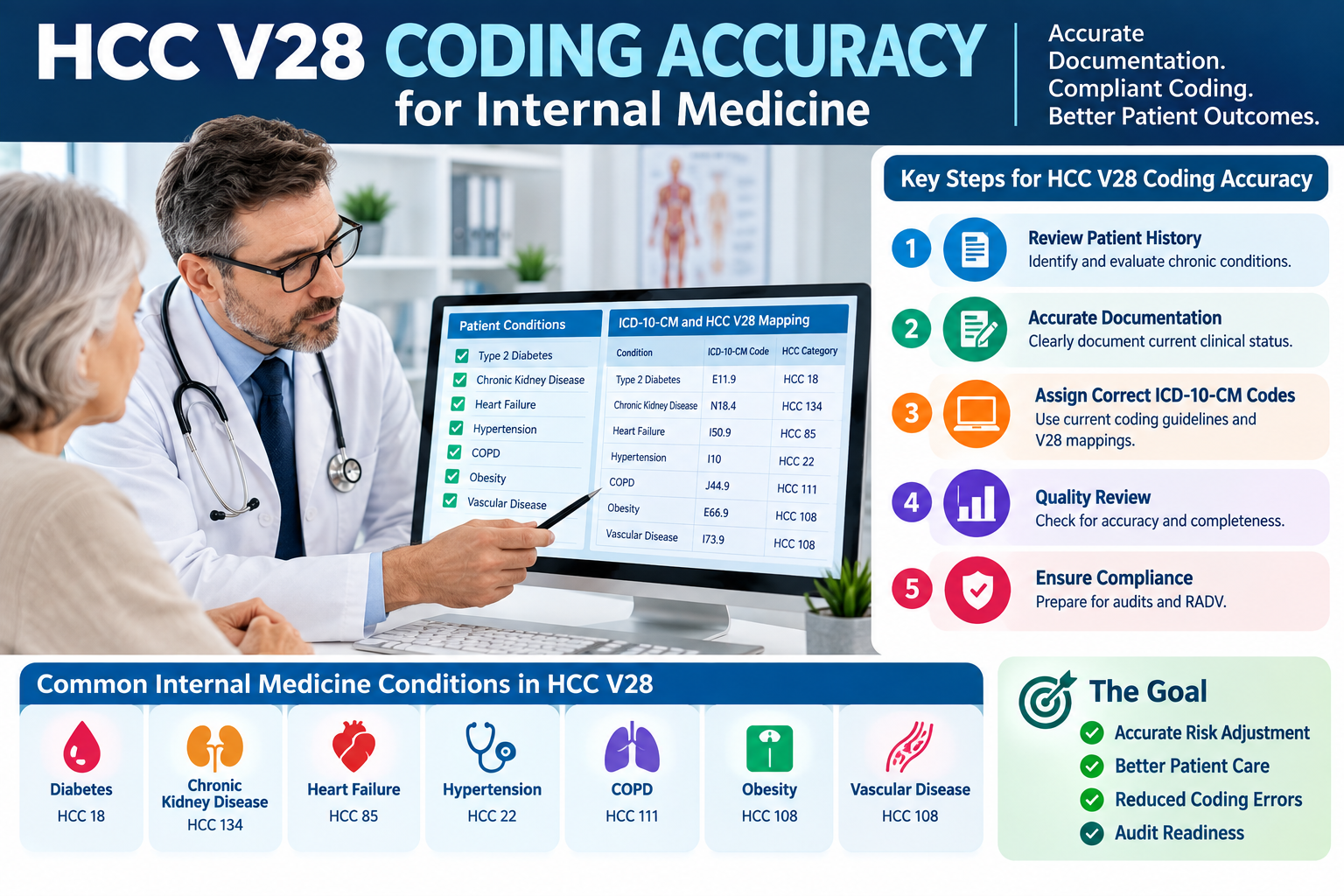
Chronic Kidney Disease
CKD is another area where specificity can matter.
When the provider documents an appropriate CKD stage, the ICD-10-CM code should accurately reflect that documentation.
The coding team should not independently determine a disease stage that the provider has not appropriately documented.
Heart Failure
Heart failure documentation should reflect the provider’s current assessment.
Historical terminology should not automatically be copied forward without reviewing the current clinical record.
This can improve both clinical clarity and HCC V28 coding accuracy.
COPD
COPD should be coded according to current clinical documentation.
A historical problem-list entry does not automatically establish that the condition was actively addressed during the current encounter.
Cancer
Cancer documentation requires careful attention to the distinction between:
- Active malignancy
- Personal history of malignancy
- Remission
- Previously treated disease
The current clinical record should determine how the condition is represented.
Vascular Conditions
Vascular diagnoses should be reviewed using current ICD-10-CM guidance and applicable CMS-HCC mappings.
Older V24 assumptions should not automatically be applied to the current model.
Understanding MEAT in Risk Adjustment Coding
MEAT is a commonly used concept in risk adjustment coding.
It generally refers to:
- M — Monitor
- E — Evaluate
- A — Assess or Address
- T — Treat
For example, a provider may monitor a chronic condition, evaluate test results, assess disease status, or modify treatment.

However, MEAT should not be treated as a formula for creating HCCs.
A diagnosis still needs appropriate clinical support and documentation.
A practical workflow is:
Clinical condition → Provider assessment → Documentation → ICD-10-CM coding → HCC review
Using MEAT as part of a broader documentation process can support HCC V28 coding accuracy, but it should not replace official coding guidance.
A Practical HCC V28 Coding Workflow
A structured workflow can make coding more consistent across an internal medicine practice.
Step 1: Review the Patient
Where appropriate, the care team can review available information before the encounter.
This can help identify chronic conditions that may require clinical attention.
The purpose is not to tell the physician what diagnosis to document. It is to help avoid overlooking relevant clinical issues.
Step 2: Document the Current Clinical Status
The provider should document the conditions actually evaluated, monitored, assessed, or treated.
Current clinical information should take priority over simply copying historical information.
Step 3: Assign ICD-10-CM Codes
The coding professional reviews provider documentation and assigns appropriate diagnosis codes.
The review should consider:
- Documentation support
- Code specificity
- Current ICD-10-CM requirements
- Applicable CMS mappings
- Current model information
Step 4: Perform Quality Assurance
Selected records can be reviewed for:
- Unsupported diagnoses
- Incorrect ICD-10-CM codes
- Missing specificity
- Documentation inconsistencies
- Outdated HCC references
- Recurring coding patterns
Step 5: Educate Providers and Coders
Audit findings should be converted into practical education.
If several providers repeatedly document the same condition incompletely, targeted education can address the underlying documentation problem.
This supports long-term HCC V28 coding accuracy rather than repeatedly correcting the same issue.
HCC V28 Coding Accuracy Checklist
A simple checklist can help coding teams review internal medicine records consistently.
Documentation
- Is the diagnosis documented?
- Is it clinically supported?
- Was it addressed during the encounter?
- Is appropriate specificity documented?
- Does the record reflect the patient’s current condition?
Coding
- Is the correct ICD-10-CM code assigned?
- Is the current code set being used?
- Has the applicable CMS mapping been reviewed?
- Is an outdated V24 reference influencing the decision?
Compliance
- Can the diagnosis be supported by the medical record?
- Is a historical condition being represented as active?
- Are copied-forward diagnoses being reviewed?
- Is the coding decision defensible?
This checklist can become part of a broader HCC V28 coding accuracy quality-assurance program.

How to Improve HCC V28 Coding Accuracy
Improving coding performance requires more than asking coders to make fewer mistakes.
Practices should evaluate the entire workflow.
Update Coding References
Remove outdated materials from active workflows when they no longer apply.
Review Documentation Templates
Templates should support clear clinical documentation without encouraging unnecessary boilerplate.
Audit Recurring Problem Areas
Identify diagnosis categories that repeatedly produce documentation or coding errors.
Monitor Root Causes
Do not simply count errors. Determine why they occurred.
Educate Providers
Use real documentation examples to show where greater clarity may be needed.
Review Technology
Ensure that EHR and coding tools use current code sets and applicable model information.
Maintain Compliance Oversight
Periodic review can identify unsupported diagnoses and process weaknesses.
These steps can improve HCC V28 coding accuracy while strengthening the overall coding workflow.
HCC V28 Audits and RADV Compliance
Risk Adjustment Data Validation, commonly known as RADV, is an important consideration for Medicare Advantage organizations.
CMS uses RADV to validate diagnosis information submitted for risk adjustment against supporting medical records.
For current information, practices can review the official CMS Medicare Advantage Risk Adjustment resources.
A strong audit should ask:
- Is the diagnosis documented?
- Is the diagnosis clinically supported?
- Was the condition addressed?
- Is the ICD-10-CM code accurate?
- Was the applicable HCC mapping used?
- Can the medical record support the diagnosis during an external review?
Recent HHS Office of Inspector General work demonstrates why this review matters. In a 2026 Medicare Advantage compliance audit of HumanaChoice, OIG reported that medical records did not support selected diagnosis codes for 178 of 220 sampled enrollee-years, resulting in $669,237 in reported overpayments.
Practices can review the HHS OIG Medicare Advantage compliance audit for an example of how unsupported diagnosis coding can be identified through federal oversight.
For an internal medicine practice, HCC V28 coding accuracy should therefore be considered part of a broader compliance strategy.
Common HCC V28 Coding Errors
Coding Directly From the Problem List
A problem list can provide useful clinical background, but it should not automatically determine which conditions are reported for the current encounter.
Using an Old V24 Mapping
Older model references should not be treated as current V28 guidance.
Assuming a Diagnosis From Medication
Medication use alone does not necessarily establish a diagnosis or its required specificity.
Inferring Disease Severity
Coders should not independently create stages, complications, or severity levels that the provider has not appropriately documented.
Carrying Forward Historical Conditions
Historical diagnoses should be reviewed against the current clinical record.
Focusing Only on Financial Outcomes
Coding should represent the patient’s documented health status rather than a desired risk score.
Avoiding these errors is essential for maintaining HCC V28 coding accuracy.
Measuring HCC V28 Coding Accuracy
A practice should use several KPIs rather than relying on one accuracy percentage.
Unsupported Diagnosis Rate
Measures how often reviewed diagnoses lack sufficient medical-record support.
Coding Error Rate
Tracks incorrect diagnosis coding identified through quality reviews.
Documentation Specificity
Measures how consistently providers document clinically supported specificity.
Query Rate
A high query rate may identify recurring documentation problems.
Audit Correction Rate
Shows how frequently reviewed records require correction.
Provider-Level Trends
Provider-level reporting can help identify focused education opportunities.
Together, these metrics provide a broader view of HCC V28 coding accuracy.
How Technology Supports HCC V28 Coding Accuracy
Technology can make chart review and coding workflows more efficient.
Depending on the platform, technology may assist with:
- Chart review
- Diagnosis tracking
- Historical condition review
- Coding validation
- HCC mapping
- Audit sampling
- Provider reporting
However, technology should support professional judgment rather than replace it.
An automated system should not independently create a diagnosis simply because an algorithm identifies a possible condition.
The provider’s clinical documentation remains the foundation of HCC V28 coding accuracy.
When Should an Internal Medicine Practice Outsource Medical Coding?
Some practices may benefit from outsourced medical coding when they:
- Have a growing Medicare Advantage population
- Need additional coding expertise
- Have limited internal resources
- Experience recurring coding errors
- Need regular chart audits
- Want additional compliance support
- Need scalable coding capacity
An experienced coding partner can support ICD-10-CM coding, chart review, quality assurance, and compliance workflows.
For practices that need professional coding support, explore CodeMAXX Medical Coding Services.
HCC V28 Coding Accuracy and Medical Billing
Coding does not operate independently from the broader revenue cycle.
Accurate diagnosis coding should work alongside:
- Charge capture
- Claim submission
- Denial management
- Payment posting
- Documentation review
- Compliance monitoring
- Revenue-cycle reporting
A disconnected coding process can create inconsistencies between clinical documentation and billing operations.
Practices looking for broader support can explore Medical Billing & Practice Management Services.
Integrating coding with broader revenue-cycle processes can help create a more consistent workflow.
Audit Support for Internal Medicine Practices
A structured audit can identify problems before they become recurring issues.
An audit may uncover:
| Audit Finding | Potential Cause |
|---|---|
| Unsupported diagnosis | Documentation or compliance gap |
| Incorrect ICD-10-CM code | Coding education issue |
| Missing specificity | Provider documentation issue |
| Old V24 mapping | Reference-management problem |
| Historical condition reported as active | Problem-list management issue |
| Repeated queries | Documentation workflow issue |
The purpose of an audit is not simply to produce an error count.
The objective is to understand why errors occur and improve the underlying process.
Practices that need additional review and compliance support can explore MD Audit Shield – RAC.
10 Best Practices for HCC V28 Coding in 2026
1. Use Current CMS Resources
Verify the applicable model and current coding resources instead of relying exclusively on old HCC reference sheets.
2. Keep ICD-10-CM References Updated
Use the appropriate current code set and official coding guidance.
3. Document the Current Clinical Picture
Avoid relying entirely on historical documentation.
4. Use Specificity When Supported
Specificity should come from appropriate provider documentation.
5. Review Chronic Conditions
Relevant conditions should be addressed when clinically appropriate.
6. Avoid Unsupported Diagnoses
Do not report a diagnosis simply because it may affect risk adjustment.
7. Conduct Regular Audits
Periodic chart review can identify recurring issues.
8. Track Root Causes
Understand why errors happen instead of simply counting them.
9. Provide Targeted Education
Use actual audit findings to develop provider and coder training.
10. Connect Documentation and Coding
The strongest workflow connects clinical documentation, coding, quality assurance, and compliance.
These practices can create a more sustainable approach to HCC V28 coding accuracy.
Frequently Asked Questions About HCC V28 Coding Accuracy
What is HCC V28 coding accuracy?
HCC V28 coding accuracy refers to accurately documenting and coding clinically supported diagnoses according to applicable ICD-10-CM and CMS-HCC requirements.
Why is HCC V28 coding accuracy important for internal medicine?
Internal medicine physicians commonly manage multiple chronic conditions, making accurate documentation and diagnosis coding particularly important for Medicare Advantage risk adjustment.
Is V28 the same as V24?
No. The updated model includes changes to condition categories, diagnosis mappings, and other model components.
Does every diagnosis create an HCC?
No. Not every ICD-10-CM diagnosis maps to a payment HCC. Applicable coding, documentation, mapping, and model requirements must be considered.
What does MEAT mean in HCC coding?
MEAT generally means Monitor, Evaluate, Assess or Address, and Treat. It is commonly used as a framework when reviewing whether a condition was addressed.
Can a coder infer an HCC from medication use?
Medication use alone should not be used to independently establish a diagnosis or clinical specificity that the provider has not documented.
What is RADV?
RADV stands for Risk Adjustment Data Validation. CMS uses RADV to validate diagnosis information submitted for Medicare Advantage risk adjustment against supporting medical records.
How can a practice improve HCC V28 coding accuracy?
Practices can improve their process by maintaining current CMS resources, strengthening clinical documentation, training coding staff, conducting regular audits, and addressing recurring documentation problems.
Final Takeaway
HCC V28 coding accuracy is not simply about selecting a diagnosis code.
It requires a connected process:
Clinical documentation → ICD-10-CM coding → CMS-HCC review → Quality assurance → Compliance
Internal medicine practices should regularly review their documentation templates, coding references, provider education, audit procedures, and compliance controls.
The objective should always be an accurate representation of the patient’s documented clinical condition.
When documentation, coding, quality assurance, and compliance work together, practices can create a more consistent and defensible risk-adjustment workflow.
For additional support with coding, billing, and audit services, visit Pro Health Care Advisors.